
Theodore Ushakov
The Holy Righteous Warrior Theodore Ushakov, Admiral of the Russian Fleet
Righteous · b. 13/24 February 1745, at Burnakovo in the Yaroslavl lands — d. 2/14 October 1817, at Alekseevka near the Sanaksar monastery
Commemorated 23 May — With the Synaxis of the Saints of Rostov and Yaroslavl, 23 July — Glorification at the Sanaksar monastery, 2001, 2 October — Repose at Alekseevka, 1817
Theodore Ushakov (1745–1817) was the admiral who created the Russian Black Sea fleet and never lost to it a battle, a ship, or a man into captivity — and who, having commanded in forty-three engagements, ended his life in prayer and almsgiving beside the walls of the Sanaksar monastery, where his uncle Theodore of Sanaksar had been abbot. He broke the Ottoman fleets at Fidonisi, Kerch, Tendra and Kaliakra; he took Corfu in 1799 in an assault from the sea that Suvorov envied him; and in the Ionian Islands he set up, with the counsel of the local clergy, a Christian polity that returned the islanders their churches. Refused advancement, he resigned in 1807, withdrew to the country by Sanaksar, gave away what he had to the widows and orphans of the fleet and to prisoners of the Napoleonic wars, and died in 1817. The Russian Church glorified him in 2001 as a righteous warrior, not for his victories but for his mercy; he is honoured as the patron of the Russian navy, and his glorification is kept on July 23.
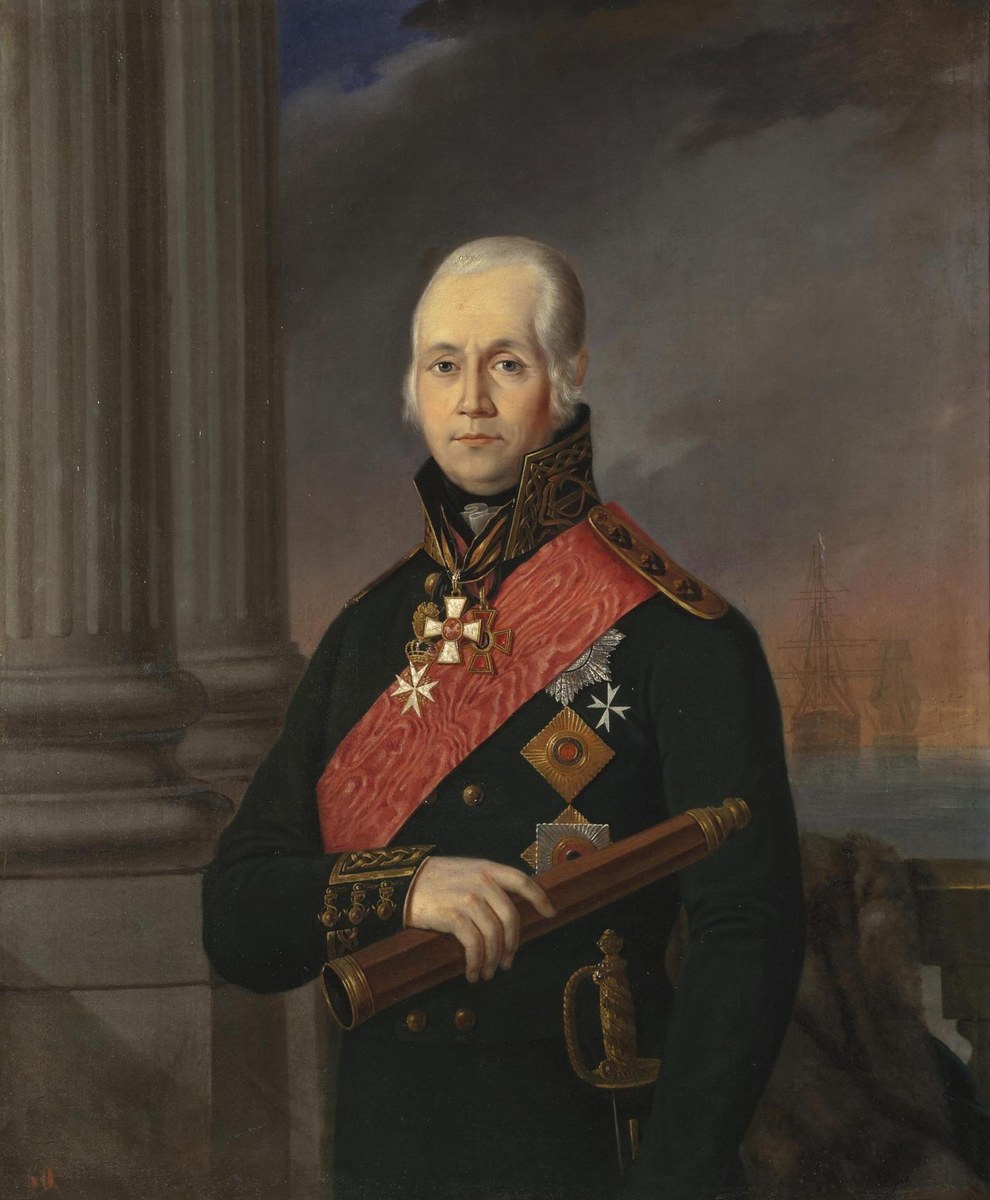

Origins
Theodore Fyodorovich Ushakov was born on 13 February 1745 (old style; 24 February new style) at Burnakovo, a village of the Romanov district in the Yaroslavl lands, into a family of small landed nobility of modest means and marked piety. The household kept the fasts and the church's hours strictly. Its most notable member was the boy's uncle, Ivan Ignatievich Ushakov, a guardsman of the Preobrazhensky regiment who left the world for the monastic life, was tonsured Theodore, and became the restorer and abbot of the Sanaksar monastery in the Tambov lands — a strict and much-persecuted elder, himself glorified by the Russian Church, whose life ran alongside his nephew's from beginning to end. That the sailor and the monk bore the same name in religion is not accidental to the way the Russian Church has read the admiral's life.
At sixteen Theodore entered the Naval Cadet Corps at St Petersburg, and in 1761 was enrolled in the Imperial Navy. He served first in the Baltic, then in the Russo-Turkish war of 1768–1774 in the Azov and Black Sea flotillas, and afterwards commanded the imperial yacht and convoyed merchantmen in the Mediterranean — an apprenticeship in seamanship and in the politics of the Levant alike.
Sevastopol and the Black Sea fleet
After the annexation of the Crimean khanate in 1783 Ushakov was sent to the new naval station at Akhtiar — Sevastopol — to build a fleet and a base together. He did both, and did them through an outbreak of plague, which he contained in his own command by quarantine and rigorous discipline while losing fewer men than any other officer on the coast. The care of ordinary seamen was, from this period on, the constant note of his service: he fed them, doctored them, and would not spend them.
In the war of 1787–1792 he made his name. At Fidonisi (1788) he broke the Ottoman line with a squadron nominally inferior; at the Straits of Kerch (1790) he stopped a landing intended for the Crimea; at Tendra (1790) and at Cape Kaliakra (1791) he destroyed Ottoman fleets outright, the second victory bringing the war to an end. His tactics broke with the rigid line-of-battle doctrine of the age: he concentrated on the enemy flagships, kept a reserve of frigates in hand, closed to short range, and pursued. Naval historians count him among the reformers of sailing tactics; the fleet simply called him Ushak-Pasha, the name the Turks gave him.
Corfu and the Ionian Islands
Promoted full admiral in 1798, Ushakov was given the strangest command of his life: a combined Russian and Ottoman fleet, Russia and the Porte having become allies against revolutionary France. With it he cleared the French from the Ionian Islands in 1798–99, and in February 1799 stormed Corfu, whose fortress of Vido was reckoned impregnable from the sea — an operation carried by naval gunfire and landing parties without a besieging army, and the feat for which Suvorov said he would have been glad to serve as a midshipman under Ushakov.
What followed matters more to his glorification than the assault. He forbade plunder, protected the French garrison after its surrender, and gave the islands back their Orthodox churches, which the French had closed; and he presided over the framing of a constitution for the Septinsular Republic, the first Greek state of modern times, in which the local clergy and notables governed themselves under Russian and Ottoman guarantee. He then blockaded and reduced French positions along the Italian coast, and conducted himself in Naples and Rome with a restraint that the Neapolitan court did not show. He returned to the Black Sea in 1800.
Retirement, poverty, and mercy
Alexander I, who came to the throne in 1801, had little use for the Black Sea fleet or for its admiral, and Ushakov was moved to a training command in the Baltic. In 1807 he resigned, and in 1810 settled in the village of Alekseevka in the Temnikov district of Tambov, beside the Sanaksar monastery, where his uncle Theodore lay buried. He never married. He lived in the monastery's rhythm, keeping the long services in Great Lent in a cell within its walls, and gave away what he had: to the families of the fleet's dead, to the poor of the district, to the prisoners of war taken in the Napoleonic campaigns, for whose care he emptied his savings.
In 1812, when Napoleon crossed the Niemen, the nobility of Tambov elected the old admiral to command the provincial militia. He declined by reason of his health, and gave instead the whole of the money he had lying in the bank, and turned his house at Alekseevka into a hospital. He died there on 2 October 1817 (old style; 14 October new style), and was buried, at his own wish, in the Sanaksar monastery beside his uncle.
Glorification
The Russian Church glorified Theodore Ushakov as a righteous warrior in 2001, at the Sanaksar monastery, where his relics had been uncovered; the general glorification for the whole Russian Church followed at the Bishops' Council of 2004. The act of glorification rests explicitly not on his victories but on the manner of them and on the life that followed: that in forty-three actions he never lost a ship and never let a single one of his men be taken prisoner; that he treated the defeated with mercy; that he restored the churches of the Ionians; and that he ended in poverty, prayer and almsgiving. He was named patron of the Russian navy, and — a curiosity of the modern calendar — in 2005 also of the long-range aviation.
Feast and commemoration
October 2 (church date; Old Calendar civil October 15) is the day of his repose and his principal feast. July 23 (Old Calendar civil August 5) keeps his glorification of 2001, and is the day on which he stands in the Russian and Ukrainian calendars beside the martyrs of Lycia and the Pochaev icon. He is commemorated also with the Synaxis of the Saints of Rostov and Yaroslavl on May 23, his birthplace lying in the Yaroslavl lands. The feast is Russian and Ukrainian; the Greek and Antiochian calendars do not carry it. His relics rest at the Sanaksar monastery in Mordovia, and a naval cathedral bearing his name stands at Saransk.
Hymns
Troparion — Tone 4 (common of the righteous)
The image of the righteous shone forth in thee, O Theodore: in the midst of arms thou didst keep mercy, and in the midst of honours, poverty of spirit; having given away thy substance to the captive and the orphan, thou didst finish thy course in prayer. Entreat Christ our God that He may save our souls.
Original translation from the Slavonic
Iconography
Ushakov is painted as a righteous warrior: standing full-length, in the dark blue and gold uniform coat of an admiral of the Russian fleet with its orders on the breast — a concession to portraiture that Russian iconography of glorified laymen has made since the canonisations of the twentieth century — with a halo, the right hand raised in blessing or holding a scroll, and the left resting on the hilt of a sword or holding a small church. Behind or beside him, ships under sail and the walls of the Sanaksar monastery are commonly shown; the fortress of Corfu appears in the fuller compositions. In icons of the Synaxis of the Saints of Rostov and Yaroslavl he stands among the ranks of laymen.
No pre-1900 icon of him exists or can exist: he was glorified only in 2001, and every icon of him is a modern painter's copyrighted work. The images of him made in his own lifetime and in the nineteenth century are secular portraits of the admiral, not icons, and are not stored here as such. He is accordingly entered in the the list of icons still being sought index, with the note that the want is structural rather than accidental.
The stored image is the 19th-century painted portrait of the admiral in uniform and decorations, stored per the §50 ruling as a labelled portrait. A free-licensed painted icon remains the eventual want and is listed among the upgrade-wanted icons.
Disputed questions
- The date of the glorification. The commemoration is fixed to July 23 old style, which is August 5 new style, and that is the day the calendars keep. Accounts of the act itself give the first days of August 2001 with some variation (August 5 and August 7 both appear in print); the discrepancy is between the day of the liturgical act and the day of the announcing decree, and the corpus records the calendar date rather than adjudicating it. The general canonisation of 2004 did not move the day.
- Uncle or kinsman? The Russian Church's own accounts, and the tradition of the Sanaksar house, name Theodore of Sanaksar (†1791) the admiral's paternal uncle, and the relationship is part of the reason the two are venerated together at the same monastery. Secular biographies of the admiral often pass over it in silence. That entry is not yet written in this corpus; when it is, the relationship is to be stated from both sides.
- A soldier among the saints. Ushakov is classified here righteous — the type of a layman who lived in the world in holiness — and not by any military term, since the controlled vocabulary of this corpus has none and the Church's own designation is праведный воин, "righteous warrior." His glorification belongs with those of Alexander Nevsky and Demetrius of Thessalonica in the tradition's long refusal to separate the soldier's calling from the possibility of sanctity, and with the equally long insistence that it is mercy, not victory, that sanctifies.