
Theodota of Bithynia
The Holy Martyr Theodota and her Three Children
Martyr · d. c. 304
Commemorated 29 July — Martyrdom with her three sons in Bithynia, 22 December — Commemorated with the great-martyr Anastasia
Theodota (†c. 304) was a young Christian widow of Nicaea in Bithynia, a friend and helper of the great-martyr Anastasia the Deliverer-from-Bonds, who with her three small sons suffered martyrdom in the persecution of Diocletian. Refusing a pagan official who sought to marry her and preserving her purity, she was sent for judgment to Bithynia; her eldest son Evodus confessed Christ boldly under beating, and mother and children together were cast into a burning furnace. She is commemorated on July 29 and, with Anastasia and her companions, on December 22.
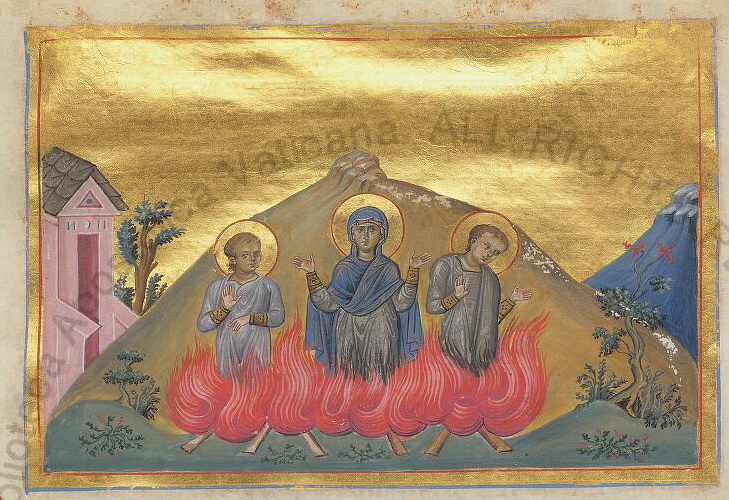

Theodota's story is preserved chiefly in the Life of Anastasia the Deliverer-from-Bonds, whose ministry to the imprisoned confessors of Diocletian's persecution she shared. A native of Nicaea in Bithynia and widowed young, she raised her three sons in the faith and led a life of piety, becoming Anastasia's faithful companion in the visiting and tending of prisoners.
When the persecution reached them, the two women were arrested. A dignitary named Leucadius, taken with Theodota's beauty, brought her and her children into his house intending to marry her; but she kept herself in purity, yielding neither to enticement nor to threat, and the frustrated official sent her on to the governor of Bithynia, Nicetas, for trial. There, when the judge threatened torture, her eldest son Evodus answered that Christians do not fear torments but only the loss of God, and was beaten before his mother's eyes until his blood ran; Theodota prayed not that his sufferings be spared but that he be strengthened, rejoicing that he was counted worthy of a martyr's death. Attempts to defile Theodota were thwarted — the Life says an angel held back all who approached — and the governor, ascribing the wonder to sorcery, condemned mother and children to death by fire. They were cast into a red-hot furnace and so gave up their souls together. The Greek synaxarion's verses celebrate her ardour: "Theodota bears the fire with her dearest ones, boiling with the love of God, and hotter than the flame."
Feast and commemoration
Her principal feast is July 29 (church date; Old Calendar civil August 11), "the Martyr Theodota and her three children in Bithynia." Her memory is kept again on December 22 (Old Calendar civil January 4), within the forefeast of the Nativity, together with the great-martyr Anastasia and the martyrs Chrysogonus and Zoilus, in whose cycle her passion is transmitted. No proper service is appointed to her; she is commemorated in the synaxarion of each day and in the hymns of Anastasia's office.
Hymns
Troparion — Tone 4 (from the common of a woman martyr)
Thy lamb Theodota, O Jesus, crieth out with a great voice: Thee, my Bridegroom, do I love, and seeking Thee I contend, and am crucified and buried with Thee in Thy baptism; I suffer for Thy sake, that I may reign with Thee, and I die for Thee, that I may live in Thee. As a spotless sacrifice receive her who with longing is slain for Thee. By her intercessions, as Thou art merciful, save our souls.
Original translation from the Greek
Iconography
Theodota is depicted as a woman martyr with her three children about her, and her narrative scenes show the furnace into which they were cast. The stored image is the miniature from the Menologion of Basil II (Constantinople, c. 1000, Vatican Library) that is catalogued as "Theodota of Nicaea with children": by its late-December position in the manuscript and by the presence of the children — which belong to this Theodota of Bithynia, native of Nicaea, and not to the childless September martyr — it depicts the saint of this entry.
Disputed questions
- Not to be confused with Theodota of Nicaea, the martyr of an earlier persecution (†c. 230, under Alexander Severus), commemorated September 17: that Theodota suffered alone and left no children, whereas this Theodota is remembered precisely with her three sons. Both were of the region of Nicaea, and the two are readily confused; the distinguishing mark is the children. Distinct again are the righteous Theodota, mother of the Unmercenaries Cosmas and Damian (November 1), who reposed in peace.