
Thyrsus, Leucius and Callinicus
The Holy Martyrs Thyrsus, Leucius and Callinicus
Martyr · d. c. 250
Commemorated 14 December — Martyrdom under Decius
Thyrsus, Leucius and Callinicus were martyrs of the persecution under the emperor Decius (249–251), suffering about the year 250 in Bithynia. Leucius, a Christian of standing, openly rebuked the governor for his cruelty toward the faithful and was tortured and beheaded. Thyrsus, still only a catechumen, gave himself up for Christ, endured savage tortures unharmed, and by his prayer toppled an idol of Apollo before reposing under sentence of death. Callinicus, a pagan priest who watched Thyrsus's courage and his miracle, was converted on the spot, confessed Christ aloud, and was put to the sword. The three are commemorated together on December 14.
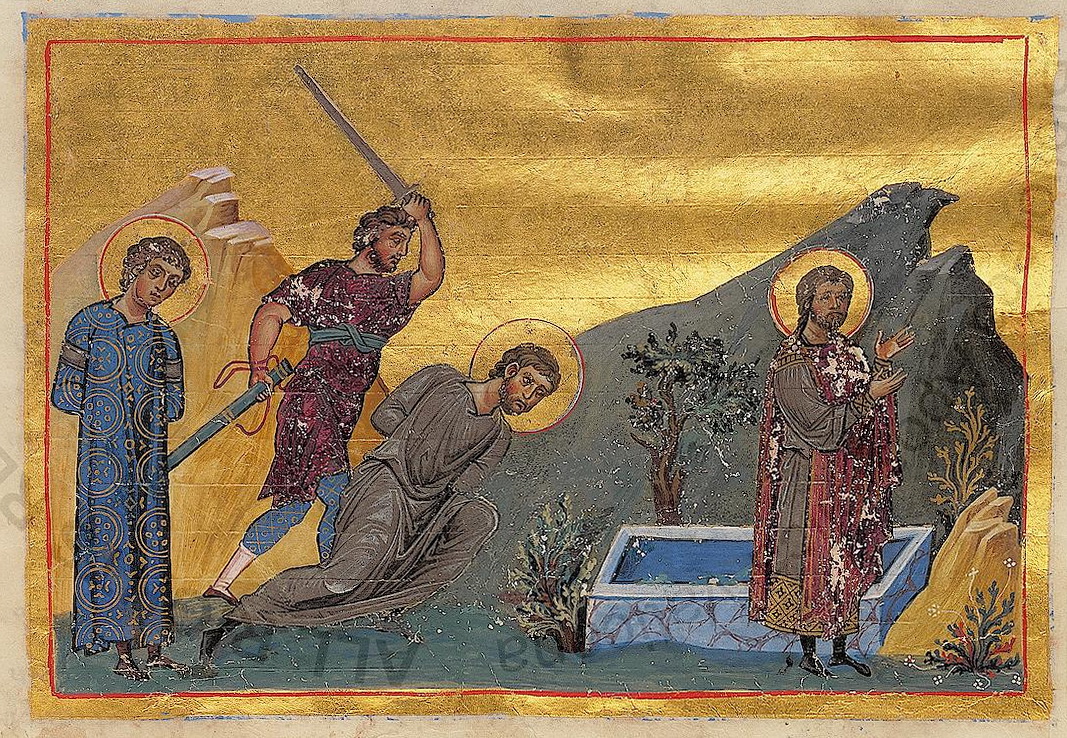
.jpg)
The company is known from the Byzantine synaxaria and the surviving Passion, which set the martyrdoms in the reign of Decius, one of the fiercest of the persecuting emperors, whose edict of 250 requiring universal sacrifice fell with particular weight on the Christians of Asia Minor.
Martyrdom
Leucius, whose name the Greek verses play upon as "the man white in spirit," was the first to suffer. He would not keep silence before the persecution and reproached the governor — named in the tradition Cumbricius — to his face for the injustice of hunting down men who had done no wrong. For this boldness he was seized, tortured, and beheaded, dying as a confessor of the faith he had defended in words.
Thyrsus was still a catechumen, not yet baptised, when he presented himself of his own accord, eager for the same crown. Brought before the governor and ordered to sacrifice, he refused, and — recalling the reproach of the prophet Jeremiah against those who say to a stock of wood, "Thou art my father" (Jeremiah 2:27) — he mocked the worship of gods made of timber and stone. A long catalogue of tortures followed: the tradition relates that his arms and legs were wrenched from their sockets, his eyes were put out, and his teeth were broken with a hammer, yet he was preserved through all of them. Taken into a temple to be forced to worship, he brought down a statue of Apollo by his prayer alone. Enraged, the governor devised still crueller torments, including a sentence that the saint be sawn asunder; but the saw could not harm him — the Greek epigram says it "found in Thyrsus no wooden stalk to saw through" — and the martyr, sealing himself with the Sign of the Cross, gave up his soul. His repose is placed on December 14, the day of the commemoration.
Callinicus was a priest of the pagan cult, present through these events. Seeing the constancy of Thyrsus under torture and the collapse of the idol at his word, he came to faith, professed Christ openly before the same tribunal, and was beheaded — receiving, like the good thief, the baptism of blood he had not received in water. His Greek name means "noble victor," and the verses of the synaxarion remark that he became by his death what his name had always said.
Veneration and later cultus
The three martyrs held an early and wide veneration. Relics associated with Thyrsus travelled westward, and his name is attached to ancient churches in the Latin West — notably at Sisteron in Provence and at Trier, where a basilica bears his dedication — so that he became one of the Eastern martyrs honoured on both sides of the later ecclesiastical divide. In the Byzantine world the company entered the Menaion for December 14 and the illustrated synaxaria, among them the Menologion of Basil II, which gives the trio one of its miniatures.
Feast and commemoration
December 14 (church date; Old Calendar civil December 27), within the Nativity Fast. The commemoration is universal in the Byzantine rite and is kept the same day as the Martyrs Philemon, Apollonius and Arrian of Antinoöpolis, with whom the day's Menaion service is shared; the Greek and Slavonic books differ over which company is treated as primary, the Slavonic Menaion giving Thyrsus, Leucius and Callinicus a proper kontakion of their own. The Greek Menaion for the same day also carries a commemoration of deliverance from a threatened earthquake.
Hymns
Troparion — Tone 4
Thy Martyrs, O Lord, in their contest received incorruptible crowns from Thee our God; for, possessed of Thy might, they cast down the tyrants and broke the feeble insolence of the demons. By their prayers, O Christ God, save our souls.
Original translation from the Greek
Kontakion — Tone 2
Champions of the true faith, you spat upon the impious tyrant and laid bare his beast-like thirst for blood; strengthened by the help of Christ, you overcame his raging violence, O Thyrsus and Leucius. Together with those who suffered at your side, intercede for us.
Original translation from the Slavonic
Iconography
The martyrs are shown as beardless and bearded youths in the tunics of their day; the Menologion of Basil II gives them a martyrdom scene in which an executioner beheads one of the company with the sword while another martyr stands beside a tomb or font — the whole set against the gold ground and rocky landscape typical of the manuscript. The stored image is that miniature (c. 985, Vat. gr. 1613).
Disputed questions
- Place of martyrdom. The sources vary. The Slavonic and OCA tradition places the suffering at Caesarea in Bithynia; the Greek styles Thyrsus "of Apollonia" (the Wikidata entity Q38117964 keeps this form and the feast of December 14); the Menologion of Basil II miniature is catalogued under "Nicomedia." All three are Bithynian centres, and the variance reflects the transmission rather than a difference of persons.
- The governor's name. Given in the received Passion as Cumbricius (Koumbrikios); the spelling is unstable across the manuscripts.
- Thyrsus's manner of death. The tradition is consistent that he was condemned to be sawn asunder yet was preserved from the saw and reposed under sentence, rather than being executed by it — an emphasis the liturgical verses make explicit.
- Leucius is not to be confused with Leucius the Confessor, Bishop of Brindisi (June 20), the Alexandrian monk sent to Apulia, whom the Slavonic books call bishop of "Vruntisiopolis." This Leucius is a Bithynian layman-martyr of the third century and no hierarch.