
Philemon, Apollonius and Arrian
The Holy Martyrs Philemon, Apollonius, Arrian and their Companions
Martyr · d. c. 305
Commemorated 14 December — Martyrdom at Antinoöpolis under Diocletian
Philemon and Apollonius were martyrs of Antinoöpolis (Antinoe) in the Egyptian Thebaid during the persecution of Diocletian, suffering about the year 305. Apollonius, a reader of the Church, was afraid of torture and paid a pagan flute-player named Philemon to sacrifice to the idols in his place; but when Philemon put on the reader's clothes and came to the altar, grace touched his heart, he confessed Christ, and — praying for baptism, he received a sudden shower of rain as his baptism. Both were beheaded, and their example converted their judge, the governor Arrian, who with four of his bodyguards was in turn martyred by drowning. Their brother Theonas and the wider company of the Thebaid martyrs are remembered with them on December 14.
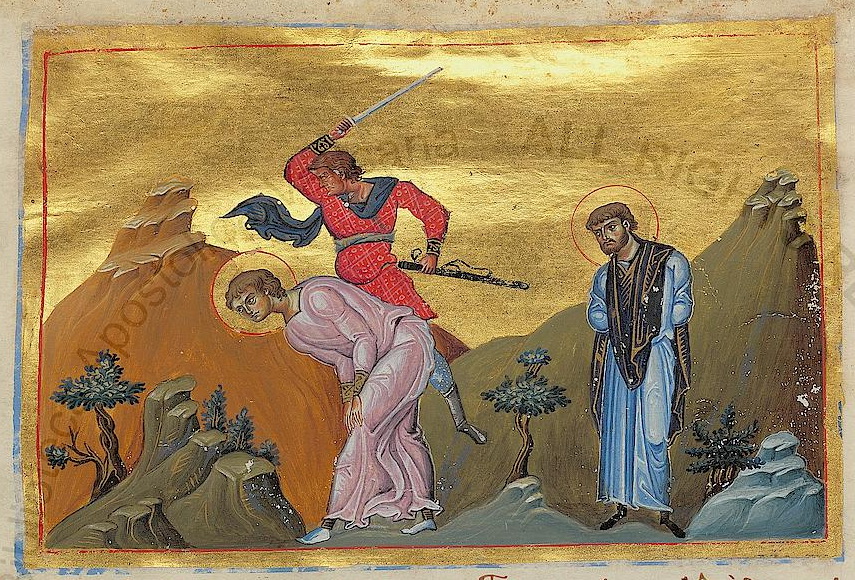
.jpg)
The Passion of these martyrs belongs to the great persecution under Diocletian and Maximian, whose edicts of 303–305 struck the Church of Egypt with special ferocity. The events are set at Antinoöpolis, the Hadrianic city on the Nile in the Thebaid, and centre on the conversion of a pagan musician and, through him, of the very magistrate charged with enforcing the persecution.
The exchange of Philemon and Apollonius
The governor of the Thebaid, Arrian (Arianus), had arrested a large company of Christians — the synaxaria give the number as thirty-seven, and name among them Ascla and Leonides, who are commemorated on May 20 — and set before them the usual choice of sacrifice or death. Most chose to die. One of them, Apollonius, a reader of the Church, shrank from the torture, and privately arranged with a well-known pagan flute-player of the city, Philemon, to take his place at the altar: he gave Philemon his own clothes and four gold coins to go and offer the sacrifice in his stead, with his face covered so that the substitution would pass unnoticed.
Philemon put on the reader's garments and approached the altar to perform the sacrifice. But as he came near, the tradition relates, his heart was flooded with divine grace and the eyes of his mind were opened: instead of sacrificing he made the Sign of the Cross and cried out that he was a Christian and a servant of Christ. The governor, not recognising him under the disguise and supposing him to be Apollonius, sent for the flute-player Philemon to come and play, thinking music might calm the man and incline him to worship. When the servants could not find Philemon, they brought his brother Theonas, who laughed and said, "Philemon is standing before you." The disguise uncovered, Philemon confessed that he had truly become a Christian, though he had never been baptised; and when he prayed, a sudden heavy rain fell upon him, which the tradition receives as his baptism.
Martyrdom
Because it was Apollonius whose stratagem had led Philemon to the faith, the governor brought him out again, and this time Apollonius too confessed Christ boldly, his fear overcome. Arrian had both tortured and then beheaded. But no sooner had he killed them than he was struck with blindness; Philemon appeared to him in a dream and told him to anoint his eyes with earth from the martyr's grave, and when he did so his sight was restored. Convinced by the miracle, Arrian himself, together with four of his bodyguards — the protectores whom the Greek synaxarion honours as the "Four Protectors who contended with holy Arrian" — believed in Christ and confessed the faith. All were martyred, the tradition says by drowning in the sea, about the year 305.
Veneration and later cultus
The company was widely commemorated in the Christian East, and the story of the substituted sacrifice — a persecutor's device turned into the conversion of both the substitute and the judge — made it a favourite of the synaxaria. The martyrdom is illustrated in the Menologion of Basil II under December 14, and the day's Greek Menaion carries a full canon and proper kontakion for the martyrs. The martyrs of Antinoöpolis stand within a larger Egyptian cycle: the name of the governor Arianus (Apa Arianos) recurs across a whole family of Coptic martyr-acts of the Thebaid.
Feast and commemoration
December 14 (church date; Old Calendar civil December 27), within the Nativity Fast. The commemoration is universal in the Byzantine rite and shares the day with the Martyrs Thyrsus, Leucius and Callinicus; the December 14 Menaion service in the Greek books is proper to Philemon, Apollonius and Arrian, whose canon (in the plagal second tone) and kontakion it supplies, while the Slavonic Menaion gives the day's proper kontakion to the Thyrsus company instead — a difference of arrangement recorded here.
Hymns
Troparion — Tone 4
Thy Martyrs, O Lord, in their contest received incorruptible crowns from Thee our God; for, possessed of Thy might, they cast down the tyrants and broke the feeble insolence of the demons. By their prayers, O Christ God, save our souls.
Original translation from the Greek
Kontakion — Tone 4
Come, let us all assemble today and, with sacred songs of praise, extol the luminaries of the Church, hymning them as the prize-winning athletes of Christ our God.
Original translation from the Greek
Iconography
The martyrs are shown in the dress of the late-antique city — Philemon sometimes distinguished by the flute or double pipe of his former trade — and the scene of their death is the standard beheading of the synaxarion cycle. The stored image is the Menologion of Basil II miniature (c. 985, Vat. gr. 1613), which sets two martyrs and their executioner against the gold ground and rocky hills of the manuscript.
Disputed questions
- Date. The synaxaria set the martyrdoms under Diocletian; the OCA notice gives "circa 305," while some Greek accounts place the arrests earlier, about 286–290. The Diocletianic persecution of 303–305 is the usual anchor, and the entry follows the later date.
- Members of the company. The transmitted rolls vary. Besides Philemon, Apollonius and Arrian, the sources name Philemon's brother Theonas (given by the Slavonic books as Theotichus), the four bodyguards martyred with Arrian, and — among the thirty-seven first arrested — Ascla and Leonides, who have their own commemoration on May 20. The names are given here as transmitted rather than as a fixed list.
- Not the Apostle Philemon. This Philemon, the flute-player of Antinoöpolis martyred about 305, is not to be confused with Philemon the Apostle of the Seventy, the recipient of St Paul's Epistle, commemorated November 22 and February 19. Likewise Apollonius the reader is distinct from the Apostle Apollos of the Seventy.