
Timothy of Symbola
Our Venerable Father Timothy of Symbola, the Wonderworker
Venerable · Wonderworker · b. eighth century, of Italian descent — d. c. 795
Commemorated 21 February — Repose of the venerable wonderworker
Timothy (died c. 795) was a monk and ascetic of the monastery called Symbola on Mount Olympus in Bithynia — the "holy mountain" of Asia Minor, thick in that age with monasteries and hermits. Of Italian descent, he entered the monastic life young and gave himself so wholly to fasting, vigil, and unceasing prayer under the guidance of the archimandrite Theoctistus that he attained a great purity and dispassion of soul, and with it the grace of wonderworking: he healed diseases of body and soul and drove out unclean spirits, so that the Church remembers him as a healer and a "star of many lights risen from the East." He reposed in peace in extreme old age about the year 795 and is commemorated on February 21, the day on which his office leads the Menaion.

Origins and entry into the monastic life
Timothy was, the tradition holds, of Italian origin, born in the eighth century. Nothing of his family or homeland is recorded beyond that descent; the sources take up his life at the point where it becomes the Church's — his entry, while still young, into the monastic state. He came to the monastery of Symbola, which lay in the region of Mount Olympus of Bithynia in Asia Minor — not the Olympus of Thessaly, but the great forested massif above the Sea of Marmara that in the eighth and ninth centuries was to Byzantine monasticism what Nitria and Scetis had been to Egypt, a whole mountain of communities, sketes, and solitaries. There he placed himself under the direction of the archimandrite Theoctistus, the abbot and spiritual father of the house, and was schooled in obedience.
Ascetic struggle
Under that guidance Timothy embraced the full rigour of the ascetic life. The synaxarion and his hymns dwell on the constancy of his labour: much abstinence and long fasting, intense and unremitting prayer, the vigils and self-denial by which the monastic fathers warred against the passions. By this discipline, kept without slackening through many years, he subdued the promptings of the passions and rose to a settled purity and dispassion (apatheia) — the tranquillity of a soul wholly turned to God. He is said to have lived at times in stricter solitude, withdrawing as a hermit for closer converse with God, while remaining a son and ornament of the Symbola community.
The gift of wonders
Out of this purity came the grace for which he is chiefly remembered. God gave Timothy the gift of healing and of wonders: he cured diseases of every kind in those who came to him, and — the mark the tradition presses most — he received authority over unclean spirits, casting demons out of the possessed. His hymnography names him θαυματοφόρος, the bearer of wonders, and likens him to a brightly shining star whose beams are his miracles, kindling the hearts of the faithful. The healing of soul as much as of body is stressed: he was a physician of the passions to those he counselled, and a worker of visible cures to those he prayed over.
Repose
Having lived out a long life in this labour and this grace, Timothy reposed in peace in advanced old age, about the year 795. He was buried at his monastery, and his memory was kept from early times in the synaxaria of the Church of Constantinople, whence it passed into the general calendar of the Byzantine rite.
Feast and commemoration
Timothy is kept on February 21 (church date; Old Calendar civil March 6), and it is his office that the Greek Menaion appoints for the day — the stichera, the apolytikion, the proper kontakion, and the canon are of Timothy the venerable, while the other saints of February 21 (Eustathius of Antioch, George of Amastris, John Scholasticus, and Zacharias of Jerusalem) are commemorated in the synaxarion notices. The Greek and Slavic calendars agree on the day. Mount Olympus of Bithynia gave the Church many saints of this era whose feasts cluster in the winter and spring months; Timothy is one of the elder generation of them, before the storms of the second Iconoclasm.
Hymns
Troparion — Tone 4
O God of our fathers, who dealest ever with us according to thy gentleness: withdraw not thy mercy from us, but by their supplications guide our life in peace.
Original translation from the Greek
Kontakion — Tone 4
Risen like a many-lighted star out of the East, thou hast shone into the hearts of the faithful the excellences of thy wonders, O God-minded Timothy, bearer of miracles.
Original translation from the Greek
Stichera
O God-minded father Timothy, by much abstinence and by strained and constant prayer thou didst utterly still the leapings of the passions, and being made pure wast filled with the gifts of the Spirit — to heal the sick and to drive out unclean spirits from those who ran to thee with faith.
Iconography
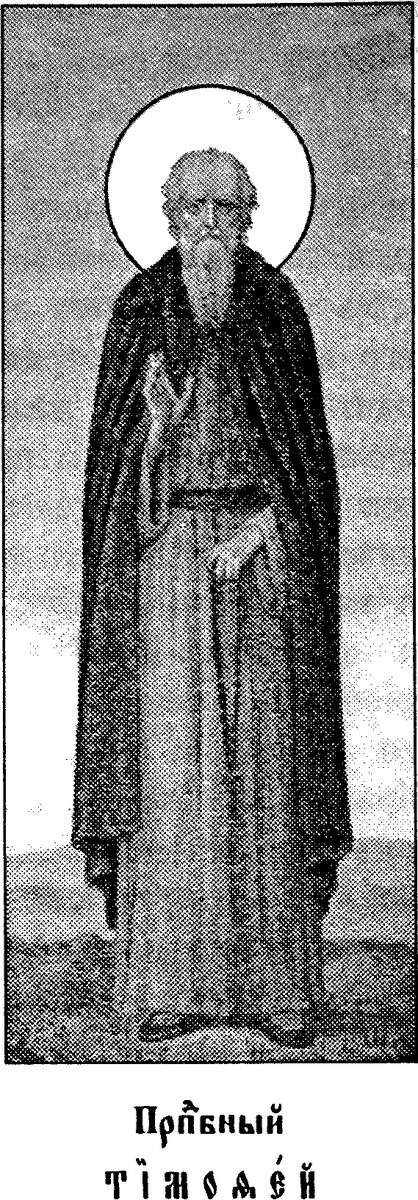
Timothy is depicted in the common type of a venerable monastic father: an aged monk in the dark analavos and mantle of the great schema, with a long grey beard, his right hand raised in blessing or holding a scroll, his whole bearing that of the ascetic elder. The stored image is the captioned plate of the illustrated Zhitiya Svyatykh (1903–1911).