
Trophimus, Sabbatius and Dorymedon
The Holy Martyrs Trophimus, Sabbatius and Dorymedon
Martyr · d. c. 276
Commemorated 19 September — Martyrdom under Probus, at Antioch of Pisidia and Synnada
Trophimus, Sabbatius and Dorymedon (†c. 276) are the chief martyrs of September 19, sufferers under the emperor Probus. Trophimus and Sabbatius, Christian strangers arriving at Antioch of Pisidia during a riotous pagan festival, were arrested when their grief at the spectacle betrayed them. Sabbatius died at Antioch under torture; Trophimus, driven three days to Synnada in Phrygia in iron sandals set with nails, was cared for in prison by the senator Dorymedon, a secret Christian, until Dorymedon's own refusal of a pagan feast exposed him. Thrown to the beasts and left untouched, Trophimus and Dorymedon were beheaded together. The three are commemorated as one company.
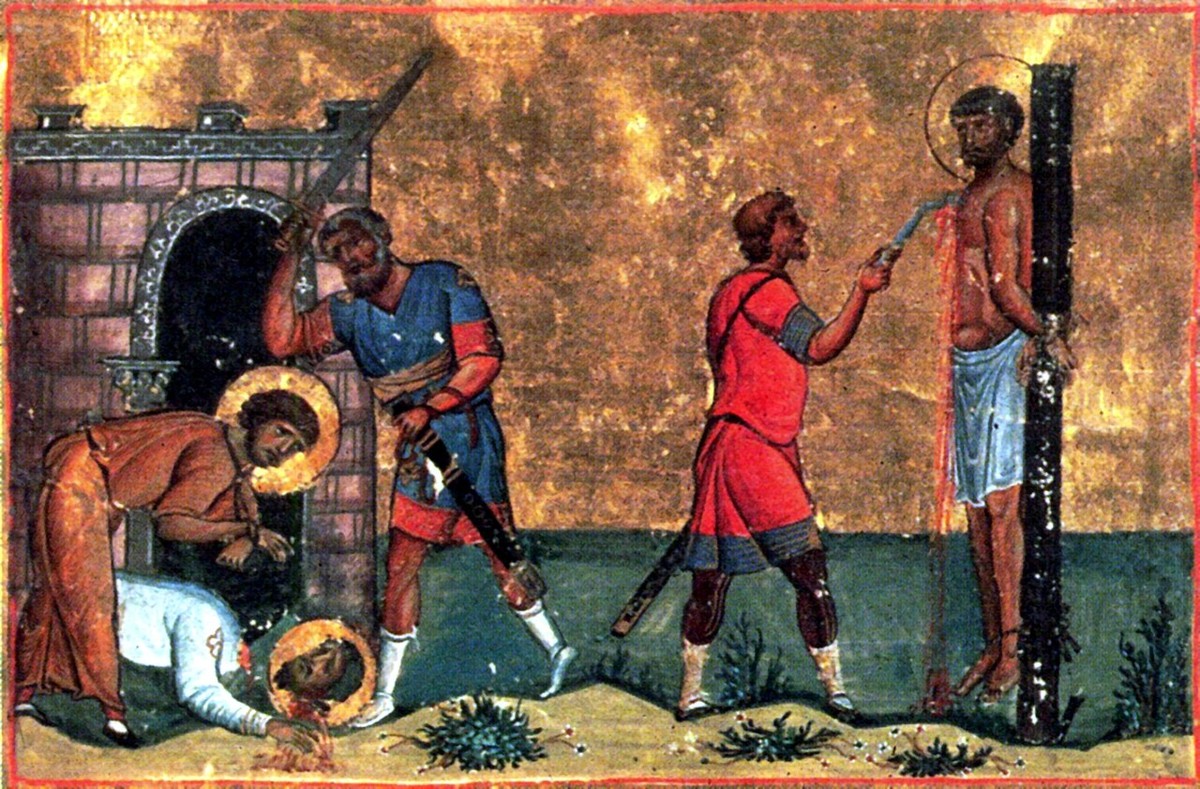

The confession at Antioch of Pisidia
The passio places the martyrdom in the reign of the emperor Probus (276–282), and the year usually given is 276, at its beginning. Trophimus and Sabbatius — the accounts introduce them simply as Christians, and say nothing certain of their origin — came to Antioch of Pisidia at the moment the city was celebrating a festival of its gods, with sacrifices, libations and the attendant debauchery. The two men made no secret of their sorrow: they prayed aloud that God would lead the erring out of their delusion, and the crowd, noticing strangers who would not join the worship, seized them and brought them before the governor.
Interrogated separately, both confessed Christ plainly and refused every demand to sacrifice. Sabbatius, whose answers gave the court nothing but the confession that he was a Christian and that Christ was his hope, was tortured with such savagery — the accounts speak of his body being raked until the flesh came away — that he died of it at Antioch, the first of the three to finish his course.
Trophimus at Synnada
Trophimus the governor sent on to Synnada in Phrygia, to Dionysius, governor of the Phrygian province, a man with a reputation as a torturer. The journey itself was made a punishment: Trophimus was shod in iron sandals set with sharp nails and driven on foot, with mounted guards, the three days' road from Antioch to Synnada. Before Dionysius he withstood a fresh course of tortures, answering, as the passio records, with the words of the psalm: "Many are the afflictions of the righteous, but the Lord shall deliver him out of them all" (Psalm 33/34:19). He was then left to rot in prison.
Dorymedon
At Synnada a member of the city council — the tradition styles him a senator — named Dorymedon was a Christian in secret. He came to the prison, washed and bound Trophimus's wounds, and cared for him. When the city kept the festival of the Dioscuri, Castor and Pollux, Dorymedon's absence was noticed; questioned, he answered openly that he was a Christian and would not honour demons. Neither persuasion nor torture moved him, and he was condemned with Trophimus. Both were exposed to wild beasts in the arena — the beasts, released against them, left them unharmed — and were finally beheaded with the sword. The Church joined the three names in a single commemoration from early times, and the Menaion hymns them as one company: the kontakion is addressed to "glorious Trophimus with thy fellow contestants."
Veneration and later cultus
The commemoration on September 19 is universal in the Byzantine rite: the Synaxarion of Constantinople carries the company on this day, the Menologion of Basil II gives their notice and a miniature of the martyrdom, and the Greek Menaion provides proper stichera for each of the three by name, a proper kontakion and oikos, and a full canon. The Slavonic Menaion adds a proper troparion that plays on their number: "God, praised in Trinity, hath glorified a trinity of martyrs." The Roman Martyrology likewise keeps Trophimus, Sabbatius and Dorymedon on September 19, dividing the geography as the passio does (Sabbatius at Antioch, Trophimus and Dorymedon at Synnada).
Feast and commemoration
September 19 (church date; Old Calendar civil October 2), within the afterfeast of the Elevation of the Cross, with whose service the martyrs' texts are joined in the Menaion. The company is the principal commemoration of the day in the Greek, Slavic and Antiochian usage alike; the OCA and the Moscow Patriarchate calendar (verified live) both carry it, and the Roman Martyrology keeps the same date. In the received Greek Menaion the day's apolytikion is that of the Cross, the martyrs receiving stichera, kontakion, oikos and canon; the Slavonic books add the proper troparion below.
Hymns
Troparion — Tone 8
God, praised in Trinity, hath glorified a trinity of martyrs, Trophimus, Sabbatius and Dorymedon; for believing in him they cast down the enemy. By their prayers, O Christ our God, have mercy on us.
Original translation from the Slavonic
Kontakion — Tone 4
As the foundation of athletes and the buttress of godliness, the Church honoureth and glorifieth thy light-bearing contest, O all-hymned and blessed one, noble-hearted athlete, glorious Trophimus; with thy fellow contestants ask cleansing for them that hymn thee, for thou art invincible.
Original translation from the Greek
Iconography
The three are painted as a company of martyrs with crosses in hand — Dorymedon sometimes distinguished by the dress of a councillor. The stored image is the miniature of the Menologion of Basil II (Constantinople, c. 985; Vat. gr. 1613): a composite of their passion, showing at the left the beheading of the martyrs at Synnada — one already fallen, one bowing beneath the sword — and at the right Sabbatius bound to a stake and torn, the torture under which he died at Antioch.
Disputed questions
-
Not to be confused: the Sabbatius of this company (†c. 276, Antioch of Pisidia) is distinct from the venerable Sabbatius of Solovki (†1435, commemorated September 27).
-
Which Antioch. The Greek hagiographic tradition places the arrest at Antioch of Pisidia, the natural pairing with Synnada in neighbouring Phrygia; retellings that say simply "Antioch" (as the OCA's does) can leave the reader supposing the Syrian metropolis. This entry follows the Pisidian identification.
-
The day's title. Calendar headings commonly style all three "of Synnada," though Sabbatius died at Antioch and never reached Synnada; the style reflects the place of the company's final martyrdom and presumably of the joint cultus.
-
Year. The martyrdom is fixed only by the reign of Probus (276–282); 276 is the year most commonly given, and some sources say 278.
-
Not to be confused with Trophimus of the Seventy, the apostle and companion of Paul (commemorated April 15 with Aristarchus and Pudens), nor with the other martyrs Trophimus of the fixed calendar: Trophimus and Thalus at Laodicea (March 11), Trophimus and Eucarpion at Nicomedia (March 18), and Trophimus and Theophilus of Lycia with thirteen companions (July 23).