
Tsotne Dadiani
The Holy and Right-believing Tsotne Dadiani the Confessor, Prince of Egrisi
Confessor · Prince · d. before 1259
Commemorated 30 July — Commemoration of the confessor of Egrisi
Tsotne Dadiani was eristavi — duke — of Egrisi, the western Georgian principality of Odishi (Samegrelo, Mingrelia), in the middle of the thirteenth century, when Georgia lay under Mongol occupation. About the year 1246 the Georgian nobility met secretly at Kokhtastavi in Meskheti to plan a rising; the plot was betrayed, and the conspirators were seized and carried to Ani, where they were stripped, bound hand and foot, smeared with honey and laid out under the sun to be eaten by insects until they should confess and name their fellows. Tsotne had not been taken with them: he was absent from the meeting on its business. When he learned what was being done to his companions he rode to Ani, went in among them, took off his own clothes, bound himself, and lay down beside them. The Mongol commander, astonished past anger, questioned him, was told that he had come to share the punishment of men who had done nothing without him, and released the whole company. The Georgian Church glorified him on 26 October 1999, and keeps his memory on July 30.
.jpg)
Georgia under the Mongols
The Mongol armies reached the Caucasus in the 1220s and returned to stay in the 1230s. Queen Rusudan, daughter of Tamar, died about 1245 leaving the kingdom divided between rival claimants and effectively administered from Karakorum: Georgia was cut into eight tumens for the purposes of taxation and conscription, its nobles made responsible for delivering both, and its fighting men drafted into Mongol campaigns far from home. It was an occupation designed to be paid for by those occupied, and it fell hardest on the great houses, who had to raise the tribute from their own people and lead their own retainers away to die in Persia.
Tsotne, son of Shergil Dadiani, was eristavi of Egrisi in those years — the lord of the wet, forested, semi-independent west, between the Likhi range and the Black Sea. The chronicles describe him as a soldier of standing and a man of unusual personal weight among his peers.
The conspiracy at Kokhtastavi
About 1246 the Georgian lords — among them the amirspasalar and the eristavis of Kartli, Kakheti and the west — gathered at Kokhtastavi, a stronghold on Mount Kokhta in Meskheti in the south, to concert a general rising against the Mongols. It was a serious plan and a broad one, and it required, as such plans do, a great deal of provisioning and movement that could not be entirely concealed.
It was betrayed. The Mongol authorities descended on the meeting, took the conspirators, and carried them south to Ani, the great ruined-and-rebuilt city on the Armenian border, for interrogation. There they were put to a punishment chosen for its protractedness rather than its violence: stripped naked, bound hand and foot, smeared with honey, and laid out in the open under the summer sun, to be blistered by the heat and devoured by flies and wasps, until they should confess the conspiracy and give up the rest of the names. They confessed nothing.
"I have come to lie down with them"
Tsotne was not among them. He had left the assembly before the arrest — the chronicle says on the business of the rising itself, to raise men and supplies — and so was at liberty when the news reached him.
He might have stayed at liberty. Instead he took two attendants and rode for Ani. He came to the place where his companions lay, dismounted, and — in the sight of the Mongol guards, who did not stop him because they did not understand what he was doing — took off his own clothes, had himself bound in the same manner, and lay down among them in the sun.
The report went to the Mongol commander, who came to see it. He asked the Georgian what he meant by it. The answer preserved in the chronicle is the reason the Church remembers him: that these men were suffering for a thing they had not done alone; that he had been of their counsel from the beginning; and that it was not fitting that he should be free and comfortable while they lay bound — and if they were to die, he had come to die with them.
The effect was total. The commander, the sources say, took the act for a proof that men who would do such a thing were not conspirators but men of honour — or, in the more sober reading, found himself confronted by a gesture for which his procedures had no answer. He ordered them all unbound, clothed, and set free, and the whole company went home alive.
After
Tsotne's later years are not recorded. He does not appear among the participants in the next Georgian conspiracy against the Mongols, that of 1259, and the historians take his absence as evidence that he had died before that year. He is remembered in his own principality as a just ruler and a builder, and the Dadiani house of which he was head governed Odishi and Samegrelo for six centuries after him.
The Georgian Church, which had never forgotten the story — it is told at length in the medieval Chronicle of a Hundred Years and has been a staple of Georgian schooling and literature ever since, most famously in the twentieth-century historical novel that bears his name — glorified him formally on 26 October 1999 by act of the Holy Synod under Patriarch Ilia II, as Tsotne Dadiani the Confessor, "for his faith, love and devotion."
Feast and commemoration
July 30 (church date; New Calendar civil July 30; Old Calendar civil August 12 — the date on which the Georgian Church, which keeps the Julian reckoning, observes him). The day falls immediately before the Dormition Fast, which opens on August 1. The commemoration is Georgian: it belongs to the national synaxarion, and a proper service was composed for it after the glorification of 1999. Where it appears outside Georgia — as in the American calendar — it stands as a notice among the day's commemorations, without an office.
Hymns
Troparion — Tone 4 (common of a confessor)
Thou didst not count thy freedom a thing to be grasped, but didst go down of thine own will into the bonds of thy brethren, O right-believing Tsotne; and by that love thou didst loose them all. Wherefore Christ God, who laid down his life for his friends, hath glorified thee: intercede with him that our souls may be saved.
Original translation from the Georgian
Iconography
The modern Georgian icons of Tsotne, painted since the glorification of 1999, give him the type of a right-believing prince: a young or middle-aged man with a short beard and long hair, in the red and gold court dress of the Georgian nobility with a broad embroidered collar, holding the martyr's or confessor's cross in his right hand, and inscribed in the mkhedruli and asomtavruli scripts. Narrative icons show the scene at Ani — the bound men laid out in the sun and the prince, half-stripped, lying down among them.
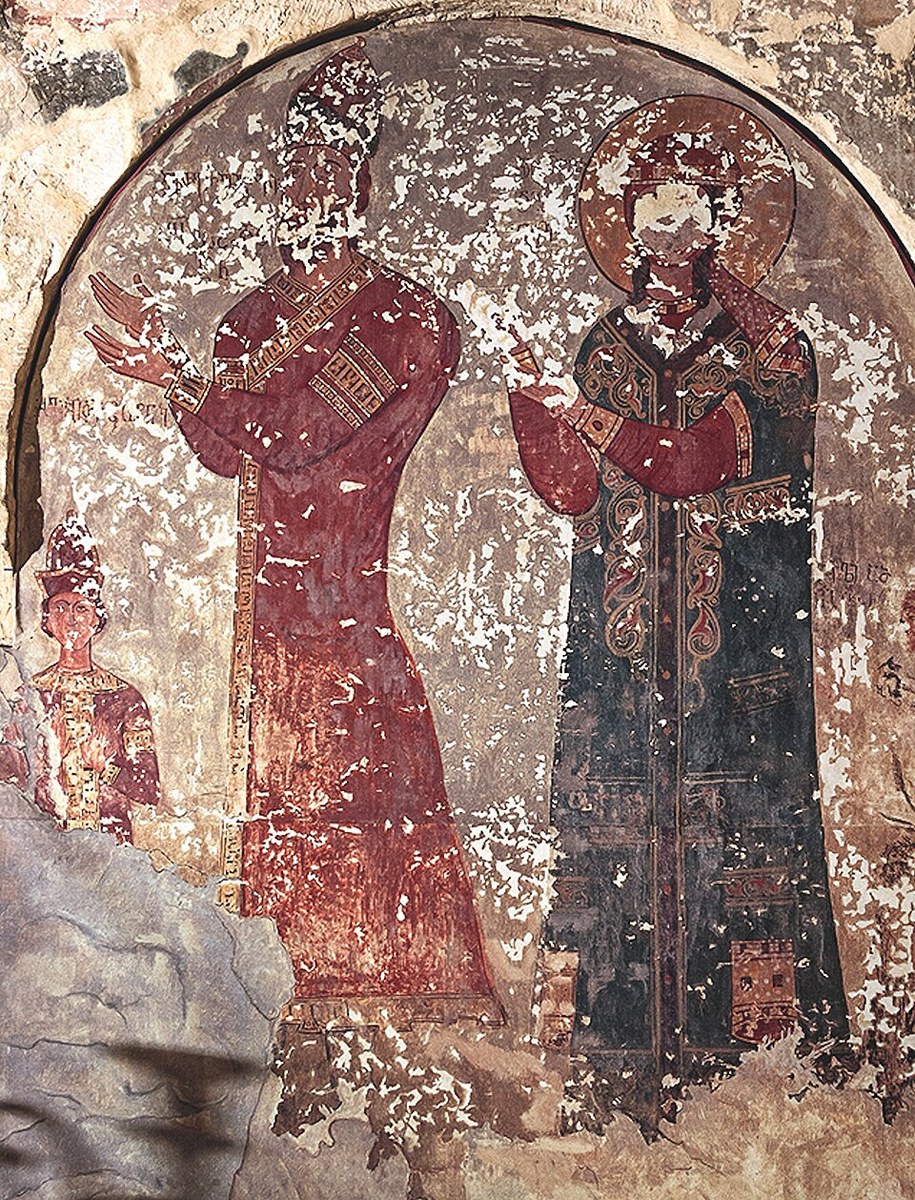
Older imagery of him is donor imagery rather than iconography. The stored image is the Dadiani donor panel from the monastery church of Khobi in Samegrelo, a wall painting of the thirteenth or fourteenth century in which, on the published reading of the fresco, Prince Shergil Dadiani and his wife Natela are shown with their children Tsotne and Tamar: two tall standing figures with hands raised in offering, the man on the right haloed and richly robed in dark blue and gold, the woman on the left in deep red, with a small crowned child at the lower left — the young Tsotne — and Georgian inscriptions running down the field beside them. The panel is much damaged. It is stored here as the oldest surviving image connected with the saint, with the caution that the identification of the individual figures rests on the reading of the inscriptions in the Georgian art-historical literature rather than on anything legible in the photograph.
Disputed questions
- Why a confessor and not a martyr? He did not die for the faith; he did not die at all on this occasion, and the Mongols were not persecuting Christianity as such — the conspiracy was political and the torture was investigative. What the Church honours is the act: a voluntary and useless-seeming self-surrender, offered for others and expecting death, which is the pattern of Christ's own self-offering, and which the Georgian tradition places beside the passion-bearers of the Slavic north as a form of witness proper to a Christian ruler. The title aghmsarebeli, confessor, is used in that sense.
- The date of the conspiracy. The Kokhtastavi assembly is placed by the Georgian chronicles in the years after Rusudan's death and is usually dated 1246–1248; proposals as late as 1250 exist. The chronology of the whole period is loose, and the sequence — Rusudan's death, the division of the kingdom, the conspiracy, the torture at Ani — is firmer than any of its dates.
- The lateness of the glorification. His veneration in Samegrelo is old and popular, but the formal canonisation is of 1999, and his commemoration is accordingly kept by the Georgian Church and by those (such as the Orthodox Church in America, which carries him on July 30) who list the Georgian saints; it is not in the Greek, Antiochian or Russian menaia. His proper service is modern.