
Valentine of Interamna
The Holy Hieromartyr Valentine, Bishop of Interamna
Hieromartyr · Bishop · Wonderworker · d. c. 269–273, Rome
Commemorated 30 July — The hieromartyr Valentine, bishop of Interamna, and those with him
Valentine was bishop of Interamna Nahars — the modern Terni in Umbria, some sixty miles north of Rome — in the third century, and was renowned for a gift of healing. Called to Rome by a Greek rhetorician named Craton, whose son lay crippled and beyond the physicians' help, he asked and was granted a night alone with the boy, and gave him back straightened and whole; whereupon Craton, his household, and the three Athenian students lodging with him — Proculus, Ephebus and Apollonius — received baptism, and after them Abundius, son of the prefect of the city. Denounced for turning the young men of Rome from the gods, Valentine was seized, scourged and beheaded by night, and his three disciples carried the body home to Interamna and buried it there. The Byzantine calendars keep him on July 30; the Latin West keeps him on February 14, where his memory has become entangled beyond disentangling with that of a Roman presbyter of the same name.

Bishop of Interamna
Interamna Nahars — "between the rivers of the Nar" — was a Roman municipium on the Flaminian Way at the meeting of the Nera and the Serra, a day's hard ride north of Rome. The tradition makes Valentine its bishop, consecrated young, in the middle years of the third century, and gives no account of his birth, his family or his election; the passion begins with him already in the see and already famous. What it dwells on is the charism of healing: he is said to have cured diseases that the physicians had abandoned, and to have done it by prayer and the sign of the Cross, without art or medicine, and to have turned many to Christ in that way.
Craton's son
At Rome in those years there kept a school a Greek man of letters named Craton, and three young men had come from Athens to study under him — Proculus, Ephebus and Apollonius. Craton's son, called in the Latin acts Chaeremon, was afflicted in the spine: his body had folded in on itself so that his head was drawn down to his knees, and he had been given up by every physician consulted, at very great expense.
Hearing of the bishop of Interamna, Craton sent for him. Valentine came, and when he had seen the boy he said that faith, not skill, would cure him, and asked to be left alone with him for the night. The whole house heard him at prayer through the dark hours. In the morning the boy stood upright and whole. Craton, his wife and household, and the three Athenian students were baptised; and the students attached themselves to Valentine as disciples, remaining with him thereafter.
Among the young men of Rome who followed them into the faith was Abundius, son of the prefect of the city — and it was that conversion which sealed the bishop's fate. To lose a scholar's household was one thing; to lose the son of the prefect to the new religion was a public scandal, and the pressure to make an example was irresistible.
Martyrdom
Valentine was arrested and required to sacrifice. He refused, and answered his judges with the confession of Christ. He was scourged, and, when neither threat nor torment moved him, he was condemned; and because his cure of Craton's son had made him a name in the city and an open execution risked a demonstration, the sentence was carried out by night, in secret, by beheading. The passion sets his death in the reign of Claudius II or of Aurelian, about the years 269 to 273; the Roman tradition gives the date as 14 February and the place as the Flaminian Way.
His three disciples — Proculus, Ephebus and Apollonius — recovered the body under cover of dark, carried it north to Interamna, and buried it outside the city on the road, at the place where the basilica of San Valentino now stands. There they stayed, preaching; and there the consul Leontius, informed of them, had them taken and, like their master, put to death by night. Abundius, coming to look for them, found them dead and buried them beside Valentine — and was himself martyred after. They are kept with the bishop on the same day, and their entry stands here.
Cult at Terni
Terni has venerated Valentine as its patron and first bishop without interruption since antiquity. The basilica raised over the grave on the Flaminian road is attested from the fourth century; the relics were transferred into the crypt of the present basilica in the seventeenth, and the city keeps his feast in February with a procession that is among the oldest continuously observed in Umbria. The Byzantine reception is later and quieter: the synaxaria enter him under July 30, with the three Athenians and Abundius, and give him no proper office, so that in the Greek and Slavic books he is a notice rather than a feast.
Feast and commemoration
July 30 (church date; New Calendar civil July 30; Old Calendar civil August 12) in the Byzantine calendars, kept with his three disciples and Abundius. The day falls in the free season between the Apostles' Fast and the Dormition Fast, which opens on August 1. The Greek and Slavic books give him a bare notice — no canon, no proper hymns — and the office of the day belongs to the apostles of the Seventy; the Antiochian calendar lists him among the day's commemorations in the same way. In the Latin West his feast is February 14, where he is honoured at Terni as the city's patron and first bishop with a full local proper, and where, in the Roman calendar as revised in 1969, the general commemoration of "St Valentine" was removed from the universal calendar precisely because of the confusion between the two martyrs of the name — a removal that touches Roman practice only and not the Byzantine notice on July 30.
Hymns
Apolytikion — Tone 4
As a sharer in the ways and a successor to the thrones of the Apostles, O divinely inspired one, thou didst find in contemplation the means to ascend to divine heights; rightly dividing the word of truth, thou didst struggle for the faith even unto blood, O hieromartyr Valentine: intercede with Christ God that our souls may be saved.
Kontakion — Tone 2
Thou didst raise up the son of the stranger by a night of prayer, and by that healing didst gather a household and three scholars into the fold of Christ; then, laying down thy own life by night for the flock, thou wast made the first shepherd and the crown of the city between the rivers, O hieromartyr Valentine.
Original translation from the Greek
Iconography
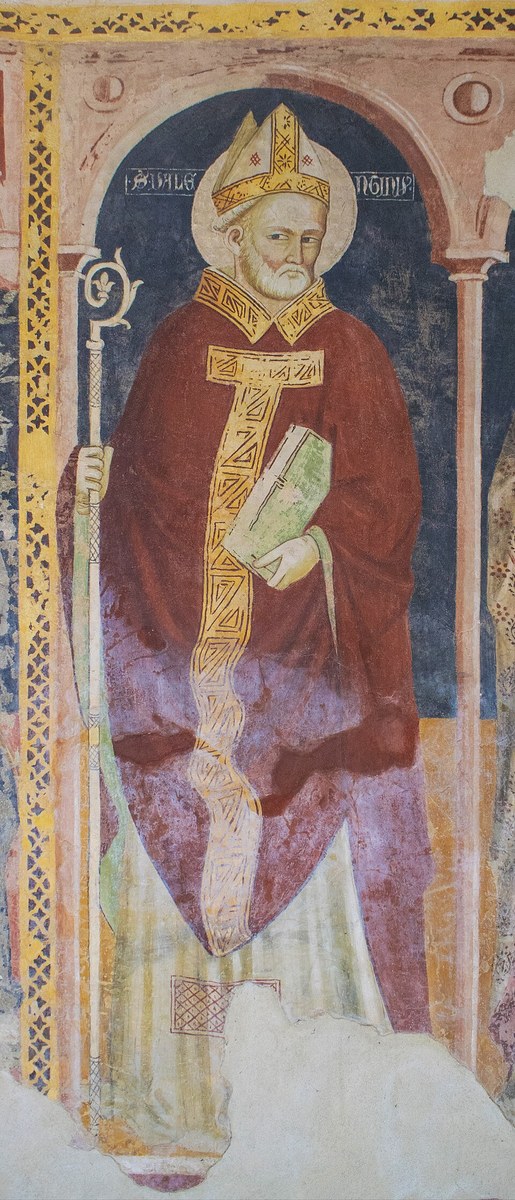
The Byzantine books, which give Valentine no office, give him no settled type either; he appears where he appears as a hierarch-martyr — bearded, in phelonion and omophorion, blessing and holding the Gospel-book, sometimes with the martyr's cross — and in the menologion rows for July he is one of the standing bishops. It is the Latin West that developed his imagery, and there he is a Western bishop: mitre, crozier and cope, holding a book, and often accompanied by the healed child of Craton at his feet or by a bunch of the flowers with which Terni keeps his February feast; scenes of the healing and of the beheading by night belong to the Umbrian cycles.
The stored image is a 15th-century Umbrian fresco in the church of Santa Maria del Monumento at Terni, the saint's own city: Valentine full-length under a painted arch, inscribed S. VALENTINUS, in a red cope with a broad orphrey worked in gold, wearing the mitre and holding the crozier in his right hand and a green book in his left, an elderly man with a short white beard. The underlying wall painting is long out of copyright; the photograph is by Giosuè Tacconi, who released it under CC BY-SA 4.0, and the image is stored here as a faithful reproduction of the old work.
Disputed questions
- One Valentine or two? The Roman calendars of the fourth century know a martyr Valentine buried on the Flaminian Way at the sixtieth milestone (that is, at Terni) and a martyr Valentine buried on the Flaminian Way at Rome itself, and commemorate both on 14 February. From these two entries the Latin tradition developed two passions: that of Valentine bishop of Interamna, told above, and that of Valentine the presbyter of Rome, who appears in this collection as a companion of Marinus, Martha, Audifax and Abbacum (July 6; kept in the West on 19 January). The two passions share so much — the same reign, the same road, the same date, the healing of a blind or crippled child in the house of the man who arrested him, the beheading by night — that most modern hagiographers, and the Bollandists before them, regard them as two developments of a single martyr, the Roman entry probably a doublet generated by the presence of relics at both ends of the same road. The Church's calendars keep both, and this collection keeps both, with the identification recorded here and in the companion entry rather than asserted.
- The Byzantine date. Why the Greek synaxaria set a Western bishop on July 30 rather than on his Roman date of February 14 is not explained in the books. The most economical account is that the Greek compilers took the group — bishop, three Athenian disciples, and the prefect's son — from a Latin passion in translation and entered it at a day that was free, as they did with a number of Italian and African martyrs; the Athenian origin of the three students would have commended the story to a Greek reader.
- The dating of the reign. The passion names Claudius (Claudius II Gothicus, 268–270) in most recensions and Aurelian (270–275) in others; neither is secure, and the whole chronology rests on a text no earlier than the fifth or sixth century.
- What the acts are worth. The Passio of Valentine of Interamna is a late and literary composition, and its named officials (the consul Leontius, the unnamed prefect) cannot be checked against the fasti. What is early and independent of it is the cult: a martyr's grave on the Flaminian road at the sixtieth mile, a basilica over it in the fourth century, and a city that has never stopped keeping his memory.
- The February 14 customs. The lovers' associations of "St Valentine's Day" belong to the later medieval West and to vernacular literature, not to either passion; they are noted here only because they now obscure both martyrs.