
Victor and Stephanida
The Holy Martyrs Victor the Soldier and Stephanida
Martyr · d. c. 175
Commemorated 11 November — Martyrdom at Damascus
Victor and Stephanida were martyrs of the second century, put to death at Damascus in the reign of the emperor Marcus Aurelius (161–180). Victor, a Christian soldier, refused the sacrifice demanded of the legions and passed unharmed through a succession of tortures, working miracles that converted his persecutors; Stephanida, the young wife of one of his torturers, seeing the power of Christ at work in him, confessed the faith aloud and was martyred by being torn apart between two bent palm trees. They are commemorated together on November 11.
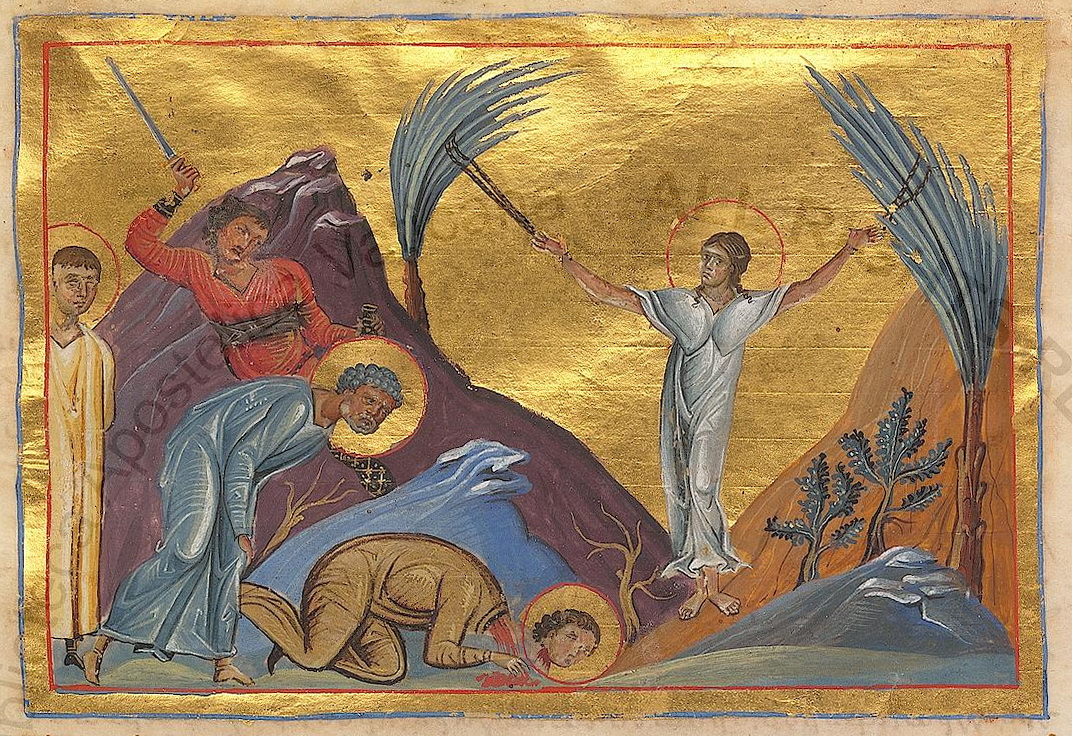
.jpg)
The Holy Martyr Victor was a soldier during the reign of Marcus Aurelius the Philosopher (161–180). When the emperor raised a persecution against the Christians, and the customary sacrifice to the gods was made the test of a soldier's loyalty to the gods, the emperor, and the state, Victor refused to offer it and confessed himself a Christian. He was handed over to torture but came through every torment unhurt. By the power of prayer, the tradition relates, he overcame a sorcerer set against him, who thereupon renounced his sorcery and became a Christian; and through Victor's prayers soldiers who had been struck blind suddenly received their sight.
Witnessing these wonders worked by the Lord through Victor, Stephanida — the young Christian wife of one of the men torturing him — openly glorified Christ. For this confession she was condemned to a cruel death: she was bound to two palm trees that had been bent down to the ground, and when the trees were released and sprang back they tore her in two. She was but fifteen (some accounts say sixteen) years old. Victor was then sentenced to be beheaded. Hearing the commander's order, he foretold that his executioners would all die within twelve days and that the commander would be taken captive by the enemy within twenty-four; and so, the account says, it came to pass. The martyrs suffered in the second century at Damascus, where their honoured relics were laid to rest.
Feast and commemoration
November 11 (church date; Old Calendar civil November 24), kept universally in the Byzantine rite. Victor and Stephanida are commemorated together with the great-martyr Menas and the deacon-martyr Vincent of Spain, all four being named together in the synaxarion verses and hymns of the day; Menas as the leading commemoration gives the day its character, and the service of the martyrs is common to them. Stephanida is honoured as one of the young women-martyrs of the early Church; Victor is counted among the soldier-martyrs.
Hymns
Troparion — Tone 4
Thy martyrs, O Lord, in their contest received incorruptible crowns from Thee our God; for having Thy strength, they cast down the tyrants and broke the powerless insolence of the demons. By their supplications, O Christ God, save our souls.
Original translation from the Greek
Kontakion — Tone 4
Unto Thy glory, O Lord and Maker of all, Thou hast shown forth in the world Thy passion-bearers and martyrs, adorned with virtues, that they might possess an unconquerable victory.
Original translation from the Greek
Iconography
The two are shown as martyrs — Victor as a young soldier-martyr with the cross of confession, sometimes in military dress; Stephanida as a young woman-martyr, at times depicted with the two palm trees of her death. The stored image is the miniature for November 11 from the Menologion of Basil II (c. 1000, Vatican Library), which portrays the martyrs of the day, Menas, Victor, Vincent, and Stephanida.