
Vincent of Saragossa
The Holy Martyr Vincent, Deacon of Saragossa
Martyr · Deacon · d. 304
Commemorated 11 November — Commemorated in the Byzantine calendar with the martyrs of the day
Vincent of Saragossa (died 304) was a deacon of the Spanish church and the protomartyr of the Iberian peninsula, put to death at Valencia in the persecution of Diocletian. Ordained by Bishop Valerius of Saragossa and given charge of preaching in his stead, he was arrested with his bishop, defended the faith with famous eloquence before the governor Dacian, and endured a series of savage tortures — the rack, the iron hooks, the gridiron — before dying in prison. One of the most widely venerated martyrs of the ancient West, honoured already by Augustine and Prudentius, he is kept in the Byzantine calendar among the martyrs of November 11.
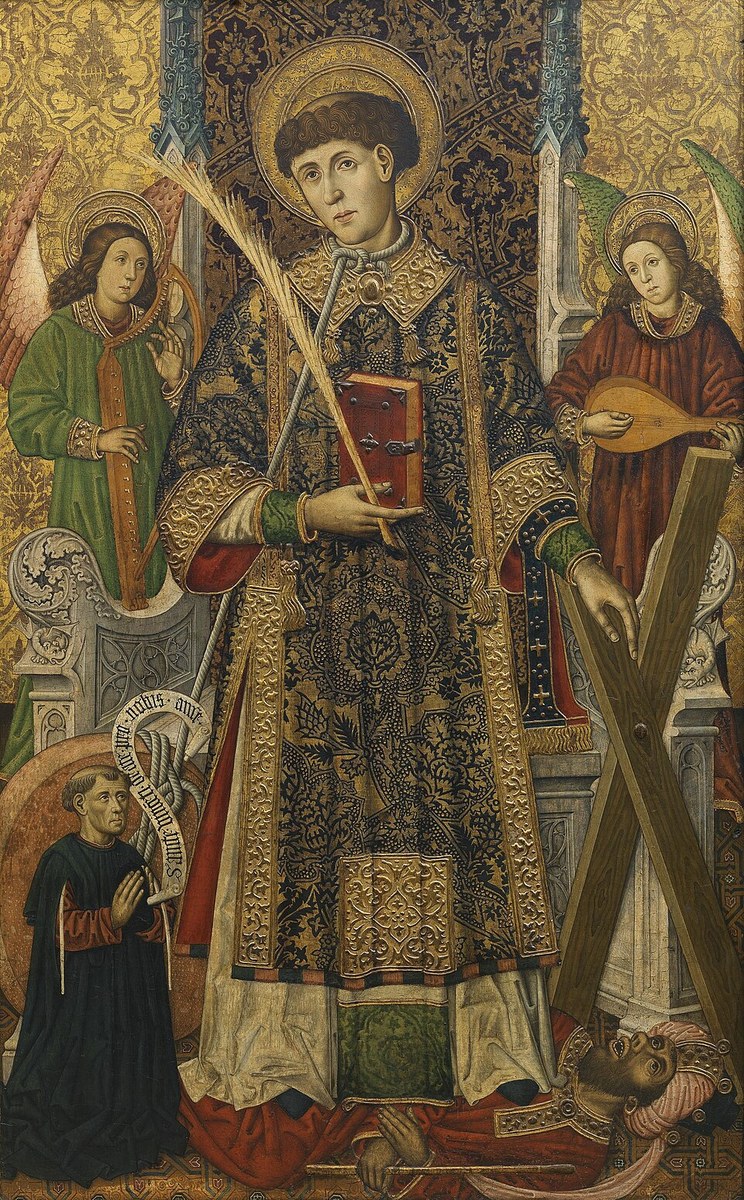

Vincent was, from childhood, the disciple of Valerius (Valerian), bishop of Saragossa (the Roman Caesaraugusta) in the north of Spain. Grown to maturity, he was ordained deacon by Valerius, and because the bishop was slow and hesitant in speech he entrusted his eloquent deacon with the office of preaching to the people. When Diocletian's persecution reached Spain, the governor Dacian, sent with full power to seek out and destroy Christians, had bishop and deacon denounced to him; they were arrested, dragged in chains from Saragossa to Valencia, and thrown into prison, beaten and starved.
At the interrogation the aged Valerius spoke haltingly, and Vincent asked and received his blessing to answer in his stead. He made before the judge and the assembled people the boldest speech of his life, professing Christ and defying the idols. Dacian sent the bishop into exile but turned the full weight of his fury on the deacon. Vincent was stretched and torn on the rack, scourged, and raked with iron hooks; when they took him down he is said to have climbed back himself, reproaching the executioners for their sloth, until his tormentors were exhausted. He was then roasted on an iron gridiron strewn with salt and hot coals. Cast back half-dead into a cell whose floor was strewn with broken pottery, he was heard by the astonished guard singing psalms, and an unearthly light was seen in the prison. He died there of his wounds, in the year 304. Christians reverently gathered and buried his body.
Veneration and later cultus
Vincent's cult spread with extraordinary speed and reach through the ancient Church. Saint Augustine preached several sermons on his feast and testified that it was celebrated throughout the Roman world; the Spanish poet Prudentius devoted one of the hymns of his Peristephanon to his passion; and Pope Leo the Great, Paulinus of Nola, and the Latin martyrologies all attest his memory. His relics were dispersed widely — to Valencia, and later, by various translations, to Lisbon (of which he became patron), to Castres and Paris in Gaul, and elsewhere — and churches and towns across the West bear his name. Though a Latin (pre-schism Western) saint, he passed into the Greek synaxaria and so into the Byzantine calendar, where he is commemorated on November 11 with the martyrs Menas, Victor, and Stephanida.
Feast and commemoration
In the Byzantine rite Vincent (Greek Βικέντιος) is kept on November 11 (church date; Old Calendar civil November 24), joined in the service with Menas, Victor, and Stephanida; the synaxarion verses of the day name him among them. In the Western churches his own principal feast is January 22, the traditional day of his martyrdom, on which he was and is widely celebrated.
Hymns
Troparion — Tone 4
Thy martyrs, O Lord, in their contest received incorruptible crowns from Thee our God; for having Thy strength, they cast down the tyrants and broke the powerless insolence of the demons. By their supplications, O Christ God, save our souls.
Original translation from the Greek
Iconography
Vincent is depicted as a young deacon in the sticharion (or, in Western art, the dalmatic), holding the Gospel book and the palm of martyrdom, and frequently identified by the instruments of his passion — a gridiron, and sometimes a millstone, an ewer, or a raven, from the legends of the guarding and recovery of his body. The stored image is a fifteenth-century Aragonese panel by Tomás Giner (c. 1462–1466) showing the saint as a deacon with the Gospel and the martyr's palm.