
Vitus, Modestus and Crescentia
The Holy Martyrs Vitus the Child, Modestus his Tutor, and Crescentia his Nurse, of Lucania
Martyr · Child Martyr · d. c. 303, in Lucania in southern Italy
Commemorated 16 May — Commemoration in the Slavic and Byzantine menologia, 15 June — Western and Greek usage keeps the three martyrs on this day
Vitus was a boy of a great pagan house of Sicily or Lucania who was brought to Christ in secret by the two servants who had charge of him — his tutor Modestus and his nurse Crescentia — and who suffered with them about the year 303, in the persecution of Diocletian. The passion relates that his own father tried first indulgence and then torture to break him; that the three fled by sea to Lucania in southern Italy; that Vitus, brought before the emperor, cast a demon out of the emperor's son and was for that repaid with the cauldron and the lions, from which he came out unhurt; and that the three at last gave up their souls together by the river Silarus. In the West Vitus became one of the most popular saints of the Middle Ages — patron of Bohemia and of Saxony, one of the Fourteen Holy Helpers, invoked against the nervous disorder still called St Vitus's dance. In Slavic and Byzantine usage the three are kept on May 16, and in the West on June 15.
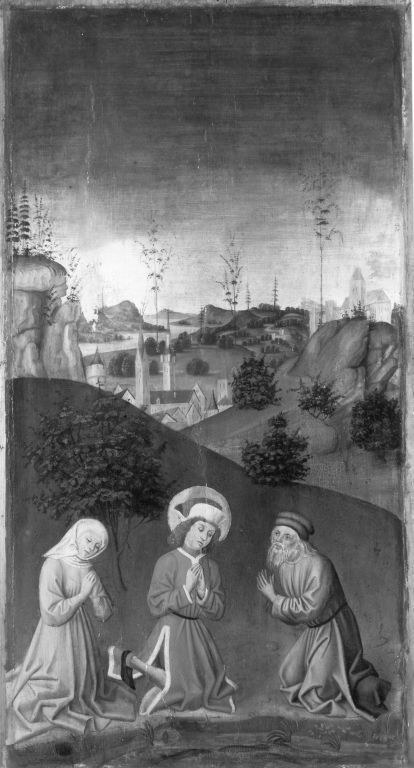

The child and his household
The passion — a text of the sixth or seventh century, and legendary in its detail — makes Vitus the son of Hylas, a wealthy pagan of senatorial rank; the sources divide between Mazara in Sicily and Lucania in the south of the Italian mainland for his home, and his cult is claimed by both. He was a boy of seven, or in other accounts twelve, when he was instructed in the faith of Christ, not by any preacher but by the two Christians of his own household who had the raising of him: Modestus, his paedagogus or tutor, and Crescentia, his nurse, whom the Slavonic calendars style питательница, the one who fed him.
His father discovered it, and the passion dwells on the ordinary cruelty of a household turned inquisitor: persuasion, then bribes and amusements suited to a child's age, then beating, then confinement — and the boy unmoved through all of it. Warned in a dream, the three took ship and crossed to Lucania, to the banks of the Silarus, where they lived hidden and where Vitus is said to have healed and taught.
Martyrdom
Their refuge did not last. Arrested and brought at length to Rome, Vitus was presented to Diocletian himself. The emperor's son was tormented by an unclean spirit; the child cast it out; and when he would not sacrifice in thanksgiving to the gods who had not been able to do it, the emperor turned on him as on a sorcerer. The passion piles up the deliverances: Vitus is thrown into a cauldron of molten lead — or of boiling pitch and resin — and is unharmed; a lion is loosed on him and lies down at his feet; the three are stretched on the rack, and an earthquake throws down the temples and kills many of the pagans, and an angel brings them back to Lucania. There, worn out with their sufferings, they reposed together, about the year 303. A noblewoman named Florentia found the bodies and buried them where they lay.
Cult in the West
Whatever the passion is worth as history, the cult is very old and very great. The relics were translated to Saint-Denis near Paris in 836 and thence to Corvey in Saxony, from which Vitus's veneration spread through Germany and the Slavic lands; a relic given to Wenceslaus of Bohemia made him patron of Bohemia, and the cathedral of Prague bears his name to this day. He was reckoned among the Fourteen Holy Helpers, and was invoked by dancers, actors, smiths and brewers, against snakebite, storm, epilepsy, and above all against the convulsive disorder which took his name — St Vitus's dance, the chorea, from the dancing manias that made for his shrines in the late Middle Ages.
Feast and commemoration
May 16 (church date; Old Calendar civil May 29) in Slavic and OCA usage — the reason these Western martyrs stand in a Byzantine-rite May calendar at all. June 15 in the Latin West and in Greek reckoning. There is no proper Byzantine hymnography for the commemoration; the office is taken from the common of several martyrs.
Hymns
Troparion — Tone 4 (common of several martyrs)
Thy martyrs, O Lord, in their contest received incorruptible crowns from thee, our God; for possessing thy strength, they cast down the tyrants and shattered the feeble insolence of the demons. By their prayers, O Christ God, save our souls.
Original translation from the Greek
Iconography
Vitus is painted as a child-martyr: a beardless boy, short-haired, in the tunic and mantle and holding the cross of martyrdom, small in stature beside his companions. Modestus is shown as a bearded man of middle or advanced age, Crescentia as a veiled matron, the two standing over him or on either side, so that the group reads at once as a boy with the two servants who taught him. Western medieval art gives Vitus his own attributes — the cauldron he was cast into, a cock, a lion, a palm — and often shows him as a youth in the cauldron with hands joined in prayer; Bohemian and Saxon art is full of him. No pre-1900 image of the three in the Byzantine manner has been located, so the stored image is a Western work per §34: the panel of Gabriel Mälesskircher's Veitsaltar (1476, Bavarian State Painting Collections) — the boy Vitus kneeling in prayer between Crescentia and Modestus, the axe of the persecution laid at his knee. The available reproduction is greyscale; a colour photograph of the same panel, or a Byzantine image, is listed among the upgrade-wanted icons.
Disputed questions
- The date of the feast. The Latin West, and the Greek synaxaria that follow it, keep Vitus, Modestus and Crescentia on June 15; the Slavic menologion — and the OCA calendar with it — keeps them on May 16. Both dates are in use and neither is an error; this entry is filed at May 16, the day at which the three enter the Byzantine-rite calendar followed by this collection, with the June date recorded here.
- Sicily or Lucania. The passion is not consistent, and the two regional cults are ancient and rival. It is likely that a genuine Lucanian martyr's grave attracted a legendary passion, and that the Sicilian connection came with the story.
- Historicity. Modestus and Crescentia are widely held by critical hagiography to be additions to an original solitary martyr Vitus, whose name alone appears in the earliest martyrologies. The Church commemorates the three as transmitted.
- Not to be confused with Modestus of Jerusalem, the seventh-century patriarch, whose entry in this collection notes this martyr Modestus under the June 15 date.