
Modestus of Jerusalem
Our Father among the Saints Modestus, Archbishop of Jerusalem
Patriarch · Bishop · b. c. 537, Sebasteia in Cappadocia — d. 634
Commemorated 18 December — Repose
Modestus (c. 537–634) was the archbishop who rebuilt the holy places of Jerusalem after the catastrophe of the Persian sack. Born in Cappadocia and tonsured on Mount Sinai, he governed the great monastery of St Sabbas and then, as locum tenens of the widowed patriarchal throne, led the restoration of the churches — above all the Church of the Holy Sepulchre — that Chosroes II's army had burned in 614, when the True Cross was carried off and the Patriarch Zachariah taken captive. With the help of John the Merciful of Alexandria he raised the shrines from their ashes and buried the martyred monks of St Sabbas. On Zachariah's death he became patriarch himself, reposing at the age of ninety-seven. He is honoured as a wonderworker and, in popular devotion, as a protector of flocks and herds.

Origins and monastic formation
Modestus was born about 537 into a Christian family at Sebasteia in Cappadocia. Drawn to the strict ascetic life from his youth, he was tonsured a monk on Mount Sinai and afterwards came to Palestine, where he became superior of the monastery of St Theodosius the Cenobiarch, and is associated in the tradition with the governance of the Great Lavra of St Sabbas (Mar Saba) in the Judean desert. His long life spanned the last decades of Byzantine Palestine before the Arab conquest.
The Persian sack and the restoration of the holy places
In 614 the armies of the Sasanian king Chosroes (Khosrow) II overran Syria and Palestine and took Jerusalem by storm. The tradition records a vast slaughter of Christians and the burning of the city's churches; the Patriarch Zachariah was led away into captivity in Persia together with the relic of the Precious Cross. In the ruined and shepherdless Church, Modestus was set to govern as locum tenens of the patriarchal throne.
His work of these years earned him his place in the calendar. Aided by the generosity of St John the Merciful, Patriarch of Alexandria, he rebuilt the devastated shrines of the Holy City — the Church of the Anastasis (Holy Sepulchre) foremost among them, together with the churches of Golgotha, the Ascension, and Gethsemane — and gathered and buried the monks of St Sabbas who had been massacred by the invaders. After some fourteen years, and the emperor Heraclius's victory over Persia, Zachariah returned from exile in 628 bearing the recovered Cross; and on the aged patriarch's death Modestus at last succeeded him as Archbishop and Patriarch of Jerusalem.
Repose
Modestus reposed in 634, at the age of ninety-seven, on the eve of the Arab conquest that would close the Byzantine age of the Holy City. His head is venerated at the Monastery of Simonopetra on Mount Athos.
Veneration and later cultus
Modestus is remembered chiefly as the restorer of the holy places and as a wonderworker. A distinctive strand of his cult, especially strong in the Greek and Balkan countryside, makes him a protector of animals — oxen, sheep, bees, and the beasts of the farm — invoked against cattle-plague and for the health of the flocks; special blessings under his name are read over herds. His head-relic at Simonopetra keeps his memory alive on the Holy Mountain.
Feast and commemoration
December 18 (church date; Old Calendar civil December 31). The feast is kept across the Byzantine rite. He is styled both "Archbishop" and "Patriarch" of Jerusalem, the two titles reflecting the single see he governed first as administrator and then as patriarch.
Hymns
Troparion — Tone 4
Having lived in holiness, O God-wise Modestus, and adorned with the vesture of the hierarchs, most blessed shepherd of Jerusalem, thou now standest before Christ in gladness and dost illumine the ends of the earth with wonders. Be a helper to those who call upon thee, praying, O father, for us all.
Original translation from the Greek
Kontakion — Tone 3
Beholding the steadfastness of thy shining struggles and the riches of thy compassion toward all, the all-good Bestower of the contest, our God, granted thee His abundant gifts, O Modestus, glorious hierarch and wonderworker. Wherefore, praying to thee, we cry aloud: Deliver us from grievous circumstances, and grant healing to our infirmities.
Original translation from the Greek
Iconography
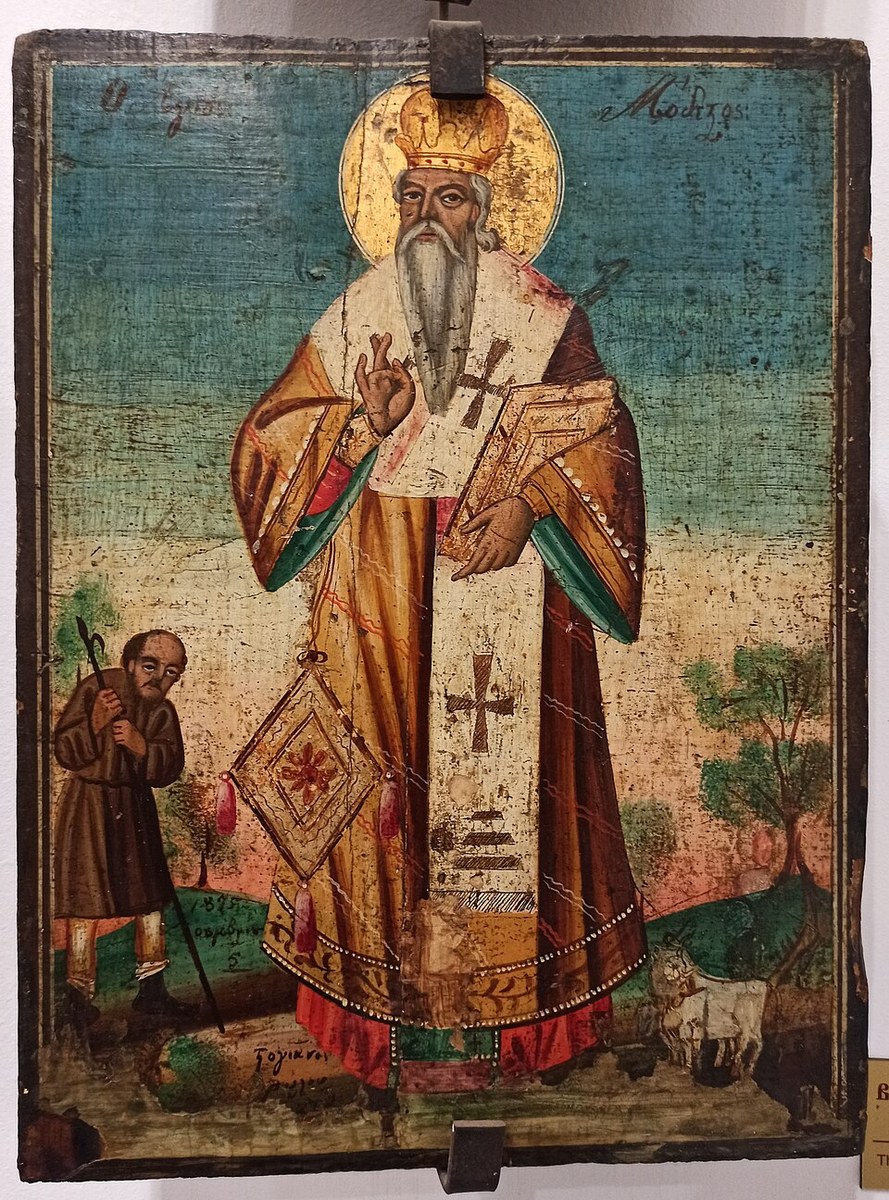
Modestus is depicted as an aged hierarch, white-bearded, in bishop's vesture (omophorion and phelonion), blessing with the right hand and holding a Gospel book or a scroll. Because of his patronage of animals, Greek and Balkan icons and prints frequently place him among oxen, sheep, and other livestock, sometimes with a plough or a farmstead, as the protector of the herds. The stored image is an 1851 Bulgarian icon from Zidarovo (now in the Burgas art gallery), showing him as a hierarch in the traditional manner.
Disputed questions
- Archbishop or Patriarch. Modestus governed the see of Jerusalem first as administrator (locum tenens) during Zachariah's captivity and only afterwards, on Zachariah's death (c. 630), as patriarch in his own right; the calendars style him variously, and both titles are correct of different periods.
- Not to be confused with the martyr Modestus who, with Vitus and Crescentia, is commemorated on June 15 in the West and on May 16 in Slavic and OCA usage — a distinct and earlier saint.