
Ludmila of Bohemia
The Holy Martyr Ludmila, Princess of the Czechs
Martyr · Princess · b. c. 860 — d. 921
Commemorated 16 September — Martyrdom at Tetín
Ludmila (c. 860–921) was the first Christian princess of Bohemia, wife of Bořivoj I, and the grandmother and first teacher of Wenceslaus (Václav), the Czech prince and passion-bearer. Baptized with her husband by Methodius, Archbishop of Moravia and Enlightener of the Slavs, she spent her long widowhood building up the infant Czech Church, and raised her grandson in the faith. In the regency struggle that followed her son's death, her pagan- leaning daughter-in-law Drahomíra had her strangled at her retreat of Tetín on the night of September 15–16, 921. The first martyr of the Czech lands and patroness of Bohemia, she is venerated across the Orthodox world, especially in the Czech and Russian churches, on September 16.
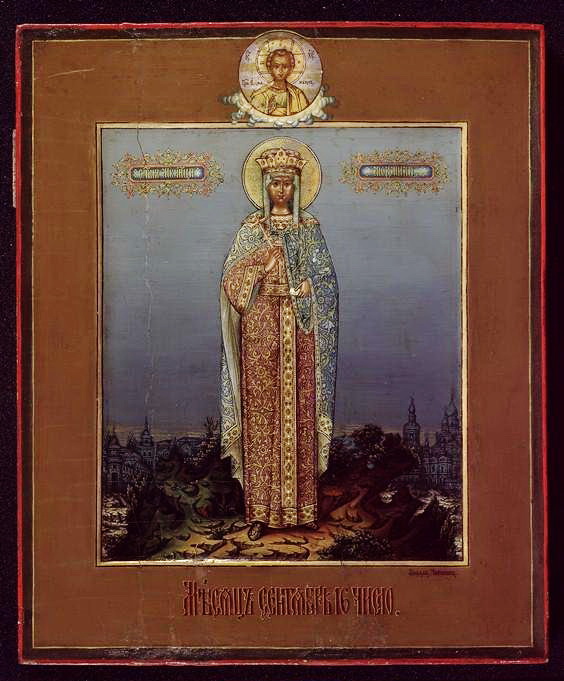
.jpg)
Origins and early life
Ludmila was born about 860, the daughter of Slavibor, a Slavic prince whom the earliest Latin legend makes ruler of the Pšovans, the people of the Mělník country north of Prague (a later strand of the tradition calls him a prince of the Sorbs). Married young to Bořivoj I, first historically attested duke of Bohemia of the house of Přemysl, she shared his conversion: husband and wife were baptized by Methodius, Archbishop of Moravia — Bořivoj at the court of Svatopluk of Moravia (c. 883), Ludmila shortly after — and with baptism came the Slavonic liturgy and clergy of the Cyrillo-Methodian mission into Bohemia. The tradition assigns to their patronage the first churches of the land, at Levý Hradec and at Prague. Before baptism, the Prologue Life says plainly, she had served idols with zeal; after it she served Christ with greater zeal — the pattern her troparion celebrates as morning star of the Czech land.
Widowhood and the raising of Wenceslaus
Bořivoj died young — about thirty-six — leaving Ludmila a widow around the year 889. Through the reigns of her sons Spytihněv (†915) and Vratislav (†921) she lived in prayer, almsgiving and works of mercy, a mother to the poor and a steady patroness of the young church in a land still largely pagan. Vratislav married Drahomíra, of the still-heathen Havolans, and to Ludmila was entrusted the upbringing of their eldest son Wenceslaus: she taught him the faith, and under her roof — from a priest of the Slavonic rite named Paul, a disciple of the Methodian mission — he learned his letters. Whatever Christian formation shaped the future passion-bearer of the Czechs was formed at his grandmother's side.
Martyrdom
When Vratislav died in February 921, Wenceslaus was perhaps eighteen and not yet ruling in his own right; power fell to Drahomíra as regent. Rivalry over the boy and over the direction of the land — the sources speak of a pagan reaction fostered by the regent — hardened into hatred of the dowager princess. Ludmila, seeking peace, withdrew from Prague to the small fortress of Tetín on the Berounka. There, on the night of September 15–16, 921, two retainers of Drahomíra, named in the legends Tunna and Gomon, broke into her chamber as she prayed and strangled her — with her own veil, the tradition says, which became her attribute in art. The legends note the martyr's bitterness of the death she was given: killed without the shedding of blood, she was denied even the martyr's crimson, and the hagiographers answer that her whole life had been the slow martyrdom of mercy.
Relics and translations
Ludmila was buried at Tetín, in the city wall by the church; healings and signs — lights and fragrance at the grave — began at once, to the alarm of Drahomíra, who is said to have built a church over the grave to claim the wonders for herself. When Wenceslaus took power he brought his grandmother home: in 925 her relics were translated to Prague and laid in the basilica of Saint George within the castle, where they rest to this day in the Ludmila chapel. Her formal ecclesiastical veneration was confirmed in the mid-twelfth century, though her cultus at Saint George's — tended by the Benedictine nuns whose abbey adjoined the basilica — is attested much earlier.
Veneration and later cultus
Ludmila is the first saint of the Czech nation and its patroness, invoked especially by grandmothers, mothers and teachers; with Wenceslaus she stands at the head of the Czech heavenly protectors. Her veneration, established well before the schism, belongs to the common inheritance of East and West: the Roman church keeps her on September 16, and the Orthodox Church keeps the same day, with a full proper service in Church Slavonic. Her memory is kept with particular solemnity by the Orthodox Church of the Czech Lands and Slovakia, which honours her as its own protomartyr and celebrated the eleven-hundredth anniversary of her martyrdom in 2021; the Russian Church carries her in its calendar, and the name Lyudmila, spread through the Slavic world by her cultus, remains among the most common of Russian women's names. Portions of her relics have been given in modern times to Orthodox churches, including the Prague Orthodox cathedral of Cyril and Methodius.
Feast and commemoration
September 16 (church date; Old Calendar civil September 29), the day of her martyrdom, within the afterfeast of the Elevation of the Cross — she shares the day with the great-martyr Euphemia. The commemoration is not universal in the Greek books: the printed Greek Menaion and its synaxarion for the day do not carry her. She is kept by the Orthodox Church of the Czech Lands and Slovakia (as a principal national feast), by the Russian Church — whose Menaion appoints her a full service, and whose calendar dates her †927 — and by the OCA; her veneration in other Slavic churches follows the Russian books. The Roman Martyrology keeps the same day. In Czech usage the translation of her relics to Prague (925) is also remembered, on November 10 in the current Catholic calendar of Bohemia; no separate Orthodox feast of the translation is recorded in the calendars consulted.
Hymns
Troparion — Tone 4
Leaving the darkness of idolatry, and with fervent love receiving the light of the Orthodox faith of Christ, thou didst appear, O holy Ludmila, as a star of the morning, and by the light of thy holiness didst begin the true day of the worship of God in the Czech land.
Original translation from the Slavonic
Kontakion — Tone 2
From heaven didst thou receive the love of God, and therefore wast thou slain by thine own kin, O most radiant Ludmila; pray for us all who with faith honour thee.
Original translation from the Slavonic
Iconography
Ludmila is depicted as a princess in mantle and headcloth — in Orthodox icons usually crowned, in the Western tradition often in a widow's white veil — holding the martyr's cross; her distinctive attribute is the veil or scarf of her strangling, shown about her neck or in her hand. She appears constantly beside her grandson Wenceslaus, whom she sometimes shelters under her mantle; the murder at Tetín is pictured in Bohemian manuscripts from the fourteenth century (the Dalimil Chronicle, the Velislav Bible). The stored icon is a Russian menaion icon for September 16 painted by Osip Chirikov in 1893–1894 (State Museum of the History of Religion, Saint Petersburg): the crowned princess stands full-length in richly ornamented robes, a cross in her hand, Christ blessing from heaven above, with the inscription "the month of September, the 16th day."
Disputed questions
- Year of death. The Czech tradition and modern scholarship place the murder on the night of September 15–16, 921 — consistent with the translation of her relics under Wenceslaus in 925. The Russian calendars and the OCA give 927, an older reckoning still printed in the Slavic service books. The feast day itself, September 16, is common to all.
- Her father's people. The oldest Latin legend (Fuit in provincia Boemorum) makes Slavibor prince of the Pšovans of Mělník; the Church Slavonic Prologue Life calls Ludmila "daughter of a Serbian (Sorbian) prince." Both transmissions are recorded.
- Her age at death is given as sixty-one in the older literature (fitting a birth c. 860); the sources do not state it directly.