
Xenophon of Robeika
Our Venerable Father Xenophon, Abbot of Robeika
Venerable · d. 1262
Commemorated 26 January — Commemoration on the day of his name, 28 June — Repose
Xenophon of Robeika (died 1262) was a Russian monastic of the Novgorod tradition, a disciple of the school of Varlaam of Khutyn who, after serving as abbot of the great Khutyn monastery, withdrew to seek a stricter solitude and founded a monastery of Saint Nicholas on the Robeika river, some miles from Novgorod. He is venerated as the founder-abbot of that house and is commemorated among the saints of Novgorod. His feast is kept on January 26 (the day of his name, shared with the ancient Xenophon of Constantinople) and his repose on June 28.

Xenophon belonged to the flowering of monasticism around Novgorod in the generations after Varlaam of Khutyn (†1192, kept November 6). The tradition makes him a disciple of that school — tonsured, the accounts say, under an abbot Varlaam at a Novgorod monastery — who rose to become abbot of the Khutyn monastery itself, the chief of Varlaam's foundations. Seeking a life hidden from honour and closer to the solitude of the first monks, he laid down his office and withdrew to the banks of the little Robeika river, north-east of Novgorod, where he built a monastery dedicated to Saint Nicholas and gathered a small brotherhood. There he ended his days in ascetic labour, and reposed in 1262; his relics rested in the church of his own foundation, and he was venerated locally as its holy founder and among the saints of the Novgorod land.
Feast and commemoration
Xenophon is commemorated on January 26 (church date; Old Calendar civil February 8) — the day of his patronal name, shared with the elder Xenophon — and his repose is kept on June 28 (Old Calendar civil July 11); he is also honoured in the synaxis of the Saints of Novgorod. His veneration is Russian and local to the Novgorod land.
Iconography
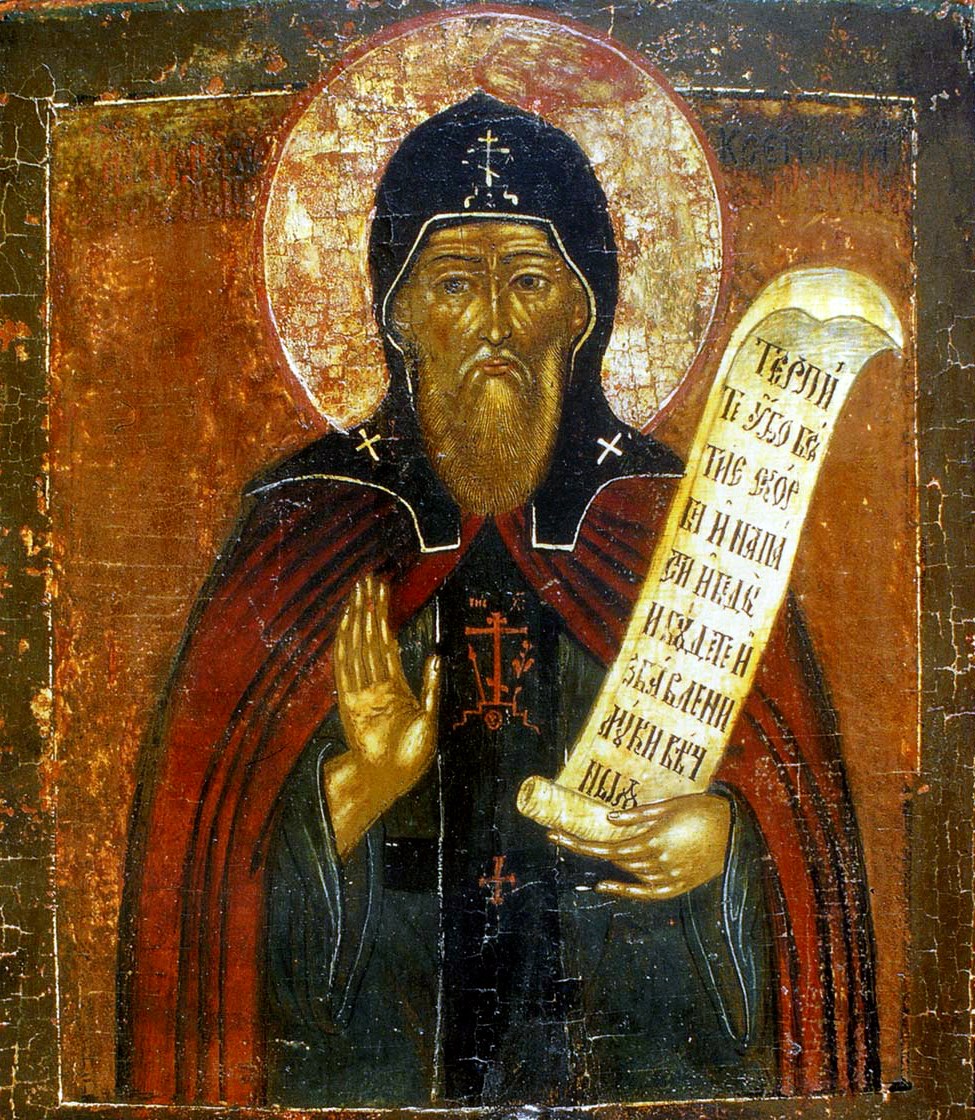
Xenophon is depicted in the manner of the Russian venerable founders: an aged monk in the schema, with a long grey beard, holding a scroll, and often shown with the church of his Robeika monastery in the background or in his hand as its founder. The stored image is a 17th-century Russian icon of the venerable founder.
Disputed questions
- The chronology and the master. The Life makes Xenophon a direct disciple of an abbot Varlaam, and later hagiographers took this to be Varlaam of Khutyn himself; but Varlaam of Khutyn reposed in 1192, and a death for Xenophon in 1262 leaves a gap the direct discipleship strains to bridge. Historians accordingly suspect a conflation of more than one Varlaam of the Novgorod monasteries across the intervening generations. The saint's own veneration at Robeika is secure; the details of his early formation are transmitted with the uncertainty of much early-Russian hagiography, and are given here as received.
- Not to be confused with the ancient Xenophon of Constantinople (6th century), kept the same day, January 26 — the senator whose whole family embraced monasticism. The two share only the name and the feast; this Xenophon is the thirteenth-century Russian abbot of Robeika.