
Xenophon and Mary and their sons Arcadius and John
Our Venerable Fathers Xenophon and Mary and their Sons Arcadius and John
Venerable · d. 6th century
Commemorated 26 January — Repose of the whole family in the monastic life
Xenophon and his wife Mary were a wealthy and devout senatorial couple of Constantinople in the reign of Justin I and Justinian (early sixth century) whose whole household was sanctified. They sent their two sons, Arcadius and John, to Berytus (Beirut) to study law; on the voyage the ship was wrecked, and the brothers, cast ashore separately and each believing the other and their parents drowned, both renounced the world and became monks in the Holy Land without knowing the other had survived. When after long silence the grieving parents came on pilgrimage to Jerusalem to learn their sons' fate, the family was reunited — the boys living as ascetics — and Xenophon and Mary in their turn gave away their fortune to the poor and received the monastic habit, so that all four ended their lives in the desert, adorned with the gift of wonders. They are kept together on January 26 as a beloved image of a whole family made holy.
.jpg)
Origins: a noble house of the reigning City
Xenophon belonged to the senatorial aristocracy of Constantinople, in the years of the emperors Justin I (518–527) and Justinian (527–565). He was a man of great wealth and rank, and — what the tradition dwells on far more than his fortune — of a piety equal to it: he and his wife Mary used their riches in the fear of God, giving generously to the poor, keeping their household in temperance and prayer, and raising their two sons in the Scriptures and the faith. The synaxaria present the couple as the very type of Christian nobility, holding their possessions loosely, "as though not possessing," and living in the world without being of it. This inward detachment is the hinge of the whole story: when God asked everything of them, they were already free enough to give it.
The sons sent to Berytus, and the shipwreck
When Arcadius and John had grown, their father sent them, as was the custom of noble Constantinopolitan families, to complete their education in law at Berytus (Beirut), the celebrated Roman law-school of the Eastern Mediterranean. The brothers took ship together. On the voyage a violent storm arose and the vessel was wrecked; the ship broke apart, and the two young men, separated in the sea, each caught hold of a spar or plank and were carried, at different points and unknown to each other, to the shore. Each came safe to land alone — and each, believing his brother drowned and unwilling to return to a world that now seemed to him only shipwreck and loss, resolved to give the life God had spared him back to God. Independently, in different monasteries of Palestine, Arcadius and John each received the monastic tonsure, neither knowing that the other lived, and each supposing himself the sole survivor and his family plunged into mourning.
The parents' search, and the reunion at Jerusalem
At Constantinople the silence lengthened. Hearing at last from travellers of the loss of the ship, Xenophon and Mary were pierced with grief for their sons, yet — the account is careful to say — they did not despair or accuse God, but bowed to his will, saying with Job, "The Lord gave, and the Lord hath taken away." In time Xenophon fell gravely ill, and in his sickness, or by the counsel of a holy elder, the couple resolved to go up to Jerusalem on pilgrimage, to pray at the holy places for the souls of their children and to commit their own end to God.
There, in the Holy City, God gathered the scattered household. The tradition tells it with the delight of a recognition-scene: through a discerning elder (in some tellings a monk of the desert to whom the family's story was revealed), the parents learned that their sons were not dead but living — and living as monks; and the four were brought face to face. Arcadius and John, who had each mourned the other as lost, found each other alive; and both found the parents they had believed inconsolable at home standing before them as pilgrims. The reunion turned at once into a common resolve.
The whole family in the monastic life
Moved by what God had done, and by the vocation their sons had already embraced, Xenophon and Mary distributed the whole of their great wealth — freeing their servants and giving to the poor and to the churches and monasteries — and themselves received the monastic habit, Xenophon among the fathers of the desert and Mary in a community of nuns. The two brothers returned to their cells. And so a single senatorial family of the capital was wholly given over to God: father, mother, and both sons, each in the ascetic life. The account adds that they advanced so far in humility, prayer, and purity of heart that God granted them the gift of wonders, healing the sick and foreseeing things to come; and that all four, having run their course, reposed in peace, in the sixth century, and were numbered among the saints. Their memory has been kept ever since as one of the Church's clearest pictures of a household entirely sanctified — the point the day's hymnody returns to again and again, hailing them as a "fourfold choir" of the venerable.
Feast and commemoration
The family is commemorated together on January 26 (church date; Old Calendar civil February 8), which the tradition keeps as the day of their repose. They are honoured as a unit — "Xenophon and his companions," or "Xenophon, Mary, Arcadius and John" — and the Greek, Slavic, and Antiochian calendars agree on the day. The office is that of venerable monastics: the Menaion appoints a proper apolytikion and the traditional kontakion given below, sung with the stichera of the day, and at the Liturgy the readings of the common of venerable ascetics. On the same day the Church keeps the translation of the relics of Theodore the Studite and other saints; among these Xenophon and his household stand as the day's image of the sanctified home.
Hymns
Troparion — Tone 4
As a generation blessed of the Lord, ye were counted worthy of the glory of heaven, having glorified Christ upon the earth by the ascetic life: Xenophon the venerable and his wife, together with their holy and valiant children. Praising them, let us cry aloud with gladness: Rejoice, O fourfold choir of the saints!
Original translation from the Greek
Kontakion — Tone 4
Having fled the sea of this passing life, righteous Xenophon, with his honoured wife, rejoices now in the heavens together with their children, magnifying Christ.
Original translation from the Greek
Iconography
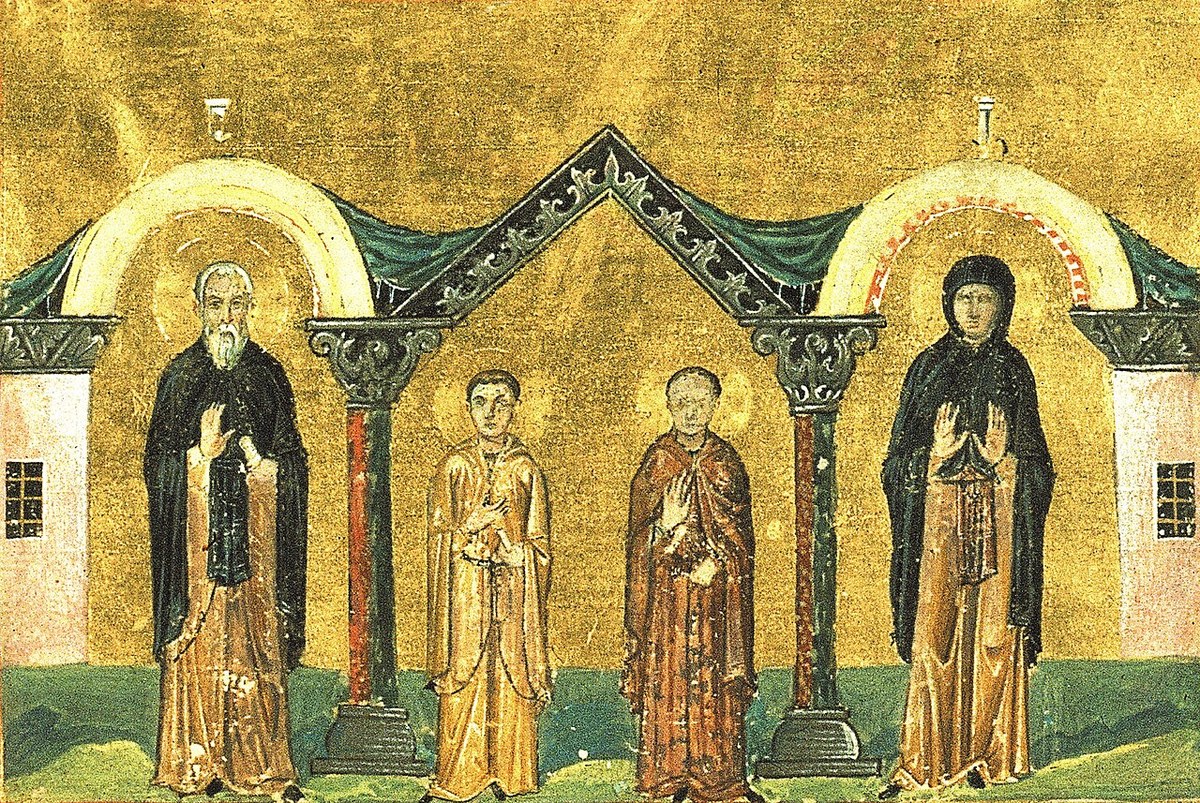
The family is depicted together, as befits a group commemoration: Xenophon and Mary as an aged monk and nun in dark habits, and the two sons Arcadius and John as younger monastics, the four ranged in a row or grouped as a household — sometimes with the scene of the shipwreck, the broken ship and the two youths in the waves, set below or beside the portrait to tell the story. The stored image is the miniature for January 26 from the Menologion of Basil II (Constantinople, c. 985; Vatican, Vat. gr. 1613), which shows the four saints standing together as a family of monastics (source, public domain, pd-old-work).
Disputed questions
- The date. The Greek synaxarion and the received Life place the family under Justin I and Justinian, that is in the earlier sixth century, and this entry follows that dating (repose "6th century"). Some calendars and the OCA synaxarion describe them more loosely as of the fifth century; the difference turns on whether their monastic years are set before or after the turn of the century, and no firm chronology survives. What is constant is the reign-of-Justinian setting and the sixth-century world of the great Palestinian monasteries into which the sons entered.
- A single tradition, richly retold. The narrative is transmitted essentially as a hagiographical récit — a story shaped to be told — and its vivid particulars (the plank in the storm, the elder's revelation, the recognition at Jerusalem) belong to that genre. The entry gives the tradition as the Church has received and loved it, without pressing its details as documented biography.
- Not to be confused with Xenophon of Robeika (†1262, kept the same day, January 26), the Russian abbot and disciple of the Novgorod tradition of Varlaam of Khutyn — a wholly different saint of a far later age who shares only the name and the feast.