
Zosimas of Babylon
Our Venerable Father Zosimas, Bishop of Babylon in Egypt
Venerable · Bishop · d. 5th–6th century
Commemorated 4 June — Repose in peace on Mount Sinai
Zosimas was a Cilician who left the world in his youth for Mount Sinai, withdrew from there to a still more solitary place in Lebanon, and was told by an aged ascetic whom he met that he would one day be a bishop in Babylon. Returning to Sinai, he was sent on business to Alexandria, and the Patriarch of Alexandria made him bishop of Babylon in Egypt — the fortress-town at the head of the Delta, in the district that became Old Cairo — where he governed his flock wisely into old age. Feeling his death approach, he returned to Sinai and reposed there in peace. He is commemorated on June 4.
_-_%D0%B8%D0%BA%D0%BE%D0%BD%D0%B0_10043_%D0%97%D0%BE%D1%81%D0%B8%D0%BC%D0%B0.png)
Cilicia and Sinai
Zosimas was born in Cilicia, in the south-east of Asia Minor, and while still a youth "left the world" — the synaxarion's formula for monastic profession — and settled on Mount Sinai. The great monastery of the Burning Bush at the foot of the mountain, refounded by Justinian in the sixth century on the site of older cells, was in his lifetime the most famous solitary place in the Christian East after the Egyptian deserts, and the community there was international: Cilicians, Syrians, Egyptians, Armenians, Latins. Zosimas belongs to it, and to it he returned to die.
From Sinai he withdrew to a place of yet greater solitude in Lebanon, seeking to be still more hidden. The account gives no length of time and no details of the ascetic regime — nothing of the kind survives — but the pattern is a recognisable one: the monastery, then the further withdrawal, then the return.
The prophecy
In Lebanon he met an aged ascetic who told him what he could not have wished to hear: that he would be bishop in Babylon. The prophecy is the whole armature of the Life; everything after it is its fulfilment, and it is told in the manner of the Egyptian and Sinaite Lives, in which an unnamed elder appears once and speaks once.
Zosimas returned to Sinai. Some time afterwards the community sent him to Alexandria on an errand of the monastery's business — the Sinai monks depended on the Egyptian patriarchate and travelled to it constantly. There the Patriarch of Alexandria — the account does not name him — consecrated him bishop of Babylon.
Bishop of Babylon in Egypt
The Babylon of this Life is not the Babylon of Mesopotamia. It is Babylon of Egypt, the old fortified town at the apex of the Nile Delta on the eastern bank, a Roman legionary station that grew into the Christian centre around which Old Cairo later formed, and a see under the Patriarch of Alexandria. That the Patriarch of Alexandria consecrated him settles the geography; the English calendars that render him "bishop of Babylon" without qualification have sometimes caused him to be imagined in Persia or Chaldaea, and the better lists say plainly "bishop of Babylon in Egypt."
Of his episcopate the record says only that he shepherded his flock wisely into great old age. No act, no controversy, no building and no council is attached to his name; he belongs to the large class of bishop-ascetics whom the synaxaria honour for the manner rather than the events of their rule.
Return to Sinai and repose
When he perceived that his death was near, Zosimas left his see and went back to Sinai, to the place of his monastic beginning, and there fell asleep in the Lord in peace. The gesture — the bishop laying down the city to die in the desert he had left for it — is the point of the Life, and it is why the calendars class him among the venerable and not simply among the hierarchs.
The century is not certainly transmitted: the jurisdictional lives give the fifth century, the English synaxarial lists the sixth. This repository indexes him under the sixth while recording the disagreement.
Feast and commemoration
June 4 (church date; New Calendar civil June 4, Old Calendar civil June 17), kept with Saint Metrophanes of Constantinople. He shares the day with the Egyptian ascetic Alonius of Scetis, so that June 4 carries two commemorations of the Egyptian and Sinaite desert. Zosimas has no proper service and is commemorated with the common of a venerable father; he is kept in the Greek and Slavonic synaxaria and, through the Russian Lives, in the Russian and American calendars. Sinai, where he died, and the Coptic-Egyptian memory of the see of Babylon are the two places to which his cultus attaches.
Hymns
Apolytikion — Tone 8 (common of a venerable father)
By the streams of thy tears thou didst make the barren desert to bring forth; and by thy sighing from the depths thou didst bear fruit a hundredfold in labours; and thou wast a beacon to the whole world, shining with miracles, O Zosimas our father. Intercede with Christ God that our souls may be saved.
Iconography
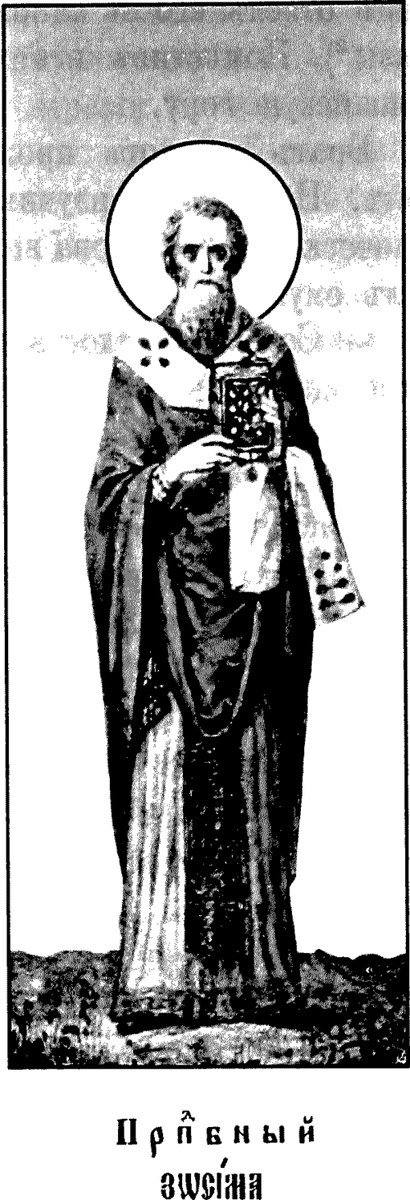
Zosimas is painted in a type that holds both halves of his life together: an aged monk-bishop, white-bearded and gaunt, wearing the omophorion of a bishop over monastic dress rather than the full hierarchical vesture, holding the Gospel and blessing, or holding a scroll. Where his ascetic identity is emphasised he is given the cowl of the great schema; where his office is, the phelonion. He is not shown with any instrument or scene, no episode of his life having entered the pictorial repertory; his place is among the venerable fathers of the calendar rows and, occasionally, among the Sinai saints.
The stored image is the plate of Saint Zosimas from the illustrated pre-1911 Russian Lives of the Saints compiled after the Menaia of Saint Dimitri of Rostov — the third of the three figures given for June 4 in the June volume, and captioned in Slavonic Прпⷣбный Зѡсі́ма, "Venerable Zosimas." It shows the saint standing full-length, elderly and balding with a long grey beard, in the dark phelonion with the crossed omophorion over it and a white epitrachelion and cuffs, holding the jewelled Gospel-book before him in both hands: the monk-bishop type exactly as described.
Disputed questions
- Not to be confused with Zosimas of Cilicia, the desert-dweller and venerable-martyr commemorated on September 19 (and January 4) — the single most likely confusion of the two, since both are Cilicians named Zosimas who lived as hermits. They are distinct: the September saint was a hermit of the Cilician wilderness who was seized under the governor Dometian, tortured, and died a martyr in the fourth century; the June saint left Cilicia for Sinai, was made a bishop in Egypt, and reposed in peace. One is a venerable-martyr, the other a venerable bishop.
- Not to be confused with the many other Zosimases of the calendar: Zosimas of Solovki (April 17), the abbot; Zosimas of Palestine (April 4), who communicated Mary of Egypt; Zosimas of Phoenicia (†c. 560); or the martyrs Zosimas of Antioch, of Apollonia and of Cilicia's Anazarbus. The name is among the commonest in the synaxaria and the epithet must always be carried with it.
- Century. Fifth or sixth; see above.
- Babylon. Egyptian, not Mesopotamian; see above.