
Zosimas of Cilicia
The Holy Venerable-Martyr Zosimas the Desert-dweller of Cilicia
Venerable Martyr
Commemorated 4 January — With Athanasius the Commentarisius (Greek and Russian tradition), 19 September — Martyrdom under the governor Dometian
Zosimas of Cilicia (4th century) was a Christian hermit who lived among the wild beasts of the Cilician wilderness, having fled the cities of the persecutors. Discovered at his ease among the animals by Dometian, governor of Cilicia, while the governor was hunting, he confessed himself a Christian and was put to fierce tortures: hung head downwards with a stone at his neck and torn with iron hooks. Challenged to prove his God by summoning one of the beasts that obeyed him, he prayed, and a lion came and bore up the stone with its paw. The terrified governor ordered him released to be sent to the emperor, but the old man immediately gave up his soul to God.
.jpg)
Ascetic struggle
The whole record of Zosimas is a synaxarion notice, transmitted in two connected forms. He lived in the fourth century, a Christian who had withdrawn from the world into the wilderness of Cilicia — the accounts give no city of origin — saying, when he was later questioned, that he could not live in the cities among the enemies of the Lord Jesus Christ, and therefore lived alone among the wild animals. The beasts, the tradition insists, kept him company tamely: the image of the old man conversing peaceably with them is the fixed centre of his memory.
Martyrdom
Dometian, the governor of Cilicia, came upon the elder while hunting: the hunters saw the beasts gathered calmly around him, and the animals fled at their approach. Interrogated on the spot — who was he, and why did he live in the desert — Zosimas answered that he was a Christian named Zosimas, and gave the reason above. Dometian threatened him: if he honoured the Nazarene, he would be given over publicly to torture, and would deny Christ. Asked by what sorcery he tamed the wild beasts, he would answer only: "I am a Christian."
The tortures were carried out in the city (given as "Nazareth" in the received notice — see below). The old man was hung head downwards with a great stone tied to his neck, and his body was raked with iron hooks. His tormentors mocked him: if the beasts obeyed him, let him call one, and they would believe in his God. Zosimas prayed, and a huge lion came into the midst; the crowd fled in terror, and the lion went to the elder and with its paw bore up the stone at his neck to ease his suffering. The governor, begging the martyr to keep the beast quiet, ordered him untied so that he might be sent to the emperor; but Zosimas, his contest complete, immediately surrendered his soul to God.
The January transmission: Athanasius the Commentarisius
The Greek synaxaria and the Russian calendar also keep, on January 4, the memory of "Zosimas the hermit and Athanasius the Commentarisius" — the same Cilician story carried one step further. In that transmission Athanasius, the commentarisius (keeper of the prison), seeing the miracle of the lion, confessed Christ; the two are then said to have withdrawn together into the Cilician mountains and to have ended their lives in asceticism, the tradition relating that a cleft of the rock received them. The Russian calendar treats the September and January commemorations expressly as one saint, styling him venerable-martyr on both days; the tension between the two endings — death under torture in September, repose in the wilderness in January — is left standing in the sources, and is recorded below rather than resolved.
Feast and commemoration
September 19 (church date; Old Calendar civil October 2), within the afterfeast of the Elevation of the Cross, on which day the OCA and the Moscow Patriarchate calendar both carry him (verified live); the received Greek Menaion's service for the day is of the feast and of the martyrs Trophimus, Sabbatius and Dorymedon only, Zosimas being a synaxarion commemoration. The joint commemoration with Athanasius the Commentarisius on January 4 (Old Calendar civil January 17) is kept in the Greek synaxaria and the Russian calendar; Athanasius, who has no separate September memory, is to be authored with the January day.
Hymns
Troparion — Tone 4 (from the common of martyrs)
Thy martyr Zosimas, O Lord, in his contest received the incorruptible crown from thee, our God; for possessing thy strength he cast down the tyrants and broke the feeble insolence of the demons. By his prayers, O Christ God, save our souls.
Original translation from the Greek
Iconography
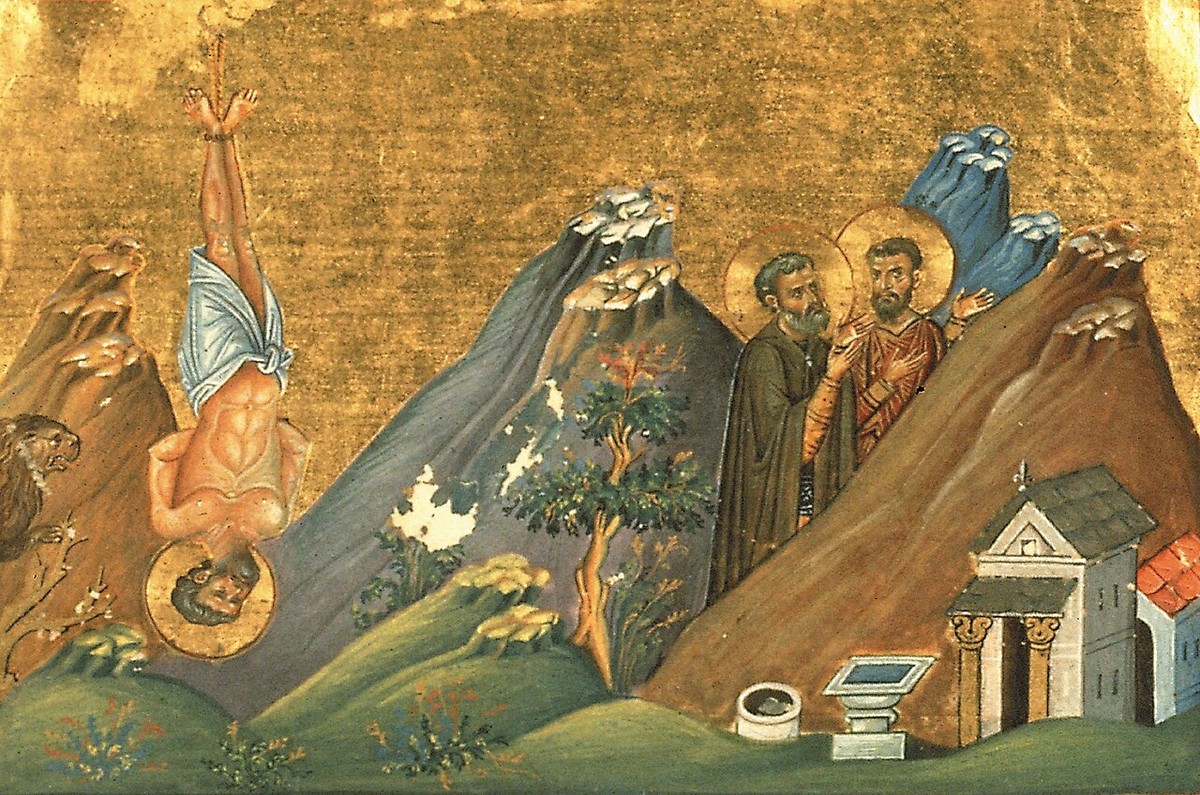
Zosimas is painted as an aged hermit, and the scene of his passion — the elder hung head downwards with the stone at his neck, the lion beneath — identifies him at once. The stored image is the miniature of the Menologion of Basil II (Constantinople, c. 985; Vat. gr. 1613), painted for the joint commemoration with Athanasius: at the left the martyr hangs head downwards from the rock with the lion approaching; at the right the two anchorites, Zosimas in the monastic mantle and Athanasius beside him, stand in prayer among the Cilician mountains before a church.
Disputed questions
- "Sicily" and "Nazareth." The OCA's English notice makes Dometian "the governor of Sicily"; the Russian text it renders reads Cilicia (правитель Киликии), as do the saint's own style and the Greek tradition — the English "Sicily" is a translation slip, recorded here because it is widely copied. The city of the tortures is given as "Nazareth" in the Russo-Slavic notice, chosen or preserved for the pun in the governor's threat ("if you honour the Nazarene, in Nazareth I shall torture you"); a Galilean venue sits oddly in a Cilician story governed by a Cilician governor, and it may be suspected that a Cilician toponym (Anazarbus, the metropolis of Cilicia Secunda, has an assonant name) lies garbled beneath it. This entry asserts only the Cilician setting.
- Martyr or venerable-martyr; one ending or two. The OCA styles him simply "Martyr Zosimas the Hermit"; the Russian calendar styles him venerable-martyr (преподобномученик), which this entry follows, since the ascetic life is the substance of his story. The September notice has him die under torture; the January notice, with Athanasius, has the two withdraw and repose in the wilderness. Both are transmitted of the same figure and neither can be preferred on the surviving evidence.
- Date. No year is transmitted; the fourth-century placement is that of the calendars, and the persecution setting would suit its opening years.
- Not to be confused, above all, with Zosimas of Babylon (June 4) — the confusion most likely to occur, since that saint too was a Cilician who lived as a hermit. They are distinct: this Zosimas was a hermit of the Cilician wilderness, seized under the governor Dometian and crowned a venerable-martyr in the fourth century; the June saint left Cilicia in youth for Mount Sinai, was made bishop of Babylon in Egypt by the Patriarch of Alexandria, and reposed in peace on Sinai.
- Not to be confused with the other hermits Zosimas of the calendar: Zosimas of Palestine (April 4), who communed Mary of Egypt; Zosimas of Solovki (April 17); or Zosimas, bishop of Syracuse (March 30). Forward slugs for these will need their own epithets.
- Not to be confused with Zosimas the Soldier (June 19), the martyr of Apollonia in Thrace who left the army, was baptised, and was beheaded at Antioch of Pisidia under Trajan in the early second century. The resemblance is real — both are martyrs named Zosimas whose whole record is a synaxarion notice, and both die under interrogation by a provincial governor — but the passions share no incident: the soldier's torments are the heated copper bed and the nailed iron sandals, and no beast appears in his story. The Menologion of Basil II miniature stored with this entry depicts the Cilician hermit and must not be reused for him.