
Apostles' Fast, day 4
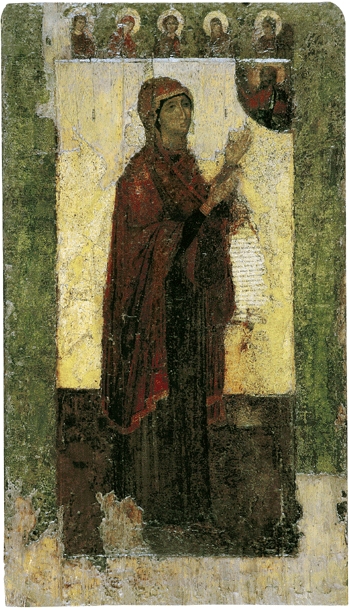
About Bogolyubskaya Icon of the Mother of God →

Saints commemorated
-
Saint of the day
Martyr Leontius and Companions
-
Aetherius of Nicomedia
Aetherius is a martyr of the Diocletianic persecution, kept on June 18 in the Greek and Slavonic books beside the martyrs of Tripoli. Of his life the synaxarion transmits nothing but the fact of his constancy: arrested, offered the usual mixture of threats and promises, and then beaten, scourged and left bleeding, he would not yield, and died faithful. His name — from αἰθήρ, the upper air — supplied the hagiographer with the one thing the notice really contains: the couplet of the day says that he endured many torments and received their reward in the breadth of the aether.
-
Hypatius and Theodulus
Hypatius, a tribune, and Theodulus, a soldier under him, were sent by the governor Hadrian to arrest the Christian officer Leontius at Tripoli in Phoenicia, and were converted on the road: Hypatius, struck down by fever, was healed after calling three times on "the God of Leontius" as an angel had told him in his sleep, and Theodulus was won by what he had watched. They came into the city as catechumens instead of captors, were baptised by the man they had come to seize, and when Hadrian tried them refused to sacrifice. Hypatius was torn with the iron claws and Theodulus beaten with rods; both were then beheaded, dying before Leontius, who was beaten to death after them.
-
Leontius of the Kiev Caves
Leontius, called the Canonarch, was a boy or very young monk of the Kiev Caves Lavra in the fourteenth century who was given the office of canonarch — the singer who intones the verses and gives out the tone for the choirs — because of the unusual beauty of his voice. He was taught the Scriptures, kept the office faithfully, and died young. His relics rest in the Far (Theodosian) Caves, and he is commemorated on June 18, the day of his heavenly patron Leontius of Tripoli, and with the fathers of the Far Caves on August 28.
-
Leontius of Tripoli
Leontius, a Greek by birth and an officer of the Roman army stationed at Tripoli in Phoenicia — the coastal city that is now Ṭarābulus in Lebanon, and to this day a metropolitan see of the Patriarchate of Antioch — is the great soldier-martyr of the Antiochian patriarchal territory. The Passion makes him a commander of exemplary courage and open-handed charity who turned many of the city from idols; the governor Hadrian, sent to suppress the Christians, dispatched the tribune Hypatius and the soldier Theodulus to arrest him, and they were converted on the road and baptised by his hand. All three were tortured; Hypatius and Theodulus were beheaded, and Leontius, hung up with a stone about his neck and beaten, gave up his soul under the blows. His martyrion at Tripoli became one of the notable shrines of the Phoenician coast: it was there, in 488, that the future patriarch Severus of Antioch was baptised.
-
Leontius the Athonite
Leontius, born at Argos in the Peloponnese in 1520, took the monastic habit at seventeen in a hermitage of the Argolid, and after the Turkish capture of Nauplion in 1540 crossed to the Holy Mountain and entered the Monastery of Dionysiou. There he remained for sixty years without once passing outside the monastery's gate — the detail on which his whole tradition turns — and there he was given the gifts of discernment and of prophecy. He reposed on 16 March 1605, aged eighty-five; his relics streamed myrrh, from which he is called Myroblytes, the Myrrh-streamer. He is commemorated on June 18, the day of his patron the martyr Leontius of Tripoli.
-
Leontius the Shepherd
A monk called Leontius the Shepherd, commemorated in the Greek books on June 18 — the fourth Leontius of a day that is crowded with them — of whom the synaxarion records only that he reposed in peace. The Greek heading places his monastery or cell beyond the city (πέραν τοῦ ἄστεος), and the couplet of the day plays his epithet against the Chief Shepherd before whom he now stands: being a shepherd, thou standest now before the Shepherd, before the Chief of shepherds, O right-minded Leontius.
-
Two Martyrs of Cyprus
Two Christians of Cyprus, whose names have not been transmitted, are commemorated on June 18. All that the synaxarion records of them is the manner of their death: their feet were burned, and they were perfected. The metrical couplet of the day sets the brevity of the torment against the length of its reward — having endured the burning of their feet for a single hour, the two martyrs rejoice eternally — and that antithesis is, in effect, the whole of what the Church has kept about them.
Troparia & kontakia
Apolytikion — Tone 4
Thy martyr Aetherius, O Lord, in his striving has received from Thee our God the crown that does not wither; for holding fast Thy might he threw down the tyrants, and shattered the feeble insolence of the demons. At his entreaties save our souls.
Apolytikion — Tone 4
O ye who bore the sword of the emperor and were found bearing the cross of Christ, Hypatius and Theodulus, ye came to bind a martyr and were loosed by him; and being washed in the rain of heaven ye were made worthy of the crown. Entreat the merciful God to grant our souls forgiveness of sins.
Apolytikion — Tone 8
In thee, O Father, was preserved unimpaired that which is according to the image; for taking up the cross thou didst follow after Christ, and by thy deeds thou didst teach us to overlook the flesh, which passes away, and to attend to the soul, which is a thing immortal. Wherefore, O venerable Leontius, thy spirit rejoices with the angels.
Apolytikion — Tone 4
Thy martyr Leontius, O Lord, in his striving has received from Thee our God the crown that does not wither; for holding fast Thy might he threw down the tyrants, and shattered the feeble insolence of the demons. At his entreaties save our souls.
Apolytikion — Tone 8
In thee, O Father, was preserved unimpaired that which is according to the image; for taking up the cross thou didst follow after Christ, and by thy deeds thou didst teach us to overlook the flesh, which passes away, and to attend to the soul, which is a thing immortal. Wherefore, O venerable Leontius, thy spirit rejoices with the angels.
Apolytikion — Tone 8
In thee, O Father, was preserved unimpaired that which is according to the image; for taking up the cross thou didst follow after Christ, and by thy deeds thou didst teach us to overlook the flesh, which passes away, and to attend to the soul, which is a thing immortal. Wherefore, O venerable Leontius, thy spirit rejoices with the angels.
Apolytikion — Tone 4
The fire that was set beneath your feet, O blessed pair, could hold you but an hour, and could not turn you back one step from Christ; wherefore, having run the short course, ye have entered into the rest that has no end. O holy martyrs of Cyprus, entreat the merciful God to grant our souls forgiveness of sins.
Kontakion — Tone 3
Thou didst appear standing to the God-loving prince, holding in thy hand the writing of thy prayer for the world, and thou didst choose thyself a dwelling in this land; wherefore we cry to thee: as thou didst stay the plague and the sword, so stay every evil from us who honour thine image, O Mother of God who lovest mankind.
Kontakion — Tone 3
The soldier of the earthly king was found a soldier of the King of heaven, and the body that was beaten became an anvil on which no stroke could tell; wherefore Tripoli holds thy grave in honour, O Leontius, and the faithful cry to thee: pray that our souls may be saved.
Troparion — Tone 1
All-hymned and most glorious Queen, Mother of God, receive this hymn of praise from thine unworthy servants, and cease not to pray to thy Son and our God for the city and for the people that hope in thee, but be a wall of defence and a shelter, granting to the faithful peace and great mercy.
Readings
Epistle
Romans 5.10-16
10For if, when we were enemies, we were reconciled to God by the death of his Son, much more, being reconciled, we shall be saved by his life. 11And not only so, but we also joy in God through our Lord Jesus Christ, by whom we have now received the atonement. 12Wherefore, as by one man sin entered into the world, and death by sin; and so death passed upon all men, for that all have sinned: 13(For until the law sin was in the world: but sin is not imputed when there is no law. 14Nevertheless death reigned from Adam to Moses, even over them that had not sinned after the similitude of Adam’s transgression, who is the figure of him that was to come. 15But not as the offence, so also is the free gift. For if through the offence of one many be dead, much more the grace of God, and the gift by grace, which is by one man, Jesus Christ, hath abounded unto many. 16And not as it was by one that sinned, so is the gift: for the judgment was by one to condemnation, but the free gift is of many offences unto justification.
Gospel
Matthew 8.23-27
23And when he was entered into a ship, his disciples followed him. 24And, behold, there arose a great tempest in the sea, insomuch that the ship was covered with the waves: but he was asleep. 25And his disciples came to him, and awoke him, saying, Lord, save us: we perish. 26And he saith unto them, Why are ye fearful, O ye of little faith? Then he arose, and rebuked the winds and the sea; and there was a great calm. 27But the men marvelled, saying, What manner of man is this, that even the winds and the sea obey him!