
Leontius of Tripoli
The Holy Martyr Leontius the Soldier, who suffered at Tripoli in Phoenicia
Martyr · d. traditionally c. 73, under Vespasian; the cult is securely attested from the fifth century
Commemorated 18 June — Martyrdom at Tripoli in Phoenicia; kept with Hypatius and Theodulus
Leontius, a Greek by birth and an officer of the Roman army stationed at Tripoli in Phoenicia — the coastal city that is now Ṭarābulus in Lebanon, and to this day a metropolitan see of the Patriarchate of Antioch — is the great soldier-martyr of the Antiochian patriarchal territory. The Passion makes him a commander of exemplary courage and open-handed charity who turned many of the city from idols; the governor Hadrian, sent to suppress the Christians, dispatched the tribune Hypatius and the soldier Theodulus to arrest him, and they were converted on the road and baptised by his hand. All three were tortured; Hypatius and Theodulus were beheaded, and Leontius, hung up with a stone about his neck and beaten, gave up his soul under the blows. His martyrion at Tripoli became one of the notable shrines of the Phoenician coast: it was there, in 488, that the future patriarch Severus of Antioch was baptised.
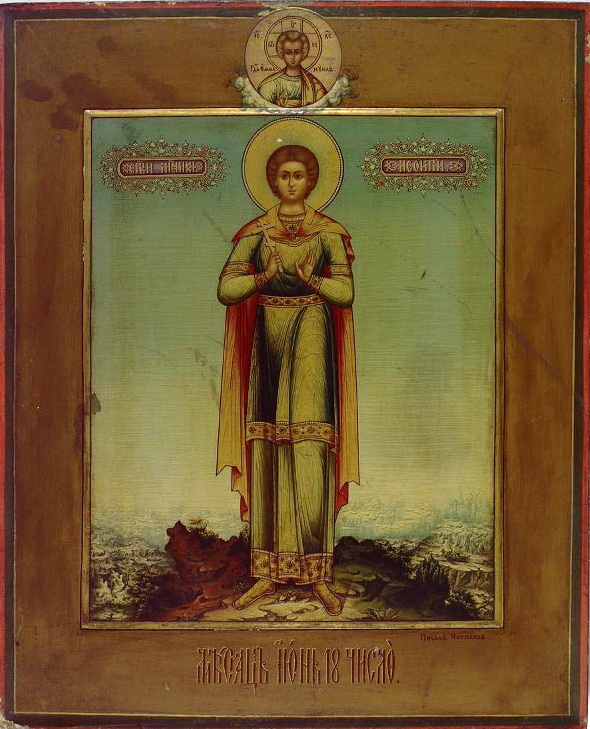
_by_O.Chirikov_(Muz.ist.relig).jpg)
A Greek officer on the Phoenician coast
The transmitted Passion presents Leontius as Greek by descent — the Greek notices say of Hellas, and one branch of the tradition names Aegina — who rose in the imperial service by merit rather than birth and was posted to Tripoli, the Phoenician port set between Byblos and Orthosia at the foot of Mount Lebanon. He held a command; the Greek texts call him στρατηλάτης, the Slavonic books "military commander," and the Latin and Syriac versions agree that he was a man of rank in the garrison rather than a private soldier.
What the Passion dwells on is not his rank but his manner of holding it. He is described as a man of unusual physical courage who was also gentle in judgment, who kept nothing of his pay, and who spent what came to him on the poor, on widows and on orphans — the classic marks by which a hagiographer signals a soldier who has already, in effect, renounced the world. He made no secret of his faith. He spoke of Christ to the men under him and to the townspeople, and the Passion says that many at Tripoli left the temples on his account. It is this — a Christian officer visibly emptying the shrines of a great pagan port — that sets the machinery of the persecution moving.
Hadrian, and the arrest that failed
A senator named Hadrian was sent to Phoenicia with authority to compel sacrifice. Hearing of Leontius before he had even reached the city, he sent ahead the tribune Hypatius with a detachment, and among them the soldier Theodulus, to seize him and hold him for trial.
The arrest never happened as ordered. On the road Hypatius fell into a violent fever and lay dying; and in his sleep — the Passion is careful to say it was in a dream, not a waking vision — an angel stood over him and told him that if he wished to live he must say three times, he and his men with him, God of Leontius, help me. He said it, and rose up well. Theodulus, who had watched the fever break at the naming of a God he did not yet worship, was the first to be persuaded; and the whole party went on to Tripoli looking not for a prisoner but for a teacher.
They found Leontius, and he catechised them. At their baptism, the Passion relates, a cloud of light overshadowed the newly-illumined and a rain fell from it upon them — the tradition's way of saying that the sacrament was completed from heaven where no font and no presbyter were at hand. The episode is the theological centre of the whole account: the soldier sent to bind the martyr is loosed by him, and the water of baptism is supplied by the sky.
The trial and the three deaths
Hadrian, arriving and finding his own officers among the accused, tried them together. Promises came first — rank, money, the emperor's favour — and then the instruments. Hypatius was torn with the iron claws; Theodulus was beaten with rods; and when neither would sacrifice, both were taken outside and beheaded. Their entry is kept with his; see Hypatius and Theodulus.
Leontius was reserved for a longer death. He was hung up — the Greek texts say from a pillar, with a stone bound about his neck to drag the body down — and beaten with sinews and rods until he died under the blows, praying, so the account has it, for the city. The metrical synaxarion catches the whole passion in a single image: Ἄκμων τὸ σῶμα τοῦ Λεοντίου — the body of Leontius is an anvil, and the strokes that fall on it only shape and never break it. The couplet's second line ties the image to the calendar: on the eighteenth he died of the blows.
His body was thrown out beyond the walls and left; the Christians of Tripoli took it up by night and buried it near the city. One detail of the Passion is unusual enough to be worth recording: the notary of the court is said to have set down the charge, the interrogation and the sentence on tablets of tin, and these were laid in the grave with the martyr. Whatever its historical value, the claim tells us that the community at Tripoli believed itself to possess documentary proof of its martyr — a claim made by a shrine that had something to show.
The shrine at Tripoli, and Severus of Antioch
The cult is far better attested than the martyrdom. By the fifth century the martyrion of St Leontius at Tripoli was among the notable shrines of the Phoenician coast, and it is fixed in the record of Antiochian history by one event above all: in 488 the young Pisidian student Severus — later Patriarch of Antioch (512–518), the greatest theologian of the anti-Chalcedonian party and one of the most considerable preachers the see of Antioch has ever had — went down from Berytus, where he was reading law, and was baptised in the church of St Leontius at Tripoli, with his fellow-student Evagrius standing sponsor. The episode is told by Severus' friend and biographer Zacharias Scholasticus, and it means that one of the decisive baptisms of sixth-century Syrian Christianity was performed at this martyr's tomb.
The dedication travelled inland as well as along the coast. The great cathedral at Bosra, built in 512/513 in the Provincia Arabia, was dedicated to Sergius, Bacchus and Leontius — Leontius standing there beside the two soldier-martyrs of Rusafa as a third patron of the Christian soldiery of the Syrian frontier. Churches of his name are recorded elsewhere in Syria and in Egypt, and his Passion survives not only in Greek (the several recensions catalogued as BHG 986–988) but in Syriac, Arabic, Georgian, Armenian and Latin — a spread of versions that belongs to a genuinely popular eastern cult and not to a bookish one.
Tripoli itself has been a see of the Patriarchate of Antioch without interruption; the modern Metropolis of Tripoli, al-Koura and their Dependencies keeps June 18 as the memory of the martyr who suffered in its own streets, and among Antiochian Christians in the Levant and in the diaspora the name Leontius is carried in his honour.
Feast and commemoration
June 18 (church date; Old Calendar civil July 1), universally. The day is his everywhere: the Greek books head it Λεοντίου καὶ τῶν σὺν αὐτῷ Ὑπατίου καὶ Θεοδούλου, the Slavonic books Мучеников Леонтия, Ипатия и Феодула, and the service of the Menaion is sung to the three together, Leontius carrying it.
The three are nevertheless given two files in this corpus rather than one. The reason is the rule of §4: Hypatius and Theodulus are known from this Passion and from nowhere else and have never been commemorated apart from Leontius, whereas Leontius has an independent cultus of his own — a martyrion at Tripoli that drew pilgrims and baptisands for centuries, a patronage of the cathedral of Bosra, dedications across Syria and Egypt, versions of his Passion in six languages, and his name alone at the head of the day in most calendars. Keeping his companions in their own entry lets each be said honestly: a full account for the martyr with a cult, an honest short one for the two soldiers who died with him. The two entries link to one another.
June 18 falls inside the window of the Apostles' Fast in most years but not in all: the fast begins on the Monday after the Sunday of All Saints and so has no fixed start, and in years of a late Pascha it has not yet begun by this date. The fast always ends on June 28.
Hymns
Apolytikion — Tone 4
Thy martyr Leontius, O Lord, in his striving has received from Thee our God the crown that does not wither; for holding fast Thy might he threw down the tyrants, and shattered the feeble insolence of the demons. At his entreaties save our souls.
Kontakion — Tone 3
The soldier of the earthly king was found a soldier of the King of heaven, and the body that was beaten became an anvil on which no stroke could tell; wherefore Tripoli holds thy grave in honour, O Leontius, and the faithful cry to thee: pray that our souls may be saved.
Original translation from the Greek
Iconography
Leontius is painted as a young martyr-soldier: beardless or lightly bearded, standing at full length, in the long belted tunic and the red martyr's cloak clasped at the shoulder, hands raised or holding the cross of witness. He is not usually given armour — the tradition prefers to show the soldier stripped of his rank and clothed in the martyrdom — and where a scene of his passion is painted he is shown hung from a pillar with a stone at his neck under the rods, or in the group of three with the beheading of Hypatius and Theodulus beside him. In the illustrated menologia he stands under the eighteenth of June.
The stored image is a Mstera-school icon of 1893–94 by Osip Semyonovich Chirikov (†1903), one of the last great Moscow icon-painters of the old workshops, now in the State Museum of the History of Religion. It is a calendar icon of the day: the saint stands full-length on a green ground above a rocky landscape, in a pale green tunic with a red cloak falling from the left shoulder, hands joined before the breast; Christ blesses from a medallion above, the inscription across the ground reads СВЯТЫЙ МУЧЕНИКЪ ЛЕОНТIЙ, and along the lower border stands the date that fixes the identification beyond doubt — МѢСЯЦЪ ІЮНЬ 18 ЧИСЛО, "month of June, the eighteenth day."
Disputed questions
- The date, and the reign of Vespasian. Every branch of the tradition puts the martyrdom under Vespasian (69–79) — hence the traditional year c. 73 and the first-century attribution followed in this entry's century field. Historically the attribution is very hard to sustain: Vespasian conducted no persecution of Christians in the provinces, the apparatus described in the Passion (a senator sent with a standing commission to compel sacrifice, an empire-wide edict, the equuleus and the claws) is that of the third and early fourth centuries, and a Christian community at Tripoli large enough to be emptying the temples in the 70s is improbable. Scholars have therefore generally placed the martyrdom, if it is historical, in the persecutions of the third century or under Diocletian, and treated the Vespasianic setting as a hagiographer's archaism reaching for the earliest possible antiquity. This entry keeps the transmitted date because that is what the liturgical books keep, and records the difficulty here.
- Tripoli in Phoenicia or Tripolis in Africa? The Greek notices divide. The Slavonic books, the Orthodox Church in America, and the Greek headings of the day all say Τρίπολις τῆς Φοινίκης — the Lebanese city; but a widely-reproduced Greek summary sets the whole story in Africa, making Hadrian governor of Africa and Leontius' service African. The confusion is easily explained: there was a second and famous Tripolis in Libya, and a copyist who knew the African city better than the Phoenician one had only to substitute the more familiar place. The Phoenician setting is the older and better supported: it is the Phoenician Tripoli that possessed his martyrion, that gives the cult its Syriac and Arabic diffusion, and that Zacharias Scholasticus names in the account of Severus' baptism. This entry follows it, and notes the African variant as a transmitted error rather than a rival tradition.
- One entry or three? The three martyrs are commemorated together on June 18 and the Passion is a single text. They are nevertheless separated here (see Feast and commemoration below).
- Not to be confused with the other saints of the name: Leontius, first bishop of Rostov (May 23), the enlightener of the Rostov land; Leontius, Patriarch of Jerusalem (May 14), the abbot of Patmos; Leontius the Canonarch of the Kiev Caves and Leontius the Athonite, both of whom fall on this same day; the shepherd Leontius, also of this day; and the Leontius of the company of Leontius, Dometius, Terentius and Domninus (October 16).