
Paschaltide, day 1
The Resurrection of our Lord and Savior Jesus Christ
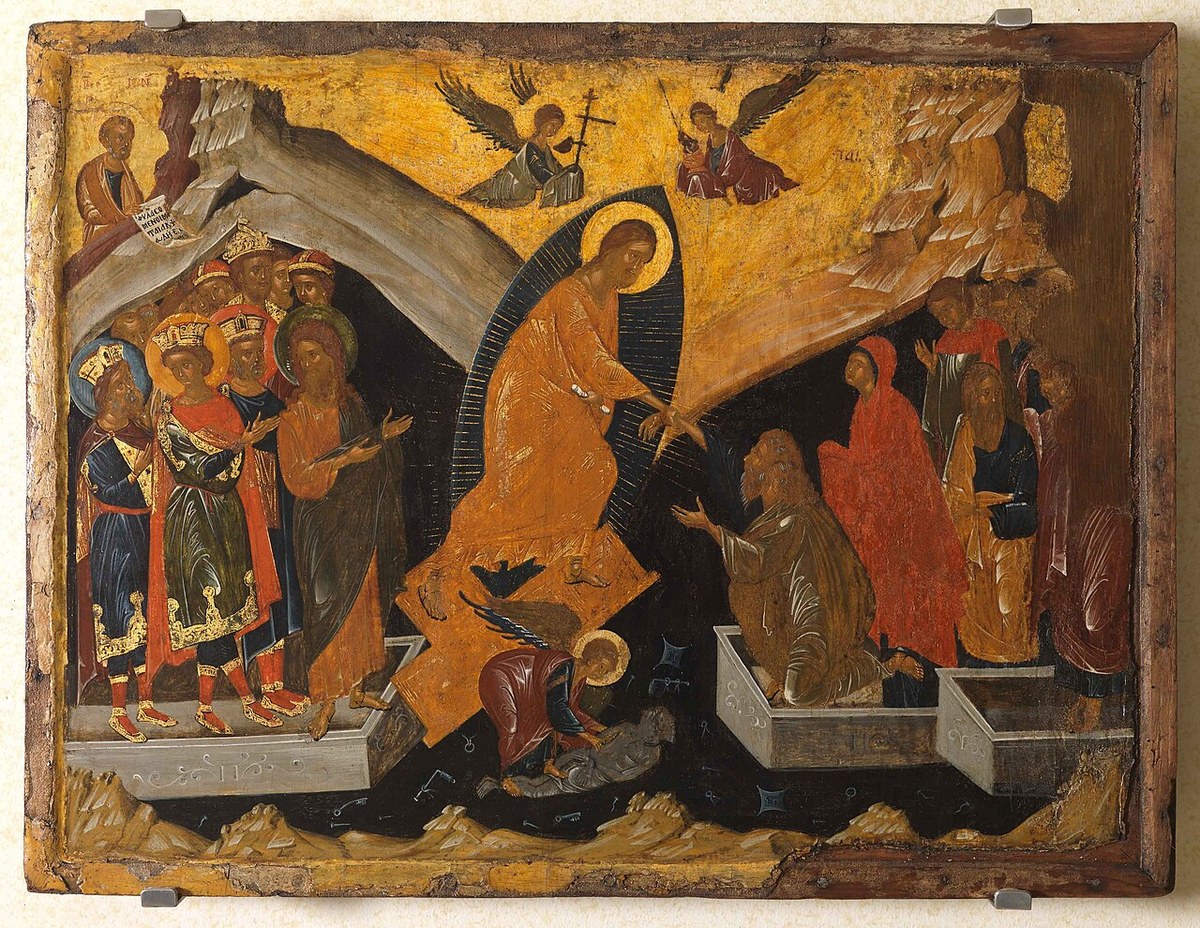
.jpg)
Saints commemorated
-
Beginning of the Pentecostarion
-
Great Martyr Irene of Thessalonica
Irenaeus, Irene and Peregrinus are three martyrs commemorated on May 5 who, according to the Latin martyrologies and the Greek synaxaristic notices that follow them, suffered at Thessalonica in the persecution of Diocletian, refusing to sacrifice to the idols and being cast into the fire. Nothing further is transmitted about them. Their dossier is unusually vexed: the Latin manuscript tradition varies, the localisation at Thessalonica has been questioned, and the presence of an Irene in the company on the very day of the Great-Martyr Irene — and in the very city associated with the other virgin-martyr Irene of Thessalonica of April 16 — makes this small commemoration one of the most easily confused in the calendar.
-
Ephraim of Nea Makri
Ephraim is a fifteenth-century Greek monk of Mount Amomon above the modern Nea Makri in Attica, held to have been tortured to death by Turkish raiders on 5 May 1426. Nothing whatever was known of him until 1950, when the nun Makaria Desipri, excavating the ruins of the abandoned Monastery of the Annunciation on the hill, uncovered a burial she took — on the strength of a series of dreams and visions she reported — to be his, and from which the whole of his transmitted biography derives. A very large popular veneration grew up around the shrine within a generation; the Church of Greece entered him in its calendar in 1998 and the Ecumenical Patriarchate in 2011. His commemoration is therefore canonically established and liturgically kept, while the historical foundation of his life rests on private revelation and not on any document, and the Church's own recognition of him was cautious and late.
-
Euthymius of Madytos
Euthymius was a monk of Constantinople who became bishop of Madytos on the European shore of the Hellespont in the last decades of the tenth century, and was famed in his own lifetime as a healer and a seer. He was born at Epivates in Thrace and is remembered chiefly, in the wider Church, as the elder brother of St Parasceva of the Balkans — "Petka" — whose Life records that he went first to the monastic state and drew her after him. He is said to have received the emperor Basil II at Madytos and to have foretold his victory over Bardas Phocas in 989. At his repose, between 989 and 996, myrrh flowed from his tomb, whence he is called the Myrrh-flowing; healings continued there. He is commemorated on May 5.
-
Irene the Great Martyr
Irene is the great-martyr whose long passion — a cycle of tortures survived, deliverances and repeated returns to preaching — made her one of the most widely honoured women saints of the Byzantine world. Born Penelope, the only daughter of a petty pagan king named Licinius, she was shut up from childhood in a tower with thirteen companions, taught the faith in secret by her tutor Apellian, and baptised Irene ("peace") by Timothy, whom the tradition identifies as the disciple of the Apostle Paul. Her father's attempt to kill her ended in his own conversion and that of some three thousand souls; thereafter she passed from city to city under a succession of rulers — Sedekias, Sapor, Numerian, Babdonus — enduring the serpent-pit, the saw, the millwheel and three heated bronze oxen, converting whole populations, and at last reposing near Ephesus, where her sealed tomb was found empty. She is commemorated on May 5.
-
Neophytus, Gaius and Gaianus
Neophytus, Gaius and Gaianus are three martyrs of whom the Greek synaxarion for May 5 preserves a single line: that they were perfected by the sword. Nothing is transmitted of their country, their persecutor, their date, or the relation between them. The one further notice attached to their memory is topographical and belongs to Constantinople: their synaxis was kept in the church of Saints Cosmas and Damian "in the quarter of Dareios", which indicates a real and located cult in the imperial city, however completely their story has been lost.
British Isles and Ireland
- St. Hydroc of Cornwall (5th C)
- St. Echa of Crayke, hermit (767)
Troparia & kontakia
Exapostilarion — Tone 2
Having fallen asleep in the flesh as a mortal man, O King and Lord, on the third day thou didst rise again, raising Adam from corruption and abolishing death: O Pascha of incorruption, O salvation of the world.
Kontakion — Tone 4
Though thou didst descend into the tomb, O Immortal, yet didst thou bring down the power of Hades, and didst rise again as victor, O Christ God, saying to the myrrhbearing women, Rejoice!, and granting peace to thine apostles — thou who dost bestow resurrection on the fallen.
Kontakion — Tone 4
Adorned with the beauties of virginity, O maiden, thou wast made yet more comely by thy contest, O Irene, stained crimson with thine own outpoured blood; and thou didst cast down the delusion of godlessness. Wherefore thou hast received the honours of victory from the hand of thy Creator.
Oikos
The maidens bearing myrrh came before the dawn, seeking as men seek the daylight the Sun that was before the sun, who for a while had set within a tomb; and they cried out to one another: O friends, come, let us anoint with spices the life-bearing and buried Body, the flesh that raises up fallen Adam, lying now in the grave. Let us go, let us make haste like the Magi, and worship, and offer our myrrh as gifts to him who is wrapped not in swaddling bands but in a linen shroud; and let us weep and cry aloud: O Master, arise, thou who dost bestow resurrection on the fallen.
The
Christ is risen from the dead, trampling down death by death, and to those in the tombs bestowing life.
The
The women who were with Mary, having come before the dawn and having found the stone rolled away from the tomb, heard from the angel: Why do you seek among the dead, as though he were a man, him who dwells in everlasting light? Behold the grave-clothes! Run and proclaim to the world that the Lord is risen, having put death to death; for he is the Son of God who saves the race of men.
The
It is the day of Resurrection! Let us be radiant, O peoples: Pascha, the Lord's Pascha! For from death to life and from earth to heaven Christ our God has brought us over, as we sing the hymn of victory. Now all is filled with light — heaven, and earth, and the places beneath the earth. Let all creation therefore keep the feast of the rising of Christ, in whom it is made firm. We keep the feast of the putting to death of death, the pulling down of Hades, and the firstfruits of another life, the eternal one; and leaping for joy we hymn the Cause of it, the only blessed and exceedingly glorious God of our fathers. This is the chosen and holy day, the one and first of the sabbaths, the queen and the lady, the feast of feasts and the festival of festivals, on which we bless Christ unto the ages. Shine, shine, O new Jerusalem, for the glory of the Lord has risen upon thee! Dance now and be glad, O Sion; and do thou rejoice, O pure Theotokos, in the rising of him whom thou didst bear. O Pascha, great and most holy, O Christ! O Wisdom and Word and Power of God! Grant us to partake of thee more perfectly in the day of thy kingdom that knows no evening.
The
Today a sacred Pascha has been shown to us: a Pascha new and holy, a Pascha mystical, a Pascha all-venerable, a Pascha that is Christ the Redeemer; a Pascha unblemished, a Pascha great, the Pascha of the faithful, the Pascha that has opened to us the gates of Paradise, the Pascha that sanctifies all the faithful. It is the day of Resurrection! Let us be radiant for the festival, and let us embrace one another. Let us say, O brethren, even to those that hate us: Let us forgive all things for the Resurrection's sake. And so let us cry aloud: Christ is risen from the dead, trampling down death by death, and to those in the tombs bestowing life.
The
Christ, having gone down alone to wrestle with Hades, came up again bearing many spoils of victory.
Troparion — Tone 4 (common of a venerable-martyr)
Trained in the discipline of the monks and made perfect in the contest of the martyrs, thou didst offer to Christ a twofold crown, O Ephraim: for having died to the world in the ascetic life, thou didst give thy body to torments for His name, and wast found faithful unto the end. Wherefore intercede with Him that our souls may be saved.
Troparion — Tone 4 (common of a hierarch)
The truth of things hath revealed thee to thy flock as a rule of faith, an image of meekness and a teacher of continence, O father and hierarch Euthymius; therefore thou hast attained by humility to the heights, and by poverty to riches. Intercede with Christ God that our souls may be saved.
Troparion — Tone 4 (common of martyrs)
Thy martyrs, O Lord, in their contest received incorruptible crowns from Thee, our God; for possessing Thy strength they cast down the tyrants and shattered the feeble insolence of the demons. By their intercessions save our souls.
Troparion — Tone 4 (common of a virgin-martyr)
Thy lamb Irene crieth unto Thee with a great voice, O Jesus: Thee, my Bridegroom, do I love, and seeking Thee I endure the contest; I am crucified with Thee and buried with Thee in Thy baptism; I suffer for Thy sake that I may reign with Thee, and I die for Thee that I may live with Thee. Receive me as a spotless sacrifice, offered to Thee in love; and by her prayers, O merciful One, save our souls.
Troparion — Tone 4 (common of martyrs)
Thy martyrs, O Lord, in their contest received incorruptible crowns from Thee, our God; for possessing Thy strength they cast down the tyrants and shattered the feeble insolence of the demons. By their intercessions save our souls.
Readings
Epistle
Acts 1.1-8
1The former treatise have I made, O Theophilus, of all that Jesus began both to do and teach, 2Until the day in which he was taken up, after that he through the Holy Ghost had given commandments unto the apostles whom he had chosen: 3To whom also he shewed himself alive after his passion by many infallible proofs, being seen of them forty days, and speaking of the things pertaining to the kingdom of God: 4And, being assembled together with them, commanded them that they should not depart from Jerusalem, but wait for the promise of the Father, which, saith he, ye have heard of me. 5For John truly baptized with water; but ye shall be baptized with the Holy Ghost not many days hence. 6When they therefore were come together, they asked of him, saying, Lord, wilt thou at this time restore again the kingdom to Israel? 7And he said unto them, It is not for you to know the times or the seasons, which the Father hath put in his own power. 8But ye shall receive power, after that the Holy Ghost is come upon you: and ye shall be witnesses unto me both in Jerusalem, and in all Judæa, and in Samaria, and unto the uttermost part of the earth.
Gospel
John 1.1-17
1In the beginning was the Word, and the Word was with God, and the Word was God. 2The same was in the beginning with God. 3All things were made by him; and without him was not any thing made that was made. 4In him was life; and the life was the light of men. 5And the light shineth in darkness; and the darkness comprehended it not. 6There was a man sent from God, whose name was John. 7The same came for a witness, to bear witness of the Light, that all men through him might believe. 8He was not that Light, but was sent to bear witness of that Light. 9That was the true Light, which lighteth every man that cometh into the world. 10He was in the world, and the world was made by him, and the world knew him not. 11He came unto his own, and his own received him not. 12But as many as received him, to them gave he power to become the sons of God, even to them that believe on his name: 13Which were born, not of blood, nor of the will of the flesh, nor of the will of man, but of God. 14And the Word was made flesh, and dwelt among us, (and we beheld his glory, the glory as of the only begotten of the Father,) full of grace and truth. 15John bare witness of him, and cried, saying, This was he of whom I spake, He that cometh after me is preferred before me: for he was before me. 16And of his fulness have all we received, and grace for grace. 17For the law was given by Moses, but grace and truth came by Jesus Christ.