
Pascha
The Holy and Great Sunday of Pascha — the Life-Bearing Resurrection of our Lord and God and Saviour Jesus Christ
Pascha — the Holy and Great Sunday of the Resurrection — is not one of the Twelve Great Feasts. It stands above and outside them, and the Church's own name for it, sung in the eighth ode of the Paschal canon, is the feast of feasts and the festival of festivals. It has no fixed date; it is the date, the single point from which the whole movable year is measured forward and backward, so that in this collection every other movable commemoration is expressed as an offset from it. What the day proclaims is that Jesus of Nazareth, crucified under Pontius Pilate and buried in a sealed tomb, rose from the dead on the third day in the same body in which he had died, and that in rising he did not merely leave death behind but broke it from the inside: he went down into Hades as one of the dead, and Hades, receiving a dead man who was also God, could not hold him and lost everyone else as well. This — not the empty tomb, and not the moment of rising, which no human being saw — is what the Orthodox icon of the feast depicts: the Anastasis, Christ standing on the shattered gates of hell and hauling Adam and Eve up out of their graves by the wrist. The service that carries the feast is the night vigil: the Midnight Office in a darkened church while the burial shroud is taken back into the sanctuary, the procession out into the open with light and censer, the first singing of Christ is risen before the closed doors, the whole Paschal canon of John of Damascus sung standing with the lights blazing, the Catechetical Homily attributed to John Chrysostom read from the ambon as it is read every year in every Byzantine church, and then the Liturgy — whose Gospel, astonishingly, is not a resurrection narrative at all but the Prologue of John, In the beginning was the Word. The date is computed, not given: by the rule received from the Council of Nicaea (325), Pascha is the Sunday after the first full moon on or after the vernal equinox, but the Orthodox Churches still compute it on the Julian reckoning, and that is why Orthodox Pascha coincides with Western Easter in some years and falls one, four or five weeks later in others. The feast is not a day but a season: Bright Week with its open doors, the fifty days to Pentecost, and a leavetaking on the Wednesday before the Ascension, thirty-eight days after the feast, on which the whole Paschal office is sung one last time.
.jpg)
The Resurrection in the four Gospels and in Paul
Every one of the four Gospels ends with the Resurrection, and no two of them tell it the same way. This is the first thing that has to be said about the Paschal narrative, and the Church has never concealed it: the accounts are four independent witnesses, not four copies, and they differ in exactly the places where independent witnesses to a sudden event differ.
Mark, almost certainly the earliest, has three women — Mary Magdalene, Mary the mother of James, and Salome — come to the tomb when the sun had risen on the first day of the week, worrying aloud about who will roll away the stone. They find it already rolled back, and inside a young man in a white robe, sitting on the right, who tells them that Jesus of Nazareth, the crucified, is risen and is not there, and sends them to tell the disciples and Peter that he goes before them into Galilee. And then Mark ends — in the oldest manuscripts, at 16:8 — with the women fleeing in trembling and astonishment and saying nothing to anyone, for they were afraid. The longer ending, Mark 16:9–20, which reports the appearance to Mary Magdalene, the two on the road, the appearance to the Eleven, the great commission and the Ascension, is absent from the two great fourth-century codices; the Byzantine textual tradition contains it, the Church reads it, and it is the eleventh of the Sunday Resurrection Gospels.
Matthew has two women, Mary Magdalene and "the other Mary," and a great earthquake: an angel descends, rolls back the stone and sits upon it, his face like lightning, and the guard set by the chief priests fall as dead men. The women are met by the risen Lord himself on the road — the Chairete, "All hail" — and take hold of his feet; the Eleven see him on a mountain in Galilee, where some worshipped and some doubted, and receive the commission to baptise all nations. Matthew alone reports the guard at the tomb and the story circulated afterwards that the disciples had stolen the body — a detail that tells us the accusation was in the air early enough to need answering.
Luke has a larger company of women, naming Mary Magdalene, Joanna and Mary the mother of James, and two men in dazzling apparel rather than one; the women are not believed, "their words seemed to them as idle tales," and Peter runs to the tomb and sees the linen cloths. Then Luke gives what no other evangelist gives: the seven-mile walk to Emmaus, the stranger who expounds Moses and all the prophets, and the recognition in the breaking of bread — the whole shape of a Christian Liturgy told as a story. That evening the Lord stands among them in Jerusalem, shows his hands and his feet, invites them to handle him, and eats a piece of broiled fish, because a ghost does not eat.
John narrows the opening scene to one woman: Mary Magdalene comes alone while it is yet dark, finds the stone taken away, and runs for Peter and the disciple whom Jesus loved. The two race to the tomb; the younger arrives first and does not go in; Peter enters and sees the linen cloths lying, and the napkin that had been about the head wrapped together in a place by itself — a detail of no theological weight whatever, which is exactly why it reads like memory. Mary, left weeping in the garden, sees two angels and then the Lord, mistakes him for the gardener, and knows him when he says her name; she is told not to cling to him, μή μου ἅπτου, because the ascent to the Father is not yet finished. That evening he comes through shut doors and breathes on them; Thomas, absent, refuses to believe on report and eight days later makes the highest confession in the New Testament, My Lord and my God. A final chapter adds the charcoal fire by the sea of Tiberias, the hundred and fifty-three fish, and the threefold restoration of Peter.
Older than all four is Paul. In 1 Corinthians 15:3–8, written about twenty-five years after the event and quoting a formula he says he had himself received, the sequence runs: Christ died for our sins according to the scriptures, was buried, rose the third day according to the scriptures, and appeared — to Cephas, then to the Twelve, then to more than five hundred brethren at once, of whom most were still alive when Paul wrote, then to James, then to all the apostles, and last of all to Paul himself. It is the earliest written witness we possess, and two features of it are worth noticing. It mentions no women. And it treats the Resurrection not as an edifying idea but as a matter of testimony with living names attached, to be checked if anyone cared to check it.
Harmonising the accounts
The differences are real and were noticed at once, by friends and by enemies. How many women? One, two, three, or "the women that came with him from Galilee"? How many angels, and were they sitting or standing? Was it still dark, or had the sun risen? Did the Lord appear first to Mary Magdalene in the garden, or to the women on the road? Were the disciples sent to Galilee, or told to stay in the city until they were clothed with power? And how are three days counted between a Friday afternoon burial and a Sunday morning rising?
Attempts to smooth the seams are as old as the second century. Tatian's Diatessaron wove the four narratives into one continuous story and was widely used in the Syriac-speaking churches — the Antiochene world's own first answer to the problem — until it was displaced by the separated Gospels. Eusebius of Caesarea devoted a whole treatise, the questions To Marinus, to the apparent clash between Matthew's "late on the sabbath" and Mark's "very early on the first day of the week," and solved it by punctuation and by observing that the two evangelists are describing different moments; the same treatise discusses the ending of Mark and records that the longer ending was missing from most copies known to him — an early and candid piece of textual criticism from a bishop with the best library in the empire. In the Latin West Augustine worked through the whole set of divergences in De consensu evangelistarum. The principle common to all of them is that the evangelists each select and compress, that none claims to be exhaustive, and that a difference of selection is not a contradiction.
The Church's own settled answer, however, is not a harmony but a liturgy. It never produced an authorised composite narrative. Instead it appointed the Eleven Resurrection Gospels, the Eothina — eleven pericopes from Matthew, Mark, Luke and John covering every appearance — to be read in unbroken rotation at Sunday Matins throughout the year, so that the ordinary Orthodox Christian hears all four accounts in their own words, differences included, several times over in a lifetime. Eleven idiomela to match them, the Eothina stichera, are traditionally ascribed to the emperor Leo VI the Wise (886–912) and the eleven Resurrection exaposteilaria to his son Constantine VII Porphyrogennetos. That is a striking editorial decision. Faced with four witnesses that will not be flattened, the Church chose to keep all four in play and to make the plurality itself liturgical.
Two things in the record are worth weighing as history rather than as devotion. The first is that all four Gospels, and every strand of the tradition behind them, agree on the empty tomb; nobody in the first century, including the opponents reported by Matthew, argues that the body was still in it. The second is that all four make women the first witnesses — in a legal and social world in which a woman's testimony carried little weight, and in a document written to persuade. Whatever else may be said, that is not how a fabricator builds a case. And it is the reason the myrrhbearing women are honoured in the Paschal hymns above the apostles: the kontakion of the feast has Christ speak his first risen word to them.
The name: Pesach, paschein, and the two Paschas
The Greek Πάσχα is not a Greek word. It is the Aramaic pasḥā, the Hebrew pesaḥ, taken over untranslated, and it means the passing-over of the destroyer in Egypt and the feast that commemorates it. The Christian feast keeps the name of the Jewish one because the Church reads the one as the fulfilment of the other: the lamb without blemish, the blood on the doorposts, the night of deliverance, the passage out of slavery and through the sea. The first ode of the Paschal canon states the whole typology in a single verb — from death to life and from earth to heaven Christ our God has brought us over, διεβίβασεν, the word for taking a people across a river.
Greek ears, however, heard something else in the name. Πάσχειν means "to suffer," and the coincidence was too good to pass up. Melito of Sardis, in his Peri Pascha of about 165 — the oldest surviving Paschal homily — exploits it, and the etymology became standard among the Fathers even after better philologists had pointed out that it is a pun and not a derivation. Out of that pun grew a genuinely useful distinction, still audible in the Byzantine books: the πάσχα σταυρώσιμον, the Pascha of the Cross, which is Great and Holy Friday, and the πάσχα ἀναστάσιμον, the Pascha of the Resurrection, which is this day. The single mystery has two faces, and the Church refuses to let either be celebrated without the other. This is why the Paschal night is entered through the Lamentations of Holy Saturday, and why the Cross stands in the middle of the paschal hymns: by the Cross joy has come into all the world.
Most Orthodox languages keep the Semitic name — Slavonic Пасха, Romanian Paştile, Arabic al-Fiṣḥ, alongside the Arabic ʿĪd al-Qiyāma, "the feast of the Rising." English is the odd one out. Easter comes, on the testimony of Bede in De temporum ratione, from Eosturmonath, an Anglo-Saxon month named after a goddess whose feasts were kept in it; Bede reports this as a matter of antiquarian fact and notes that his countrymen had transferred the old month-name to the Paschal season. That is a large part of the reason English- speaking Orthodox Christians generally say Pascha: not out of hostility to the word Easter, but because the name of the feast is a scriptural name and it seems a pity to lose it.
The descent into Hades
The Nicene-Constantinopolitan Creed does not mention the descent. It says that he was crucified, and suffered, and was buried, and rose again on the third day. The descent into Hades belongs not to the Creed but to something more pervasive: the entire hymnography of Holy Saturday and Pascha, the whole festal iconography, and a scattered but unmistakable line of scriptural witness.
Peter's sermon at Pentecost argues the Resurrection from Psalm 15 (16), thou wilt not leave my soul in Hades, neither wilt thou suffer thine Holy One to see corruption, and says that God raised him up "having loosed the pains of death, because it was not possible that he should be holden of it" (Acts 2:24–31). Paul asks who shall descend into the deep, that is, to bring Christ up again from the dead (Romans 10:7), and writes that he who ascended first descended into the lower parts of the earth, and led captivity captive (Ephesians 4:8–10). 1 Peter says that Christ, put to death in the flesh but made alive in the spirit, went and preached to the spirits in prison (3:18–20), and that the gospel was preached to the dead (4:6). The Lord himself gives the sign of Jonah, three days and three nights in the belly of the whale — which is why the whole book of Jonah is read at the Vesperal Liturgy of Holy Saturday. And the risen Christ of the Apocalypse says: I am he that liveth, and was dead; and behold, I am alive for evermore, and have the keys of Hades and of death.
The narrative filling-out of these hints came from the apocryphal Gospel of Nicodemus — the Acts of Pilate, whose second part, the Descensus ad Inferos, tells the story from below: the two sons of Symeon rising to report what they saw, the great light in the darkness, the dialogue of Hades and Satan in mounting panic, the voice like thunder demanding Lift up your gates, the bronze doors broken, and Christ taking Adam by the hand. The Church did not canonise the book, and its details are treated exactly as the Transitus narratives are treated at the Dormition: the theological core was received and preached, the extravagances dropped. But it is from the Descensus, and from the homiletic tradition it fed, that the imagery of the icon and of the hymns comes.
What the tradition means by the descent is precise, and it is worth stating without softening. Christ died a real human death: his human soul was separated from his body, and went where the dead go. His divinity remained united to both — to the body in the tomb, incorrupt, and to the soul in Hades — so that the place of the dead received, for the first and only time in its history, someone it had no power over. Death had always worked by holding; presented with a dead man who was Life itself, it could not hold, and in failing once it failed altogether. The seventh ode of the canon names the content of the feast in a single line: we celebrate the putting to death of death, the pulling down of Hades, and the firstfruits of another life, the eternal one. The Catechetical Homily makes the same point rhetorically, six times over: Hades was embittered — because it was abolished, because it was mocked, because it took a body and met God, took earth and encountered heaven, took what it saw and fell by what it did not see.
Two consequences follow, and both matter for reading the icon.
The first is that the Resurrection, in Orthodox terms, is not the reversal of one man's death. It is the destruction of death as such, from inside; and the one who is raised in the icon is not Christ but Adam — the whole race, gathered into one name. Salvation is shown as a rescue performed on the unconscious, from outside, by someone who came down to where the drowning were.
The second is a question the tradition has deliberately left open: whom did he bring out? The hymns say Hades was emptied and its gates broken; the Descensus speaks of the righteous of Israel; the Forerunner is depicted in the icon because he had gone ahead to preach there as he had preached on earth. Whether the deliverance extended further, and how far, the Orthodox Church has never defined — the texts are extravagantly universal in their rhetoric and silent in their dogmatics, and both the universalist and the restrictive readings can quote hymns. It is one of the genuinely open questions of Orthodox eschatology, and the honest thing is to say so rather than to settle it from a troparion.
"The feast of feasts and the festival of festivals"
Pascha is not counted among the Twelve. This is not an oversight in the reckoning but a statement about rank: the Twelve Great Feasts are the great feasts of the year, and Pascha is not in that series because it is the thing the series exists around. The Typikon treats it as sui generis; the Pentecostarion is its own book; its office borrows nothing from the Menaion and abolishes everything that would compete with it, so that a saint's commemoration falling on Pascha is simply transferred.
The phrase is Gregory the Theologian's. In his Oration 45, the second Paschal oration, he calls this day the Pascha of the Lord, the feast of feasts and the festival of festivals, surpassing all others as the sun surpasses the stars. John of Damascus, composing the Paschal canon some three and a half centuries later, quoted him outright: the opening words of the first ode, It is the day of Resurrection, let us be radiant, O peoples — Pascha, the Lord's Pascha, are Gregory's words set to music, and the eighth ode turns the rest of the sentence into a heirmos — the queen and lady, the feast of feasts and the festival of festivals. When an Orthodox congregation sings that line it is singing a fourth-century sermon.
The corollary runs all through the calendar. Every Sunday of the year is a little Pascha: the Sunday Matins with its Resurrection Gospel, its Having beheld the Resurrection of Christ, and its eight-week rotation of Resurrection tones is a weekly repetition of this night, which is why the Sunday office always outranks a saint. And every Great Feast is dated, in one direction or another, from this one — the fixed feasts by their relation to it in the Church's mind, the movable ones by literal arithmetic.
The history of the feast
That Christians kept an annual Pascha is attested from the second century, and so is a sharp disagreement about when. In the province of Asia the churches, appealing to the authority of the apostle John the Theologian, kept the Pascha on the fourteenth of Nisan whatever day of the week it fell on — the Quartodecimans, so called from that fourteenth. At Rome, Alexandria and in most other places, the fast was broken on the Sunday following. About 155 Polycarp of Smyrna went to Rome and discussed the matter with Anicetus; neither convinced the other and they parted in communion. About 190 Victor of Rome attempted to excommunicate the Asian churches over it; Polycrates of Ephesus replied with a list of the great men buried in Asia who had kept the fourteenth, and Irenaeus of Lyons — an Asian himself, by then a Western bishop — wrote to Victor telling him that a difference of usage in the fast was no ground for breaking the peace, and reminding him of Polycarp and Anicetus. The whole exchange is preserved in Eusebius, and it is one of the earliest documented cases of the Church deciding that liturgical uniformity is not worth a schism.
The Council of Nicaea in 325 settled the question for good in favour of the Sunday. It is worth being exact about what the council did and did not leave us. No canon of Nicaea on the date of Pascha survives; what survives is the council's synodal letter to the church of Alexandria and the circular letter of the emperor Constantine, both reporting that it was agreed that all should keep the feast on the same day, that the day should be a Sunday, and that the Churches should no longer depend on the Jewish reckoning of the month. Alexandria, with the best astronomers, was to calculate the date and announce it by an annual festal letter. The council thus fixed the principle and delegated the arithmetic — a division of labour whose consequences are still with us, because arithmetic drifts and principles do not.
The office of the feast as it is now sung is a Palestinian and Constantinopolitan achievement of the seventh to ninth centuries. The Paschal canon is John of Damascus's, from the monastery of Saint Sabbas; the same milieu that produced the Dormition canons and, in Cosmas of Maiuma, the canons of the other great feasts. The Pentecostarion, the book of the fifty days, took its present shape in the Constantinopolitan and Sabbaite synthesis that produced the received Typikon. The Paschal Vigil itself is older than any of it: in the ancient Church the catechumens were baptised on the night of Holy Saturday, and the Church still sings, in place of the Trisagion at the Holy Saturday Liturgy, As many as have been baptised into Christ have put on Christ — a fossil of the night when the newly-illumined came up out of the font in white robes and the Paschal Liturgy was their first.
Feast and commemoration
Pascha has no date. It is the day from which dates are taken: in this collection its rule is the day of Pascha itself, and every other movable commemoration — the whole Triodion from the Publican and the Pharisee at −70, Holy Week, Bright Week, the Sundays of the Pentecostarion, the Ascension at +39 and Pentecost at +49 — is expressed as a number of days before or after it. It is the only commemoration in the corpus that is a datum rather than a derivation.
The reckoning of the date: the Nicene rule and the Paschalion
The rule the Church received from Nicaea is easily stated and surprisingly hard to execute. Pascha is the Sunday following the first full moon on or after the vernal equinox. Three quantities are needed: the equinox, the full moon, and the weekday. None of the three was to be taken from anyone else's calendar; the Church was to compute them itself.
Alexandria did the computing, and the instrument it produced is the Alexandrian computus, which the Byzantine and later the Latin Church inherited. It rests on two conventions.
The first is that the equinox is fixed at 21 March. Not observed each year, but fixed — a convention, because a rule that requires an observation cannot be tabulated in advance, and the whole point was that everyone should be able to know the date years ahead.
The second is the nineteen-year lunar cycle, the Metonic cycle: nineteen solar years contain almost exactly 235 lunar months, so after nineteen years the moon returns to nearly the same phase on the same calendar date. That "almost" is the seed of every later difficulty. The cycle lets one tabulate, for each year of the nineteen, the age of the moon on 1 January (the epact) and hence the date of the fourteenth day of the paschal lunar month — the ecclesiastical full moon, which is a table entry and not an astronomical event. Pascha is then the Sunday after that. Because the whole computation is closed, the Paschalion can be printed as a table, and in the Byzantine books it is: the Typikon carries the paschal tables with their themelion, indiction, golden number and the solar-cycle letters, and a village priest with no astronomy could read off the date of Pascha, and of every movable feast with it, for any year.
The Alexandrian reckoning became universal only slowly. Rome long used a different cycle and was repeatedly out of step with Alexandria in the fourth and fifth centuries; Dionysius Exiguus at Rome in 525 translated the Alexandrian tables into the Latin world and, incidentally, invented the Anno Domini era while doing it. The Insular churches kept an older 84-year cycle, which is what the Synod of Whitby in 664 was about. By the ninth century the Christian world was computing Pascha the same way everywhere.
Two limits follow from the tables, and they are worth knowing because they explain the shape of the Orthodox year. The paschal full moon can fall no earlier than 21 March and no later than 18 April, so Pascha falls between 22 March and 25 April in the calendar in which the computation is done. And because the whole movable calendar hangs from Pascha, the length of the pre-Lenten and post-Pentecost portions of the year expands and contracts to absorb the swing — which is why some years have far more Sundays after Pentecost than others.
Why Orthodox Pascha diverges from Western Easter
Both Churches keep the Nicene rule. They differ in the calendar in which they apply it, and it is worth setting the difference out plainly, because it is constantly misdescribed as a difference of doctrine or of goodwill when it is a difference of arithmetic.
The solar drift. The Julian year is 365.25 days, about eleven minutes longer than the tropical year. Over sixteen centuries that error accumulates, and the Julian calendar has slipped thirteen days behind the sun. The Orthodox Paschalion still takes its equinox as 21 March Julian — which in 2026 is 3 April in civil (Gregorian) reckoning. The Orthodox paschal window therefore opens about two weeks after the astronomical equinox rather than at it.
The lunar drift. The nineteen-year cycle is also slightly long — about an hour and a half per cycle — and over the same span the tabulated ecclesiastical full moons have fallen four to five days behind the real moon. This second error is independent of the first and is the more consequential of the two, because a lag of a few days can push the reckoning past a Sunday and thus over a whole lunation.
The Gregorian reform of 1582, promulgated by Pope Gregory XIII in the bull Inter gravissimas, corrected both: ten days were dropped from October 1582, the centurial leap-year rule was changed, and — less famously but just as importantly — the lunar epact tables were rebuilt so that the ecclesiastical full moon again tracked the real one. Western Easter has been computed on the corrected tables ever since. The Orthodox Churches did not adopt the reform, and when the Congress of Constantinople of 1923, under Patriarch Meletios IV, introduced the Revised Julian calendar for the fixed feasts, it deliberately left the Paschalion untouched. That is the position today in the Antiochian Patriarchate and the other New Calendar Churches: fixed feasts on the civil calendar, Pascha on the Julian reckoning. The Orthodox Church of Finland is the notable exception, keeping the Gregorian Paschalion.
The practical result is a repeating but irregular pattern. In current civil terms, Orthodox Pascha falls between 4 April and 8 May — the Julian window of 22 March to 25 April, shifted by thirteen days. Compared with Western Easter it is:
- the same day in some years — 2025 (20 April), 2028, 2031, 2034, 2037, 2038;
- one week later in the commonest case — 2026 (5 April West, 12 April East), 2029, 2030, 2033, 2036, 2039;
- four or five weeks later in the years where the lunar drift has pushed the Orthodox reckoning past a Sunday and on to the following full moon — 2021 (four weeks), 2024, 2027, 2032, 2035, 2040 (five weeks).
A word on a common misunderstanding. It is often said that Orthodox Pascha is later because of a rule that it must follow the Jewish Passover. The canonical principle exists: the Byzantine canonists, commenting on the seventh of the Apostolic Canons, held that Pascha must not be kept before or together with the Passover, and the point is doctrinal as well as chronological — the Resurrection follows the Passion, and the Passion followed the Passover. But this is not a step in the computation. The Julian tables, drifting late, satisfy the condition automatically; nobody consults a Jewish calendar. The four- and five-week gaps are an artefact of the lunar tables, not of a separate rule.
None of this is a disagreement about the Resurrection, and the tone of the Orthodox literature on it is generally not polemical but weary. The two reckonings honour the same council; one has been corrected and the other has not; and the reasons for not adopting the correction were ecclesiological — that a calendar received by the whole Church should not be altered by a part of it acting alone — rather than astronomical.
Attempts at a common date
The most serious modern attempt was made in the Antiochian heartland. From 5 to 10 March 1997 the World Council of Churches and the Middle East Council of Churches convened a consultation at Aleppo, in Syria, precisely because in the Middle East the Christian minorities live side by side and keep the Resurrection on different days in the same street. Its recommendation was elegantly conservative: keep the Nicene norms exactly as they stand — the Sunday following the first vernal full moon — but calculate the equinox and the full moon astronomically, by the most accurate scientific means available, taking as the basis of reckoning the meridian of Jerusalem. No Church would have had to concede a principle; both would have had to give up a table. The proposal was widely welcomed and has not been implemented.
The question came back into view in 2025, which was both the seventeen hundredth anniversary of Nicaea and — by coincidence of the two computations — a year in which East and West kept Pascha on the same day, 20 April. The coincidence was widely remarked upon and produced expressions of hope from senior hierarchs on both sides; it produced no change to the Paschalion.
The Paschal Vigil: the Midnight Office
The Paschal night begins in the dark, and it begins with a burial. The Midnight Office (Mesonyktikon) of Pascha is sung before midnight in an unlit or dimly lit church, and its text is not paschal at all but the canon of Great and Holy Saturday, He who of old covered the pursuing tyrant with the waves of the sea — the Lamentations still hanging in the air. During its ninth ode the clergy cense the epitaphios, the burial shroud, and carry it from the tomb in the middle of the church into the sanctuary, where it is laid on the holy table and remains until the Ascension. The Church buries her Lord and then immediately stops, because the next thing cannot be sung inside the building.
The procession and the first Christ is risen
All lights are extinguished. The priest comes out of the sanctuary with a lighted candle and gives the light to the people, and in Greek usage he sings Come, receive the light from the unwaning light, and glorify Christ, who is risen from the dead. The flame passes hand to hand until the whole church is alight, and then everyone goes out — clergy, choir, people, cross, banners, Gospel book, censer — and the church is left empty behind them.
The procession circles the building and halts before the closed doors. In Greek usage the Resurrection Gospel, Mark 16:1–8, is read here, in the open air in front of the shut doors; usage varies, and in a number of Slavic recensions no Gospel is read at Paschal Matins at all. Then, standing outside, the celebrant intones the doxology to the Holy and consubstantial and life-creating Trinity, and the troparion is sung for the first time in the year:
Christ is risen from the dead, trampling down death by death, and to those in the tombs bestowing life.
The doors are opened — struck, in many places, with the hand cross — and the congregation goes back in to a church now blazing with light. The symbolism is transparent and is meant to be: the assembly stands outside a sealed tomb in the dark, the seal is broken from within, and the tomb turns out to be full of light. It is worth noting how much of the Paschal service happens outside the building. This is the one night of the year on which the Church cannot be contained by her architecture.
Paschal Matins
Paschal Matins has almost no psalmody. It is one long chain of hymnody built around the canon of John of Damascus, and it is sung fast, standing, with the church fully lit and the doors of the sanctuary wide open. Between the odes the troparion Christ is risen is sung again and again — thrice after each ode, with the verse Jesus, having risen from the tomb, as he foretold, has given us eternal life and great mercy — so that the hymn is sung dozens of times before the night is over. The celebrant censes continually, moving through the whole church and greeting the people at each ode with Christ is risen!, to which they answer Truly he is risen!; in many places he does it in a different language each time. There is no kathisma; the Hypakoe stands in its place. After the ninth ode come the exapostilarion, the Praises with the Resurrection stichera of the first tone, and then the Paschal stichera with their verses from Psalm 67 (68), Let God arise and let his enemies be scattered — the Church's oldest paschal psalm — ending in the stanza that tells the congregation to embrace one another and forgive everything for the Resurrection's sake. At that point they do: the Paschal kiss is exchanged across the whole church.
The Catechetical Homily
Then the reading. At the end of Paschal Matins, from the ambon, the deacon or priest reads the Catechetical Homily ascribed to John Chrysostom — and this is a genuine peculiarity of the Byzantine rite, because the Typikon almost never prescribes a particular sermon and here prescribes the same one, every year, in every church, without exception and without substitution. It is printed in the Pentecostarion among the offices, not among the readings, and it is treated as part of the service.
It is very short. It opens by inviting everyone in without conditions — the pious and the lover of God, those who have kept the fast and those who have not, the labourer of the first hour and the one who came at the eleventh, who is told that he will lose nothing by his lateness; the Master is generous, receives the last as the first, and pays the eleventh-hour worker as he pays the first. Then it turns to the table: the calf is fatted, let no one go away hungry, all enjoy the banquet of faith, none need lament his poverty or his sins. And then, without warning, it turns and speaks to Hades — six hammer-blows on one verb: Hades was embittered when it met thee below; embittered, for it was abolished; embittered, for it was mocked; it took a body and encountered God; it took earth and met heaven; it took what it saw and fell by what it did not see. It closes with Paul's shout from 1 Corinthians 15, O death, where is thy sting? O Hades, where is thy victory?, and a doxology.
On authorship, honesty is due. The homily is transmitted under Chrysostom's name and is printed among his works, and there is nothing in its theology or its rhetorical manner that a fourth-century Antiochene preacher could not have written; the ascending repetitions are very like him. But it is not among the securely attested pieces of his corpus, its manuscript history places it firmly in the liturgical books rather than in the sermon collections, and modern scholarship generally treats the attribution as traditional rather than established. The Church's use of it is in no way affected. It is read as the Paschal sermon of Saint John Chrysostom, and it has been for something over a thousand years.
The Paschal Liturgy
The Liturgy of Saint John Chrysostom follows at once. Its propers are all paschal: the three antiphons from Psalms 65, 66 and 67, the entrance hymn In the churches bless ye God, Christ is risen in place of the Trisagion hymn's usual setting and again in place of many of the fixed chants, and the communion verse Receive the Body of Christ; taste the fountain of immortality.
The readings are unexpected, and the choice is one of the most eloquent things about the day. The Epistle is Acts 1:1–8 — the opening of the second volume of Luke, the forty days of appearances, the promise of the Spirit, and the commission to be witnesses to the end of the earth. And the Gospel is John 1:1–17: not the empty tomb, not the appearance to Mary, but In the beginning was the Word, and the Word was with God, and the Word was God. The Church, on the night it celebrates the Resurrection, reads the Prologue. The reason is that Pascha is not read as an event inside history that needs describing but as the disclosure of who it was that died — the Resurrection is the answer to the question the Prologue asks, and the narratives have been read already, at the Vesperal Liturgy of Holy Saturday, where the Gospel is Matthew 28:1–20. In many places the Prologue is read in as many languages as the parish can muster, verse by verse, clergy and readers taking turns; in Antiochian usage Arabic, Greek and English at least, and often a dozen more. The Word made flesh is announced in whatever tongues are in the building.
Agape Vespers
On the afternoon of Pascha the Church serves Agape Vespers, sung with the Paschal stichera and a procession, at which the Gospel is John 20:19–25 — the appearance to the disciples on the evening of that same first day, the doors being shut, with Thomas absent. This too is traditionally read in many languages, and in many parishes it is the more festive of the two readings because the whole congregation joins in. The service is called the Agape from the love-feast of the ancient Church, and in many places it is followed by one.
The Artos
At the end of the Paschal Liturgy the Artos is blessed. It is a single tall loaf of leavened bread — that is what the word means — stamped with the image of the Resurrection, or with the Cross and the crown of thorns, and it is blessed with its own prayer, censed, and set on a stand before the icon of Christ, where it stays for the whole of Bright Week. It is carried in the procession at every Liturgy of the week. On Bright Saturday the prayer for the breaking of the Artos is read, the loaf is cut up, and the pieces are distributed to the people, who take them home and keep them.
The explanation given in the books is that after the Ascension the apostles, at table, would leave a portion of bread in the place where the Lord had sat, and raise it in his honour, in the knowledge that he was among them though not visible; the Artos is the Church continuing to do that for the days of the Resurrection appearances. From the same custom the monastic rite of the Panagia derives. Two further points are worth making. The Artos is not the Eucharist and is never treated as such — it is blessed bread, of the same family as the antidoron. And its leaven is deliberate: at the Jewish Passover the bread is unleavened, and the Church's paschal loaf is risen bread, living and full of air, because the body it commemorates is a living one.
The greeting, the red egg, and the table
For the whole paschal season the Paschal greeting replaces "hello." One person says Christ is risen! and the other answers Truly he is risen! — Χριστὸς ἀνέστη! / Ἀληθῶς ἀνέστη!; Христос воскресе! / Воистину воскресе!; and in the Arabic of the Antiochian Church, al-Masīḥ qām! / Ḥaqqan qām! It is used on the telephone, in letters, and at the beginning of every service until the leavetaking.
The red egg is the most widespread of all the paschal customs. The explanation is straightforward: an egg is a sealed tomb from which living things break out, and the red is the blood of Christ. Eggs are blessed with the paschal baskets, cracked against one another in the game the Greeks call tsougrisma — the winner being the last unbroken egg — and eaten first, as the food that breaks the fast. A tradition, popular and late rather than early, attaches the custom to Mary Magdalene, who is said to have come before the emperor Tiberius, announced Christ is risen, and held out an egg which turned red in her hand; the story is not attested in the ancient sources and is best described as pious rather than historical, but it is why the Magdalene is often shown holding a red egg.
The paschal table itself is regional and enormous. Greece roasts lamb and serves the tsoureki; Russia and Ukraine bless the kulich and the pyramid of sweetened curd called paskha, stamped ХВ for Christ is risen; the Arabic-speaking Levant makes maʿmūl, the semolina pastries filled with dates and walnuts, in quantities calculated for a fortnight of visiting. In every case the food is blessed after the Liturgy and eaten in the small hours.
Bright Week and the season to the leavetaking
Pascha is not a day. The week that follows it, Bright Week — Διακαινήσιμος, "the week of renewal" — is liturgically one continuous day: the whole Paschal office is repeated at each of its services, the ordinary Hours are replaced by the Paschal Hours, which are almost entirely hymnody, and the Royal Doors and the deacons' doors of the iconostasis stand open all week, so that the sanctuary and its holy table are visible from anywhere in the church. Nothing else in the year does this, and the meaning is the same as the meaning of the procession: the tomb is open, and what was hidden is not hidden. There is no fasting on the Wednesday or the Friday. A Liturgy with procession and the Artos is served daily, and Bright Friday carries the feast of the Life-Giving Fountain (5 days after Pascha). On Bright Saturday the Artos is broken and the doors are closed at the end of the Liturgy.
The season then continues through Thomas Sunday (Antipascha, 7 days after Pascha), Radonitsa (9 days after Pascha), the Myrrhbearers (+14), the Paralytic (+21), Mid-Pentecost (+24), the Samaritan Woman (+28) and the Blind Man (+35), with Christ is risen sung at the beginning of every service throughout. Through the whole of it — from Pascha until the kneeling prayers at Pentecost Vespers — the Church does not kneel, on the ancient rule that in the Lord's day and in the days of Pentecost prayer is made standing, a rule stated in the twentieth canon of Nicaea and repeated in the ninetieth of Trullo.
The leavetaking (apodosis) of Pascha falls on the Wednesday before the Ascension, thirty-eight days after the feast. The entire Paschal office is sung again, in full, one last time, and Christ is risen is sung for the last time until the following year; the epitaphios is taken from the holy table. The next day is the Ascension (39 days after Pascha), because the forty days of Acts 1:3 have run out. Ten days later comes Pentecost (+49), and the Sunday after Pentecost is All Saints (+56) — the harvest of the Resurrection, which is where the Pentecostarion ends and the long green season of the year begins.
Hymns
The
Christ is risen from the dead, trampling down death by death, and to those in the tombs bestowing life.
Kontakion — Tone 4
Though thou didst descend into the tomb, O Immortal, yet didst thou bring down the power of Hades, and didst rise again as victor, O Christ God, saying to the myrrhbearing women, Rejoice!, and granting peace to thine apostles — thou who dost bestow resurrection on the fallen.
Original translation from the Greek
Oikos
The maidens bearing myrrh came before the dawn, seeking as men seek the daylight the Sun that was before the sun, who for a while had set within a tomb; and they cried out to one another: O friends, come, let us anoint with spices the life-bearing and buried Body, the flesh that raises up fallen Adam, lying now in the grave. Let us go, let us make haste like the Magi, and worship, and offer our myrrh as gifts to him who is wrapped not in swaddling bands but in a linen shroud; and let us weep and cry aloud: O Master, arise, thou who dost bestow resurrection on the fallen.
The
The women who were with Mary, having come before the dawn and having found the stone rolled away from the tomb, heard from the angel: Why do you seek among the dead, as though he were a man, him who dwells in everlasting light? Behold the grave-clothes! Run and proclaim to the world that the Lord is risen, having put death to death; for he is the Son of God who saves the race of men.
Exapostilarion — Tone 2
Having fallen asleep in the flesh as a mortal man, O King and Lord, on the third day thou didst rise again, raising Adam from corruption and abolishing death: O Pascha of incorruption, O salvation of the world.
Original translation from the Greek
The
It is the day of Resurrection! Let us be radiant, O peoples: Pascha, the Lord's Pascha! For from death to life and from earth to heaven Christ our God has brought us over, as we sing the hymn of victory. Now all is filled with light — heaven, and earth, and the places beneath the earth. Let all creation therefore keep the feast of the rising of Christ, in whom it is made firm. We keep the feast of the putting to death of death, the pulling down of Hades, and the firstfruits of another life, the eternal one; and leaping for joy we hymn the Cause of it, the only blessed and exceedingly glorious God of our fathers. This is the chosen and holy day, the one and first of the sabbaths, the queen and the lady, the feast of feasts and the festival of festivals, on which we bless Christ unto the ages. Shine, shine, O new Jerusalem, for the glory of the Lord has risen upon thee! Dance now and be glad, O Sion; and do thou rejoice, O pure Theotokos, in the rising of him whom thou didst bear. O Pascha, great and most holy, O Christ! O Wisdom and Word and Power of God! Grant us to partake of thee more perfectly in the day of thy kingdom that knows no evening.
The
Today a sacred Pascha has been shown to us: a Pascha new and holy, a Pascha mystical, a Pascha all-venerable, a Pascha that is Christ the Redeemer; a Pascha unblemished, a Pascha great, the Pascha of the faithful, the Pascha that has opened to us the gates of Paradise, the Pascha that sanctifies all the faithful. It is the day of Resurrection! Let us be radiant for the festival, and let us embrace one another. Let us say, O brethren, even to those that hate us: Let us forgive all things for the Resurrection's sake. And so let us cry aloud: Christ is risen from the dead, trampling down death by death, and to those in the tombs bestowing life.
The
Christ, having gone down alone to wrestle with Hades, came up again bearing many spoils of victory.
Appointed readings
Epistle — Acts 1:1–8
1The former treatise have I made, O Theophilus, of all that Jesus began both to do and teach, 2Until the day in which he was taken up, after that he through the Holy Ghost had given commandments unto the apostles whom he had chosen: 3To whom also he shewed himself alive after his passion by many infallible proofs, being seen of them forty days, and speaking of the things pertaining to the kingdom of God: 4And, being assembled together with them, commanded them that they should not depart from Jerusalem, but wait for the promise of the Father, which, saith he, ye have heard of me. 5For John truly baptized with water; but ye shall be baptized with the Holy Ghost not many days hence. 6When they therefore were come together, they asked of him, saying, Lord, wilt thou at this time restore again the kingdom to Israel? 7And he said unto them, It is not for you to know the times or the seasons, which the Father hath put in his own power. 8But ye shall receive power, after that the Holy Ghost is come upon you: and ye shall be witnesses unto me both in Jerusalem, and in all Judæa, and in Samaria, and unto the uttermost part of the earth.
Gospel — John 1:1–17
1In the beginning was the Word, and the Word was with God, and the Word was God. 2The same was in the beginning with God. 3All things were made by him; and without him was not any thing made that was made. 4In him was life; and the life was the light of men. 5And the light shineth in darkness; and the darkness comprehended it not. 6There was a man sent from God, whose name was John. 7The same came for a witness, to bear witness of the Light, that all men through him might believe. 8He was not that Light, but was sent to bear witness of that Light. 9That was the true Light, which lighteth every man that cometh into the world. 10He was in the world, and the world was made by him, and the world knew him not. 11He came unto his own, and his own received him not. 12But as many as received him, to them gave he power to become the sons of God, even to them that believe on his name: 13Which were born, not of blood, nor of the will of the flesh, nor of the will of man, but of God. 14And the Word was made flesh, and dwelt among us, (and we beheld his glory, the glory as of the only begotten of the Father,) full of grace and truth. 15John bare witness of him, and cried, saying, This was he of whom I spake, He that cometh after me is preferred before me: for he was before me. 16And of his fulness have all we received, and grace for grace. 17For the law was given by Moses, but grace and truth came by Jesus Christ.
Iconography
The Anastasis
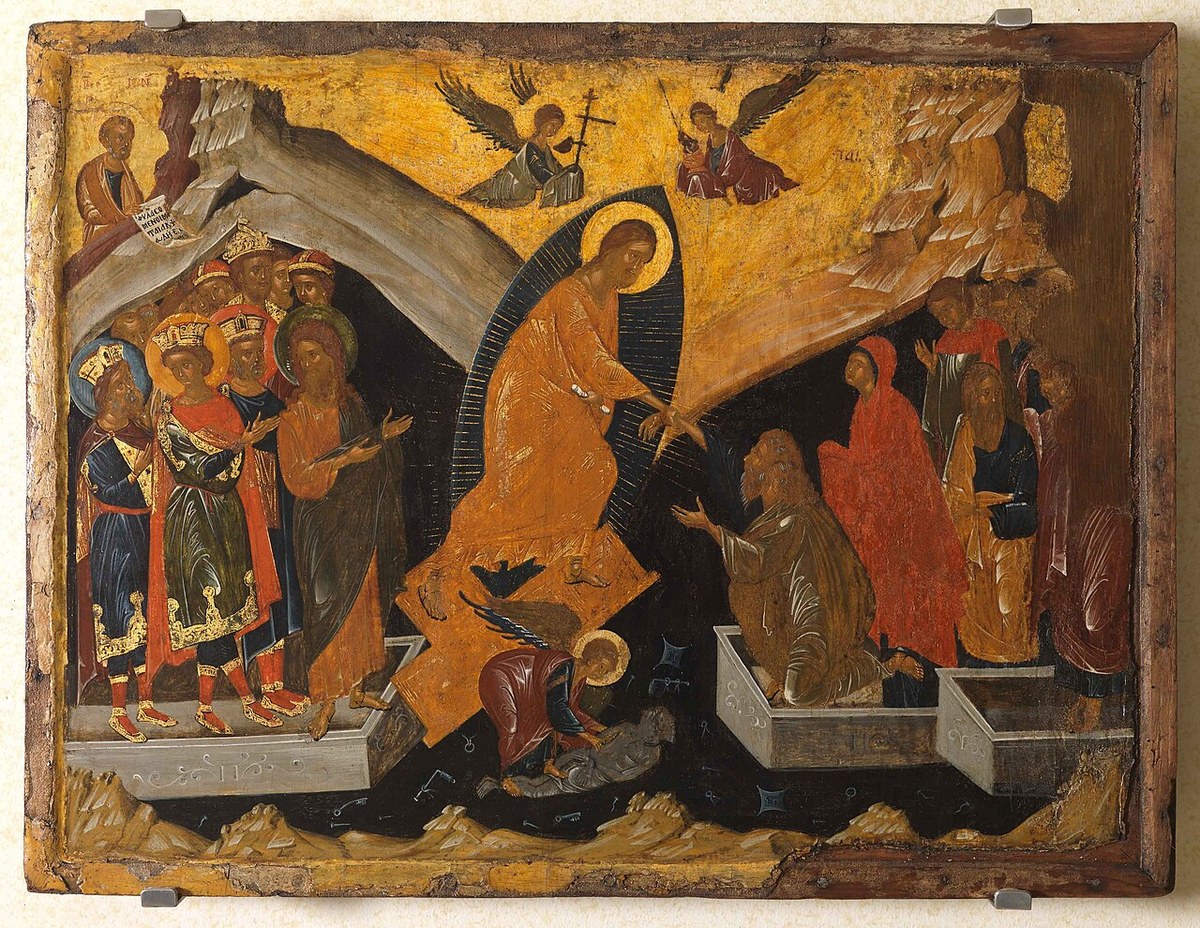
Byzantine art has no image of the Resurrection happening. This is not a failure of nerve or of skill; it is a considered refusal. No one saw the moment. The Gospels describe the tomb before and the appearances after and say nothing at all about the event between, and the iconographic tradition took the silence seriously. What it produced instead is an icon of what the Resurrection is — ἡ Ἀνάστασις, the Resurrection, also and more precisely called ἡ εἰς ᾍδου Κάθοδος, the Descent into Hades — and it is one of the two or three supreme achievements of Orthodox iconography.
The composition, fixed by the tenth or eleventh century and elaborated for six hundred years afterwards, is as follows.
At the centre stands Christ, in a mandorla: sometimes a white almond sown with stars, sometimes — and more powerfully — a body of graduated blue-black rings, the divine darkness, in which the figure is brighter than the light around it. He wears white or gold, and he is in motion. In the earlier and "dynamic" recension he strides across the picture in three-quarter profile, robes flying, leaning back against the weight of what he is pulling; in the later Palaeologan and "symmetrical" recension he stands frontally with both arms extended to either side.
Beneath his feet lie the gates of Hades, torn off and laid across each other in the form of a cross, and around them, scattered over the black floor of the pit, the broken hardware of death: nails, hinges, bolts, keys, locks, padlocks, iron bands. Painters lavished attention on this debris, and rightly: it is an inventory of the security arrangements of the world's oldest prison, all of it now junk.
To the left, Christ grips Adam — and the detail that carries the whole theology is where he grips him. He takes him by the wrist, not the hand. There is no clasp, no mutual grasp, no cooperation: Adam is dead, and a dead man cannot hold on. He is hauled up out of an open sarcophagus by a hand closed round his forearm, and everything in the picture is done from Christ's side. Behind and beyond Adam stand Eve, usually veiled in dark red, her hands covered or reaching, and the righteous of the old covenant.
The company on either side is largely fixed. John the Forerunner is prominent, gaunt in his hair-shirt, often pointing at Christ as he pointed at him in the Jordan — he is there because he had gone ahead to preach in Hades as he had preached on earth. David and Solomon stand crowned, generally in a single sarcophagus; Abel appears young, with a shepherd's crook; behind them press prophets, patriarchs and kings, ranks of them, in some recensions holding scrolls. Above, angels may fly with the Cross and the instruments of the Passion. And below, in the blackness under the broken gates, lies the bound figure of Hades or Satan, sometimes trussed by an angel, sometimes pinned under the fallen doors — small, dark, and finished.
Two observations about how the icon is used. First, its placement in churches is often pointed: it stands in the festal tier of the iconostasis, and very frequently over the west door, so that the congregation walks out of the building under an image of being pulled out of a grave. Second, the Anastasis is also the standard funeral and cemetery image of the Orthodox East, for the obvious reason.
What the icon is not: the Western empty-tomb type
The image most people in the West mean by "the Resurrection" is a different picture altogether: Christ stepping out of, or floating above, an open sarcophagus, holding a cross-staff with a white banner, while armed soldiers sleep or recoil below. That type grew up in Western art from about the eleventh and twelfth centuries, was standardised in the later Middle Ages, and reached its definitive form in the Italian Renaissance. It is a fine and serious tradition of Christian art, and the point of contrasting it here is not to disparage it.
But it is not the Orthodox festal icon, and the difference is not stylistic. The Western type depicts the moment of rising, which no evangelist describes and no witness saw, and it depicts it as a solitary event: one man, his own tomb, his own body, and spectators who are unconscious. The Anastasis depicts the consequence and the content of the rising, and it is unavoidably corporate: Christ is not shown rising at all, he is shown lifting other people, and the persons in the foreground are the human race. One picture answers the question "what happened to Jesus?" The other answers "what happened to us?" That is why the Orthodox tradition holds to the second.
Honesty requires two qualifications. The empty-tomb type did enter Orthodox art, chiefly through Western engravings in the seventeenth and eighteenth centuries; Russian and Greek painters of that period produced Resurrections in the Western manner, and hybrid compositions in which Christ rises above the tomb in the upper register while the Anastasis occupies the lower are not rare. The liturgical books and the twentieth-century recovery of traditional iconography have pushed steadily back toward the Anastasis, and it is the type one finds in any church painted according to the tradition today. And second, the myrrhbearers at the tomb — the women, the angel seated on the stone, the discarded grave-clothes — is a thoroughly authentic Byzantine subject, ancient and much loved; it is simply not the icon of Pascha. It is the icon of the Sunday of the Myrrhbearers and the visual companion of the Eleven Resurrection Gospels.
The stored images
The first stored icon is an anonymous panel of the late fourteenth century from Constantinople, 47.2 × 62 cm, inscribed Ἡ εἰς ᾍδου Κάθοδος — a fully developed Palaeologan Anastasis, and unusual in being wider than it is tall, so that the composition spreads sideways into two crowds. Christ, in a robe of hot orange-gold, stands within a deep blue mandorla ruled with fine gold rays and set against a great dark cave-mouth; the gold ground above is bare. He is caught mid-stride, the body turned to his left, and with his right hand he grips the wrist of Adam, a white-bearded old man kneeling in an open white sarcophagus at the right and reaching up with both arms; Eve, wrapped head to foot in scarlet, stands immediately behind him with a second group of the righteous crowded into a further sarcophagus beyond. On the left stand the kings of Israel in gold-brocaded robes and jewelled crowns, four or five of them pressed together on a stone ledge, with John the Forerunner in front of them in a worn ochre mantle, his hands open toward Christ; above them at the top left a prophet leans out from behind the rock holding an open scroll — the panel's Greek description identifies him as Jonah, the sign of the three days. Two angels fly across the gold at the top, one bearing the Cross and the other a lance and reed. Beneath Christ's feet the gates lie crossed, and the black pit below is strewn with keys, nails, bolts and iron hinges, painted small and precise; at the very bottom centre a haloed figure in dark red bends over the prostrate grey body of Hades to bind him. The panel's own edges, worn and scarred, are part of what one sees.
The second stored image is the greatest of all Anastasis compositions: the fresco in the conch of the parekklesion of the Church of the Holy Saviour in Chora at Constantinople, painted about 1316–1321 in the rebuilding and decoration financed by Theodore Metochites. It is the symmetrical recension at full power. The inscription Η ΑΝΑCΤΑCΙC runs across the top of the curve with the monogram ΙC ΧC beneath it. Christ stands frontally in a white mandorla of concentric bands strewn with stars, in white robes whose folds are drawn with a violence entirely absent from his face, and his arms go out to both sides at once: with his right hand he takes Adam by the wrist and pulls him bodily out of his sarcophagus at the left, the old man's whole weight trailing behind him, and with his left he takes Eve, wrapped in deep red, out of hers at the right. Both are being lifted clear off the ground. Behind Adam stand John the Forerunner and a group of prophets and kings; behind Eve a further company with Abel holding his crook. Beneath Christ's feet the two leaves of the gates lie crossed on the rock, and the whole lower band of the fresco is given over to the strewn locks, bolts, keys, hinges and nails, scattered across a black ground in which the bound figure of the enemy can be made out. The placement is the point: this is the apse of a funerary chapel, painted above the tombs of the founder's circle, so that the dead of the Chora lie under an image of the dead being raised.
The licence basis of the two images is not the same, and the distinction matters. The Constantinopolitan panel is a faithful flat photographic reproduction of a fourteenth-century painting and is stored as pd-old-work. The Chora image is a photograph taken inside the building, up into a curved conch — an angled architectural shot in which the photographer holds a copyright of his own over and above the long-expired rights in the fresco. It is stored on the strength of that photographer's own free licence: CC BY 2.0, by Joseph Kranak, released on Flickr and licence-reviewed on Wikimedia Commons (file page), and its basis is therefore cc-license, not pd-old-work.