
James the Persian
The Holy Great Martyr James the Persian, the Sawn-Asunder
Great Martyr · b. 4th century — d. c. 421
Commemorated 27 November — Martyrdom by dismemberment at Bethlapat in Persia
James the Persian (died c. 421), surnamed Intercisus — "the sawn-asunder" or "cut to pieces" — is among the most venerated of the Persian martyrs. A Christian of noble and wealthy family, he rose to high favour at the court of the Sassanid kings Yazdegerd I and Bahram V; and when Yazdegerd turned to persecuting the Church, James, to keep the royal friendship, joined the king in the worship of the sun and fire. His mother and his wife, both Christians, wrote to rebuke him and to break off communion with him, and their letter recalled him to repentance. Confessing Christ before Bahram V, he was condemned to be dismembered joint by joint — fingers, toes, hands, feet, arms and legs cut away one by one, some twenty-eight pieces — and at last beheaded. Throughout the long torture he gave thanks that God had granted him to redeem his denial by such a death. His graphic martyrdom passed into the Menologia and into the iconography of the Church.
.jpg)
Origins and early life
James was born in the fourth century at Bethlapat (Beth Lapat, the Persian Gundeshapur, in the province of Beth Huzaye / Elam in the Sassanid realm), into a Christian family both wealthy and illustrious. His wife too was a Christian, and the tradition remembers that the household was raised in piety, in the love of prayer and of the Scriptures. Gifted and well-connected, James entered the service of the Persian court and rose high in the favour of the king of kings, holding an honoured place under Yazdegerd I (399–420) and continuing under his successor Bahram V (420–438).
The fall
Yazdegerd I, who in the earlier part of his reign had shown the Christians of his empire a rare tolerance — so much so that the Church of the East held its organising council under his protection — turned in his last years to a violent persecution. In this changed climate James, unwilling to forfeit the king's friendship and the standing he enjoyed at court, dissembled his faith and, to please his master, took part in the royal worship of the sun and of fire. The hagiographers name the fault plainly: from human respect and love of position he denied, in act if not in word, the God he had been raised to serve.
When word of his conformity reached his mother and his wife at home, they were filled with grief; and they wrote him a letter — the pivot of the whole story — in which they reproached him bitterly, telling him that by his cowardice he had cut himself off not only from them, who would no longer share bed or board or communion with an apostate, but from God himself. The letter found its mark. Reading it, James understood the enormity of what he had done; the fear of being severed from Christ overwhelmed the fear of the king, and he wept aloud, imploring the Lord's forgiveness and resolving to confess the faith whatever it should cost.
Martyrdom
His change did not stay hidden. His fellow-courtiers, hearing him at prayer to Jesus Christ, denounced him, and he was brought before Bahram V. Under interrogation James confessed himself a Christian and a servant of the one true God, and no argument, promise, or threat of the king could move him to renounce Christ a second time. Enraged, and resolved to make of him a public terror, Bahram condemned him to a death of calculated cruelty: he was to be taken apart alive, limb by limb and joint by joint.
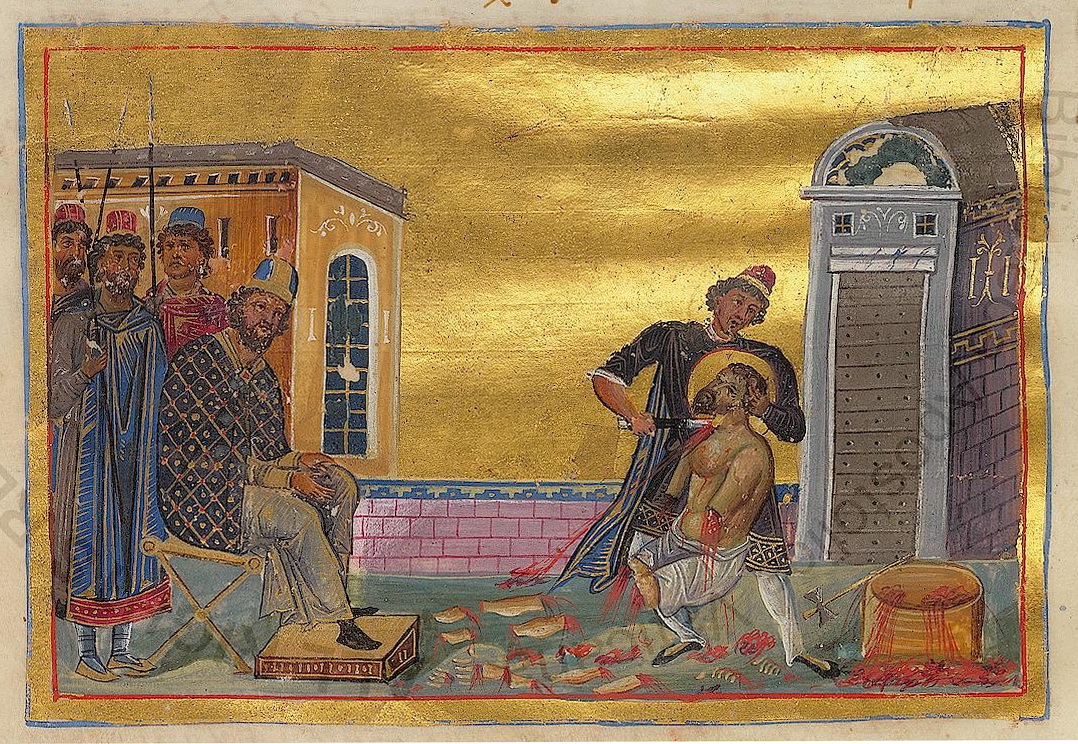
The executioners began with the fingers of one hand and worked through the whole body — the fingers and the toes, then the hands and the feet, then the forearms and the lower legs, then the arms and the thighs — severing him, according to the tradition, into some twenty-eight pieces, and pausing at each to urge him to relent. At every stroke James turned the mutilation into a prayer of thanksgiving, blessing God who had granted him, through these very torments, to wipe away the sin of his denial and to be numbered among the martyrs; the Church's hymns picture him praising the Lord as each part was cut, "his body pruned like a vine-branch." When nothing remained to be cut away, the executioners struck off his head. The Christians of the place gathered up the fragments of his body and buried them with great reverence.
Date and setting
The martyrdom is placed at Bethlapat in Persia, about the year 421, at the opening of the reign of Bahram V, in the persecution that had begun under Yazdegerd I and continued under his son; some accounts give 420 or 422. It belongs to the great age of the Persian martyrs, the long sequence of Christians put to death under the Sassanids from Shapur II onward, whose sufferings the Byzantine calendar keeps in numbers rivalling the martyrs of Rome.
Veneration
James's death made a deep impression on the whole Christian world, East and West. His feast entered the Byzantine synaxaria and the Roman Martyrology alike; proper hymns were composed for him, and his martyrdom — its long, deliberate dismemberment lending itself to a stark image — was set among the illustrations of the Menologia, including the illuminated Menologion of Basil II (c. 1000). Portions of his relics were venerated in a number of centres. His surname Intercisus, "the cut-through," fixed the manner of his death in his very name, and he is invoked especially as a model of the penitent who repairs a grievous fall by an unflinching confession.
Feast and commemoration
November 27 (church date; Old Calendar civil December 10), kept universally in the Byzantine rite, and in the West on the same day in the Roman Martyrology. The commemoration falls within the Nativity Fast. James is styled Great Martyr (μεγαλομάρτυς) in the Greek and Slavonic books for the pre-eminence of his veneration and the severity of his passion.
Hymns
Troparion — Tone 4
Thy martyr James, O Lord, in his contest received an incorruptible crown from thee our God; for possessed of thy might, he cast down the tyrants and shattered the feeble insolence of the demons. By his prayers, O Christ God, save our souls.
Original translation from the Greek
Kontakion — Tone 2
Persuaded by thy good wife, O stout-hearted one, and fearing the dread judgement seat, thou didst spurn the mind and the terror of the Persians, O James, and wast shown a wondrous martyr, thy body cut through like a vine-branch.
Original translation from the Greek
Iconography
James is shown as a young or middle-aged courtier-martyr, richly dressed in the Persian manner and often crowned with the martyr's wreath; in narrative scenes he stands or kneels while executioners sever his limbs, the ground strewn with the pieces of his body — one of the most graphic martyrdoms in the Byzantine pictorial repertoire. The stored image is the miniature of his passion from the Menologion of Basil II (Constantinople, c. 985), which shows the dismemberment in progress.
Disputed questions
- Which James. He is to be distinguished from the several apostolic and other saints of the same name: James the Brother of the Lord (October 23), James the son of Alphaeus (October 9), James the son of Zebedee (April 30) — and, on this very day, from the Russian saint James the Wonderworker, Bishop of Rostov (†1392), and from the ascetic bishop James of Nisibis (†c. 350, January 13), a Syrian hierarch and father of Nicaea of a century earlier. The Persian great-martyr's distinguishing surname is Intercisus, "the sawn-asunder."
- The number of pieces. The tradition that the martyr was cut into twenty-eight parts is fixed in the later accounts; the earliest witnesses emphasise the manner (limb by limb, joint by joint) more than an exact count.