
Paschaltide, day 4 · 3 days since Pascha
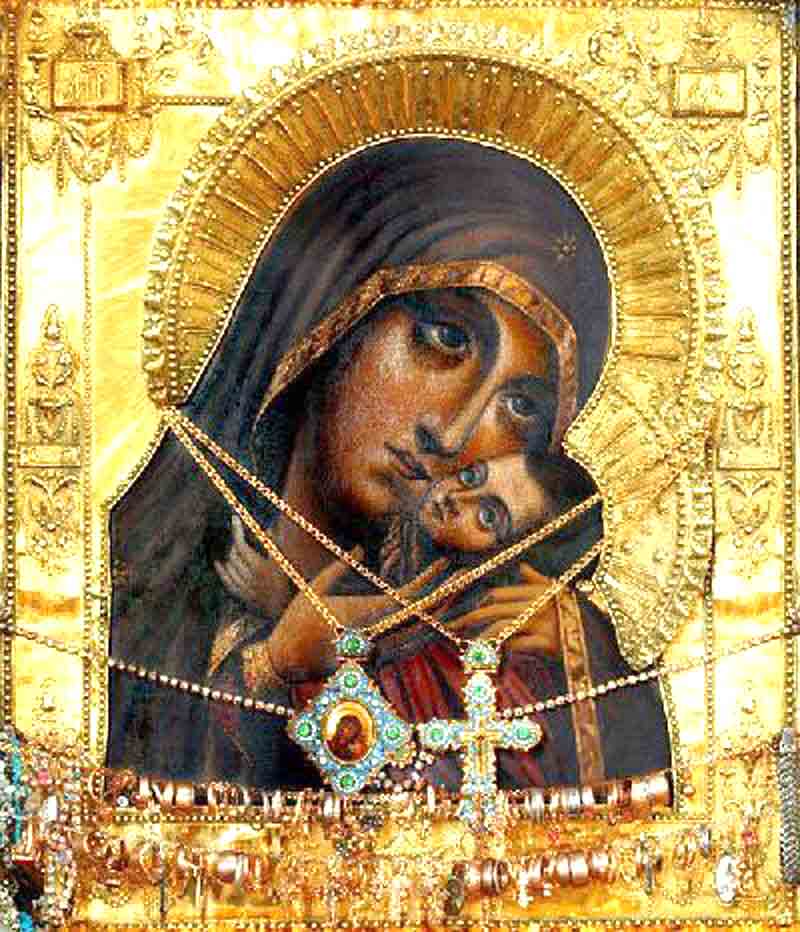
About Kasperov Icon of the Mother of God →

Saints commemorated
-
Great Martyr Irene of Thessalonica
Irenaeus, Irene and Peregrinus are three martyrs commemorated on May 5 who, according to the Latin martyrologies and the Greek synaxaristic notices that follow them, suffered at Thessalonica in the persecution of Diocletian, refusing to sacrifice to the idols and being cast into the fire. Nothing further is transmitted about them. Their dossier is unusually vexed: the Latin manuscript tradition varies, the localisation at Thessalonica has been questioned, and the presence of an Irene in the company on the very day of the Great-Martyr Irene — and in the very city associated with the other virgin-martyr Irene of Thessalonica of April 16 — makes this small commemoration one of the most easily confused in the calendar.
-
Ephraim of Nea Makri
Ephraim is a fifteenth-century Greek monk of Mount Amomon above the modern Nea Makri in Attica, held to have been tortured to death by Turkish raiders on 5 May 1426. Nothing whatever was known of him until 1950, when the nun Makaria Desipri, excavating the ruins of the abandoned Monastery of the Annunciation on the hill, uncovered a burial she took — on the strength of a series of dreams and visions she reported — to be his, and from which the whole of his transmitted biography derives. A very large popular veneration grew up around the shrine within a generation; the Church of Greece entered him in its calendar in 1998 and the Ecumenical Patriarchate in 2011. His commemoration is therefore canonically established and liturgically kept, while the historical foundation of his life rests on private revelation and not on any document, and the Church's own recognition of him was cautious and late.
-
Euthymius of Madytos
Euthymius was a monk of Constantinople who became bishop of Madytos on the European shore of the Hellespont in the last decades of the tenth century, and was famed in his own lifetime as a healer and a seer. He was born at Epivates in Thrace and is remembered chiefly, in the wider Church, as the elder brother of St Parasceva of the Balkans — "Petka" — whose Life records that he went first to the monastic state and drew her after him. He is said to have received the emperor Basil II at Madytos and to have foretold his victory over Bardas Phocas in 989. At his repose, between 989 and 996, myrrh flowed from his tomb, whence he is called the Myrrh-flowing; healings continued there. He is commemorated on May 5.
-
Irene the Great Martyr
Irene is the great-martyr whose long passion — a cycle of tortures survived, deliverances and repeated returns to preaching — made her one of the most widely honoured women saints of the Byzantine world. Born Penelope, the only daughter of a petty pagan king named Licinius, she was shut up from childhood in a tower with thirteen companions, taught the faith in secret by her tutor Apellian, and baptised Irene ("peace") by Timothy, whom the tradition identifies as the disciple of the Apostle Paul. Her father's attempt to kill her ended in his own conversion and that of some three thousand souls; thereafter she passed from city to city under a succession of rulers — Sedekias, Sapor, Numerian, Babdonus — enduring the serpent-pit, the saw, the millwheel and three heated bronze oxen, converting whole populations, and at last reposing near Ephesus, where her sealed tomb was found empty. She is commemorated on May 5.
-
Neophytus, Gaius and Gaianus
Neophytus, Gaius and Gaianus are three martyrs of whom the Greek synaxarion for May 5 preserves a single line: that they were perfected by the sword. Nothing is transmitted of their country, their persecutor, their date, or the relation between them. The one further notice attached to their memory is topographical and belongs to Constantinople: their synaxis was kept in the church of Saints Cosmas and Damian "in the quarter of Dareios", which indicates a real and located cult in the imperial city, however completely their story has been lost.
British Isles and Ireland
- St. Hydroc of Cornwall (5th C)
- St. Echa of Crayke, hermit (767)
Troparia & kontakia
Kontakion — Tone 6
Protection of Christians that cannot be put to shame, mediation unto the Creator unfailing: despise not the suppliant voices of sinners, but be quick to help us who cry to thee in faith; hasten to intercession and make speed to entreaty, O Theotokos, who dost ever protect them that honour thee.
Kontakion — Tone 4
Adorned with the beauties of virginity, O maiden, thou wast made yet more comely by thy contest, O Irene, stained crimson with thine own outpoured blood; and thou didst cast down the delusion of godlessness. Wherefore thou hast received the honours of victory from the hand of thy Creator.
Troparion — Tone 4
To the Theotokos let us now run in haste, we sinners and lowly ones, and let us fall down in repentance, crying from the depth of our soul: O Lady, help us, having compassion upon us; make haste, for we perish from the multitude of our transgressions; turn not thy servants away empty, for thee alone have we as our hope.
Troparion — Tone 4 (common of a venerable-martyr)
Trained in the discipline of the monks and made perfect in the contest of the martyrs, thou didst offer to Christ a twofold crown, O Ephraim: for having died to the world in the ascetic life, thou didst give thy body to torments for His name, and wast found faithful unto the end. Wherefore intercede with Him that our souls may be saved.
Troparion — Tone 4 (common of a hierarch)
The truth of things hath revealed thee to thy flock as a rule of faith, an image of meekness and a teacher of continence, O father and hierarch Euthymius; therefore thou hast attained by humility to the heights, and by poverty to riches. Intercede with Christ God that our souls may be saved.
Troparion — Tone 4 (common of martyrs)
Thy martyrs, O Lord, in their contest received incorruptible crowns from Thee, our God; for possessing Thy strength they cast down the tyrants and shattered the feeble insolence of the demons. By their intercessions save our souls.
Troparion — Tone 4 (common of a virgin-martyr)
Thy lamb Irene crieth unto Thee with a great voice, O Jesus: Thee, my Bridegroom, do I love, and seeking Thee I endure the contest; I am crucified with Thee and buried with Thee in Thy baptism; I suffer for Thy sake that I may reign with Thee, and I die for Thee that I may live with Thee. Receive me as a spotless sacrifice, offered to Thee in love; and by her prayers, O merciful One, save our souls.
Troparion — Tone 4 (common of martyrs)
Thy martyrs, O Lord, in their contest received incorruptible crowns from Thee, our God; for possessing Thy strength they cast down the tyrants and shattered the feeble insolence of the demons. By their intercessions save our souls.
Readings
Epistle
Acts 2.22-36
22Ye men of Israel, hear these words; Jesus of Nazareth, a man approved of God among you by miracles and wonders and signs, which God did by him in the midst of you, as ye yourselves also know: 23Him, being delivered by the determinate counsel and foreknowledge of God, ye have taken, and by wicked hands have crucified and slain: 24Whom God hath raised up, having loosed the pains of death: because it was not possible that he should be holden of it. 25For David speaketh concerning him, I foresaw the Lord always before my face, for he is on my right hand, that I should not be moved: 26Therefore did my heart rejoice, and my tongue was glad; moreover also my flesh shall rest in hope: 27Because thou wilt not leave my soul in hell, neither wilt thou suffer thine Holy One to see corruption. 28Thou hast made known to me the ways of life; thou shalt make me full of joy with thy countenance. 29Men and brethren, let me freely speak unto you of the patriarch David, that he is both dead and buried, and his sepulchre is with us unto this day. 30Therefore being a prophet, and knowing that God had sworn with an oath to him, that of the fruit of his loins, according to the flesh, he would raise up Christ to sit on his throne; 31He seeing this before spake of the resurrection of Christ, that his soul was not left in hell, neither his flesh did see corruption. 32This Jesus hath God raised up, whereof we all are witnesses. 33Therefore being by the right hand of God exalted, and having received of the Father the promise of the Holy Ghost, he hath shed forth this, which ye now see and hear. 34For David is not ascended into the heavens: but he saith himself, The LORD said unto my Lord, Sit thou on my right hand, 35Until I make thy foes thy footstool. 36Therefore let all the house of Israel know assuredly, that God hath made that same Jesus, whom ye have crucified, both Lord and Christ.
Gospel
John 1.35-51
35Again the next day after John stood, and two of his disciples; 36And looking upon Jesus as he walked, he saith, Behold the Lamb of God! 37And the two disciples heard him speak, and they followed Jesus. 38Then Jesus turned, and saw them following, and saith unto them, What seek ye? They said unto him, Rabbi, (which is to say, being interpreted, Master,) where dwellest thou? 39He saith unto them, Come and see. They came and saw where he dwelt, and abode with him that day: for it was about the tenth hour. 40One of the two which heard John speak, and followed him, was Andrew, Simon Peter’s brother. 41He first findeth his own brother Simon, and saith unto him, We have found the Messias, which is, being interpreted, the Christ. 42And he brought him to Jesus. And when Jesus beheld him, he said, Thou art Simon the son of Jona: thou shalt be called Cephas, which is by interpretation, A stone. 43The day following Jesus would go forth into Galilee, and findeth Philip, and saith unto him, Follow me. 44Now Philip was of Bethsaida, the city of Andrew and Peter. 45Philip findeth Nathanael, and saith unto him, We have found him, of whom Moses in the law, and the prophets, did write, Jesus of Nazareth, the son of Joseph. 46And Nathanael said unto him, Can there any good thing come out of Nazareth? Philip saith unto him, Come and see. 47Jesus saw Nathanael coming to him, and saith of him, Behold an Israelite indeed, in whom is no guile! 48Nathanael saith unto him, Whence knowest thou me? Jesus answered and said unto him, Before that Philip called thee, when thou wast under the fig tree, I saw thee. 49Nathanael answered and saith unto him, Rabbi, thou art the Son of God; thou art the King of Israel. 50Jesus answered and said unto him, Because I said unto thee, I saw thee under the fig tree, believest thou? thou shalt see greater things than these. 51And he saith unto him, Verily, verily, I say unto you, Hereafter ye shall see heaven open, and the angels of God ascending and descending upon the Son of man.