
Kasperov Icon of the Mother of God
The Kasperov Icon of our Most Holy Lady the Theotokos and Ever-Virgin Mary
Kept 29 June — The renewal of the darkened image in the house of Maria Kasperova at Novo-Ivanovka, February 1840, kept on this day, 1 October — The deliverance of Odessa from the allied fleet in the Crimean War, 1855, kept with the Protection of the Theotokos, Pascha offset 3
The Kasperov icon is the chief wonderworking image of the Mother of God in the southern Ukrainian lands — of Kherson and above all of Odessa, where it has been kept in the Dormition cathedral. A small oil-painted panel brought out of Transylvania to the Kherson country by a Serb at the end of the sixteenth century, it passed by inheritance until in 1809 it came to a landowner's widow named Maria Kasperova, in whose house, in February 1840, the darkened and almost illegible faces of the Mother and the Child were seen suddenly to brighten and the image to be renewed. Healings followed, the Holy Synod recognised the icon as wonderworking, and in the Crimean War it was carried in procession about besieged Odessa, which was left untouched by the allied fleet. It is commemorated on June 29, on October 1 with the Protection, and on the Wednesday of Bright Week.

Origin and the years of obscurity
The tradition, as the Odessa records give it, is that the icon was carried into the Kherson steppe from Transylvania at the end of the sixteenth century by a Serb, and that it descended in his family from generation to generation as a household blessing. It is a small panel in oils rather than a Byzantine tempera-and-gold icon, and it belongs to the sort of Balkan devotional painting that travelled north with refugees and settlers in the Ottoman centuries. Nothing is recorded of it for two hundred years.
In 1809 it came by inheritance to Maria Kasperova, a landowner's widow of the Olviopol district, at the village of Novo-Ivanovka. By then the paint had darkened so far with age and lamp-smoke that the figures could scarcely be made out.
The renewal, February 1840
In the winter of 1840 the widow, in a season of great trouble, spent a long night at prayer before the image. As she prayed she saw the darkened faces of the Mother of God and of the Child grow bright, and the whole icon was found renewed — the event that gives the icon its date and its name, and the reason the Church keeps its principal feast in June rather than on the anniversary of any later deliverance.
Healings were reported almost at once, and in such number that the neighbourhood began carrying the icon from house to house and from village to village; the diocesan authority investigated, and the Holy Synod recognised it as wonderworking. In 1844 it was translated to a parish church, and thereafter to Kherson and to Odessa, whose people adopted it as their own.
The Crimean War and Odessa
In the war of 1853–1856 the icon was brought into Odessa and carried in procession around the city while the allied fleet lay off the coast. The city was not stormed; the tradition attaches the deliverance to Great and Holy Friday of 1855, and to a Liturgy served before the icon on the feast of the Protection of the Theotokos, after which the fleet withdrew. From that deliverance comes the October 1 commemoration, kept together with the Protection, whose meaning it repeats in local form. From the same period comes the custom, still observed, of an Akathist before the icon every Friday in the Dormition cathedral at Odessa.
The icon remained the palladium of the city through the upheavals of the twentieth century and is venerated by the faithful of the Ukrainian and Russian Churches and by the Orthodox Church in America, whose synaxarion carries it on all three of its days.
Feast and commemoration
Three commemorations are kept:
- June 29 (Old Calendar civil July 12) — the principal feast, of the renewal of the image in 1840. It falls on the great feast of the Chief Apostles Peter and Paul, in whose shadow it is kept: in practice the icon is honoured at the proskomedia, in the litanies and at a moleben rather than by a sung service of its own.
- October 1 (Old Calendar civil October 14) — the deliverance of Odessa, kept with the Protection of the Theotokos.
- The Wednesday of Bright Week — a movable commemoration, entered here under 3 days after Pascha and belonging to the movable cycle, not to any fixed day.
The feast is local — Kherson, Odessa and the Ukrainian south — rather than universal, and is carried in Russian, Ukrainian and OCA usage.
Hymns
Troparion — Tone 4
To the Theotokos let us now run in haste, we sinners and lowly ones, and let us fall down in repentance, crying from the depth of our soul: O Lady, help us, having compassion upon us; make haste, for we perish from the multitude of our transgressions; turn not thy servants away empty, for thee alone have we as our hope.
Original translation from the Slavonic
Kontakion — Tone 6
Protection of Christians that cannot be put to shame, mediation unto the Creator unfailing: despise not the suppliant voices of sinners, but be quick to help us who cry to thee in faith; hasten to intercession and make speed to entreaty, O Theotokos, who dost ever protect them that honour thee.
Original translation from the Slavonic
Appointed readings
Epistle — Philippians 2:5–11
5Let this mind be in you, which was also in Christ Jesus: 6Who, being in the form of God, thought it not robbery to be equal with God: 7But made himself of no reputation, and took upon him the form of a servant, and was made in the likeness of men: 8And being found in fashion as a man, he humbled himself, and became obedient unto death, even the death of the cross. 9Wherefore God also hath highly exalted him, and given him a name which is above every name: 10That at the name of Jesus every knee should bow, of things in heaven, and things in earth, and things under the earth; 11And that every tongue should confess that Jesus Christ is Lord, to the glory of God the Father.
Gospel — Luke 10:38–42; 11:27–28
38Now it came to pass, as they went, that he entered into a certain village: and a certain woman named Martha received him into her house. 39And she had a sister called Mary, which also sat at Jesus’ feet, and heard his word. 40But Martha was cumbered about much serving, and came to him, and said, Lord, dost thou not care that my sister hath left me to serve alone? bid her therefore that she help me. 41And Jesus answered and said unto her, Martha, Martha, thou art careful and troubled about many things: 42But one thing is needful: and Mary hath chosen that good part, which shall not be taken away from her. 27And it came to pass, as he spake these things, a certain woman of the company lifted up her voice, and said unto him, Blessed is the womb that bare thee, and the paps which thou hast sucked. 28But he said, Yea rather, blessed are they that hear the word of God, and keep it.
Iconography
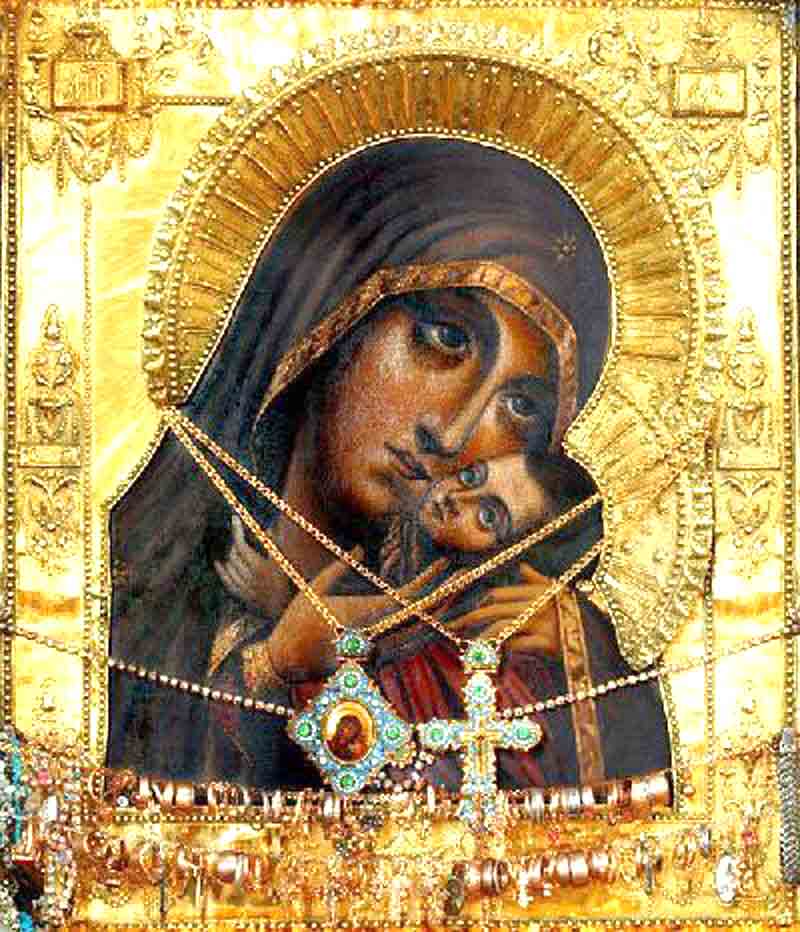
The Kasperov image is of the Eleousa family — the Mother of God inclining her head toward the Child — but painted in oils in a South Slav and Central European manner rather than in the Byzantine technique, and the modelling of the faces is naturalistic. The Mother holds the Child on her left arm; he holds a scroll. Its distinguishing feature is the pair of small standing figures flanking the central group, identified as John the Forerunner and the Martyr Tatiana — almost certainly the patrons of the original owners, and a sure sign of a private devotional commission rather than a church panel. The image is heavily overlaid with a riza and votive offerings in its later photographs.
The stored image shows the icon as it is venerated at the Holy Spirit cathedral in Kherson: the sixteenth-century panel set under a silver-gilt riza with a rayed halo, the metal covering everything but the faces and hands, and hung about with votive crosses and a pectoral medallion. The flanking figures of the Forerunner and the Martyr Tatiana are hidden by the cover and are known from descriptions rather than from this photograph. Storage rests on the age of the underlying work — a panel of about 1550 under a pre-modern riza, photographed frontally as a faithful flat reproduction — and not on any modern photographer's grant; the Commons file carries a public-domain tag for the photograph itself in addition.