
Ascensiontide, day 9 · 47 days since Pascha
Leavetaking of Ascension
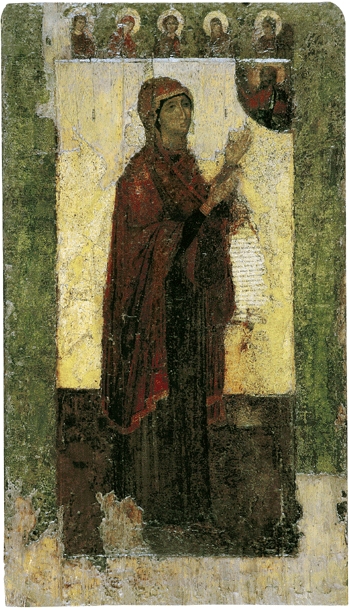
About Bogolyubskaya Icon of the Mother of God →

Saints commemorated
-
Martyr Leontius and Companions
-
Aetherius of Nicomedia
Aetherius is a martyr of the Diocletianic persecution, kept on June 18 in the Greek and Slavonic books beside the martyrs of Tripoli. Of his life the synaxarion transmits nothing but the fact of his constancy: arrested, offered the usual mixture of threats and promises, and then beaten, scourged and left bleeding, he would not yield, and died faithful. His name — from αἰθήρ, the upper air — supplied the hagiographer with the one thing the notice really contains: the couplet of the day says that he endured many torments and received their reward in the breadth of the aether.
-
Hypatius and Theodulus
Hypatius, a tribune, and Theodulus, a soldier under him, were sent by the governor Hadrian to arrest the Christian officer Leontius at Tripoli in Phoenicia, and were converted on the road: Hypatius, struck down by fever, was healed after calling three times on "the God of Leontius" as an angel had told him in his sleep, and Theodulus was won by what he had watched. They came into the city as catechumens instead of captors, were baptised by the man they had come to seize, and when Hadrian tried them refused to sacrifice. Hypatius was torn with the iron claws and Theodulus beaten with rods; both were then beheaded, dying before Leontius, who was beaten to death after them.
-
Leontius of the Kiev Caves
Leontius, called the Canonarch, was a boy or very young monk of the Kiev Caves Lavra in the fourteenth century who was given the office of canonarch — the singer who intones the verses and gives out the tone for the choirs — because of the unusual beauty of his voice. He was taught the Scriptures, kept the office faithfully, and died young. His relics rest in the Far (Theodosian) Caves, and he is commemorated on June 18, the day of his heavenly patron Leontius of Tripoli, and with the fathers of the Far Caves on August 28.
-
Leontius of Tripoli
Leontius, a Greek by birth and an officer of the Roman army stationed at Tripoli in Phoenicia — the coastal city that is now Ṭarābulus in Lebanon, and to this day a metropolitan see of the Patriarchate of Antioch — is the great soldier-martyr of the Antiochian patriarchal territory. The Passion makes him a commander of exemplary courage and open-handed charity who turned many of the city from idols; the governor Hadrian, sent to suppress the Christians, dispatched the tribune Hypatius and the soldier Theodulus to arrest him, and they were converted on the road and baptised by his hand. All three were tortured; Hypatius and Theodulus were beheaded, and Leontius, hung up with a stone about his neck and beaten, gave up his soul under the blows. His martyrion at Tripoli became one of the notable shrines of the Phoenician coast: it was there, in 488, that the future patriarch Severus of Antioch was baptised.
-
Leontius the Athonite
Leontius, born at Argos in the Peloponnese in 1520, took the monastic habit at seventeen in a hermitage of the Argolid, and after the Turkish capture of Nauplion in 1540 crossed to the Holy Mountain and entered the Monastery of Dionysiou. There he remained for sixty years without once passing outside the monastery's gate — the detail on which his whole tradition turns — and there he was given the gifts of discernment and of prophecy. He reposed on 16 March 1605, aged eighty-five; his relics streamed myrrh, from which he is called Myroblytes, the Myrrh-streamer. He is commemorated on June 18, the day of his patron the martyr Leontius of Tripoli.
-
Leontius the Shepherd
A monk called Leontius the Shepherd, commemorated in the Greek books on June 18 — the fourth Leontius of a day that is crowded with them — of whom the synaxarion records only that he reposed in peace. The Greek heading places his monastery or cell beyond the city (πέραν τοῦ ἄστεος), and the couplet of the day plays his epithet against the Chief Shepherd before whom he now stands: being a shepherd, thou standest now before the Shepherd, before the Chief of shepherds, O right-minded Leontius.
-
Two Martyrs of Cyprus
Two Christians of Cyprus, whose names have not been transmitted, are commemorated on June 18. All that the synaxarion records of them is the manner of their death: their feet were burned, and they were perfected. The metrical couplet of the day sets the brevity of the torment against the length of its reward — having endured the burning of their feet for a single hour, the two martyrs rejoice eternally — and that antithesis is, in effect, the whole of what the Church has kept about them.
Troparia & kontakia
Apolytikion — Tone 4
Thy martyr Aetherius, O Lord, in his striving has received from Thee our God the crown that does not wither; for holding fast Thy might he threw down the tyrants, and shattered the feeble insolence of the demons. At his entreaties save our souls.
Apolytikion — Tone 4
O ye who bore the sword of the emperor and were found bearing the cross of Christ, Hypatius and Theodulus, ye came to bind a martyr and were loosed by him; and being washed in the rain of heaven ye were made worthy of the crown. Entreat the merciful God to grant our souls forgiveness of sins.
Apolytikion — Tone 8
In thee, O Father, was preserved unimpaired that which is according to the image; for taking up the cross thou didst follow after Christ, and by thy deeds thou didst teach us to overlook the flesh, which passes away, and to attend to the soul, which is a thing immortal. Wherefore, O venerable Leontius, thy spirit rejoices with the angels.
Apolytikion — Tone 4
Thy martyr Leontius, O Lord, in his striving has received from Thee our God the crown that does not wither; for holding fast Thy might he threw down the tyrants, and shattered the feeble insolence of the demons. At his entreaties save our souls.
Apolytikion — Tone 8
In thee, O Father, was preserved unimpaired that which is according to the image; for taking up the cross thou didst follow after Christ, and by thy deeds thou didst teach us to overlook the flesh, which passes away, and to attend to the soul, which is a thing immortal. Wherefore, O venerable Leontius, thy spirit rejoices with the angels.
Apolytikion — Tone 8
In thee, O Father, was preserved unimpaired that which is according to the image; for taking up the cross thou didst follow after Christ, and by thy deeds thou didst teach us to overlook the flesh, which passes away, and to attend to the soul, which is a thing immortal. Wherefore, O venerable Leontius, thy spirit rejoices with the angels.
Apolytikion — Tone 4
The fire that was set beneath your feet, O blessed pair, could hold you but an hour, and could not turn you back one step from Christ; wherefore, having run the short course, ye have entered into the rest that has no end. O holy martyrs of Cyprus, entreat the merciful God to grant our souls forgiveness of sins.
Kontakion — Tone 3
Thou didst appear standing to the God-loving prince, holding in thy hand the writing of thy prayer for the world, and thou didst choose thyself a dwelling in this land; wherefore we cry to thee: as thou didst stay the plague and the sword, so stay every evil from us who honour thine image, O Mother of God who lovest mankind.
Kontakion — Tone 3
The soldier of the earthly king was found a soldier of the King of heaven, and the body that was beaten became an anvil on which no stroke could tell; wherefore Tripoli holds thy grave in honour, O Leontius, and the faithful cry to thee: pray that our souls may be saved.
Troparion — Tone 1
All-hymned and most glorious Queen, Mother of God, receive this hymn of praise from thine unworthy servants, and cease not to pray to thy Son and our God for the city and for the people that hope in thee, but be a wall of defence and a shelter, granting to the faithful peace and great mercy.
Readings
Epistle
Acts 27.1-44
1And when it was determined that we should sail into Italy, they delivered Paul and certain other prisoners unto one named Julius, a centurion of Augustus’ band. 2And entering into a ship of Adramyttium, we launched, meaning to sail by the coasts of Asia; one Aristarchus, a Macedonian of Thessalonica, being with us. 3And the next day we touched at Sidon. And Julius courteously entreated Paul, and gave him liberty to go unto his friends to refresh himself. 4And when we had launched from thence, we sailed under Cyprus, because the winds were contrary. 5And when we had sailed over the sea of Cilicia and Pamphylia, we came to Myra, a city of Lycia. 6And there the centurion found a ship of Alexandria sailing into Italy; and he put us therein. 7And when we had sailed slowly many days, and scarce were come over against Cnidus, the wind not suffering us, we sailed under Crete, over against Salmone; 8And, hardly passing it, came unto a place which is called The fair havens; nigh whereunto was the city of Lasea. 9Now when much time was spent, and when sailing was now dangerous, because the fast was now already past, Paul admonished them, 10And said unto them, Sirs, I perceive that this voyage will be with hurt and much damage, not only of the lading and ship, but also of our lives. 11Nevertheless the centurion believed the master and the owner of the ship, more than those things which were spoken by Paul. 12And because the haven was not commodious to winter in, the more part advised to depart thence also, if by any means they might attain to Phenice, and there to winter; which is an haven of Crete, and lieth toward the south west and north west. 13And when the south wind blew softly, supposing that they had obtained their purpose, loosing thence, they sailed close by Crete. 14But not long after there arose against it a tempestuous wind, called Euroclydon. 15And when the ship was caught, and could not bear up into the wind, we let her drive. 16And running under a certain island which is called Clauda, we had much work to come by the boat: 17Which when they had taken up, they used helps, undergirding the ship; and, fearing lest they should fall into the quicksands, strake sail, and so were driven. 18And we being exceedingly tossed with a tempest, the next day they lightened the ship; 19And the third day we cast out with our own hands the tackling of the ship. 20And when neither sun nor stars in many days appeared, and no small tempest lay on us, all hope that we should be saved was then taken away. 21But after long abstinence Paul stood forth in the midst of them, and said, Sirs, ye should have hearkened unto me, and not have loosed from Crete, and to have gained this harm and loss. 22And now I exhort you to be of good cheer: for there shall be no loss of any man’s life among you, but of the ship. 23For there stood by me this night the angel of God, whose I am, and whom I serve, 24Saying, Fear not, Paul; thou must be brought before Cæsar: and, lo, God hath given thee all them that sail with thee. 25Wherefore, sirs, be of good cheer: for I believe God, that it shall be even as it was told me. 26Howbeit we must be cast upon a certain island. 27But when the fourteenth night was come, as we were driven up and down in Adria, about midnight the shipmen deemed that they drew near to some country; 28And sounded, and found it twenty fathoms: and when they had gone a little further, they sounded again, and found it fifteen fathoms. 29Then fearing lest we should have fallen upon rocks, they cast four anchors out of the stern, and wished for the day. 30And as the shipmen were about to flee out of the ship, when they had let down the boat into the sea, under colour as though they would have cast anchors out of the foreship, 31Paul said to the centurion and to the soldiers, Except these abide in the ship, ye cannot be saved. 32Then the soldiers cut off the ropes of the boat, and let her fall off. 33And while the day was coming on, Paul besought them all to take meat, saying, This day is the fourteenth day that ye have tarried and continued fasting, having taken nothing. 34Wherefore I pray you to take some meat: for this is for your health: for there shall not an hair fall from the head of any of you. 35And when he had thus spoken, he took bread, and gave thanks to God in presence of them all: and when he had broken it, he began to eat. 36Then were they all of good cheer, and they also took some meat. 37And we were in all in the ship two hundred threescore and sixteen souls. 38And when they had eaten enough, they lightened the ship, and cast out the wheat into the sea. 39And when it was day, they knew not the land: but they discovered a certain creek with a shore, into the which they were minded, if it were possible, to thrust in the ship. 40And when they had taken up the anchors, they committed themselves unto the sea, and loosed the rudder bands, and hoised up the mainsail to the wind, and made toward shore. 41And falling into a place where two seas met, they ran the ship aground; and the forepart stuck fast, and remained unmoveable, but the hinder part was broken with the violence of the waves. 42And the soldiers’ counsel was to kill the prisoners, lest any of them should swim out, and escape. 43But the centurion, willing to save Paul, kept them from their purpose; and commanded that they which could swim should cast themselves first into the sea, and get to land: 44And the rest, some on boards, and some on broken pieces of the ship. And so it came to pass, that they escaped all safe to land.
Gospel
John 17.18-26
18As thou hast sent me into the world, even so have I also sent them into the world. 19And for their sakes I sanctify myself, that they also might be sanctified through the truth. 20Neither pray I for these alone, but for them also which shall believe on me through their word; 21That they all may be one; as thou, Father, art in me, and I in thee, that they also may be one in us: that the world may believe that thou hast sent me. 22And the glory which thou gavest me I have given them; that they may be one, even as we are one: 23I in them, and thou in me, that they may be made perfect in one; and that the world may know that thou hast sent me, and hast loved them, as thou hast loved me. 24Father, I will that they also, whom thou hast given me, be with me where I am; that they may behold my glory, which thou hast given me: for thou lovedst me before the foundation of the world. 25O righteous Father, the world hath not known thee: but I have known thee, and these have known that thou hast sent me. 26And I have declared unto them thy name, and will declare it: that the love wherewith thou hast loved me may be in them, and I in them.