
Pentecost week, day 1 · 49 days since Pascha
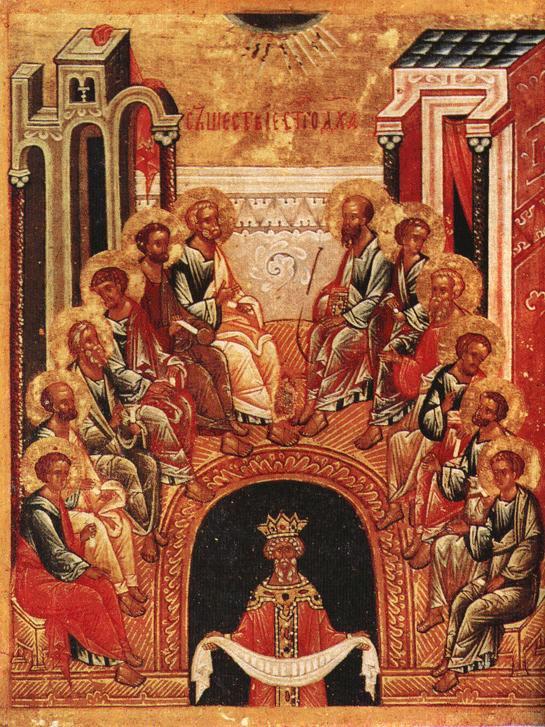
Holy Pentecost

Saints commemorated
-
Martyrs Manuel, Sabel, Ismael of Persia
Three brothers of a noble Persian house — a pagan father, a Christian mother who had them baptised in secret — who entered the royal service and were sent as ambassadors to negotiate a peace with the emperor Julian the Apostate. Received with honour, they were ruined by a single refusal: they would not join the emperor at his sacrifices. Julian broke off the negotiation, held the envoys as prisoners, and when they answered that they had been sent to treat of peace and not of gods, had them tortured and beheaded at Chalcedon in 362. The outrage against the persons of ambassadors was answered, the tradition says, by the very war Julian had been trying to avert; and the emperor died in it a year later. Their relics were enshrined at Constantinople, and Theodosius the Great built a church over them.
-
Our Holy Father Botolph, Abbot of the Monastery of Ikanhoe (680)
-
Ananias the Iconographer
Ananias was a monk of the Monastery of Saint Antony the Roman at Novgorod and a painter of icons, remembered for two things: the beauty of the images he made of the holy wonderworkers, and the fact that for thirty-three years he never once passed outside the monastery walls. He reposed in the sixteenth century — the year is given variously as 1521, 1561 and 1581 — and was buried in the monastery, at a place no longer known. He is commemorated on June 21, and again with the Synaxis of the Saints of Novgorod on the third Sunday after Pentecost.
-
Botolph of Iken
The Anglo-Saxon abbot of Icanho, whose monastery the Anglo-Saxon Chronicle records him beginning to build in 654 — a fixed point in a century that gives historians very few. Botolph was formed as a monk on the Continent, returned to East Anglia, and settled with his brother on a tract of marsh and heath on the tidal Alde in what is now Suffolk, where he governed a community for some quarter of a century until his repose about 680. The near-contemporary Life of Ceolfrith — the best witness to him, written by someone who had no reason to flatter — calls him a man of unequalled life and learning, full of the grace of the Holy Spirit. When the Danes came, his relics were carried inland and eventually divided between Thorney, Ely and Westminster; from the churches at the gates of London that bear his name he became the patron of travellers, and the town of Boston — Botolph's stone — carries his name still.
-
Hervé of Plouvien
Blind from birth, the son of a bard, Hervé became the most loved of all the saints of Brittany after Yves — a singer and teacher who never took priest's orders, never held any rank above exorcist, and governed the monastic school at Plouvien and then the abbey of Lanhouarneau in Léon by the authority of what he was rather than of any office. His century is the sixth, his repose about 575. He is the Breton patron of the blind, of bards and musicians, invoked for diseases of the eyes and for sick horses; and the wolf that ate his plough-beast and was made to take its place in the harness is the best-known animal in Breton hagiography.
-
Hypatius of Rufinianae
A Phrygian who ran away from a beating at eighteen and died forty-odd years later the most consulted abbot on the Asian shore of the Bosphorus. Hypatius restored the deserted monastery of the Rufinianae — the suburban foundation of the murdered prefect Rufinus at the Oak, outside Chalcedon — and governed it for nearly half a century, to his repose in 446. He sheltered Alexander the Sleepless when the Akoimetoi were driven out of the capital; he struck the name of Nestorius from the diptychs of his church before any council had condemned him, and against his own bishop's wishes; and he broke by open threat of martyrdom a plan to revive the Olympic games at Chalcedon. His disciple Callinicus wrote his Life — one of the finest and most concrete documents of early Byzantine monasticism.
-
Isaurus, Basil, Innocent, Felix, Hermias and Peregrinus
Six martyrs of the third century who carry the printed service of June 17 in the Greek Menaion — the day's chief commemoration in Greek use, though the Slavonic books put them second. The company is led by Isaurus, a deacon of Athens, who with five companions crossed into Macedonia and came to Apollonia, where they lodged in a cave outside the city and went in to preach. Arrested and refusing to sacrifice, three of them — Felix, Hermias and Peregrinus — were beheaded first, and Isaurus, Basil and Innocent after them, about the year 283, in the persecution under Numerian. The Menaion's own notice of them is a single bare line of names: the narrative comes from the fuller passion preserved in the Greek synaxaristic collections.
-
Joseph and Pior
Two of the disciples of Anthony the Great, commemorated together on June 17. Of Joseph the calendars transmit nothing but the name. Pior is one of the best-drawn of the Egyptian fathers: an anchorite of Scetis who left his father's house under a vow never to look on his family again and kept it for fifty years, drank all his life from a well of bitter water he had dug himself rather than move to a sweeter place, and ate walking about, so that eating should never become an occupation. His sayings are preserved in the Apophthegmata and his life is described by Palladius in the Lausiac History and by the historian Sozomen.
-
Moling of Ferns
An Irish monk of the seventh century — reckoned among the four prophets of Ireland — who founded the monastery of Tech Moling on the river Barrow, the place that still bears his name as St Mullins in County Carlow, and who became the second bishop of Ferns after Máedóc. He is remembered for two things above all: for talking the high king Finnachta out of the Bórama, the ruinous cattle-tribute laid on Leinster by the kings of Tara, by a play on words that the Irish have relished for thirteen centuries; and for the Book of Mulling, the little pocket gospel-book that bears his name and preserves, on its last page, a plan of his own monastery — the earliest such plan to survive from anywhere in the Celtic world. He died in 697.
-
Nectan of Hartland
A Welsh hermit of the sixth century, reckoned the eldest of the many children of Brychan of Brycheiniog, who crossed the Bristol Channel with a company of his kindred and settled alone in a wooded valley above the sea at Stoke, by Hartland in north Devon. Given two cows by a swineherd whose lost pigs he had found, he went after the thieves who took them, preached to them, and was beheaded for it. The Life relates that he took up his own head and carried it back the half mile to the spring beside his cell before he laid it down. His shrine at Hartland was among the great pilgrim churches of the Devon coast; King Athelstan, healed at his intercession on the campaign of 937, endowed it, and the parish keeps him still.
-
Philonides of Kourion
The first bishop of Kourion whose name is preserved — the Cypriot city on the cliff above the southern sea whose great sanctuary of Apollo Hylates made it one of the strongholds of the old religion on the island. Philonides was taken in the persecution of Diocletian, about the year 306, with a presbyter, a deacon and a reader of his church, who were put to death before his eyes. When his captors threatened, if he would not sacrifice, to hand him over to be sexually violated, the aged bishop got out to the edge of the cliff, prayed, signed himself three times with the cross, and cast himself down, choosing death over defilement. He is commemorated on June 17 and, in Cyprus, again on August 30.
-
Shalva of Akhaltsikhe
A Georgian commander of the generation that won the great victories of Queen Tamar and lived to see them undone. Shalva of Akhaltsikhe, of the princely house of the Toreli, was one of the victors of Shamkori in 1195, where he took the caliph's own standard and gave it as an offering to the Khakhuli icon of the Mother of God. Thirty years later, in the reign of Rusudan, he and his brother Ivane were sent with six thousand men against the vast army of the Khwarazmian sultan Jalal ad-Din, and were left unsupported by a jealous commander-in-chief; Ivane was killed, and Shalva taken. The sultan offered him cities and treasure to become a Muslim. He refused, was tortured through a day, and was thrown half dead into prison, where he died in 1227.
British Isles and Ireland
- St. Botolph, abbot and confessor, of Boston, and his brother St. Adolph (680)
- St. Molling, abbot of Aghacainid (697)
- St. Briavel, hermit (6th C)
Readings
Vespers
Numbers 11.16-17, 24-29
16And the LORD said unto Moses, Gather unto me seventy men of the elders of Israel, whom thou knowest to be the elders of the people, and officers over them; and bring them unto the tabernacle of the congregation, that they may stand there with thee. 17And I will come down and talk with thee there: and I will take of the spirit which is upon thee, and will put it upon them; and they shall bear the burden of the people with thee, that thou bear it not thyself alone. 24And Moses went out, and told the people the words of the LORD, and gathered the seventy men of the elders of the people, and set them round about the tabernacle. 25And the LORD came down in a cloud, and spake unto him, and took of the spirit that was upon him, and gave it unto the seventy elders: and it came to pass, that, when the spirit rested upon them, they prophesied, and did not cease. 26But there remained two of the men in the camp, the name of the one was Eldad, and the name of the other Medad: and the spirit rested upon them; and they were of them that were written, but went not out unto the tabernacle: and they prophesied in the camp. 27And there ran a young man, and told Moses, and said, Eldad and Medad do prophesy in the camp. 28And Joshua the son of Nun, the servant of Moses, one of his young men, answered and said, My lord Moses, forbid them. 29And Moses said unto him, Enviest thou for my sake? would God that all the LORD’s people were prophets, and that the LORD would put his spirit upon them!
Joel 2.23-32
23Be glad then, ye children of Zion, and rejoice in the LORD your God: for he hath given you the former rain moderately, and he will cause to come down for you the rain, the former rain, and the latter rain in the first month. 24And the floors shall be full of wheat, and the fats shall overflow with wine and oil. 25And I will restore to you the years that the locust hath eaten, the cankerworm, and the caterpiller, and the palmerworm, my great army which I sent among you. 26And ye shall eat in plenty, and be satisfied, and praise the name of the LORD your God, that hath dealt wondrously with you: and my people shall never be ashamed. 27And ye shall know that I am in the midst of Israel, and that I am the LORD your God, and none else: and my people shall never be ashamed. 28And it shall come to pass afterward, that I will pour out my spirit upon all flesh; and your sons and your daughters shall prophesy, your old men shall dream dreams, your young men shall see visions: 29And also upon the servants and upon the handmaids in those days will I pour out my spirit. 30And I will shew wonders in the heavens and in the earth, blood, and fire, and pillars of smoke. 31The sun shall be turned into darkness, and the moon into blood, before the great and the terrible day of the LORD come. 32And it shall come to pass, that whosoever shall call on the name of the LORD shall be delivered: for in mount Zion and in Jerusalem shall be deliverance, as the LORD hath said, and in the remnant whom the LORD shall call.
Ezekiel 36.24-28
24For I will take you from among the heathen, and gather you out of all countries, and will bring you into your own land. 25Then will I sprinkle clean water upon you, and ye shall be clean: from all your filthiness, and from all your idols, will I cleanse you. 26A new heart also will I give you, and a new spirit will I put within you: and I will take away the stony heart out of your flesh, and I will give you an heart of flesh. 27And I will put my spirit within you, and cause you to walk in my statutes, and ye shall keep my judgments, and do them. 28And ye shall dwell in the land that I gave to your fathers; and ye shall be my people, and I will be your God.
Matins Gospel
John 20.19-23
19Then the same day at evening, being the first day of the week, when the doors were shut where the disciples were assembled for fear of the Jews, came Jesus and stood in the midst, and saith unto them, Peace be unto you. 20And when he had so said, he shewed unto them his hands and his side. Then were the disciples glad, when they saw the Lord. 21Then said Jesus to them again, Peace be unto you: as my Father hath sent me, even so send I you. 22And when he had said this, he breathed on them, and saith unto them, Receive ye the Holy Ghost: 23Whose soever sins ye remit, they are remitted unto them; and whose soever sins ye retain, they are retained.
Epistle
Acts 2.1-11
1And when the day of Pentecost was fully come, they were all with one accord in one place. 2And suddenly there came a sound from heaven as of a rushing mighty wind, and it filled all the house where they were sitting. 3And there appeared unto them cloven tongues like as of fire, and it sat upon each of them. 4And they were all filled with the Holy Ghost, and began to speak with other tongues, as the Spirit gave them utterance. 5And there were dwelling at Jerusalem Jews, devout men, out of every nation under heaven. 6Now when this was noised abroad, the multitude came together, and were confounded, because that every man heard them speak in his own language. 7And they were all amazed and marvelled, saying one to another, Behold, are not all these which speak Galilæans? 8And how hear we every man in our own tongue, wherein we were born? 9Parthians, and Medes, and Elamites, and the dwellers in Mesopotamia, and in Judæa, and Cappadocia, in Pontus, and Asia, 10Phrygia, and Pamphylia, in Egypt, and in the parts of Libya about Cyrene, and strangers of Rome, Jews and proselytes, 11Cretes and Arabians, we do hear them speak in our tongues the wonderful works of God.
Gospel
John 7.37-52, 8.12
37In the last day, that great day of the feast, Jesus stood and cried, saying, If any man thirst, let him come unto me, and drink. 38He that believeth on me, as the scripture hath said, out of his belly shall flow rivers of living water. 39(But this spake he of the Spirit, which they that believe on him should receive: for the Holy Ghost was not yet given; because that Jesus was not yet glorified.) 40Many of the people therefore, when they heard this saying, said, Of a truth this is the Prophet. 41Others said, This is the Christ. But some said, Shall Christ come out of Galilee? 42Hath not the scripture said, That Christ cometh of the seed of David, and out of the town of Bethlehem, where David was? 43So there was a division among the people because of him. 44And some of them would have taken him; but no man laid hands on him. 45Then came the officers to the chief priests and Pharisees; and they said unto them, Why have ye not brought him? 46The officers answered, Never man spake like this man. 47Then answered them the Pharisees, Are ye also deceived? 48Have any of the rulers or of the Pharisees believed on him? 49But this people who knoweth not the law are cursed. 50Nicodemus saith unto them, (he that came to Jesus by night, being one of them,) 51Doth our law judge any man, before it hear him, and know what he doeth? 52They answered and said unto him, Art thou also of Galilee? Search, and look: for out of Galilee ariseth no prophet. 12Then spake Jesus again unto them, saying, I am the light of the world: he that followeth me shall not walk in darkness, but shall have the light of life.
Troparia & kontakia
Apolytikion — Tone 8
Blessed art thou, O Christ our God, who hast shown forth the fishermen as all-wise, sending down upon them the Holy Spirit, and through them taking the whole world in thy net. O Lover of mankind, glory to thee.
Apolytikion — Tone 8 (common of a venerable monastic)
In thee, O Father, was the image of God preserved unimpaired; for taking up the Cross thou didst follow Christ, and by thy deeds thou didst teach us to despise the flesh, which passeth away, but to care for the soul, a thing immortal. Wherefore, O venerable Ananias, thy spirit rejoiceth with the angels.
Apolytikion — Tone 4 (common of several martyrs)
Thy martyrs Isaurus, Basil, Innocent, Felix, Hermias and Peregrinus, O Lord, in their contest received incorruptible crowns from Thee our God; for possessing Thy strength, they cast down the tyrants and shattered the feeble insolence of the demons. By their intercessions save our souls.
Kontakion — Tone 8
When the Most High came down and confounded the tongues, he divided the nations; when he distributed the tongues of fire, he called all men into unity; and with one accord we glorify the all-holy Spirit.
Kontakion — Tone 2
Ye were revealed as a threefold light of the Trinity, brothers in blood and in the confession of the faith, who trampled upon the deceit of the fire-worshippers and were not moved by the threatenings of the tyrant; wherefore, O Manuel, Sabel and Ismael, ye were crowned together and intercede unceasingly for us all.
Megalynarion — Tone 7
O Mother who hast not known man, Virgin Theotokos, who didst conceive without experience of corruption and didst lend flesh to the all-fashioning Word; vessel of him whom nothing can contain, place of thine own uncircumscribed Maker: thee do we magnify.
Oikos
Give swift and steadfast consolation to thy servants, O Jesus, when our spirits grow listless. Be not parted from our souls in afflictions, be not far from our minds in adversities, but come to us always before we call. Draw near to us, draw near, thou who art everywhere; and as thou wast ever with thine apostles, so unite thyself to those who long for thee, O compassionate one, that being joined to thee we may hymn and glorify thine all-holy Spirit.
Troparion — Tone 8 (common of a venerable father)
By a flood of tears thou didst make the barren desert fruitful, and with sighs from the depths thou didst bring forth fruit a hundredfold in labours; thou becamest a beacon shining upon the world by thy wonders, O Botolph our father: intercede with Christ God that our souls may be saved.
Troparion — Tone 8 (common of a venerable father)
By a flood of tears thou didst make the barren desert fruitful, and with sighs from the depths thou didst bring forth fruit a hundredfold in labours; thou becamest a beacon shining upon the world by thy wonders, O Hervé our father: intercede with Christ God that our souls may be saved.
Troparion — Tone 8 (common of a venerable father)
By a flood of tears thou didst make the barren desert fruitful, and with sighs from the depths thou didst bring forth fruit a hundredfold in labours; thou becamest a beacon shining upon the world by thy wonders, O Hypatius our father: intercede with Christ God that our souls may be saved.
Troparion — Tone 8 (common of venerable fathers)
By a flood of tears ye made the barren desert fruitful, and with sighs from the depths ye brought forth fruit a hundredfold in labours; ye became beacons shining upon the world by your wonders, O our fathers Joseph and Pior: intercede with Christ God that our souls may be saved.
Troparion — Tone 4 (common of several martyrs)
Thy martyrs Manuel, Sabel and Ismael, O Lord, in their contest received incorruptible crowns from Thee our God; for possessing Thy strength, they cast down the tyrants and shattered the feeble insolence of the demons. By their intercessions save our souls.
Troparion — Tone 8 (common of a venerable father)
By a flood of tears thou didst make the barren desert fruitful, and with sighs from the depths thou didst bring forth fruit a hundredfold in labours; thou becamest a beacon shining upon the world by thy wonders, O Moling our father: intercede with Christ God that our souls may be saved.
Troparion — Tone 4 (common of a martyr)
Thy martyr Nectan, O Lord, in his contest received an incorruptible crown from Thee, our God; for possessing Thy strength, he cast down the tyrants and shattered the feeble insolence of the demons. By his intercessions save our souls.
Troparion — Tone 4 (common of a hieromartyr)
As a sharer in the ways and a successor to the thrones of the Apostles, O divinely-inspired one, thou didst find in contemplation the means to ascend to divine heights; rightly dividing the word of truth, thou didst struggle for the faith even unto blood, O hieromartyr Philonides: intercede with Christ God that our souls may be saved.
Troparion — Tone 4 (common of a martyr)
Thy martyr Shalva, O Lord, in his contest received an incorruptible crown from Thee, our God; for possessing Thy strength, he cast down the tyrants and shattered the feeble insolence of the demons. By his intercessions save our souls.