
Manuel, Sabel and Ismael
The Holy Martyrs Manuel, Sabel and Ismael, the Persian Brothers
Martyr · d. 362
Commemorated 17 June — Beheading at Chalcedon under Julian the Apostate
Three brothers of a noble Persian house — a pagan father, a Christian mother who had them baptised in secret — who entered the royal service and were sent as ambassadors to negotiate a peace with the emperor Julian the Apostate. Received with honour, they were ruined by a single refusal: they would not join the emperor at his sacrifices. Julian broke off the negotiation, held the envoys as prisoners, and when they answered that they had been sent to treat of peace and not of gods, had them tortured and beheaded at Chalcedon in 362. The outrage against the persons of ambassadors was answered, the tradition says, by the very war Julian had been trying to avert; and the emperor died in it a year later. Their relics were enshrined at Constantinople, and Theodosius the Great built a church over them.
_-_June_-_28_Manuel,_Savel_and_Ishmael.jpg)
Three brothers of Persia
The three were brothers, of an illustrious family of Persia, in the generation when the Church beyond the Roman frontier was living under the long persecution of the Sasanian house and its Magian priesthood. Their father is remembered as a pagan and a servant of the fire; their mother as a Christian, who — the account is careful about this — had them baptised and instructed in Christ without their father's knowledge, and put them in the charge of a priest for their education. It is one of the small, credible details of the passion: in the Persian empire of the fourth century a Christian mother in a Zoroastrian noble house could keep faith only in secret, and did.
Grown, the brothers followed their father into the service of the crown, and rose in it. They were, by the passion's account, at once soldiers and men of affairs, and they held their faith openly enough for it to be known and yet not so as to bar them from office — which was possible in the intervals between the great persecutions.
The embassy to Julian
The king of the Persians — whom the Greek text names Alamundaros (Ἀλαμούνδαρος) — sent them into the Roman empire as his ambassadors, to conclude a treaty of peace. They came into Bithynia, to Chalcedon on the Asian shore opposite Constantinople, where the emperor Julian was then keeping a great pagan festival, and were received at first with the honour due to envoys.
The rupture came at the sacrifices. Julian, who had staked his reign on the restoration of the old worship, invited — then required — the Persian ambassadors to take part in the rites of the festival with him; and the three refused. The emperor took the refusal as a public affront and, in a breach of the law of nations that the passion dwells on, broke off the negotiations and put the ambassadors in chains as though they were common criminals.
Interrogated, the brothers gave an answer of great political shrewdness and no compromise at all: they had been sent by their king to treat of peace between two empires, not to dispute about gods; the worship of God was a matter in which no king and no emperor had authority over them; and if the emperor wished to discuss religion, he might, but they would not sacrifice. Julian answered that men who dishonoured his gods could not be trusted with his peace — and ordered them tortured.
The passion
The tortures recorded are those of the Persian and Roman repertoire together, and the passion gives them in detail: the brothers were hung up and their limbs nailed to trees; iron spikes were driven into their heads; sharpened reeds and splinters were forced beneath the nails of their hands and feet. Through all of it, the account says, they prayed and gave thanks as men who felt nothing — which is the hagiographer's way of saying that the torture achieved nothing, neither apostasy nor a word of complaint.
Julian at last gave the sentence of beheading, and — because the bodies of martyrs had already become a power in the empire he was trying to un-Christianise — ordered the corpses burned, so that there should be no relics and no shrine.
The earthquake, and the recovery of the relics
At this point the passion turns to wonder. As the fire was prepared, an earthquake shook the place, the ground opened, and the bodies of the three were taken down into it. For two days the Christians of Chalcedon prayed at the spot; on the third the earth gave them back, whole and giving off a sweet fragrance. Many of the pagans who had watched the execution and the sign that followed it were baptised. The faithful took up the relics and buried them with honour, and the tomb became a place of healing.
The historical residue under the wonder is simple and likely enough: an execution at Chalcedon, an attempt to destroy the bodies, and a Christian community that recovered and enshrined them — which is precisely what the later cultus presupposes.
The war, and the death of Julian
The sequel belongs as much to the history of the reign as to the passion. When the Persian king learned that his ambassadors had been seized under safe-conduct and put to death, he regarded it — rightly, by any reckoning of the period — as an act of war, and mobilised. Julian marched east; and in the Persian campaign of 363, on the retreat from Ctesiphon, he was struck by a spear from an unknown hand and died of the wound.
The Church read that death as judgement, and attached to it the vision given to St Basil the Great: praying before an icon of the Mother of God with the figure of the martyr Mercurius armed beside her, Basil saw the figure of Mercurius absent from the icon and, returning, saw it back in place with the spear bloodied. The tradition thus binds three commemorations together — Manuel, Sabel and Ismael; Mercurius; and the deliverance of the Church from Julian — and treats the death of the persecutor as the direct answer to the blood of the three envoys.
Veneration at Constantinople
The relics were carried across the strait to Constantinople. In 395, the tradition records, the emperor Theodosius the Great built a church in their honour in the capital; the brothers' names remained attached to a quarter and a foundation of the city thereafter, and their memory was kept there with a public procession. From Constantinople the feast passed into the Greek and Slavonic books, and it is universal on June 17.
Feast and commemoration
June 17 (church date; Old Calendar civil June 30). The day is universal, and in the Greek books the three brothers share it with the martyrs Isaurus, Basil, Innocent, Felix, Hermias and Peregrinus — who in fact carry the printed service in the Menaion — and with the venerable Hypatius of Rufinianae. In the Slavonic books and in Russian and Antiochian usage, Manuel, Sabel and Ismael head the day. The feast falls within the window of the Apostles' Fast in most years, though not in all: the fast has no fixed beginning, and in years of a late Pascha it has not yet begun by June 17.
Hymns
Troparion — Tone 4 (common of several martyrs)
Thy martyrs Manuel, Sabel and Ismael, O Lord, in their contest received incorruptible crowns from Thee our God; for possessing Thy strength, they cast down the tyrants and shattered the feeble insolence of the demons. By their intercessions save our souls.
Original translation from the Greek
Kontakion — Tone 2
Ye were revealed as a threefold light of the Trinity, brothers in blood and in the confession of the faith, who trampled upon the deceit of the fire-worshippers and were not moved by the threatenings of the tyrant; wherefore, O Manuel, Sabel and Ismael, ye were crowned together and intercede unceasingly for us all.
Original translation from the Greek
Iconography
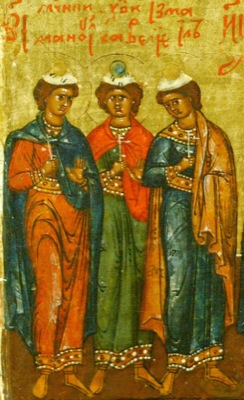
The three are painted together and always as Persians: young men, beardless or lightly bearded, in the long belted tunic and mantle of the eastern nobility, and — the distinguishing mark — in the soft Persian cap, the pointed or rounded head-covering that the Byzantine painters used for the martyrs of the Persian church as they used the turban for the Arabs. Each holds the martyr's cross. They stand as a close-set group of three, the middle brother usually a little forward, and their names are written above them; in the martyrdom scene they are shown bound and beheaded together, sometimes with the earthquake opening beneath the bodies.
The stored image is a cell from a 17th-century Russian menaion icon for the month of June (Church Archaeological Cabinet of the Moscow Theological Academy), inscribed in Slavonic with the three names: the brothers stand shoulder to shoulder in red, green and blue mantles over pearled tunics, in the Persian caps, each with a small white cross held before the breast.
Disputed questions
- "Alamundaros, king of the Persians." The name in the Greek passion is that of al-Mundhir (Ἀλαμούνδαρος), the dynastic name of the Lakhmid Arab kings of al-Hira, who were the client-allies and frontier commanders of the Sasanian empire — not kings of Persia themselves. The passion, written for a Greek audience which knew the name as that of the great power on the eastern frontier, has made a Persian great king of him. Whether the historical sender was a Lakhmid phylarch, or the Sasanian Shapur II whose reign covers the period, cannot be recovered; the corpus records the difficulty rather than resolving it. It does not touch the fact of the martyrdom, which the cult at Chalcedon and Constantinople attests independently.
- The date and place. The martyrdom is put at 362, with the execution at Chalcedon. Julian left Constantinople for Antioch in the course of 362 and wintered there; a Bithynian stage of that journey, or a festival kept at Chalcedon during it, is the natural setting, and is what the passion describes. Some later retellings move the scene to Constantinople itself, which is where the relics ended and where the feast was kept — the likeliest source of the confusion.
- Not the martyrs of Bulgaria. Distinguish these three from Manuel, George and the 377 martyrs of Bulgaria (January 22, †c. 817), and from Manuel of Crete; the name is common and the day-lists have occasionally run them together.