
Pentecost
The Holy Pentecost — the Descent of the Holy Spirit upon the Apostles
The Holy Pentecost — the Descent of the Holy Spirit upon the Apostles — is the Great Feast kept on the fiftieth day from Pascha, always a Sunday, and the crown and close of the whole paschal season. On that morning, as the apostles were gathered with one accord in the upper room at Jerusalem, there came a sound out of heaven "as of a rushing mighty wind" that filled the house, and there appeared to them cloven tongues as of fire which sat upon each one of them, and they began to speak in other tongues as the Spirit gave them utterance (Acts 2:1–4). The Jewish feast of Weeks, which had gathered pilgrims out of every nation under heaven to Jerusalem, found its fulfilment in that hour: the Law once written in fire on tablets of stone was now written by fire upon hearts of flesh, and the confusion of tongues at Babel was undone, not by the restoration of one language but by the gift of all. Peter stood forth and preached, and about three thousand souls were baptized that day. The Church therefore keeps Pentecost as her own birthday — the day on which the promise of the Father was fulfilled, the mission of Christ completed, and the Holy Trinity fully made known — and calls it, in Slavic usage, the Day of the Holy Trinity. Alone among the feasts it is followed the same evening by the Kneeling Vespers, at which the faithful bend the knee for the first time since Pascha, while the great prayers ascribed to Basil the Great are read aloud over them.

The narrative of Acts
The feast rests upon a single chapter, and the Church reads it whole. After the Ascension the Eleven returned to Jerusalem and went up into "an upper room" (Acts 1:13), where they continued with one accord in prayer "with the women, and Mary the mother of Jesus, and with his brethren" (Acts 1:14); the company numbered about a hundred and twenty (Acts 1:15), and out of it Matthias was chosen by lot to fill the place of Judas, so that the apostolic college stood complete at twelve. Then, Luke writes, "when the day of Pentecost was fully come, they were all with one accord in one place. And suddenly there came a sound from heaven as of a rushing mighty wind, and it filled all the house where they were sitting. And there appeared unto them cloven tongues like as of fire, and it sat upon each of them. And they were all filled with the Holy Ghost, and began to speak with other tongues, as the Spirit gave them utterance" (Acts 2:1–4).
Every clause of this is taken up by the hymnography and by the icon. The sign comes from heaven and it comes suddenly: not summoned by the apostles but sent, the promise of the Father which they had been told to await (Acts 1:4). It comes as a sound (ἦχος) "as of a rushing mighty wind" (ὥσπερ φερομένης πνοῆς βιαίας) — not wind itself but the noise of wind, for the Spirit is like the wind of Christ's own image, which "bloweth where it listeth, and thou hearest the sound thereof, but canst not tell whence it cometh" (John 3:8); and the Greek pnoē carries the breath which God breathed into Adam at the creation and which the risen Christ breathed upon the disciples in the upper room on the evening of Pascha (John 20:22), so that Pentecost completes what the Resurrection began. It fills the whole house, not the apostles only: the sanctification is of a place and a body, not of individuals in isolation. And it appears as tongues — divided, distributed tongues (γλῶσσαι διαμεριζόμεναι) "as of fire," which do not consume but rest upon each head. Fire is the element of the theophanies of the Old Covenant, of the bush that burned and was not consumed and of the mountain that smoked; here it neither burns nor terrifies, but sits, quietly, upon fishermen. The Fathers dwell on the word cloven or divided: the one Spirit is undivided in himself and yet wholly given to each, so that no one receives a fragment.
There were then dwelling at Jerusalem "Jews, devout men, out of every nation under heaven" (Acts 2:5), and the sound drew them together, and each heard the Galileans speaking in his own dialect. Luke sets down the catalogue of the nations with the care of a man who had it from witnesses — Parthians, Medes and Elamites, the dwellers in Mesopotamia, Judaea and Cappadocia, in Pontus and Asia, Phrygia and Pamphylia, Egypt and the parts of Libya about Cyrene, strangers of Rome both Jews and proselytes, Cretans and Arabians (Acts 2:9–11) — a list that runs from the Iranian east to the Latin west and takes in the whole world the apostles would have to walk. All of them heard "the wonderful works of God" spoken in their own tongue, and were amazed; and some mocked, saying, "These men are full of new wine" (Acts 2:13). That mockery is sung at Vespers of the feast as sharply as the wonder: the nations, not knowing the power of the all-holy Spirit, "thought that the change of tongues was drunkenness."
The feast of Weeks and its fulfilment
The day the Spirit chose was already a feast, and one of the three great pilgrim feasts of Israel. The Law appointed that from the morrow after the sabbath on which the sheaf of the first-fruits was waved, seven full weeks should be counted — "seven sabbaths shall be complete" — and on the fiftieth day a new offering of two leavened loaves of the first-fruits of the wheat harvest should be brought to the Lord (Leviticus 23:15–17); Deuteronomy reckons it from the putting of the sickle to the corn (Deuteronomy 16:9–10), and Exodus calls it simply "the feast of harvest" (Exodus 23:16). Hence its Hebrew name, Shavuot, the feast of Weeks, and its Greek name in the Hellenistic Jewish books — ἡ πεντηκοστή, "the fiftieth [day]," which is the name the Church inherited. Because it was a pilgrim feast, Jerusalem was full; because it was a harvest feast, its symbol was first-fruits; and because in the Judaism of the Second Temple period the day had come to be associated with the giving of the Law at Sinai, fifty days from the Passover of the Exodus, it already carried the memory of fire and cloud and thunder on the mountain.
The Church reads all three of these as prophecy. Against the Law of Sinai, written by the finger of God on tablets of stone in the midst of fire and darkness and tempest (Exodus 19:16–19; Deuteronomy 4:11–13), she sets the law of the Spirit written "not in tables of stone, but in fleshy tables of the heart" (2 Corinthians 3:3; Jeremiah 31:33), in tongues of fire that rest and do not consume; and the second canon of the feast opens precisely there, with Moses, "the slow of tongue," veiled in the divine gloom and proclaiming the God-written law, as the type of the unlettered apostles made orators by the Spirit. Against the harvest and its first-fruits she sets the three thousand gathered in by Peter's single sermon, the first sheaf of the world's harvest, and the apostles themselves as the first-fruits of the renewed humanity. And a reading beloved of the tradition, though it belongs to homily rather than to Scripture, sets the three thousand who fell in the camp on the day of the golden calf (Exodus 32:28) against the three thousand who were added to the Church on the day of Pentecost: what the letter slew, the Spirit gave life. That antithesis is a patristic commonplace, not a datum of Acts, and is best offered as the Church's reading rather than as history.
The tongues of fire and the reversal of Babel
The theological centre of the feast, and the burden of its greatest hymns, is the undoing of Babel. On the plain of Shinar men built a tower to make themselves a name, and the Lord confounded their language, "that they may not understand one another's speech," and scattered them abroad over the face of all the earth (Genesis 11:1–9); from that scattering come the nations and their tongues, and with them the mutual deafness in which human beings have lived ever since. At Pentecost the scattering is reversed — but not by the abolition of the many languages. The Spirit does not restore one tongue to the human race; he gives all tongues to the Church, so that the division which sin made into a wall becomes, in grace, a plurality that serves the truth. Unity is restored without uniformity: this is why Pentecost is the charter of a Church that preaches in every language and translates her worship into every language, and why the Byzantine mission to the Slavs, or the Arabic of the Antiochene churches, is not a concession to weakness but an act of Pentecost.
The kontakion of the feast states it in two clauses, and the doxastikon of the aposticha at Great Vespers elaborates it into an antiphonal poem — "Once the tongues were confounded, because of the boldness of the tower-building; but now the tongues are made wise, because of the glory of the knowledge of God. There God condemned the impious for their offence; here Christ enlightened the fishermen by the Spirit. Then the loss of speech was wrought for punishment; now the harmony is made new for the salvation of our souls." The two events are set in exact parallel, member for member, and the Church's reading of Acts 2 is given entire in six lines.
Two questions have always attended the gift itself. The first is what kind of speaking is described: Luke says the apostles spoke in other tongues and that each hearer heard his own dialect, which can be read either as a miracle of speech in the speakers or as a miracle of hearing in the hearers; the Fathers divide, and the hymnography preserves both, sometimes praising the apostles as made "orators" and sometimes marvelling that the peoples "were sounded to, each in his own way," from the one voice of the disciples. The second is the relation of this gift to the "tongues" of 1 Corinthians 12–14, which Paul describes as unintelligible without interpretation and ranks below prophecy. The Church has generally distinguished them: the Pentecostal gift is missionary, given for the hearing of the nations, and the whole festal hymnography treats it as intelligible speech in real languages — the sign of a Church sent out, not a private ecstasy.
Peter's sermon and the three thousand
Because some had mocked, Peter stood up with the eleven and lifted up his voice (Acts 2:14–36): these men are not drunken, for it is but the third hour of the day — nine in the morning, the hour at which the Church still keeps the Third Hour in memory of the descent. What is happening is what Joel had foretold: "It shall come to pass in the last days, saith God, I will pour out of my Spirit upon all flesh: and your sons and your daughters shall prophesy" (Acts 2:17, citing Joel 2:28–32). The prophecy is the hinge of the sermon, and it is read again at the Great Vespers of the feast as the second of its three Old Testament lessons: what has come to pass is not an incident but the opening of the last days, and the Spirit is poured out not on a caste of prophets but "upon all flesh," on daughters as on sons, on servants as on masters.
From Joel, Peter turns to Jesus of Nazareth, "a man approved of God among you by miracles and wonders and signs," delivered up by the determinate counsel of God, crucified by their hands, and raised by God, "whom God hath raised up, having loosed the pains of death: because it was not possible that he should be holden of it." He proves the Resurrection from Psalm 15 (16):8–11 — "thou wilt not leave my soul in hell, neither wilt thou suffer thine Holy One to see corruption" — arguing that David, whose sepulchre stands among them to that day, spoke not of himself but as a prophet of the Christ; and he proves the Ascension and the session from Psalm 109 (110):1, "The Lord said unto my Lord, Sit thou on my right hand." Then comes the conclusion, and it is the earliest Christian sermon's whole dogma in one line: "Therefore let all the house of Israel know assuredly, that God hath made that same Jesus, whom ye have crucified, both Lord and Christ" (Acts 2:36).
They were "pricked in their heart," and asked, "Men and brethren, what shall we do?" — and Peter answered, "Repent, and be baptized every one of you in the name of Jesus Christ for the remission of sins, and ye shall receive the gift of the Holy Ghost" (Acts 2:37–38). "Then they that gladly received his word were baptized: and the same day there were added unto them about three thousand souls" (Acts 2:41). It is worth pausing on what has just been described: the first Christian preaching, the first Christian repentance, the first Christian baptism, and the first mass reception into the Church, all in one morning, and all as the immediate work of the Spirit who had come an hour before. Luke closes the chapter with the shape of the life that followed — "they continued steadfastly in the apostles' doctrine and fellowship, and in breaking of bread, and in prayers" (Acts 2:42) — teaching, communion, Eucharist and prayer, which is the Church's own description of herself.
The birth of the Church
Pentecost is called, without exaggeration and in every tradition, the birthday of the Church. Before that morning the disciples were a company gathered around a memory and a promise; after it they are a body with a mission, a voice, a sacramental life and a visible boundary of baptism. The whole apparatus of the Church appears on that single day: the preaching of the apostles, the calling of the nations, baptism for the remission of sins, the laying-on of the Spirit's gift, the breaking of bread. From this the tradition draws two conclusions that the hymnography never lets go of. The first is that the Church is not a human association that later acquired the Spirit, but a creature of the Spirit from her first hour; the sticheron sings that the Spirit "supplies all things — he pours forth prophecies, he perfects priests, he has taught wisdom to the unlettered, he has shown forth fishermen as theologians, he knits together the whole institution of the Church." The second is that the Spirit's coming is not an event that recedes into the past. Pentecost is not commemorated as a thing finished but entered as a thing continuing: at every ordination, every chrismation, every consecration of the Gifts the Church prays the Spirit to come down, and the day's own hymn "We have seen the true light, we have received the heavenly Spirit, we have found the true faith, worshipping the undivided Trinity" — first sung at this feast — was afterwards taken into the Divine Liturgy itself, where it is sung after communion on nearly every day of the year, so that every Liturgy ends with the confession of Pentecost.
And with the descent of the Spirit the revelation of God is complete. The Father had spoken and the Son had appeared, and at the Jordan the Trinity was manifested at the Theophany; but at Pentecost the third Person comes in his own name and by his own operation, so that the Church has now known each of the three, not as a doctrine argued but as a Person met. This is the ground of the feast's overwhelmingly trinitarian hymnography — and of its second name.
"Trinity Sunday": the double naming of the day
In the Greek books the day is Ἡ Ἁγία Πεντηκοστή and nothing else, and the synaxarion notice reads simply, "On this same day, the eighth Sunday from Pascha, we celebrate the holy Pentecost." In Russian, Ukrainian, Serbian, Bulgarian and Romanian usage the ordinary name of the same Sunday is Trinity — Троица, День Святой Троицы, Rusaliile alongside it — while Пятидесятница, "Pentecost," survives as the learned or liturgical name. The double naming is worth explaining carefully, because it is easily misunderstood in three different directions.
First, the Slavic name is not an error but a reading of the day's own texts. The services of Pentecost are the most densely trinitarian of the year: the doxastikon at Great Vespers, ascribed to the emperor Leo the Wise, is a compressed dogmatic treatise — "Come, ye peoples, let us worship the Godhead in three hypostases: the Son in the Father, with the Holy Spirit; for the Father timelessly begot the Son, coeternal and sharing his throne, and the Holy Spirit was in the Father, glorified together with the Son" — and the troparia of the canons return again and again to the consubstantiality and the distinction of the Persons. Because the descent of the Spirit completes the manifestation of the Trinity, the day was popularly named from what it completes rather than from what it narrates.
Second, this is not the Western Trinity Sunday. In the Roman rite Trinity Sunday is a distinct feast on the Sunday after Pentecost, of medieval Western growth, extended to the whole Latin Church by Pope John XXII in 1334. The Byzantine rite has no such feast: the Sunday after Pentecost is the Sunday of All Saints, and no separate day is set aside for the dogma of the Trinity, precisely because Pentecost itself is that day. The similarity of the names conceals a real difference of structure, and conflating them produces the common confusion in which Orthodox "Trinity Sunday" is placed a week late.
Third, the Slavic usage divides the mystery over two days rather than merging it: the Sunday is Trinity, and the Monday is the Day of the Spirit (Духов день), so that the Person whose coming is celebrated receives his own day immediately after the Godhead he reveals. In Russian practice the naming was further reinforced by the custom of setting out the icon of the Trinity — the Hospitality of Abraham, in Rublev's recension or another — for veneration in the centre of the church on the feast, and by the great number of churches and monasteries dedicated to the Holy Trinity, above all the Trinity-Sergius Lavra, which keep their patronal feast on this day. Honesty requires saying both things at once: what the Church celebrates on the fiftieth day is the Descent of the Holy Spirit, and the Slavic name Trinity Day is a true but secondary designation drawn from the theology of the descent, not an alternative account of the event.
Feast and commemoration
The fiftieth day from Pascha, counting Pascha itself as the first, and therefore always a Sunday — the eighth Sunday of the paschal cycle, and the last day of the Pentecostarion's central section. As a movable feast it has no fixed calendar date: 49 days after Pascha in this collection's rule vocabulary, with the rule file at 49 days after Pascha. It is one of the Twelve Great Feasts, and with Pascha and the Ascension forms the paschal triad; where the Twelve are counted as a list of fixed days, Pentecost is reckoned among them notwithstanding its movability, and only Pascha stands above it. It is served with an All-night Vigil, with its own festal antiphons and entrance verse at the Liturgy, and — as on Pascha, the Nativity, Theophany, Lazarus Saturday and Great Saturday, the ancient baptismal days of the year — with the baptismal hymn "As many as have been baptized into Christ" sung in place of the Trisagion.
The feast has no forefeast, since the whole Pentecostarion is its preparation; the fiftieth day is prepared by fifty days. It is immediately preceded by the Trinity Soul Saturday (48 days after Pascha), on which the Church makes a general commemoration of all the departed before entering the feast — placing the dead, deliberately, on the threshold of the day on which she will pray for them on her knees. The afterfeast runs a full week to the leavetaking on the Saturday (55 days after Pascha), and the whole of that week is fast-free. Where a liturgical colour is appointed the feast is served in green, the colour of the Spirit who is the Giver of Life, and in Slavic practice the green of Pentecost is one of the most strongly marked colours of the year; Greek usage keeps no fixed colour system and vests brightly, often also in green.
In the Arabic-speaking Church of Antioch the feast is عيد العنصرة (ʿĪd al-ʿAnṣara), the name by which it is universally known in the Levant, with عيد الخمسين (ʿĪd al-Khamsīn, "the feast of the fifty") as the transparent alternative; the Antiochian Archdiocese, keeping the New Calendar, observes the feast on the same civil Sunday as the Greek churches, since the paschal computation is common to all the churches that follow the Julian Paschalion. The English "Whitsunday," from the white garments of the baptized, belongs to the Western tradition and to the English-speaking Orthodox usage that has borrowed it.
The Kneeling Vespers
Nothing else in the Byzantine year resembles the Vespers of Pentecost evening, the γονυκλισία or Kneeling Vespers. Liturgically it is the Vespers of the Monday of the Holy Spirit, and therefore belongs already to the day after the feast; in practice, so that the faithful may be present, it is served in most churches immediately after the Divine Liturgy on Pentecost Sunday itself, in the late morning of the feast — an anomaly of timing that the whole Orthodox world has accepted for the sake of the prayers.
The occasion of its strangeness is a canon. Canon 20 of the First Ecumenical Council at Nicaea (325) forbids kneeling on the Lord's Day and throughout the fifty days of Pentecost, ordering that on those days prayers be offered to God standing; canon 90 of the Council in Trullo (692) repeats the prohibition for Sundays and fixes the hours between which it runs. The reason is dogmatic, not disciplinary: kneeling is the posture of penitence and of the fallen, while standing upright is the posture of the risen, and in the fifty days of Pascha the Church stands because she is confessing the Resurrection with her body. For fifty days, then, no one kneels and no prostration is made. At this Vespers the fifty days are complete, and the Church kneels for the first time — and immediately, three times over, with the deacon's summons "Again and again, bowing the knee, let us pray to the Lord," and with the people prostrate and bareheaded while the priest reads the prayers aloud from the middle of the church, "in the hearing of all," as the rubric requires. The gesture is thus not a return to mourning but the first act of the new season: having stood through Pascha, the Church now bends the knee to receive the Spirit she has been given.
There are three sets of prayers, seven prayers in all in the Greek books, of increasing length and scope. The first set — "O most pure, undefiled, unoriginate, invisible, incomprehensible, unsearchable, unchangeable, unsurpassable, immeasurable, long-suffering Lord…" with a second prayer blessing the God who lit the day with the sun and the night with fire — is a long confession of sin and plea for mercy, in which the Church names her own unworthiness before she asks for anything. The second set — "Lord Jesus Christ our God, who hast given thy peace to men and the gift of the all-holy Spirit…" — turns to the Spirit himself and asks for the grace to pray: it is here that the prayer of the day asks God to teach us to pray, on the ground of Romans 8:26, that we know not what we should pray for as we ought and that the Spirit himself maketh intercession for us. The third set is the most famous and the longest — "O ever-flowing, living and illuminating fountain, coeternal creative power of the Father, who hast most excellently fulfilled all the economy for the salvation of men, O Christ our God," followed by the great prayer "O God, great and eternal, holy and love of mankind" — and it is the Church's prayer for the dead. It gives thanks for both of our thresholds, our entrance into this world and our going out of it; it confesses that "for thy servants, O Lord, there is no death, when we depart from the body and go home to thee, but a passing over from what is more grievous to what is better and more delightful, a rest and a joy"; it asks God to give rest to all the fathers and mothers, brothers and sisters and children of every one present, and to all the souls that have gone before in the hope of the resurrection, to set their names in the book of life and to bring them into the bosom of Abraham, Isaac and Jacob; and it asks, for those who have gone before, "liberty and release" (ἐλευθερίαν καὶ ἄνεσιν). It is on the strength of that petition that the tradition speaks of Pentecost evening as the one hour of the year at which the Church prays even for those held in hades — a formulation that belongs to the Slavonic recension of the office and to the Church's understanding of the prayer rather than to the letter of the Greek text, but which states truly what the prayer intends: on the day the Spirit came, the Church's intercession reaches as far as it can reach.
At this Vespers, too, the hymn "O Heavenly King, the Comforter, the Spirit of Truth" returns. It has been silent since Pascha, for the Church does not invoke the Spirit's coming during the days in which she is awaiting it, and its place at the beginning of every prayer has been taken by the paschal troparion. It is sung here as the doxastikon of the stichera, again ascribed in the books to Leo the Wise, and from this evening it resumes its ordinary place at the head of all Orthodox prayer for the rest of the year.
The green of the day
Pentecost is a green feast, and in Slavic lands a green festival. The churches are dressed in cut branches — birch above all in Russia, lime and maple elsewhere, oak in some southern usages — set against the icons and the pillars and by the doors; the floor is strewn with fresh-cut grass, so that the whole church smells of hay; the vestments are green; and the people come to the Kneeling Vespers holding bunches of flowers and green leaves, which they hold before them while they kneel and afterwards take home to keep behind the icons. The custom has several roots, and it is honest to name them all. It belongs to the harvest character of the fiftieth day, inherited from the feast of Weeks with its first-fruits and its two loaves. It figures the Spirit as "the Giver of Life," at whose coming what was dry puts out leaves: the antiphon of the day sings that "by the Holy Spirit the streams of grace well up, watering the whole creation unto the bringing forth of life." In Russia it was drawn also into the Trinity naming of the day, and the branches were associated with the oaks of Mamre under which Abraham received the three strangers. And it stands in continuity with the older Slavic greenery of the same season — the Semik and the Rusalia week — which the Church did not so much abolish as baptize. What was a rite of the returning summer became a confession that the Spirit renews the face of the earth.
The Monday of the Holy Spirit
The morrow of the feast, 50 days after Pascha, is the Monday of the Holy Spirit (Δευτέρα τοῦ Ἁγίου Πνεύματος; in Slavic usage Духов день, the Day of the Spirit), and it follows the recurring logic by which the day after a Great Feast honours the chief person of the mystery just celebrated — as January 7 honours the Forerunner and December 26 the Theotokos. Here, uniquely, the person honoured is not a saint but God: the day is given to the Holy Spirit himself, the third Person of the Trinity, worshipped and glorified together with the Father and the Son. Its Vespers is the Kneeling Vespers already described; its Matins and Liturgy continue the hymns of the feast, with the Gospel of Matthew 18:10–20 and the Epistle Ephesians 5:9–19. In Greece and Cyprus the Monday of the Holy Spirit is a public holiday, as Whit Monday long was in the West; in Russia Духов день carries a body of popular observance of its own, including the blessing of the fields and, in many places, the veneration of the earth as "the mother" whose life the Spirit renews.
The leavetaking, and the Sunday of All Saints
The afterfeast runs through the week, and the leavetaking (apodosis) falls on the Saturday, 55 days after Pascha, when the whole festal office of Pentecost is sung once more and then laid aside for a year. The week between is fast-free, one of the year's "solid" weeks — a relaxation which the popular mind connected with the joy of the descent, and which the Typikon grants without explanation.
The next day, 56 days after Pascha, is the Sunday of All Saints, and it is placed there as the fruit of the tree planted the week before. The reasoning is made explicit in the tradition: the Spirit who came upon the apostles has been working ever since in human nature, and the harvest of that work is the whole company of the saints — apostles and prophets, martyrs and confessors, hierarchs, ascetics, the righteous, the known and the unnumbered. Having celebrated the sowing, the Church displays the crop. A homily of John Chrysostom on "all the saints of the whole world," preached on the Sunday after Pentecost, shows the commemoration already in place at Antioch and Constantinople at the end of the fourth century, which makes it one of the oldest of the movable Sundays. With that Sunday the Pentecostarion closes; the Octoechos resumes its eight-week rotation, the weeks of the year begin to be numbered "after Pentecost," and on the following Monday the Apostles' Fast begins, so that the Church passes from the harvest of the saints directly into the fast that leads to Peter and Paul. Many local churches keep the Sunday after that, 63 days after Pascha, as the Sunday of All Saints of their own land — of Russia, of Mount Athos, of Antioch — extending the same logic one step nearer home.
Hymns
Apolytikion — Tone 8
Blessed art thou, O Christ our God, who hast shown forth the fishermen as all-wise, sending down upon them the Holy Spirit, and through them taking the whole world in thy net. O Lover of mankind, glory to thee.
Kontakion — Tone 8
When the Most High came down and confounded the tongues, he divided the nations; when he distributed the tongues of fire, he called all men into unity; and with one accord we glorify the all-holy Spirit.
Original translation from the Greek
Oikos
Give swift and steadfast consolation to thy servants, O Jesus, when our spirits grow listless. Be not parted from our souls in afflictions, be not far from our minds in adversities, but come to us always before we call. Draw near to us, draw near, thou who art everywhere; and as thou wast ever with thine apostles, so unite thyself to those who long for thee, O compassionate one, that being joined to thee we may hymn and glorify thine all-holy Spirit.
Megalynarion — Tone 7
O Mother who hast not known man, Virgin Theotokos, who didst conceive without experience of corruption and didst lend flesh to the all-fashioning Word; vessel of him whom nothing can contain, place of thine own uncircumscribed Maker: thee do we magnify.
Appointed readings
Epistle — Acts 2:1–11
1And when the day of Pentecost was fully come, they were all with one accord in one place. 2And suddenly there came a sound from heaven as of a rushing mighty wind, and it filled all the house where they were sitting. 3And there appeared unto them cloven tongues like as of fire, and it sat upon each of them. 4And they were all filled with the Holy Ghost, and began to speak with other tongues, as the Spirit gave them utterance. 5And there were dwelling at Jerusalem Jews, devout men, out of every nation under heaven. 6Now when this was noised abroad, the multitude came together, and were confounded, because that every man heard them speak in his own language. 7And they were all amazed and marvelled, saying one to another, Behold, are not all these which speak Galilæans? 8And how hear we every man in our own tongue, wherein we were born? 9Parthians, and Medes, and Elamites, and the dwellers in Mesopotamia, and in Judæa, and Cappadocia, in Pontus, and Asia, 10Phrygia, and Pamphylia, in Egypt, and in the parts of Libya about Cyrene, and strangers of Rome, Jews and proselytes, 11Cretes and Arabians, we do hear them speak in our tongues the wonderful works of God.
Gospel — John 7:37–52; 8:12
37In the last day, that great day of the feast, Jesus stood and cried, saying, If any man thirst, let him come unto me, and drink. 38He that believeth on me, as the scripture hath said, out of his belly shall flow rivers of living water. 39(But this spake he of the Spirit, which they that believe on him should receive: for the Holy Ghost was not yet given; because that Jesus was not yet glorified.) 40Many of the people therefore, when they heard this saying, said, Of a truth this is the Prophet. 41Others said, This is the Christ. But some said, Shall Christ come out of Galilee? 42Hath not the scripture said, That Christ cometh of the seed of David, and out of the town of Bethlehem, where David was? 43So there was a division among the people because of him. 44And some of them would have taken him; but no man laid hands on him. 45Then came the officers to the chief priests and Pharisees; and they said unto them, Why have ye not brought him? 46The officers answered, Never man spake like this man. 47Then answered them the Pharisees, Are ye also deceived? 48Have any of the rulers or of the Pharisees believed on him? 49But this people who knoweth not the law are cursed. 50Nicodemus saith unto them, (he that came to Jesus by night, being one of them,) 51Doth our law judge any man, before it hear him, and know what he doeth? 52They answered and said unto him, Art thou also of Galilee? Search, and look: for out of Galilee ariseth no prophet. 12Then spake Jesus again unto them, saying, I am the light of the world: he that followeth me shall not walk in darkness, but shall have the light of life.
Iconography
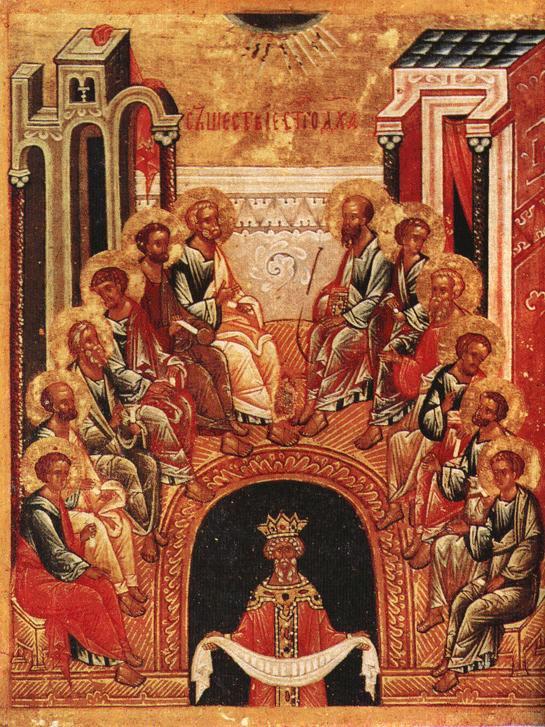
The icon of Pentecost is one of the most stable and one of the most theologically packed of the festal cycle, and it is not an illustration of Acts 2. Its subject is the Church.
The apostles are seated — not standing, not amazed, but seated in the calm of teachers — in a horseshoe or semicircle open toward the viewer, sometimes within an architectural upper room, sometimes on a bench that curves like an apse. That shape is the shape of a synthronon, the bench of a bishop and his presbyters in the sanctuary of an early church, and of a council: the icon shows the apostolic college in session. Above them a segment of heaven opens, and from it descend rays, one to each head, with a tongue of fire resting on each. The rays are of equal length and the tongues of equal size, for the one Spirit is given wholly to each and not in portions. Almost always twelve figures are shown, and the twelve are not the historical twelve of Acts 1:26: Paul is regularly among them, usually balancing Peter at the head of one arm of the semicircle, and Luke and Mark, who were not apostles of the Twelve, commonly appear as well. This is not carelessness. The icon states that the Spirit given in the upper room is the Spirit of the whole apostolic Church, and it therefore shows the apostolic college as the Church came to know it, including the apostle who was not yet converted and the evangelists who wrote her Gospels. Several hold books, the evangelists; the rest hold scrolls, the preaching.
At the centre of the upper arc two possibilities have always existed, and the tradition has never chosen between them. In one recension the central place is left empty — a vacant seat or a draped throne between Peter and Paul — the place of Christ, who is the invisible head of the assembly, ascended and yet present, so that the icon is a portrait of the Church with a visible absence at her centre. In the other, the Theotokos occupies that place, enthroned or standing in the midst of the apostles, with a tongue of fire upon her head like theirs. This second recension is the earlier one attested in surviving art — it appears already in the Syriac Rabbula Gospels of 586 — and it is dominant in Syro-Palestinian and later in much Western art; the recension without her is dominant in the Byzantine and Russian tradition from the middle Byzantine period onward and is the one the Greek hymnography implies, since the hymns of the feast speak only of the apostles. Both are canonical, and the reason for the divergence is textual: Acts 2:1 says "they were all with one accord in one place," and whether "all" reaches back to the hundred and twenty of Acts 1:15, who included "Mary the mother of Jesus," or only to the Twelve of Acts 1:26, is genuinely undecidable. The icon with the Theotokos reads the upper room as the Church, whose image she is; the icon without her reads it as the apostolic mission, and leaves Christ's own seat empty. Neither is a correction of the other.
Below the apostles, in a dark arch or cave beneath the bench, sits a crowned old man, half length, holding out a white cloth on which lie twelve scrolls. He is labelled, in Greek icons, ὁ Κόσμος — Kosmos, "the World." Each of his attributes is legible. He is old because the world had grown old in Adam and was ready to pass away; he is crowned because sin had reigned in it as a king; he sits in darkness because he sat in the shadow of ignorance and death, "the people that walked in darkness"; and he holds out a cloth of twelve scrolls because he is receiving the preaching of the twelve apostles, gathering it as a subject receives a decree, and because the linen he spreads is the gesture of reverent reception. He is not a demon and not a personified evil; he is the human world, waiting under the Church for the word that will renew him — the necessary lower half of a composition whose upper half is the descending fire. In a second recension the space beneath the apostles is filled instead with the peoples and tribes of Acts 2:9–11, ranged in groups and sometimes labelled with their nations, hearing each in his own tongue; a few icons combine the two. The variant with Kosmos is the more contemplative, turning the catalogue of the nations into a single figure; the variant with the peoples is the more narrative.
The stored icon is a fine example of the mature Byzantine-Slavic type: a panel of about the year 1500 from the archbishop's workshop at Novgorod, inscribed СОШЕСТВІЕ СТ҃ГО ДХА, "the Descent of the Holy Spirit." Twelve apostles sit on a curved bench between two buildings, the pale empty seat of Christ at the summit of the arc between Peter and Paul; a segment of heaven at the top sends down twelve rays, and beneath, in the black arch of the substructure, the crowned old man Kosmos holds out his white cloth with the scrolls of the apostolic preaching. It is the recension without the Theotokos, with Kosmos below.
The second stored image is the earliest surviving representation of the feast of any consequence, and stands for the other recension: folio 14v of the Rabbula Gospels, a Syriac gospel book written and illuminated in the year 586 at the monastery of St John of Zagba, in the Syriac hinterland of Antioch (Florence, Biblioteca Medicea Laurenziana, Plut. I.56). Under a dark arch — the upper room, with the trees of Jerusalem visible outside it — the Theotokos stands frontally at the centre in a dark blue maphorion, her hands drawn to her breast, and the apostles stand ranged on either side of her, all of them with a tongue of flame above the head, while the dove of the Spirit descends upon her from the apex of the arch. There is no Kosmos, no bench, no seated college: the composition is upright, crowded and processional, closer to the Ascension images of the same manuscript, and it shows how early and how firmly the eastern Syriac tradition placed the Mother of God in the midst of the apostles at Pentecost. For a repository written from the Antiochene tradition the miniature has a further claim: it is the oldest dated witness to the feast's iconography, and it was made within the patriarchate of Antioch.
Two further points of the tradition are worth recording. The icon of Pentecost is not the icon of the Trinity: the Byzantine tradition never depicts the Trinity as three divine Persons at Pentecost, and where the day is called Trinity Sunday in Slavic usage the icon set out for veneration is the Hospitality of Abraham — a distinct image, of a distinct scriptural subject, whose use on this day is a devotional practice and not an identification of the two feasts. And the tongues of fire are always painted as flames resting, never as flames rising or spreading: the Spirit's fire in this icon does not consume, and the iconographers keep the distinction with care.
Disputed questions
Who received the Spirit in the upper room? Acts 2:1 says "they were all with one accord in one place," and the antecedent is disputed. If it reaches back to Acts 1:14 the company includes the women and the Theotokos; if only to the Twelve of Acts 1:26, the gift is apostolic and collegial. The Church has never settled the question dogmatically, and the two readings are preserved side by side in the icon, which shows the Twelve alone in some recensions and the Theotokos enthroned among them in others (see Iconography below). The hymnography of the feast addresses itself throughout to the apostles and does not mention the Theotokos in connection with the descent; the iconographic tradition that includes her — early, Syro-Palestinian, and never suppressed — reads the upper room ecclesially, as the Church in miniature with the Mother of God at her heart.
Who wrote the kneeling prayers? The three sets of prayers read at the Vespers of Pentecost evening are universally ascribed in the service books and in usage to Basil the Great. The ascription is traditional rather than documented: the printed Pentecostarion carries the prayers without an author's name, several of them are ordinary Vesperal prayers of the Byzantine rite pressed into this office, and their lengths and styles are not uniform. What can be said with confidence is that the collection is very old, that its central prayers are consonant with Basil's manner and with his treatise On the Holy Spirit, and that the Church has prayed them under his name for many centuries. This entry follows the tradition's ascription while noting that it is an ascription.
The green branches. The strewing of grass and the cutting of birch for Pentecost, universal in the Russian countryside, is not prescribed by the Typikon and has an evident continuity with pre-Christian usages of the same season — the Slavic Semik and Rusalia week, whose name survives in the Romanian Rusalii for the feast itself. That continuity is a matter of record and does not make the custom pagan: the Church took the greenery and gave it a meaning, as she took the fiftieth day itself from Israel. What should be resisted is the opposite error of reading the birch as an ancient Christian symbol; it is a local custom, beautifully apt, of no great antiquity.