
Balykino Icon of the Mother of God
The Balykinskaya Icon of our Most Holy Lady the Theotokos and Ever-Virgin Mary
Kept 30 June — The giving of the weeping icon to the church of St Nicholas at Balykino, 30 June 1711
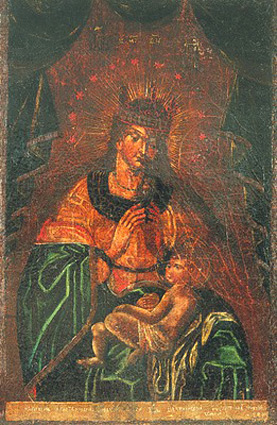
The Balykino (Balykinskaya) icon is a wonderworking image of the Mother of God of the Starodub country in the old province of Chernigov, on the border of what are now Russia and Ukraine. It belonged to Timothy Dulsky, an officer of the Starodub regiment, and in the years when the armies of Charles XII were moving through the Severian lands it was seen to weep: tears stood in the eyes of the Mother of God. Dulsky vowed to give the icon to a church, learned that the village of Balykino was building one, and then delayed — until the Mother of God appeared to him twice in his sleep and he carried the image to the newly raised wooden church of St Nicholas at Balykino on 30 June 1711, the day the Church has kept ever since. Healings followed in such number that pilgrims came from the neighbouring provinces; a copy given (the tradition says) by John Maximovitch of Tobolsk in 1712 to the Entry convent at Orel grew more famous than the original. The icon is painted in the Ukrainian manner of its century, and shows the Theotokos with her hands folded in prayer and the Child lying before her — a composition drawn from Western images of the Nativity and the Adoration.

Timothy Dulsky and the weeping of the image
The story belongs to the last years of the Great Northern War. In 1708–1709 the Swedish army under Charles XII wintered in the Severian country and moved south through it toward Poltava, and the Starodub regiment — a Cossack regiment of the Hetmanate, with its own colonel and its own gentry — stood in the path. The icon was then the household image of Timothy Dulsky, an officer of that regiment, and it was in the alarm of those months that the tears were seen upon it. The tradition is precise about the sign and silent about its interpretation: it does not make the weeping a prophecy of any particular disaster, and the sources do not connect it with the battle of 1709. What Dulsky did was to vow that the image should not remain a private possession.
The vow, the delay, and the two dreams
He heard that the villagers of Balykino, in the Starodub district, were raising a church to St Nicholas, and resolved to give it there; but the building was slow and the vow was not kept. The account preserved at Balykino says that the Mother of God appeared to him twice in his sleep to require the fulfilment of what he had promised, and that only after the second appearance did he carry the icon to the finished wooden church. The delivery is dated 30 June 1711, and it is this — not the weeping, and not any later miracle — that fixes the feast. The pattern is a common one in the Slavic accounts of wonderworking images: an image in a private house, a sign upon it, a vow, a delay, and a dream that ends the delay; the day kept is the day the icon passed from the household to the Church.
Miracles, and the fire
Healings at the icon are reported from soon after its enshrinement, and the church at Balykino became a place of pilgrimage for the Chernigov, Orel and Smolensk countries. The eighteenth- and nineteenth-century record is of the usual kind — cures of the blind, the paralysed and the possessed, entered in the church's book and attested by the diocesan authority — and it is on the strength of these that the image was recognised as wonderworking.
Shortly before the revolution a fire in the church damaged the icon; the tradition of the place records that the face of the Mother of God was left untouched by the flames, and the survival was itself received as a wonder. What became of the panel in the Soviet decades is not clearly transmitted.
The Orel copy
A close copy of the Balykinskaya was given, according to the tradition of the house, by John (Maximovitch), then archbishop of Chernigov and afterwards metropolitan of Tobolsk and enlightener of Siberia (†1715), to the Entry of the Theotokos convent at Orel in 1712. That copy became in time the more celebrated of the two: it was the convent's chief treasure, healings were recorded before it through the nineteenth century — the cure of a paralysed woman in 1858 is the best documented — and the Orel veneration carried the name of the icon far beyond the village that gave it. The relation of copy to original here is the ordinary one in the Russian tradition, where a spisok taken from a wonderworking image is honoured as sharing in its grace, and the same feast serves both.
What is not known
Neither the age nor the origin of the original panel is recorded. The image now identified as the Balykinskaya in the collection of the Andrei Rublev Museum in Moscow is dated 1792 and assigned to the West Ukrainian school; it is therefore a later replica of the type rather than the panel Dulsky owned, and this entry does not confuse the two. Nothing is transmitted of Dulsky beyond his regiment and his name, and the village church of St Nicholas has left no foundation charter that would fix the year of its building independently of the icon's own story.
Feast and commemoration
June 30 (church date; New Calendar civil June 30; Old Calendar civil July 13) — the giving of the icon to the church at Balykino in 1711. The commemoration is Russian, Ukrainian and OCA; it is not in the Greek or Antiochian books. The day is that of the Synaxis of the Twelve Apostles, and like the other icon-feasts that fall on great days it is kept in the shadow of the apostolic office — at the proskomedia, in the litanies, and at a moleben before the image rather than by a sung service of its own, except at Balykino and at Orel, where it is the patronal festival. It shares the day with a second Ukrainian image, the Gorbanevka icon of the Poltava country; the two are unconnected, and the coincidence is of the calendar only.
Hymns
Troparion — Tone 4
To the Theotokos let us now run in haste, we sinners and lowly ones, and let us fall down in repentance, crying from the depth of our soul: O Lady, help us, having compassion upon us; make haste, for we perish from the multitude of our transgressions; turn not thy servants away empty, for thee alone have we as our hope.
Original translation from the Slavonic
Kontakion — Tone 6
Protection of Christians that cannot be put to shame, mediation unto the Creator unfailing: despise not the suppliant voices of sinners, but be quick to help us who cry to thee in faith; hasten to intercession and make speed to entreaty, O Theotokos, who dost ever protect them that honour thee.
Original translation from the Slavonic
Appointed readings
Epistle — Philippians 2:5–11
5Let this mind be in you, which was also in Christ Jesus: 6Who, being in the form of God, thought it not robbery to be equal with God: 7But made himself of no reputation, and took upon him the form of a servant, and was made in the likeness of men: 8And being found in fashion as a man, he humbled himself, and became obedient unto death, even the death of the cross. 9Wherefore God also hath highly exalted him, and given him a name which is above every name: 10That at the name of Jesus every knee should bow, of things in heaven, and things in earth, and things under the earth; 11And that every tongue should confess that Jesus Christ is Lord, to the glory of God the Father.
Gospel — Luke 10:38–42; 11:27–28
38Now it came to pass, as they went, that he entered into a certain village: and a certain woman named Martha received him into her house. 39And she had a sister called Mary, which also sat at Jesus’ feet, and heard his word. 40But Martha was cumbered about much serving, and came to him, and said, Lord, dost thou not care that my sister hath left me to serve alone? bid her therefore that she help me. 41And Jesus answered and said unto her, Martha, Martha, thou art careful and troubled about many things: 42But one thing is needful: and Mary hath chosen that good part, which shall not be taken away from her. 27And it came to pass, as he spake these things, a certain woman of the company lifted up her voice, and said unto him, Blessed is the womb that bare thee, and the paps which thou hast sucked. 28But he said, Yea rather, blessed are they that hear the word of God, and keep it.
Iconography
The Balykinskaya is not of any of the settled Byzantine families — not Hodegetria, not Eleousa, not Orans. The Mother of God is shown seated or half-kneeling, crowned, her hands folded upon her breast in prayer, her head inclined and her eyes turned down toward the Child, who lies naked or lightly draped before her on a cloth or cushion, one hand raised. Behind them falls a canopy or curtain, and rays of gilt light spread from the two figures. The composition is Western in descent — it derives from the Nativity and the Adoration of the Child as those subjects were painted in Catholic Europe, and it reached the Orthodox of the Hetmanate through the Polish and Ukrainian workshops of the seventeenth and eighteenth centuries, which is exactly the milieu in which the Starodub country lay. It belongs, in other words, to that late-baroque Ukrainian iconography which the Russian Church received, venerated, and never quite naturalised.
The technique is likewise of its place and time: painted on canvas laid down on a wooden panel, in oils, with a naturalistic modelling of the flesh and heavy gilt ornament, rather than in egg tempera on gesso.
The stored image is a panel of 1792 of the West Ukrainian school, now in the Central Museum of Ancient Russian Culture and Art (the Andrei Rublev Museum) in Moscow, and catalogued there as the Balykinskaya: the crowned Mother of God with hands joined at her breast beneath a red canopy, the Child seated on a green cushion at her knees, a starred nimbus about her head and a donor's inscription along the lower margin (source, public domain, pd-old-work). It is a replica of the type, not the original panel of 1711, and is stored and described as such. The lower inscription cannot be read at the resolution available, so the identification rests on the museum's title and on the composition, which is unmistakable.