
Synaxis of the Twelve Apostles
The Synaxis of the Holy, Glorious and All-praised Twelve Apostles
Apostle · Evangelist · Martyr · d. 1st century
Commemorated 30 June — The common assembly (synaxis) of the Twelve Apostles, on the day after Peter and Paul
On June 30, the day after the great feast of the Chief Apostles, the Church keeps the Synaxis of the Holy, Glorious and All-praised Twelve Apostles — the common assembly of that company which the Lord "ordained twelve, that they should be with him, and that he might send them forth to preach" (Mark 3:14). Each of the Twelve has his own day somewhere in the year, and several have two or three; but the tradition, unwilling that any one of them should seem to be honoured above his brethren, gathered them all into a single festival and set it immediately after the feast of Peter and Paul, so that the day which crowns the Apostles' Fast opens at once upon the whole apostolic choir. The feast is ancient — the ordinances behind it are traced to the fourth century, and it is bound up with the great Church of the Holy Apostles raised by Constantine at his new capital and rebuilt by Justinian, where the emperors were buried among cenotaphs of the Twelve. The roll of this day is the roll of the Gospel lists: Peter and Andrew, the two sons of Zebedee, Philip and Bartholomew, Thomas and Matthew, James of Alphaeus, Jude Thaddaeus and Simon the Zealot — with Matthias, chosen by lot into the place "from which Judas by transgression fell" (Acts 1:25), and with Paul, who was not of the Twelve and is yet never separated from them.
.jpg)
The institution of the Twelve
The Twelve are not a committee of the Lord's admirers but an act of election. Luke records that before he chose them Jesus "went out into a mountain to pray, and continued all night in prayer to God; and when it was day, he called unto him his disciples: and of them he chose twelve, whom also he named apostles" (Luke 6:12–13). Mark gives the double purpose in a single sentence — "that they should be with him, and that he might send them forth to preach, and to have power to heal sicknesses, and to cast out devils" (Mark 3:14–15) — and the two halves of it are the whole of the apostolic office: first companionship, then mission; first the seeing and hearing at first hand, then the sending. It is on the first of these that the Church's whole notion of apostolic witness rests, and it is why the qualification laid down when Matthias was chosen was that the man must have "companied with us all the time that the Lord Jesus went in and out among us... beginning from the baptism of John, unto that same day that he was taken up from us" (Acts 1:21–22). An apostle is a witness of the Resurrection, and can be nothing else.
The number is likewise deliberate. Twelve is the number of the sons of Jacob and of the tribes of Israel, and the Lord himself makes the reference explicit: "ye which have followed me... shall sit upon twelve thrones, judging the twelve tribes of Israel" (Matthew 19:28). The Twelve are the patriarchs of the Israel that is being re-founded; the Apocalypse sets their names on the twelve foundations of the wall of the heavenly city (Revelation 21:14). Because the number carries this meaning, the breach in it after the betrayal could not simply be left — the college had to be made whole again before Pentecost, and it was.
The four lists, and the vexed names
The New Testament gives four rosters of the Twelve — Matthew 10:2–4, Mark 3:16–19, Luke 6:14–16, and Acts 1:13 (the last necessarily without Judas) — and they agree substantially while differing in two respects that the tradition has always had to handle.
The order varies, but not at random. In every list Peter stands first and Judas Iscariot last; the Twelve fall into three groups of four, and the first name of each group of four is fixed (Peter, Philip, and James the son of Alphaeus), whatever the shuffling within the group. This is the mark of a memorised list, transmitted as a unit.
The names differ at one point. Where Matthew and Mark have Thaddaeus (some manuscripts, "Lebbaeus called Thaddaeus"), Luke and Acts have "Judas of James." The Church has always read these as one man under two names — the apostle whom this repository keeps as Jude, called Thaddaeus to distinguish him from the traitor; the Fourth Gospel marks the same anxiety when it says "Judas saith unto him, not Iscariot" (John 14:22). Similarly Matthew and Mark's "Simon the Canaanite" (Aramaic qan'ana, the zealous) is Luke's "Simon called Zelotes": one apostle, one epithet, two languages.
Two further identifications are debated rather than settled. Bartholomew — a patronymic, bar-Tolmai, "son of Tolmai," and never a personal name — is identified by most of the tradition since the twelfth century with Nathanael of Cana (John 1:45–51), on the strength of his standing beside Philip in the synoptic lists as Nathanael stands beside Philip in John; but the printed Greek Menaion instead identifies Nathanael with Simon the Zealot, and this collection keeps Nathanael under his own name on April 22 without adopting either equation. And Matthew the publican is "Levi the son of Alphaeus" of Mark 2:14 — which, if pressed, would make him a brother of James the son of Alphaeus; the tradition notes the coincidence of the patronymic without insisting on the relation.
The roll of the Twelve
The following is the roll of the Twelve as the synaxaria give it for this day, with each apostle's own commemoration(s) in parentheses. Each is authored at full depth on his own principal feast; the name is linked here where that entry already exists in this collection, and given as plain text where it is still to be written.
- Peter, Simon bar-Jonas, called Cephas, the chief of the apostles (June 29; and January 16, the veneration of his chains)
- Andrew the First-called, his brother, crucified at Patras (November 30)
- James the son of Zebedee, first of the Twelve to be martyred, beheaded by Herod Agrippa I (April 30)
- John the Theologian, his brother, the beloved disciple and evangelist (September 26, the Metastasis; and May 8)
- Philip, of Bethsaida, martyred at Hierapolis (November 14)
- Bartholomew, flayed at Albanopolis in Armenia (June 11; and August 25, the return of his relics)
- Thomas, called Didymus, apostle of India (October 6; and the Sunday after Pascha)
- Matthew the Evangelist, the publican, called Levi (November 16)
- James the son of Alphaeus (October 9)
- Jude, called Thaddaeus, the brother of James, author of the catholic epistle (June 19)
- Simon the Zealot, the Canaanite (May 10)
- Matthias, numbered with the eleven in the place of Judas (August 9)
To these the Church adds, on this day as on every other, the Apostle Paul (June 29) — who was not of the Twelve, who never walked with the Lord in Galilee, and who is nevertheless reckoned with Peter as one of the two Koryphaioi, the Chief Apostles, on the ground of the vision on the road to Damascus and of a labour "more abundantly than they all" (1 Corinthians 15:10). Byzantine hymnography and iconography treat the Twelve and Paul as one company without ever pretending that he was the thirteenth: the feast of June 29 gives him his place, and June 30 gathers the Twelve as such.
Judas Iscariot and the choosing of Matthias
Every one of the three Gospel lists ends with Judas Iscariot, "who also betrayed him" — and the Church names him in the reading and does not name him in the festival. He is the one member of the Twelve whom the Synaxis of the Twelve does not commemorate; the Apostle who "by transgression fell, that he might go to his own place" (Acts 1:25). The tradition draws from him a lesson it never softens: that election is not security, that a man may stand in the apostolic college, be sent out, work miracles, and be lost; and the anaphora and the Holy Week hymnody return to him again and again as the type of the communicant who eats unworthily. Nothing in the feast is a rehabilitation of Judas, and nothing in it is a triumph over him.
The number was restored before Pentecost. In the days between the Ascension and the descent of the Spirit, Peter stood up in the midst of the hundred and twenty and proposed that the vacancy be filled, quoting the psalms — "let his habitation be desolate... and his bishopric let another take" (Acts 1:20, from Psalms 68:26 and 108:8 LXX). Two men met the qualification of having accompanied the Lord from the baptism of John to the Ascension: Joseph called Barsabas, surnamed Justus, and Matthias. The assembly prayed, "Thou, Lord, which knowest the hearts of all men, shew whether of these two thou hast chosen," and gave forth their lots; and the lot fell upon Matthias; and he was numbered with the eleven apostles (Acts 1:23–26). Matthias is therefore, uniquely, an apostle of the Twelve chosen after the Resurrection and by lot; the Byzantine calendar keeps him on August 9, and the tradition sends him to preach in Judaea and in the country about Colchis on the Black Sea, where he was martyred. Joseph Barsabas, the man not chosen, is himself numbered among the Seventy and commemorated on October 30 — a delicacy of the tradition worth noticing: it honours the runner-up.
Their sending and their ends
The Twelve were sent out twice: first within Israel only, "go not into the way of the Gentiles... but go rather to the lost sheep of the house of Israel" (Matthew 10:5–6), and after the Resurrection to "all nations" (Matthew 28:19), "unto the uttermost part of the earth" (Acts 1:8). Eusebius reports the early tradition that the world was divided among them by lot, and the synaxaria set out the resulting map: Peter to Pontus, Galatia, Cappadocia and at last to Rome; Andrew to Bithynia, Scythia and the shores of the Black Sea, and to Achaia where he died; John to Ephesus and Asia; Philip to Phrygia; Bartholomew to Armenia and, by one report, to India; Thomas to Parthia and to the Indians of Malabar; Matthew to the Ethiopians; James of Alphaeus and Jude Thaddaeus to Syria, Mesopotamia, Persia and Armenia; Simon the Zealot variously to Persia, to Egypt and Africa, or (in the Georgian and Abkhazian tradition) to Nikopsia on the Caucasian coast; Matthias to Colchis. Only James the son of Zebedee stayed and died in Jerusalem, beheaded by Herod Agrippa I about the year 44 (Acts 12:2) — the first of the Twelve to be killed, and the only apostolic martyrdom recorded in Scripture. Only John is held by the constant tradition to have reposed in peace, at a great age, at Ephesus. The remaining ten died violently, and the instruments of their deaths — the inverted cross, the flaying knife, the spear, the saw, the club — became their iconographic attributes.
The feast and the Church of the Holy Apostles
The commemoration is bound to a building. Constantine the Great raised at his new capital a great church of the Holy Apostles, in which he set twelve cenotaphs, one for each of the Twelve, with his own tomb among them — a gesture that his biographer Eusebius records with some care and that later Byzantines found audacious. Into it were translated in the year 356–357 the relics of Andrew from Patras, of Luke from Thebes in Boeotia, and of Timothy from Ephesus. Justinian rebuilt the church on a cruciform plan about 550, and it became the imperial mausoleum and, after Hagia Sophia, the second church of the city; it survived the Latin sack, served briefly as the patriarchal cathedral after 1453, and was then demolished, the Fatih Mosque rising on its site. The Byzantine practice of keeping the synaxis — the "assembly," the day on which the faithful gathered at a particular shrine — took its name from precisely such gatherings, and the feast of June 30 is the synaxis of that church: the whole company honoured together in the place dedicated to them all.
Feast and commemoration
June 30 (church date; New Calendar civil June 30; Old Calendar civil July 13), kept universally in the Byzantine rite and in the Antiochian, Greek, Slavic, Romanian and Georgian calendars alike. The day stands immediately after the feast of the Chief Apostles Peter and Paul (June 29) and therefore after the close of the Apostles' Fast, which always ends on that feast however late or early it began; June 30 is consequently never a fast day of the apostolic fast, though the ordinary Wednesday and Friday rule applies when it falls on those days. Its Greek heading is ἡ Σύναξις τῶν Ἁγίων ἐνδόξων καὶ πανευφήμων Ἀποστόλων τῶν ΙΒ´, and the synaxarion distich for the day runs: "I honour the twelve God-seers, the friends of Christ; heroes I dare to call them, and gods" — with the calendrical verse, "on the thirtieth are gathered the twelve glorious initiates."
The feast is not among the Twelve Great Feasts, but in Greek and Slavic usage it is kept with a vigil or polyeleos where the church is dedicated to the Apostles, and in many places it is the patronal feast of churches of the Holy Apostles. In Russian practice a further gloss attaches: because the Twelve are the patriarchs of the new Israel, the day is one on which the Church's own apostolic succession is deliberately recalled. Each apostle keeps his own feast besides, and the entries for those days carry the fuller lives; the entry's record of each of the Twelve authored in this collection records June 30 as a feast of rank: synaxis.
Hymns
Apolytikion — Tone 3
Holy Apostles, intercede with the merciful God, that he may grant to our souls the forgiveness of transgressions.
Kontakion — Tone 2
The steadfast and God-uttering heralds, the chief of thy disciples, O Lord, hast thou taken to thyself unto the enjoyment of thy good things and unto rest; for their labours and their death hast thou received above every whole burnt-offering, thou who alone knowest the secrets of hearts.
Original translation from the Greek
Appointed readings
Epistle — 1 Corinthians 4:9–16
9For I think that God hath set forth us the apostles last, as it were appointed to death: for we are made a spectacle unto the world, and to angels, and to men. 10We are fools for Christ’s sake, but ye are wise in Christ; we are weak, but ye are strong; ye are honourable, but we are despised. 11Even unto this present hour we both hunger, and thirst, and are naked, and are buffeted, and have no certain dwellingplace; 12And labour, working with our own hands: being reviled, we bless; being persecuted, we suffer it: 13Being defamed, we intreat: we are made as the filth of the world, and are the offscouring of all things unto this day. 14I write not these things to shame you, but as my beloved sons I warn you. 15For though ye have ten thousand instructers in Christ, yet have ye not many fathers: for in Christ Jesus I have begotten you through the gospel. 16Wherefore I beseech you, be ye followers of me.
Gospel — Mark 3:13–19
13And he goeth up into a mountain, and calleth unto him whom he would: and they came unto him. 14And he ordained twelve, that they should be with him, and that he might send them forth to preach, 15And to have power to heal sicknesses, and to cast out devils: 16And Simon he surnamed Peter; 17And James the son of Zebedee, and John the brother of James; and he surnamed them Boanerges, which is, The sons of thunder: 18And Andrew, and Philip, and Bartholomew, and Matthew, and Thomas, and James the son of Alphaeus, and Thaddaeus, and Simon the Canaanite, 19And Judas Iscariot, which also betrayed him: and they went into an house.
Iconography
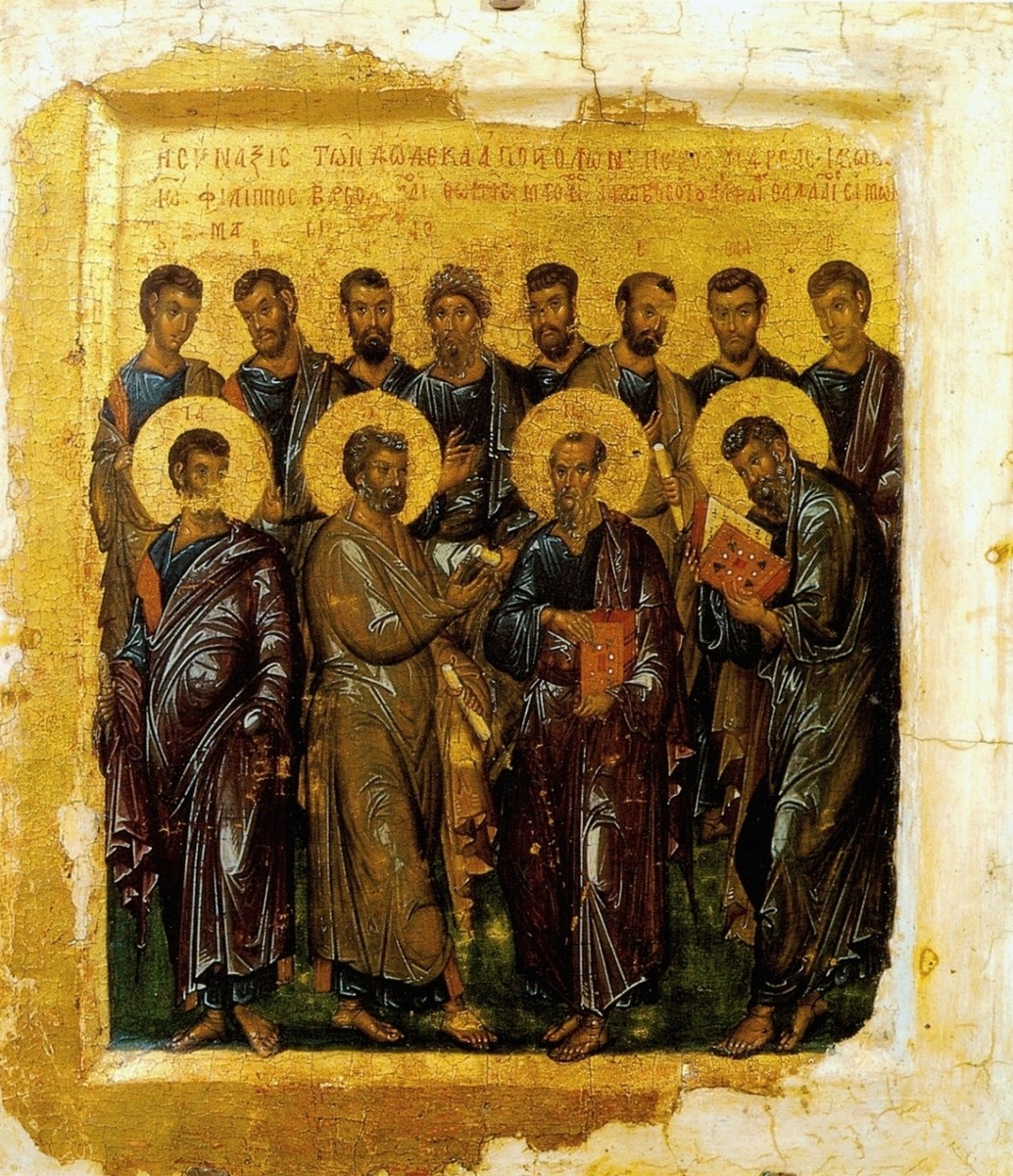
The Synaxis of the Twelve is one of the settled "assembly" types. The apostles are ranged in two or three rows, or in a single frontal file, without landscape or architecture — a gold ground, and above it the titulus Ἡ Σύναξις τῶν δώδεκα ἀποστόλων with each name written over its head. Peter and Paul stand at the centre or at the two ends, Peter grey-haired with a short curling beard, Paul bald-fronted with a long dark beard and always the book; John the Theologian is white-haired and aged; Andrew has the wild grey hair and unkempt beard that are his invariable mark; Thomas, Philip and the younger apostles are beardless or lightly bearded. The evangelists among them (Matthew, John) carry codices, often jewelled; the rest carry closed scrolls, the sign of the preached rather than the written word. No instruments of martyrdom appear in the pure Byzantine form of the type — those belong to the individual icons and to the Western tradition; here the point is the college, not the several passions. A related and later type places the Twelve about an enthroned Christ, or shows them receiving the commission, and in the Russian Sobor icons the ranks are multiplied and inscribed.
The stored image is the panel of the Synaxis of the Twelve Apostles painted by a Constantinopolitan master in the early fourteenth century, brought from the Pantokrator monastery on Athos and now in the Pushkin Museum in Moscow — twelve figures in two ranks on a gold ground, the Greek titulus and the apostles' names still legible along the upper margin, Peter at the head of the lower row with his scroll and the two book-bearing evangelists beside him (source, public domain, pd-old-work; the photograph is a faithful flat reproduction of a two-dimensional work six centuries out of copyright and carries no separate photographic right).
Disputed questions
Is the feast Constantinian? The tradition, followed by the Slavic and Greek synaxaria and by modern jurisdictional calendars, ascribes the ordering of the Synaxis to the fourth century, and links it to Constantine's church. The evidence is indirect: no fourth-century typikon survives, and the first firm calendrical witness to a June 30 assembly of the Twelve is Byzantine and later. What can be said safely is that a common commemoration of the Apostles as a body is early, that the Constantinopolitan church of the Holy Apostles is the natural site of such an assembly, and that the placement on June 30 depends on the prior fixing of June 29.
Why the day after Peter and Paul? The synaxaria give the reason plainly: lest the greater fame of the Chief Apostles should seem to depress the others. The Synaxis of the Twelve is therefore a corrective feast, of exactly the kind the Byzantine calendar likes — the day after a saint's feast keeps those who stood next to him (as December 26 keeps the Theotokos after the Nativity, and January 7 the Forerunner after the Theophany). Here the "synaxis of the day after" honours the whole college in the shadow of its two greatest members, and its whole meaning is the equality of the apostolic dignity.
The three Jameses and the three Judases. The calendar distinguishes James the son of Zebedee (April 30), James the son of Alphaeus (October 9), and James the Brother of the Lord (October 23), who was not of the Twelve but of the Seventy and first bishop of Jerusalem; and Jude Thaddaeus of the Twelve (June 19) from Thaddaeus of the Seventy, the apostle of Edessa (August 21, not yet authored here), and from Judas Iscariot. The manuscripts confuse them freely; the feast keeps only the two of the Twelve.