
John of Tobolsk
Our Father among the Saints John (Maximovich), Metropolitan of Tobolsk and All Siberia
Bishop · Wonderworker · b. 1651 — d. 1715
Commemorated 10 June — Repose at Tobolsk (1715); glorified 1916
John Maximovich (1651–1715) was Metropolitan of Tobolsk and All Siberia, the last of the great Kievan scholar-bishops of the seventeenth century to be sent east, and the founder of the missionary church of Siberia in its settled form. Born at Nezhin and trained at the Kiev-Mohyla college, where he afterwards taught, he was tonsured at the Kiev Caves monastery, became Archbishop of Chernigov in 1697 — where he founded the school that is reckoned the first seminary in Russia and set up a printing press — and in 1711 was sent as metropolitan to Tobolsk. From there he pressed the Siberian mission to the peoples of the north and east, and in 1714 despatched the mission that was to become the Russian ecclesiastical mission in Peking. He was the author of the Heliotropion (Iliotropion), a treatise on the conforming of the human will to the will of God. He died on 10 June 1715, on his knees at prayer, having that day served the poor at table. He was glorified in 1916.
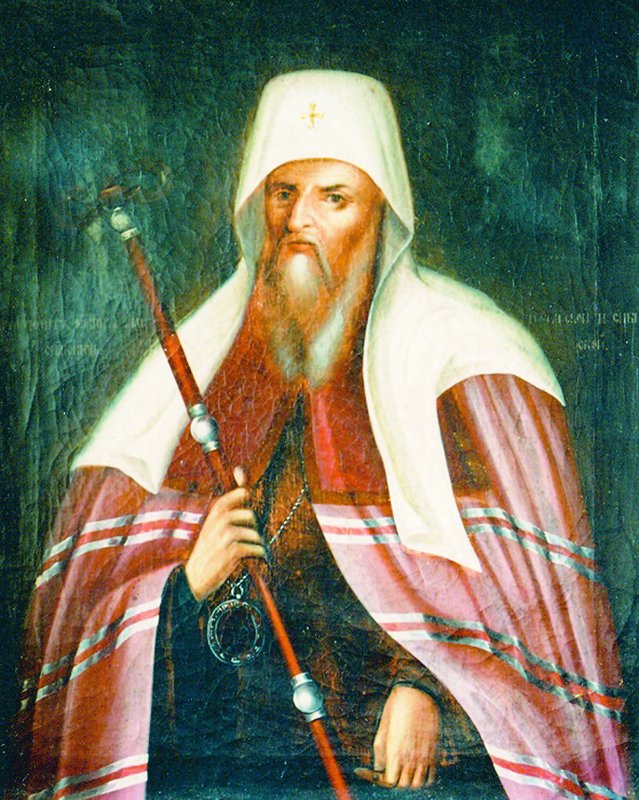
.jpg)
Nezhin, Kiev, and the Caves
He was born in 1651 at Nezhin in the Chernigov country, the eldest of the seven sons of Maxim Vasilievich and Euphrosyne — the patronymic that gave the family the name Maximovich. He was educated at the Kiev-Mohyla college, the great Orthodox academy of the Ukrainian lands, and was kept on there as a teacher of Latin: he belonged, that is, to the learned Kievan clergy whose Latin and Polish schooling made them the intellectual class of the Russian Church of that century.
In 1680 he was tonsured at the Kiev Caves monastery. His preaching and teaching made him quickly known, and the question that ran through his whole life as a writer was already his subject: how a man is to bring his own will into conformity with the will of God.
Archbishop of Chernigov
On 10 January 1697 he was consecrated Bishop (afterwards Archbishop) of Chernigov by Patriarch Adrian — the last patriarch of Moscow before the two-century vacancy. At Chernigov he did the two things that mark him. He founded a theological school on the model of the Kiev academy, which is generally reckoned the first seminary in Russia and became the pattern for the diocesan seminaries that followed; and he set up a printing press, from which he issued a stream of devotional and moral works, his own and others'.
His writings are numerous: sermons, verse, moral treatises, scriptural commentary, and above all the Heliotropion — "the sunflower," the plant that turns always to the sun — published in Latin in 1714 and afterwards translated into Slavonic-Russian. Its subject is the conformity of the human will to the divine, and it remains the work by which he is read. He is also the author of a Theatron and of collections of moral instruction; the whole corpus belongs to the Latin-schooled Kievan devotional literature of the age, and is its most attractive product.
Metropolitan of Tobolsk
In 1711 he was raised to Metropolitan of Tobolsk and All Siberia — a promotion in rank that was, in the politics of the time, also a removal to the furthest see in the empire; the tradition remembers that he accepted it without complaint. Siberia at that date was a missionary province of enormous extent and few clergy, and his four years there were spent in the work of a missionary metropolitan: the sending of priests to the Ostyaks, Voguls and other peoples of the north and east; the founding of churches and schools; the support of Metropolitan Philotheus (Leshchinsky), his predecessor and successor in the see, in the baptism of the Siberian peoples. The notices credit the mission of these years with many thousands of conversions.
In 1714, at the direction of Peter I and with the patriarchal blessing, he despatched to Peking the mission under Archimandrite Hilarion (Lezhaisky) which became the permanent Russian ecclesiastical mission in China — the beginning of the Orthodox Church in Peking and, at long remove, of the Chinese Orthodox Church.
His personal life at Tobolsk is remembered for almsgiving: he kept an open table for the poor and served them himself. On 10 June 1715, having done so that day, he withdrew to his rooms and was found dead on his knees at prayer.
Glorification and relics
Veneration at Tobolsk began at once and continued through the eighteenth and nineteenth centuries, sustained by healings at his tomb. His glorification — long petitioned by the Siberian dioceses — was decreed in 1916, and the solemnity was the last canonisation of the Russian Church before the revolution; the future patriarch St Tikhon was among the hierarchs who took part. His relics rest in the cathedral of the Protection of the Mother of God at Tobolsk, where they survived the Soviet period and are venerated still.
Feast and commemoration
June 10 (church date; Old Calendar civil June 23) — the day of his repose, kept in the Russian, Ukrainian and OCA calendars; the Greek and Antiochian books do not carry him. He is also commemorated in the Synaxis of the Saints of Siberia, which is kept on this same June 10 and of which he is the chief figure, and in the Synaxis of the Saints of Chernigov for his years in that see. In Tobolsk the day is the cathedral's feast. On June 10 his commemoration falls with the Finding of the Relics of Basil of Ryazan and with Silvanus of the Kiev Caves, the day's principal Greek commemoration being Timothy of Prusa.
Hymns
Troparion — Tone 8 (common of a hierarch)
O God of our fathers, who dealest ever with us according to Thy gentleness: take not Thy mercy from us, but by the prayers of Thy hierarch John, guide our life in peace.
Original translation from the Slavonic
Kontakion — Tone 4 (composed on the Heliotropion)
As the sunflower turns unceasing to the sun, so didst thou teach us to turn the will of man to the will of God, O hierarch John; and having served the poor at thy table, thou wast found upon thy knees, thy prayer unfinished and thy course fulfilled.
Iconography
John of Tobolsk is painted as a metropolitan: in the white klobuk of a Russian metropolitan surmounted by a cross, in sakkos and omophorion or in the mantle with the tablets and stripes, with the panagia on the breast, holding the crozier in one hand and blessing or holding the Gospel with the other. Two attributes are proper to him: the sunflower, for the Heliotropion, and the open book; and where his repose is shown he is painted kneeling in prayer, as he was found. Icons painted after 1916 usually give him a full grey beard and the ascetic face of the glorification portraits, and set the Tobolsk kremlin in the background.
The stored image is a Russian portrait of the second half of the eighteenth century from the Tyumen Regional Museum of Fine Arts: the metropolitan half-length, turned slightly to his right, in the white klobuk with its gold cross and the long white veil falling over the shoulders, in a rose-coloured mantle with the pale ribbon-stripes of a hierarch's mantiya, the panagia on a chain at the breast, holding the archpastoral staff in the right hand; two painted inscriptions stand in the dark ground to left and right of the head, illegible at the available resolution. It is a parsuna-type painted portrait of the kind Russian sees made of their hierarchs before iconographic types existed, and precedes the glorification by a century and a half. Identification rests on the museum's and the Orthodox Encyclopedia's attribution rather than on a legible inscription — that limitation is stated here in the interests of the repository's identity-verification discipline; the vesture (a metropolitan of the eighteenth century) is consistent, and no other saint of that rank and period is at risk of confusion. Public domain as a faithful reproduction of a pre-1900 two-dimensional work.
Disputed questions
- Not to be confused with St John (Maximovitch), Archbishop of Shanghai and San Francisco (1896–1966, glorified 1994, commemorated June 19 / July 2 and on the Saturday nearest that day), who bore the same surname and was of the same family: the twentieth-century saint was a descendant of the Tobolsk metropolitan's family and took the name John at tonsure in his honour. Confusion between the two is constant in English, where both are "St John Maximovitch," and it is compounded by the near-coincidence of their feasts in June. They are two saints, two centuries and two continents apart. (At the time of writing this collection has no entry for the Archbishop of Shanghai; the cross-reference is to be completed when it is authored.)
- Whether he was sent to Tobolsk in disgrace. A persistent tradition, deriving from the eighteenth-century Chernigov material, has the appointment made at the instance of Peter I's favourite Menshikov after a quarrel; the sober account is that Siberia needed a metropolitan of stature. The tradition is recorded because it is old, not because it is established.
- The date of the glorification. 1916 is certain; some accounts give 1915 for the Synod's decision and 1916 for the solemnity.
- The Latin question. His Latin schooling and the Latin first edition of the Heliotropion drew criticism in his own century and later from those who saw the Kievan learning as a Western intrusion. The judgement of the Russian Church, expressed in his glorification, was that the theology is Orthodox and the form of learning incidental.