
Cyprus Icon of the Mother of God
The Cyprus Icon of our Most Holy Lady the Theotokos and Ever-Virgin Mary
Kept 9 July — The principal commemoration of the icon in the Russian and American calendars, 20 April — Second commemoration of the icon, Pascha offset 50
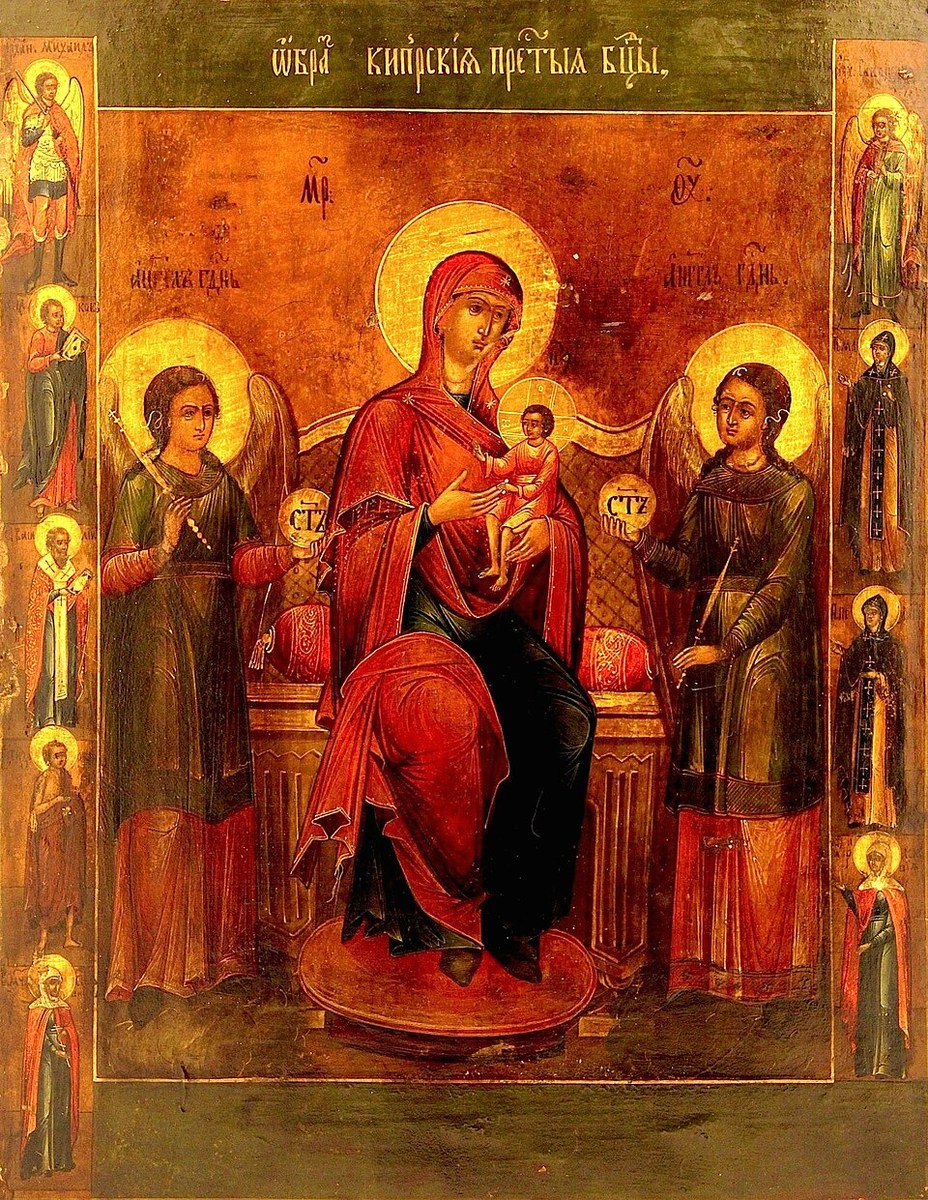
The Cyprus Icon shows the Mother of God enthroned, the divine Infant on her arm, with an angel standing on either side — a composition of the Panachranta ("All-Pure") family, and one of the oldest arrangements in Christian art. Its prototype is said to have appeared in the year 392 on the island of Cyprus, at the tomb of the Righteous Lazarus, the friend of Christ, and to be kept there in a monastery. Copies of the type came early into Russia, where the best known stood in the Dormition Cathedral of the Moscow Kremlin and in the church of the village of Stromyn in the Moscow diocese. To the icon belong a famous story of an arrow shot at it by an unbeliever, and a family of Russian variants under the by-names "Cleansing," "Knife" and "Hawk." It is commemorated on July 9, on April 20, and on the Day of the Holy Spirit.

The prototype on Cyprus
The tradition places the appearance of the original image in 392, on Cyprus, at the tomb of the Righteous Lazarus — the four-days-dead friend of Christ who, by the received account, came to the island after his raising, was made bishop of Kition, and died there a second time; his memory is kept on October 17, and his principal feast is the movable Lazarus Saturday. The icon is said to remain in a monastery of the island. The date and the association with Lazarus's tomb belong to the tradition as the Russian synaxaria received it and are not documented independently; what is certain is that the enthroned type with flanking angels is a genuinely early Cypriot and Eastern Mediterranean composition.
The arrow
The Greek Synaxarion, in an account read during the week of the Triumph of Orthodoxy, tells of an icon of the Mother of God — most probably this one — that hung by the gate of a church of the Theotokos on Cyprus. An Arab riding past, to show his contempt for Christianity, shot an arrow at it. The arrow struck the Virgin's knee, and blood flowed from the wound. Seized with terror, the man set spurs to his horse and rode for home, and was struck dead before he reached it. The story belongs to the great body of iconophile miracle-narratives read at the Sunday of Orthodoxy, and it is the reason one branch of the Russian tradition calls copies of this icon by the by-name of a weapon.
The Russian copies
Renowned copies of the Cyprus icon stood in the Dormition Cathedral of Moscow — the coronation church of the Russian sovereigns — and in the Nikolo-Golutvin church of the village of Stromyn in the Moscow diocese, the latter kept, the American calendar notes, on the Sunday of Orthodoxy. Some copies carry additional names: "Cleansing" (Ochistitelnaya), "Knife," and "Hawk."
- The "Hawk" icon takes its name from its finding. The Christian ruler of Cyprus was hunting with a trained hawk; the bird, stooping at another, became entangled in a thicket, and the ruler ordered the thicket cut away to free it. His servants recovered the hawk and found in the thicket an icon of the Mother of God. A monastery was built on the place.
- The "Cleansing" icon was in another Cypriot monastery and was famous for the healing of diseases of the eyes.
- The Stromyn copy became famous in 1841. A girl of eighteen from Stromyn, near Moscow, lay near death; in a dream she saw the Cyprus icon standing over the entrance of the church, and a voice from it said: take me into your house, have the priest serve a moleben with the blessing of water, and you will be cured. She was brought to the church, found the icon after a long search, obeyed, and after the moleben was strong enough to carry the icon back to the church herself; shortly afterwards she was completely healed. The rector reported the healings that followed to the Metropolitan Philaret of Moscow.
Feast and commemoration
July 9 (church date; New Calendar civil July 9, Old Calendar civil July 22), kept in the Russian and American calendars with the Kolochsk Icon and the saints of the day. A second fixed commemoration falls on April 20 (Old Calendar civil May 3), and a movable one on the Day of the Holy Spirit, the Monday after Pentecost — the day on which the Church turns from the Trinity to the Spirit, and on which several icons of the Mother of God are kept. On Cyprus the veneration is local to the monastery that holds the prototype.
Hymns
Troparion — Tone 4 (common of an icon of the Mother of God)
Today the faithful keep radiant festival, overshadowed by thy coming, O Mother of God; and looking upon thy most pure image we cry with compunction: shelter us beneath the precious veil of thy protection, and deliver us from every evil, entreating thy Son, Christ our God, to save our souls.
Original translation from the Slavonic
Kontakion — Tone 6
Enthroned thou art shown in thine image, O Queen, with the angels standing about thee and the Word upon thine arm; the impious arrow drew blood from thee and the wound became a wonder, and to this day thou dost cleanse the eyes of them that look on thee. Wherefore we cry: hail, O thou refuge of the islands and of the Russian land.
Original translation from the Slavonic
Appointed readings
Epistle — Philippians 2:5–11
5Let this mind be in you, which was also in Christ Jesus: 6Who, being in the form of God, thought it not robbery to be equal with God: 7But made himself of no reputation, and took upon him the form of a servant, and was made in the likeness of men: 8And being found in fashion as a man, he humbled himself, and became obedient unto death, even the death of the cross. 9Wherefore God also hath highly exalted him, and given him a name which is above every name: 10That at the name of Jesus every knee should bow, of things in heaven, and things in earth, and things under the earth; 11And that every tongue should confess that Jesus Christ is Lord, to the glory of God the Father.
Gospel — Luke 10:38–42; 11:27–28
38Now it came to pass, as they went, that he entered into a certain village: and a certain woman named Martha received him into her house. 39And she had a sister called Mary, which also sat at Jesus’ feet, and heard his word. 40But Martha was cumbered about much serving, and came to him, and said, Lord, dost thou not care that my sister hath left me to serve alone? bid her therefore that she help me. 41And Jesus answered and said unto her, Martha, Martha, thou art careful and troubled about many things: 42But one thing is needful: and Mary hath chosen that good part, which shall not be taken away from her. 27And it came to pass, as he spake these things, a certain woman of the company lifted up her voice, and said unto him, Blessed is the womb that bare thee, and the paps which thou hast sucked. 28But he said, Yea rather, blessed are they that hear the word of God, and keep it.
Iconography
The Cyprus icon belongs to the Panachranta or enthroned type. The Mother of God is seated frontally upon a throne, the divine Child on her lap or held before her breast and blessing; two angels stand one on each side, inclined toward her, holding staves and orbs or speculae inscribed with the thrice-holy — the angelic insignia of the imperial court, transferred to the court of heaven. The type states the dogma directly: the Theotokos as the throne of God and as Queen, attended.
The stored image is a nineteenth-century Russian panel of the type: the Theotokos in a deep-red maphorion enthroned on a broad seat, her feet on a footstool, the small Christ seated on her left knee in red and blessing, and the two angels — youthful, wide-eyed, in green and violet — flanking her with staves and inscribed orbs. Across the top runs the Slavonic title ОБРАЗЪ КИПРСКІЯ ПРЕСВЯТЫЯ БОГОРОДИЦЫ, "The image of the Cyprus Most Holy Theotokos," and the panel's borders carry the small standing figures of the owners' patron saints, as Russian household icons of the period commonly do.
Disputed questions
- Which day is the icon's own. The Russian and American calendars give the Cyprus icon three commemorations — July 9, April 20, and the Day of the Holy Spirit (the Monday after Pentecost). July 9 is the day on which the day-lists print it and is taken here as primary; April 20 is entered as a secondary fixed feast, and the Day of the Holy Spirit as a movable rule. The Stromyn copy is additionally kept on the Sunday of Orthodoxy, which is a fourth and movable date belonging to that copy and not to the type.
- Prototype and copies. "The Cyprus Icon" in Russian usage names a type as much as a panel: the Cypriot original, the Moscow and Stromyn copies, and the by-named variants are all called by it. Nothing in the Russian tradition depends on the identification of a single physical original, and this entry does not assert one.