
Pentecost week, day 2 · 50 days since Pascha
Day of the Holy Spirit
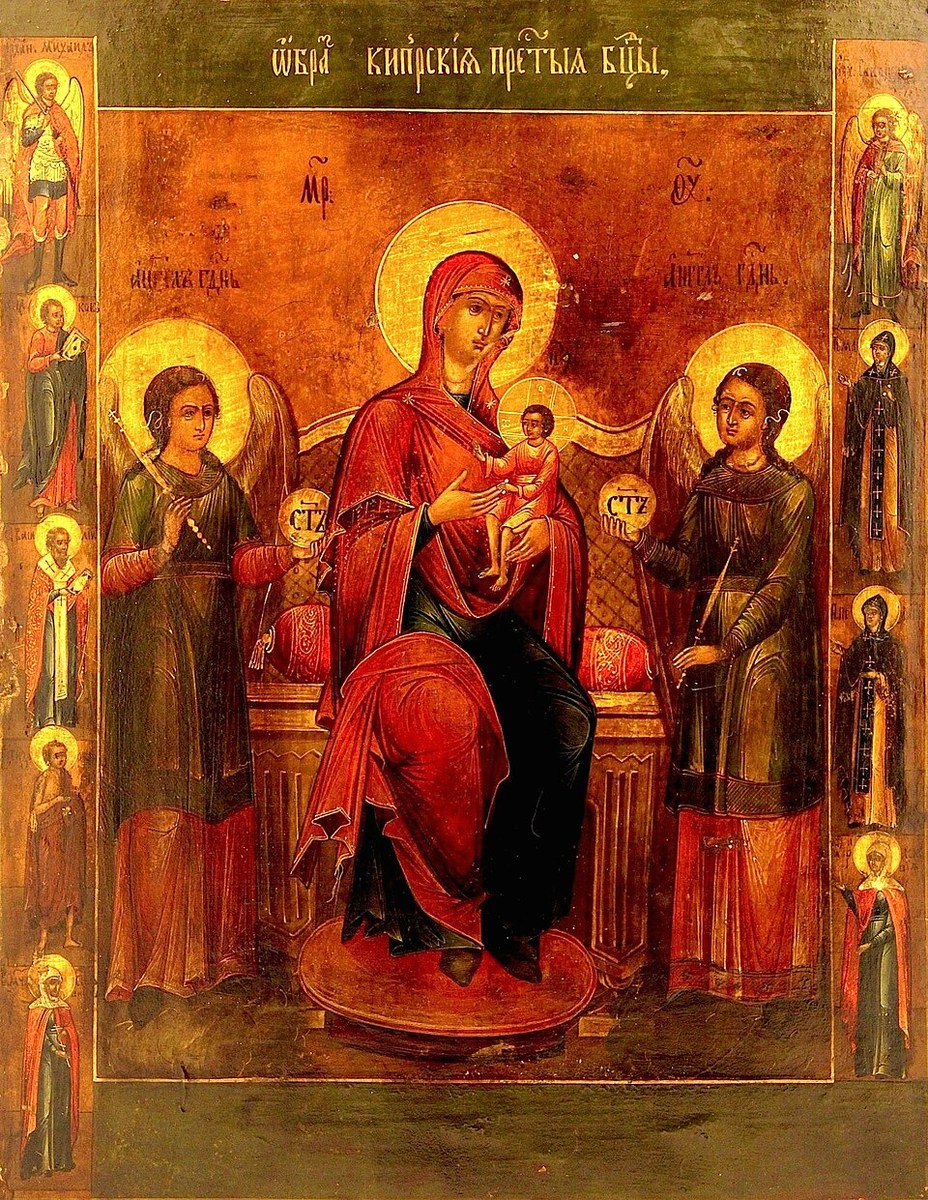
About Cyprus Icon of the Mother of God →

Saints commemorated
-
Martyr Justin the Philosopher
Justin the Philosopher (c. 100 – c. 165) is the first great apologist of the Church and the earliest Christian writer whose substantial works survive entire. Born of pagan Greek parents at Flavia Neapolis in Samaria — the ancient Shechem — he passed through Stoicism, the Peripatetics, Pythagoreanism and Platonism before an unnamed old man met by the sea turned him from the philosophers to the prophets and to Christ. Wearing still the philosopher's cloak, he taught Christianity as the one true philosophy, opened a school at Rome, and addressed to the emperors and Senate the two Apologies and to a learned Jew the Dialogue with Trypho. Denounced by the Cynic Crescens, he was scourged and beheaded with six companions under the urban prefect Rusticus, and the authentic Acts of that trial survive. His description of baptism, of the Sunday assembly and of the Eucharist is the earliest detailed account of Christian worship in existence.
-
Our Holy Father Agapitus of the Kiev Caves (1095)
Agapitus of the Kiev Caves (†1095) is the first physician of the Russian land whose name is remembered, and the first Russian saint to bear the title of the unmercenary healers — ἀνάργυροι, those who take no silver. A disciple of St Anthony of the Caves in the first generation of the Kiev-Pechersk Lavra, he healed the sick of the monastery and the city by prayer and by herbs he boiled himself, refusing all payment and all thanks, and healed among others the future Great Prince Vladimir Monomakh, whom he would not so much as let look at him. His story is told at length in the Kiev Caves Paterikon, chiefly for the sake of its counterpoint: a learned Armenian physician of Kiev, who diagnosed by inspection and predicted the day of death, and who was confounded first by Agapitus's cures and at last by the saint's foreknowledge of his own repose — after which the Armenian became an Orthodox monk. Agapitus's relics rest in the Near Caves, and he is commemorated on June 1.
-
Dionysius of Glushitsa
Dionysius of Glushitsa (1363–1437) was one of the great founders of the Northern Thebaid, the monastic wilderness of the Russian north. Born near Vologda and baptised Dimitry, he was tonsured in 1382 at the island monastery of the Saviour on the Stone (Spaso-Kamenny) on Lake Kubenskoye, and after nine years went out with a single disciple into the forest, where — hearing, the tradition says, the sound of bells on the empty banks of the river Glushitsa — he founded the Monastery of the Protection of the Theotokos, and later the hermitage of Sosnovets for those who sought greater solitude, a women's monastery under the Athonite typikon, and other houses besides. He was a painter of icons as well as a builder of monasteries, and one of the earliest Russian iconographers whose name and hand can be tied to surviving work. Renowned for extreme austerity, for open-handed almsgiving in famine, and for miracles, he reposed at Sosnovets on 1 June 1437 in his seventy-fourth year, and was canonised by the Council of Moscow in 1547.
-
Justus, Justin and their Companions
Under this title the Greek Menaion and the Slavic synaxaria keep, on June 1, the little company of Christians who were tried and beheaded at Rome about the year 165 together with Justin the Philosopher: Chariton, the virgin Charito, Euelpistus — a slave of the emperor's household, Cappadocian by birth — Hierax from Iconium in Phrygia, Paeon, and Liberian (whom the Slavic books call Valerian), with a Justin and a Justus who are almost certainly the philosopher himself, doubled in transmission. Their interrogation before the urban prefect Q. Junius Rusticus survives in the Acts of Justin, one of the earliest and soberest of all martyr-acts; each in turn confessed Christ, and to the command that they sacrifice they answered together: "Do what you will, for we are Christians, and we do not sacrifice to idols." They were scourged and beheaded.
-
Shio the New and the Martyrs of Gareji
At the end of the seventeenth century a band of Dagestani raiders fell upon the cave-monastery of David-Gareji in the semi-desert of Kakheti while the abbot was absent, plundered the church, burned or broke the icons and vestments, and put to the sword the hieromonk left in charge and three of his brethren: Shio the New, David, Gabriel and Paul. Shio was of the Kartlian nobility, from the village of Vedzisi, one of eight children of parents named Papuna and Tamar, and had come to Gareji after a murderous quarrel over the family inheritance drove him out of the world. He was known in the wilderness for humility and for the gift of counsel, and the abbot Onopre entrusted him with the governance of the house. Their mutilated relics were buried by order of the Catholicos and the king in the courtyard of the lavra, south of the tomb of St David of Gareji, and the Georgian Church keeps them on June 1.
-
Thespesius of Cappadocia
Thespesius — a Greek name meaning "divinely-uttered," and so apt to a martyr that the synaxaria remark on it — was a Christian of Cappadocia who suffered under the emperor Alexander Severus, about the year 222. Arrested by the provincial governor Simplicius for confessing Christ and brought to a temple to sacrifice, he mocked the idols to the governor's face. He was hung up and his flesh torn, plunged into boiling water, and shut for two days in a cauldron of seething oil, pitch and fat, from all of which he came out unhurt; and many pagans, the account says, were converted by the sight. He was at last beheaded outside the city, and is commemorated on June 1.
British Isles and Ireland
- St. Ronan the Silent
- Holy martyr Wistan of Evesham (850)
- Holy martyr Wite (Candida) of Dorset
Troparia & kontakia
Kontakion — Tone 6
Enthroned thou art shown in thine image, O Queen, with the angels standing about thee and the Word upon thine arm; the impious arrow drew blood from thee and the wound became a wonder, and to this day thou dost cleanse the eyes of them that look on thee. Wherefore we cry: hail, O thou refuge of the islands and of the Russian land.
Kontakion — Tone 2
Taking no silver for thy healing, thou didst give the sick the herbs of thy poor table and the prayer of thy heart, O venerable Agapitus; and thou didst hide thyself from the gifts of princes, seeking one reward alone. Wherefore Christ, the Physician of soul and body, hath crowned thee among the unmercenaries.
Kontakion — Tone 8
Hearing the sound of bells in the trackless forest, thou didst know the place of thy calling, O father Dionysius; and where no man dwelt thou didst raise a house to the Protection of the Mother of God, painting with thy own hand the images of the saints. Wherefore, having lent thy bread to God in the hungry years, thou hast received of Him an unfading crown.
Kontakion — Tone 2
Having sought out the wisdom of the Greeks and found it wanting, thou didst learn from the prophets the philosophy that saveth, O Justin; and having taught the emperors of the earth to reverence Christ, thou didst seal thy words with thy blood. Wherefore entreat Him without ceasing for us who honour thee.
Troparion — Tone 4 (common of an icon of the Mother of God)
Today the faithful keep radiant festival, overshadowed by thy coming, O Mother of God; and looking upon thy most pure image we cry with compunction: shelter us beneath the precious veil of thy protection, and deliver us from every evil, entreating thy Son, Christ our God, to save our souls.
Troparion — Tone 8 (common of a venerable father)
In thee, O Father, was preserved unblemished that which is according to the image; for taking up thy cross, thou didst follow Christ, and by thy deeds thou didst teach us to despise the flesh, which passeth away, and to care for the soul, which is immortal. Wherefore, O venerable Agapitus, thy spirit rejoiceth with the angels.
Troparion — Tone 8 (common of a venerable father)
In thee, O Father, was preserved unblemished that which is according to the image; for taking up thy cross, thou didst follow Christ, and by thy deeds thou didst teach us to despise the flesh, which passeth away, and to care for the soul, which is immortal. Wherefore, O venerable Dionysius, thy spirit rejoiceth with the angels.
Troparion — Tone 4 (common of a martyr)
Thy martyr Justin, O Lord, in his contest received an incorruptible crown from Thee, our God; for possessing Thy strength, he cast down the tyrants and shattered the feeble insolence of the demons. By his intercessions save our souls.
Troparion — Tone 4 (common of several martyrs)
O holy martyrs, who fought the good fight and received your crowns, entreat the Lord that He have mercy on our souls.
Troparion — Tone 4 (common of several martyrs)
O holy martyrs Shio, David, Gabriel and Paul, who in the wilderness of Gareji fought the good fight and received your crowns, entreat the Lord that He have mercy on our souls.
Troparion — Tone 4 (common of a martyr)
Thy martyr Thespesius, O Lord, in his contest received an incorruptible crown from Thee, our God; for possessing Thy strength, he cast down the tyrants and shattered the feeble insolence of the demons. By his intercessions save our souls.
Readings
Epistle
Ephesians 5.8-19
8For ye were sometimes darkness, but now are ye light in the Lord: walk as children of light: 9(For the fruit of the Spirit is in all goodness and righteousness and truth;) 10Proving what is acceptable unto the Lord. 11And have no fellowship with the unfruitful works of darkness, but rather reprove them. 12For it is a shame even to speak of those things which are done of them in secret. 13But all things that are reproved are made manifest by the light: for whatsoever doth make manifest is light. 14Wherefore he saith, Awake thou that sleepest, and arise from the dead, and Christ shall give thee light. 15See then that ye walk circumspectly, not as fools, but as wise, 16Redeeming the time, because the days are evil. 17Wherefore be ye not unwise, but understanding what the will of the Lord is. 18And be not drunk with wine, wherein is excess; but be filled with the Spirit; 19Speaking to yourselves in psalms and hymns and spiritual songs, singing and making melody in your heart to the Lord;
Gospel
Matthew 18.10-20
10Take heed that ye despise not one of these little ones; for I say unto you, That in heaven their angels do always behold the face of my Father which is in heaven. 11For the Son of man is come to save that which was lost. 12How think ye? if a man have an hundred sheep, and one of them be gone astray, doth he not leave the ninety and nine, and goeth into the mountains, and seeketh that which is gone astray? 13And if so be that he find it, verily I say unto you, he rejoiceth more of that sheep, than of the ninety and nine which went not astray. 14Even so it is not the will of your Father which is in heaven, that one of these little ones should perish. 15Moreover if thy brother shall trespass against thee, go and tell him his fault between thee and him alone: if he shall hear thee, thou hast gained thy brother. 16But if he will not hear thee, then take with thee one or two more, that in the mouth of two or three witnesses every word may be established. 17And if he shall neglect to hear them, tell it unto the church: but if he neglect to hear the church, let him be unto thee as an heathen man and a publican. 18Verily I say unto you, Whatsoever ye shall bind on earth shall be bound in heaven: and whatsoever ye shall loose on earth shall be loosed in heaven. 19Again I say unto you, That if two of you shall agree on earth as touching any thing that they shall ask, it shall be done for them of my Father which is in heaven. 20For where two or three are gathered together in my name, there am I in the midst of them.