
Entry of the Theotokos
The Entry (Presentation) of our Most Holy Lady the Theotokos and Ever-Virgin Mary into the Temple
The Entry of the Most Holy Theotokos into the Temple (November 21) is one of the Twelve Great Feasts, and the last of the festal cycle to arise. It keeps a tradition drawn from the second-century Protoevangelium of James: when Mary was three years old, the righteous Joachim and Anna, fulfilling the vow they had made before her birth, brought her to the Temple at Jerusalem and gave her over to the service of God; the priest received her, set her within the sanctuary, and she remained there, nourished — the tradition adds — by the hand of an angel until the time of her betrothal. The Church reads the event as the setting-apart of the living Temple of God: the girl who will contain the Uncontainable is herself carried into the place of God's dwelling, the Old Covenant handing on its holiness to the New. Kept in the East since the seventh or eighth century, the feast is celebrated with a forefeast on November 20 and an afterfeast to its leavetaking on November 25, and from it the Church begins to sing the katavasiae of the coming Nativity, "Christ is born."

The narrative of the Protoevangelium
Of the childhood of the Mother of God the canonical Gospels say nothing. What the Church keeps of it, as with the feast of her Nativity, she keeps from tradition, whose oldest written witness is the Protoevangelium of James, an apocryphal infancy narrative of about the middle of the second century. The book was never received as Scripture, and its account of matters treated by the canonical Gospels was set aside; but its story of the Virgin's early years was received into the Church's devotional memory, shaped the synaxaria and the festal hymnography, and fixed the iconography of the feast to the present day. Three fixed feasts of the year — the Conception by Anna (December 9), the Nativity of the Theotokos (September 8), and the Entry (November 21) — rest upon its narrative.
Before Mary was born, the narrative relates, Anna had vowed that the child God might grant to her barrenness would be given back to God as a gift, "to minister before him all the days of its life." The vow bound the parents to the temple. When the child was two years old Joachim proposed to bring her up; Anna asked that they wait until she was three, "lest she seek for father or mother" and turn back. And when the third year was full, Joachim summoned the undefiled daughters of the Hebrews, and they took up their lamps and went before the little girl as an escort, that she might not turn back and that her heart might be drawn toward the temple of the Lord. The priest received her, kissed and blessed her, and said, "The Lord hath magnified thy name among all generations; in thee, in the last days, the Lord will make manifest his redemption to the sons of Israel." He set her upon the step of the altar, and the Lord God put grace upon her, and — the narrative says — she danced with her feet, and all the house of Israel loved her.
The fifteen steps and the Holy of Holies
Around this spare account the hymnography and homiletic tradition raised a great structure of imagery. The bare Protoevangelium says only that the priest set the child "upon the third step of the altar"; the festal tradition elaborated the ascent into the celebrated image of the fifteen steps — the fifteen degrees by which, in the tradition, one mounted to the Temple, matched to the fifteen Songs of Ascents of the Psalter (Psalms 119–133 in the Septuagint numbering), sung by the Levites as they went up. The stichera and canons picture the three-year-old climbing all fifteen unaided, running up to the sanctuary while her parents and the virgins watch in wonder, "the ewe-lamb of God" hastening to the place prepared for her.
More daring still is the tradition the hymns will not let go of: that the priest led her not merely into the temple courts but into the Holy of Holies itself — the innermost place, entered by the high priest alone and but once a year, where the Ark had stood. The paradox is the heart of the feast's poetry. The one who is herself the true Ark, the living tabernacle, is carried into the empty Holy of Holies of the shadow; the girl who will hold the Uncontainable is set down in the place where God's presence had dwelt. The priest, the tradition adds, acted by a prophetic impulse beyond the Law, "not of himself, but that which was of God." In the received tradition this priest is named Zacharias and identified with the father of John the Forerunner (see Zachariah and Elizabeth) — a pious identification carried by the Protoevangelium and much hymnography, though the canonical Luke presents Zachariah as an ordinary priest of the course of Abijah and not as high priest, and the entry for Zachariah keeps that distinction.
The years in the Temple, and the angel
Having received her, the priest "set her down upon the third step of the altar," the narrative continues, "and she received food from the hand of an angel." So the Protoevangelium itself, in a single line, gives the tradition the feast has never forgotten: that the child Mary lived in the precincts of the Temple, nurtured "like a dove," and was fed by an angel of the Lord. Later homilists — Germanus of Constantinople and George of Nicomedia among them — developed the scene into a picture of unbroken prayer and heavenly converse: the maiden growing in the sanctuary, taught by angels, receiving from an angel's hand the bread of heaven, prepared in stillness and purity to become the dwelling-place of the Word. She remained, the tradition says, until she was twelve, when the priests — unwilling that a maiden come of age should remain within the sanctuary — entrusted her to the guardianship of the aged Joseph the Betrothed, in whose house she would receive, not long after, the Annunciation of Gabriel. Thus the Entry opens the years of her hidden preparation, between the Nativity that gave her to the world and the Annunciation that made her the Mother of God.
Origins and history of the feast
The Entry is the youngest of the great Theotokian feasts, and the one whose early history is least clear. No trace of it appears in the earliest strata of the Byzantine calendar; it emerges in the East between the seventh and eighth centuries. Some scholars connect its date and rise with the dedication of the "New" church of Saint Mary (the Nea Ekklesia) that Justinian I raised at Jerusalem near the Temple mount, consecrated in 543 — a great Marian shrine whose annual festival, as with the Nativity feast and the basilica by the Sheep Pool, may have grown into the feast of the Entry, spreading from Jerusalem to Constantinople and the wider East. Whatever its origin, by the eighth century the commemoration was kept in the capital: Germanus of Constantinople (†c. 733) preached two homilies "on the Entry of the Most Holy Theotokos," the earliest secure festal witness, and Tarasius of Constantinople is credited with homilies on the theme.
The ninth century gave the feast the service it still keeps. George of Nicomedia (fl. c. 860–880), deacon and chartophylax of Hagia Sophia and later metropolitan of Nicomedia, a friend of the patriarch Photius and one of the most fertile Marian hymnographers of Byzantium, composed the canons of the Entry that stand in the Menaion, and preached a cycle of homilies elaborating the narrative of the Temple years. By the close of the ninth century the feast was firmly established in Constantinopolitan usage; its later promotion to the rank of the Twelve Great Feasts fixed it in the place it now holds, the last of the four fixed Great Feasts of the Nativity half of the year.
The Western reception and the Roman suppression
The West received the feast late and by an unusual path. Kept for centuries only among the Greeks of southern Italy, it entered the wider Latin Church chiefly through the crusader kingdoms of the East: Philippe de Mézières, the French chancellor of the Lusignan kingdom of Cyprus, encountered the Greek feast of the Presentation there and became its passionate advocate in the West, composing a Latin office and a dramatic representation of it. Through his efforts Pope Gregory XI permitted the feast's celebration at the papal court at Avignon in 1372, and Sixtus IV extended it to the whole Roman Church in 1472.
Then came the odd reversal. In the breviary reform of 1568 Pope Pius V struck the Presentation of Mary from the Roman calendar altogether, on the ground that it rested on nothing but the apocryphal Protoevangelium and had no warrant in Scripture or the Fathers — the same scruple that had it kept as a lesser observance in the East never troubled, since the East had never held the feast to be an assertion of historical fact so much as a celebration of the Virgin's consecration. The suppression lasted seventeen years: Sixtus V restored the feast in 1585, and it has remained in the Roman calendar since, under the title "Presentation of the Blessed Virgin Mary," reduced to an obligatory memorial in the calendar reform of 1969. The Orthodox East, which gave the feast birth, never wavered in keeping it among the greatest of the year.
Theology: the living Temple, and the threshold of the Nativity
The feast's theology is written in a single word: temple. Mary is brought into the Temple to be shown as the true Temple — "the living Temple of the holy glory of Christ our God," as the exapostilarion calls her. The whole apparatus of the Old Covenant's holiness, the tabernacle and the Ark, the Holy of Holies and its once-a-year entering, the veil and the mercy-seat, are read by the hymns as figures pointing to her who would hold God in her womb; and on this day the figure meets its fulfilment face to face, as the child who is the reality is carried into the sanctuary of the shadow. The feast stands, then, at the seam of the two Covenants: the Old Testament, in the person of its priest and its Temple, receives and hands on its holiness to the one in whom the New Testament begins. The reading of Hebrews 9 at the Liturgy — the first tabernacle, its furniture, and the Holy of Holies entered by the high priest alone — is chosen precisely so, the letter's account of the shadow read over the entrance of its truth.
There is a second, forward-looking note. The Entry is the gateway of the Nativity. Falling six days into the Nativity Fast, it turns the Church's face toward Bethlehem: from this feast onward the katavasiae sung at Matins are the irmoi of the canon of the Nativity of Christ, the work of Cosmas of Maiuma — "Christ is born, give glory; Christ from the heavens, go to meet him" (Χριστὸς γεννᾶται, δοξάσατε). So the feast that shows the living Temple brought into the house of God also sounds, weeks in advance, the first note of the feast toward which the whole Temple imagery tends: the coming of the One for whom she is prepared, when the Temple of God becomes a cave and a manger.
Feast and commemoration
November 21 (church date; Old Calendar civil December 4), the fourth of the Twelve Great Feasts, kept universally in the Byzantine rite with an All-night Vigil. It has a forefeast of one day, November 20 (kept together with the commemorations of Gregory of Decapolis and Proclus of Constantinople), and an afterfeast of four days, through which the festal hymns govern the services, to the leavetaking (apodosis) on November 25, when the whole service of the feast is sung again in fullness (November 25 also being the day of Catherine the Great-Martyr and of the hieromartyr Clement of Rome, whose services are joined to the leavetaking of the feast).
Alone among the Great Feasts the Entry falls within a fasting season — the Nativity Fast, kept from November 15 to December 24. The fast is not set aside but relaxed in the feast's honour: fish, wine and oil are permitted on November 21 whatever the day of the week, as on the other festal days that fall within the Fast. In Russian usage the clergy vest in blue, the colour there appointed for feasts of the Theotokos; Greek practice knows no fixed system of liturgical colours, and festal (often light or gold) vestments are used according to local custom — the difference is one of usage, not of rank. The feast is kept on the same date, November 21, throughout the Orthodox world; the New Calendar churches (including the Antiochian Archdiocese) observe it on civil November 21, the Old Calendar churches thirteen days later, on civil December 4.
Hymns
Troparion — Tone 4
Today is the prelude of the good pleasure of God, and the proclamation of the salvation of mankind. In the Temple of God the Virgin is openly made manifest, and beforehand she announces Christ unto all. To her, then, let us cry aloud with a great voice: Rejoice, O fulfilment of the Creator's dispensation.
Original translation from the Greek
Kontakion — Tone 4
The most pure Temple of the Saviour, the precious bridal-chamber and Virgin, the sacred treasury of the glory of God, is brought this day into the house of the Lord, bringing in with her the grace that is in the divine Spirit; and the Angels of God hymn her: She is the heavenly tabernacle.
Original translation from the Greek
Appointed readings
Epistle — Hebrews 9:1–7
1Then verily the first covenant had also ordinances of divine service, and a worldly sanctuary. 2For there was a tabernacle made; the first, wherein was the candlestick, and the table, and the shewbread; which is called the sanctuary. 3And after the second veil, the tabernacle which is called the Holiest of all; 4Which had the golden censer, and the ark of the covenant overlaid round about with gold, wherein was the golden pot that had manna, and Aaron’s rod that budded, and the tables of the covenant; 5And over it the cherubims of glory shadowing the mercyseat; of which we cannot now speak particularly. 6Now when these things were thus ordained, the priests went always into the first tabernacle, accomplishing the service of God. 7But into the second went the high priest alone once every year, not without blood, which he offered for himself, and for the errors of the people:
Gospel — Luke 10:38–42; 11:27–28
38Now it came to pass, as they went, that he entered into a certain village: and a certain woman named Martha received him into her house. 39And she had a sister called Mary, which also sat at Jesus’ feet, and heard his word. 40But Martha was cumbered about much serving, and came to him, and said, Lord, dost thou not care that my sister hath left me to serve alone? bid her therefore that she help me. 41And Jesus answered and said unto her, Martha, Martha, thou art careful and troubled about many things: 42But one thing is needful: and Mary hath chosen that good part, which shall not be taken away from her. 27And it came to pass, as he spake these things, a certain woman of the company lifted up her voice, and said unto him, Blessed is the womb that bare thee, and the paps which thou hast sucked. 28But he said, Yea rather, blessed are they that hear the word of God, and keep it.
Iconography
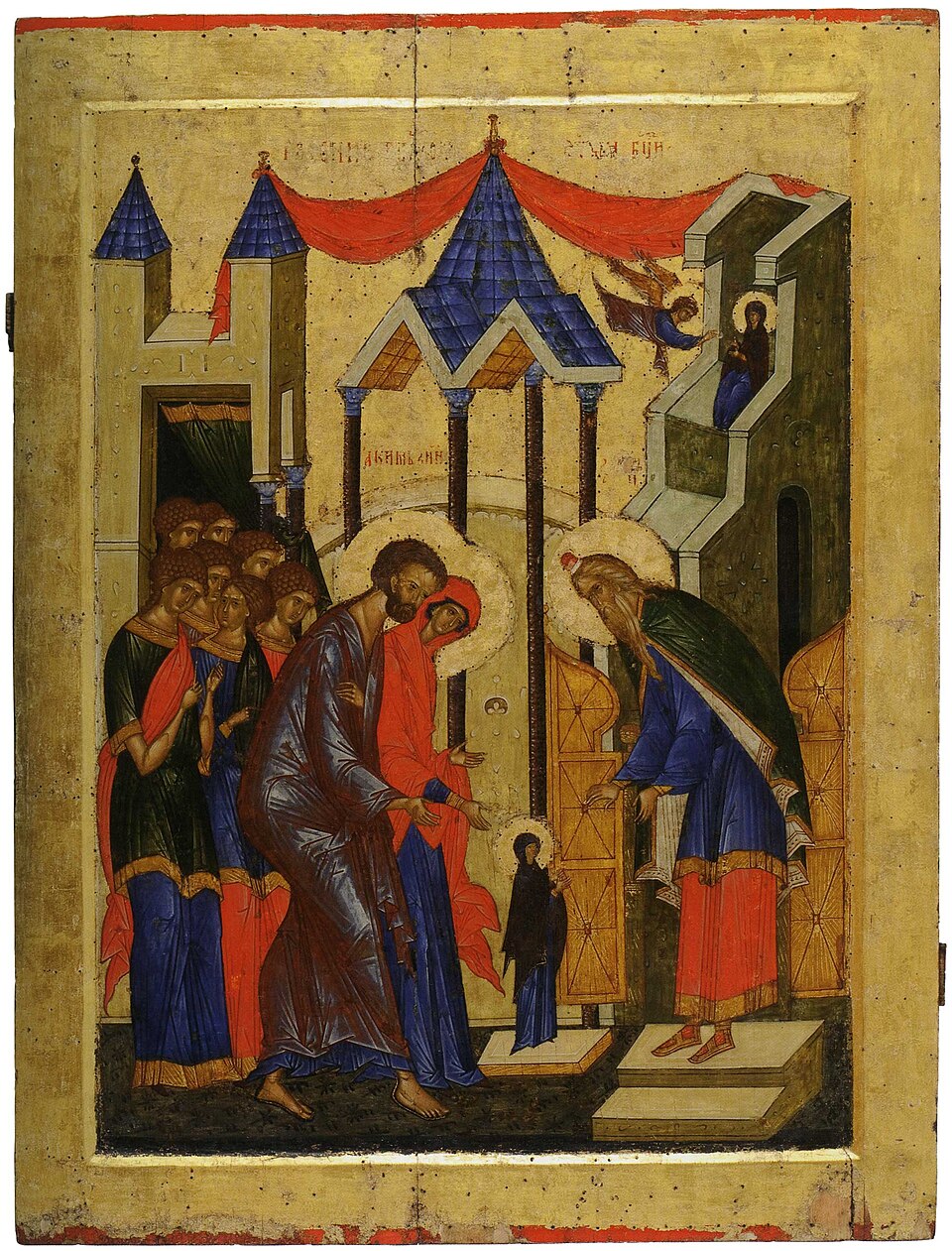
The icon of the feast is a classic pre-modern type, fixed in its essentials by middle Byzantine times and abundant in the Byzantine, Balkan and Russian traditions. The composition is built around the flight of the Temple steps. At the centre or right the high priest — inscribed Zacharias — bends down from the top of the steps, before the altar under its ciborium, and stretches out his hands to receive the tiny figure of Mary, who stands below already robed in the maphorion and haloed, her own hand raised toward him. Behind her come her parents, Joachim and Anna, presenting her with a gesture, and behind them the train of the undefiled virgins of Jerusalem, often bearing lamps or candles. In an upper corner, set apart in a little architecture of steps and a canopy, the same Mary is shown a second time, seated within the Holy of Holies, while an angel descends toward her with heavenly bread — the feeding of the Virgin by the angel, drawn straight from the Protoevangelium and almost never omitted. A red cloth (velum) is draped between the towers of the Temple, in the Byzantine convention marking an interior scene, and the Slavonic or Greek titulus of the feast runs across the top.
The stored image is a Russian icon of 1497 from the festal tier (prazdnichny chin) of the iconostasis of the Dormition Cathedral of the Kirillo-Belozersky Monastery. Before the blue-domed ciborium hung with its red veil, the grey-haired priest Zacharias bends from the altar steps with outstretched hands; the small dark-robed, haloed Mary stands on the lowest step, her hand extended toward him; at the left Joachim, in a silver mantle, inclines forward presenting the child, Anna in her red maphorion beside him, and behind them the close-ranked company of maidens; and in the upper right, within a separate stair and niche, the seated Mary receives the bread from the descending angel. The names of Joachim and of the feast are inscribed in Slavonic across the panel.