
Zachariah and Elizabeth
The Holy Prophet Zachariah and the Righteous Elizabeth, Parents of John the Forerunner
Prophet · Righteous · Priest · d. 1st century
Commemorated 24 June — With the Nativity of John the Forerunner (Greek usage, per OCA), 5 September — Principal commemoration of the prophet and his wife
Zachariah the priest and his wife Elizabeth were the parents of John the Forerunner and Baptist of the Lord. Luke's Gospel presents them as an aged, childless couple, "both righteous before God"; to Zachariah, serving at the altar of incense, the archangel Gabriel announced the conception of John, and at the child's naming Zachariah's loosed tongue uttered the prophecy known as the Benedictus. Tradition, resting on the second-century Protoevangelium of James, holds that Zachariah was murdered in the temple at Herod's command for refusing to betray his son's hiding place, and that Elizabeth, who had fled with the infant John into the wilderness, reposed forty days after her husband. They are commemorated together on September 5.

Origins and early life
Everything securely known of Zachariah and Elizabeth comes from the first chapter of the Gospel of Luke, which opens the whole New Testament narrative in their household. Zachariah (Hebrew Zekharyah, "the Lord has remembered") was a priest of the division of Abijah — the eighth of the twenty-four priestly courses instituted under David (1 Chronicles 24:10), each of which served in the Jerusalem temple in rotation. Elizabeth (Elisheba, the name of Aaron's own wife) was herself "of the daughters of Aaron," so that John the Forerunner was of priestly descent on both sides. Luke's judgment on the couple is the foundation of their veneration among the righteous: "they were both righteous before God, walking in all the commandments and ordinances of the Lord blameless" (Luke 1:6). Yet they were childless — Elizabeth was barren, and both were "well stricken in years" — a condition their contemporaries read as divine disfavour, and which the Church's hymnography reads instead as the last of the great biblical barrennesses (Sarah, Rebekah, Hannah, Anna) opened by God on the threshold of the Incarnation.
Later tradition supplies what Luke does not. The synaxaria connect Elizabeth's family with that of the Theotokos: Luke has Gabriel call Elizabeth Mary's "kinswoman" (συγγενής, Luke 1:36), and the received tradition — as the OCA synaxarion states it — makes Elizabeth the sister of Anna, the mother of the Theotokos, while other lines of the tradition make her Anna's niece, the daughter of Anna's sister Sobe. The variance is noted under Disputed questions. The tradition likewise gives Zachariah's father's name as Barach or Barachiah, harmonising with Matthew 23:35.
Ministry
Luke's narrative places the decisive event of Zachariah's priesthood during his course's temple service, when the lot fell to him "to burn incense when he went into the temple of the Lord" — the privilege, perhaps once in a priest's lifetime, of entering the holy place at the hour of the offering while the people prayed outside. There the archangel Gabriel appeared to him, standing on the right side of the altar of incense, and announced that his prayer was heard: Elizabeth would bear a son, to be named John, who would be great before the Lord, filled with the Holy Spirit from his mother's womb, and would go before the Messiah "in the spirit and power of Elias" (Luke 1:17, recalling the closing prophecy of Malachi). Zachariah doubted — "Whereby shall I know this? for I am an old man" — and for his hesitation was struck mute until the promise should be fulfilled, so that when he came out unable to pronounce the blessing, the people perceived he had seen a vision. The Church has always read the scene with a certain tenderness toward Zachariah: the priest's silence became itself a sign, the Old Covenant standing wordless until the voice of the Forerunner should be born.
Elizabeth conceived and hid herself five months, saying "Thus hath the Lord dealt with me... to take away my reproach among men." In her sixth month came the Annunciation at Nazareth, and Mary's journey "into the hill country... into a city of Juda" — identified by long tradition with Ain Karim west of Jerusalem — to the house of Zachariah. At Mary's greeting the unborn John leaped in Elizabeth's womb, and Elizabeth, filled with the Holy Spirit, became the first human being to confess the Incarnation aloud: "Blessed art thou among women, and blessed is the fruit of thy womb. And whence is this to me, that the mother of my Lord should come to me?" (Luke 1:42–43). Orthodox theology has always weighed these words heavily: before either child was born, the mother of the Forerunner confessed Mary as Theotokos in all but the later term, and her greeting, joined to Gabriel's, forms the first half of the hymn "Rejoice, O Virgin Theotokos."
When Elizabeth's son was born, her neighbours and kinsfolk would have named him for his father; Elizabeth insisted, "Not so; but he shall be called John." Appeal was made to the mute Zachariah, who wrote on a tablet, "His name is John" — a name (Yochanan, "the Lord is gracious") borne by no one in the family, given by the angel. "And his mouth was opened immediately, and his tongue loosed, and he spake, and praised God." Filled with the Holy Spirit, Zachariah prophesied — the canticle Benedictus Dominus Deus Israel, "Blessed be the Lord God of Israel, for he hath visited and redeemed his people" (Luke 1:68–79) — blessing God for raising up "an horn of salvation... in the house of his servant David" and turning at its close to the infant: "And thou, child, shalt be called the prophet of the Highest: for thou shalt go before the face of the Lord to prepare his ways." This prophecy is the ground of Zachariah's title of prophet in the calendar, and the canticle itself entered the daily prayer of the Church: in the Byzantine rite it forms part of the ninth biblical ode of the Matins canon, alongside the Magnificat.
Martyrdom
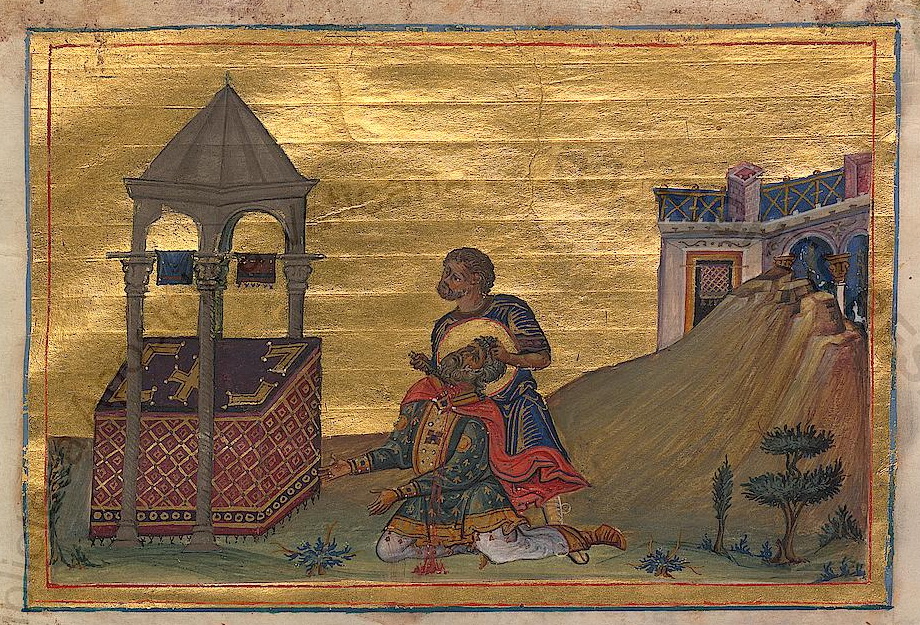
Luke says nothing of the couple's end; here the tradition of the Church takes up the thread, resting chiefly on the Protoevangelium of James, a second-century narrative whose closing chapters are our earliest witness to the martyrdom. According to this account, received into the synaxaria: when Herod, deceived by the Magi, sent to slay the infants of Bethlehem and its borders, he remembered the wonders surrounding John's birth and sought the child, fearing the foretold king. Elizabeth took the infant and fled into the hill country, and finding no hiding place, cried out to the mountain of God, which opened and received mother and child, a light shining within — the "rock of refuge" scene that passed into iconography. Herod's officers came instead to Zachariah, serving in his course at the temple, and demanded to know where his son was hidden. He answered that he was a minister of God and did not know, and at Herod's command he was murdered — in the Protoevangelium, at the very forecourt of the temple, his blood congealing on the pavement as a lasting witness; the synaxaria, following the Lord's words in Matthew 23:35, say "between the temple and the altar," and the troparion of the feast sings of the prophet "slain by the sword in the temple of God." The Protoevangelium adds that his body was not found, that the priests mourned him three days, and that the aged Symeon — the future God-receiver — was chosen by lot to succeed to his place: a detail by which the early tradition bound together the whole company of the Lord's infancy.
The application of Matthew 23:35 ("the blood of Zacharias son of Barachias, whom ye slew between the temple and the altar") to the father of the Forerunner is ancient but was never unanimous, and the question is set out under Disputed questions below. A further strand of the tradition, transmitted by Origen and Gregory of Nyssa among others, gives a second motive for the murder: that Zachariah was killed for affirming the perpetual virginity of the Theotokos by allowing Mary, after the Nativity, to stand in the temple's place of the virgins.
Elizabeth, hidden with John in the wilderness, died — the synaxaria say — forty days after her husband, and the child John "was in the deserts till the day of his shewing unto Israel" (Luke 1:80), nourished, as the tradition of the feast of his Conception relates, by the ministry of an angel.
Relics and translations
The church historian Sozomen (Ecclesiastical History 9.16–17) records that under Theodosius II, about the year 415, the remains of "the prophet Zachariah" were revealed and found at the village of Caphar-Zechariah near Eleutheropolis in Palestine, uncorrupt, clothed in white and — a detail Sozomen thought worth wonder — with a royal ornament, a child laid at his feet. Ancient and modern readers have divided over whether this finding concerned the Old Testament prophet or the father of the Forerunner; the narrative itself does not settle it, and the finding fed the veneration of both. In the West, the monastery church of San Zaccaria in Venice has claimed since the ninth century the body of Zachariah the father of the Baptist, sent from Constantinople as an imperial gift — a claim recorded here as the tradition of that church. Portions of relics attributed to both Zachariah and Elizabeth are venerated in various places; none can be traced with documentary certainty to first-century Palestine, and the entry asserts no more than the traditions themselves do.
Veneration and later cultus
Zachariah and Elizabeth stand at the head of the cycle of feasts of John the Forerunner that structures the fixed year: the Conception of John (September 23, where Gabriel's annunciation to Zachariah is the very matter of the feast), the Nativity of John (June 24, where Zachariah's prophecy is read and sung, and where, as the OCA notes, the Greek calendar commemorates the parents together with the son), the Beheading (August 29), and the Synaxis of the Forerunner (January 7). Their own feast on September 5 falls in the opening days of the church year, in the same week as the Nativity of the Theotokos — the calendar thus begins, as Luke begins, with the households in which the economy of the Incarnation was prepared. Elizabeth is further honoured wherever the Visitation is depicted or its Gospel read, above all in the Theotokos's own feasts, since her Spirit-filled greeting frames the Magnificat.
The pair have been loved as patrons of married righteousness and of couples suffering childlessness; in Russia numerous churches were dedicated to them, and the feast enjoyed particular prominence in eighteenth-century Russia as the name-day of the Empress Elizabeth Petrovna.
Hymnographic and literary legacy
Zachariah's Benedictus (Luke 1:68–79) passed into the daily liturgical prayer of East and West — in the Byzantine rite as part of the ninth ode of Matins, in the Latin rite as the Gospel canticle of Lauds — so that the prophet's one recorded prophecy is among the most repeated texts in Christian worship. Elizabeth's greeting (Luke 1:42) forms, with Gabriel's salutation, the substance of the hymn "Rejoice, O Virgin Theotokos" (and of the Western Ave Maria). The Protoevangelium of James, though never canonical, carried their story into the whole hagiographic and iconographic tradition of the East; the kontakion of the Nativity of the Theotokos and the hymnography of September 5 alike draw on it.
Feast and commemoration
September 5 (church date; Old Calendar civil September 18) is the principal commemoration of both saints, kept universally in the Byzantine rite with a proper service of the prophet in the Menaion. The OCA synaxarion notes that the Greek calendar commemorates Zachariah and Elizabeth also on June 24 with the Nativity of their son. Elizabeth is further remembered in the feast of the Conception of John (September 23), whose narrative is the couple's own. In the Roman rite the pair are commemorated together on September 23 (formerly November 5); the difference of date between East and West is a divergence of calendar tradition, not of identity.
Hymns
Troparion — Tone 4
Clothed in the vesture of the priesthood, O wise one, according to the law of God thou didst offer acceptable whole burnt offerings in a manner befitting a priest, O Zachariah; and thou wast a beacon and a beholder of mysteries, bearing in thyself the tokens of grace made manifest, O all-wise; and slain by the sword in the temple of God, O prophet of Christ, intercede together with the Forerunner that our souls may be saved.
Original translation from the Greek
Kontakion — Tone 3
Today the prophet and priest of the Most High, Zachariah, the father of the Forerunner, hath set forth the table of his memory, nourishing the faithful and mixing for them the drink of righteousness; wherefore we hymn him as a divine initiate of the grace of God.
Original translation from the Greek
Iconography
Zachariah is depicted as an aged priest of the Old Covenant, in the vestments of the Aaronic priesthood — long robe, ephod, and the rounded priestly head-covering — often censing before the altar, or holding a scroll of his prophecy; in prophet-tiers of the iconostasis he stands among the righteous of the Old Testament as the last priest-prophet before the Gospel. Narrative scenes show Gabriel appearing to him at the altar of incense (the icon of the Conception of John), the naming of John with the writing tablet, and his murder in the temple, soldiers cutting him down at the altar. Elizabeth appears in the Visitation embracing the Theotokos; in the Nativity of John; and in the affecting scene, drawn from the Protoevangelium, of her flight with the infant John into the mountain that opens to receive them — a motif set in the corner of many Nativity-of-Christ and Massacre-of-the-Innocents compositions, of which the fourteenth-century mosaic of the Chora church in Constantinople is the most famous monument.
The stored primary image is the miniature of the murder of Zachariah from the Menologion of Basil II (Constantinople, c. 985), the temple altar behind the falling prophet; the variant image is the Chora mosaic (c. 1315–1321) of Elizabeth with the infant John received into the rock.
Variant image: photograph by Wikimedia Commons user Shakko, CC BY-SA 3.0 (source); the mosaic itself is a pre-modern work.
Disputed questions
- "Zacharias son of Barachias" (Matthew 23:35). The Lord's words name a Zacharias "whom ye slew between the temple and the altar." Three identifications have been current since antiquity: (1) Zechariah son of Jehoiada the priest, stoned "in the court of the house of the Lord" under King Joash (2 Chronicles 24:20–22) — the only temple-murder of a Zechariah recorded in Scripture, favoured by Jerome (who noted that the Gospel used by the Nazarenes read "son of Jehoiada") and by most modern commentators, the patronymic being explained as a confusion or double naming; (2) the minor prophet Zechariah son of Berechiah, whose name matches exactly but of whom no violent death is recorded in Scripture; (3) the father of the Forerunner, the identification transmitted by the Protoevangelium of James and by a patristic line including Origen, Peter of Alexandria, and Gregory of Nyssa, and received into the Byzantine synaxaria and the hymnography of September 5. John Chrysostom, commenting on Matthew, already knew multiple opinions. Some modern critics have compared Josephus's account (Jewish War 4.5.4) of a Zacharias son of Baruch slain in the temple by the Zealots in 68. The repository records the question as unresolved: the Church's liturgical tradition on September 5 sings of the Forerunner's father slain in the temple, and this entry presents that tradition as tradition, without asserting the exegesis of Matthew 23:35 as settled fact.
- Was Zachariah high priest? Luke presents an ordinary priest of the course of Abijah, serving by lot; the Protoevangelium and some hymnography style him high priest (and place the annunciation within the sanctuary, or even the Holy of Holies). No Zachariah appears in the historical lists of high priests. The entry follows Luke; the liturgical epithet is noted as an honorific amplification.
- Elizabeth's kinship to the Theotokos. Luke says only "kinswoman." The OCA synaxarion makes Elizabeth the sister of Anna; another traditional genealogy makes her the daughter of Sobe, Anna's sister, hence Anna's niece and Mary's first cousin once removed. The traditions cannot be harmonised with certainty and both are recorded.
- Chronology. By the Gospel chronology their deaths fall in the period of the massacre at Bethlehem, near the end of the reign of Herod the Great — on the civil reckoning c. 4 BC, though the Church's calendar and synaxaria simply place them in the first years of the Incarnation. The frontmatter follows the calendars ("1st century") and this note records the civil wrinkle.
- Not to be confused with the prophet Zechariah son of Berechiah, author of the Book of Zechariah (commemorated February 8), nor with Zechariah son of Jehoiada; the September 5 feast is of the Forerunner's father alone.