
Founding of Constantinople
The Commemoration of the Founding and Dedication of Constantinople, the City of the Theotokos
On May 11 the Church keeps the anniversary of the dedication of Constantinople — the "birthday of the City" — when in the year 330 the Emperor Constantine the Great solemnly inaugurated the new capital he had raised on the site of ancient Byzantium and, in the act of dedication, committed the city and its people to the protection of the Most Holy Theotokos. It is the one civic anniversary of the Roman Empire that the Byzantine Church absorbed wholly into its liturgical year, because what was being founded was understood to be not merely a capital but the first city built from its foundations as a Christian city; and for eleven centuries the Great Church kept May 11 with a festal synaxis, joined to the memory of Mocius, the martyr-priest of Byzantium whose relics lay in its soil.
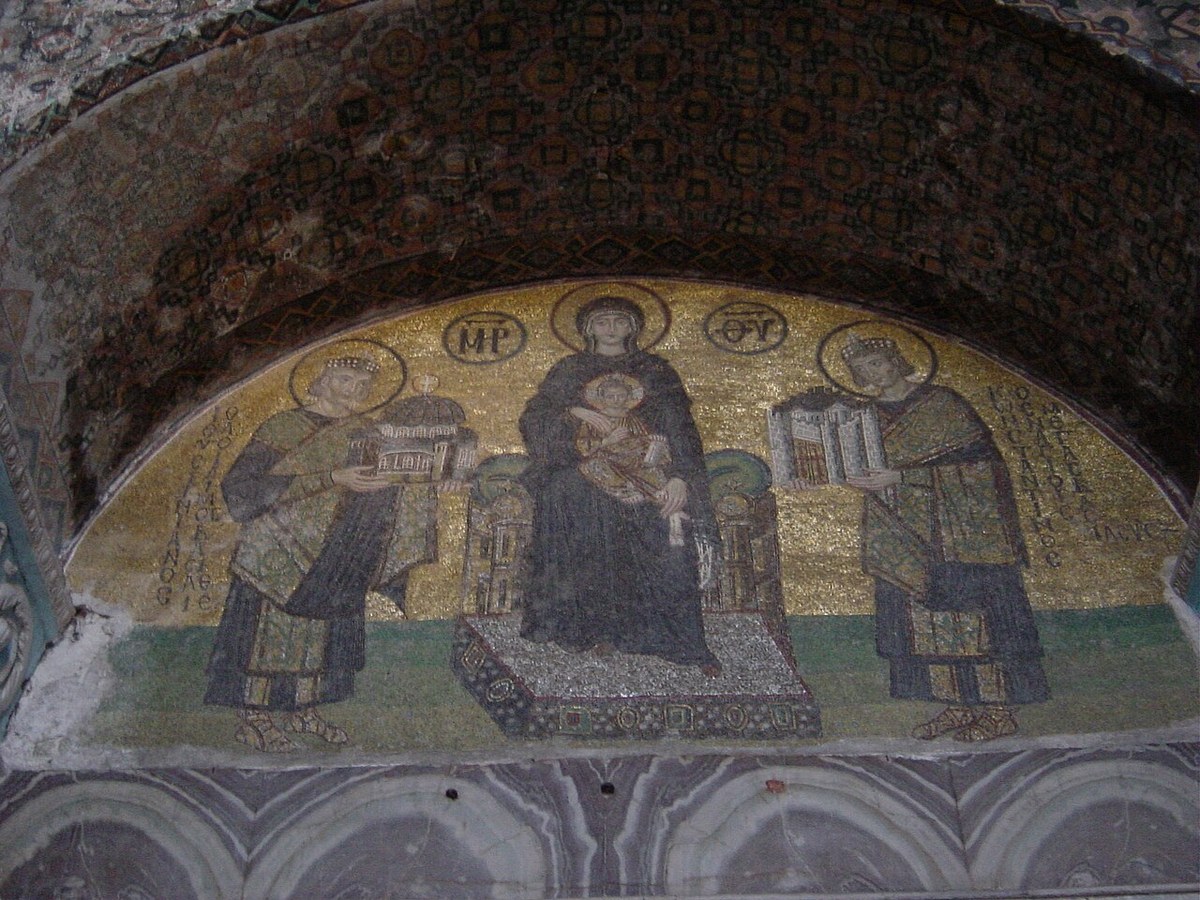
_-_Foto_G._Dall%27Orto_24-5-2006.jpg)
Why a new Rome
Constantine's decision, taken after his victory over Licinius in 324, answered several pressures at once. The empire's wealth, population and theological weight had moved east; the Danube and Persian frontiers, the two that mattered most, were both more easily governed from the Bosphorus than from the Tiber; and Rome itself, encrusted with the temples, priesthoods and dynastic memories of the old religion, was an awkward capital for an emperor who had staked his reign on the God of the Christians. The site of Byzantium, a Greek colony of the seventh century BC on the European shore of the straits, held the sea-road between the Aegean and the Black Sea and the land-road between Europe and Asia, and could be walled across a narrow neck of land and supplied by sea almost indefinitely — as its later history repeatedly proved.
The site was consecrated on 8 November 324, and building began in 325. Constantine emptied the older cities of the Greek world of their statuary and their marbles to adorn it, bringing works from Rome, Athens, Delphi, Ephesus and elsewhere — including the bronze serpent-column of the Delphic tripod, which still stands in the old hippodrome. The tradition preserved in the synaxarion tells that as the emperor walked out the line of the new walls with a spear, tracing a circuit far larger than his court thought reasonable, they ventured to object that he had gone too far; and he answered, "I shall go on until He who walks before me stops" — meaning the angel, or the providence of God, that was leading the measure.
The dedication of 11 May 330
The city was dedicated on 11 May 330, with forty days of festival — games, distributions of bread and money, processions and the acclamation of the new capital as Nova Roma, though it was the founder's own name, Constantinopolis, that stuck. The rites of the dedication were mixed in character, as everything in Constantine's reign was mixed: there was a Christian dedication of the city and its churches, and there was also a civic and imperial ceremonial inherited from the pagan past, including the annual carrying-round of a statue in the hippodrome on the anniversary, a custom later abolished. But the substance of what was done was unambiguous to Byzantine memory: the city was founded without a temple to the old gods at its centre, with churches instead — Holy Peace (Hagia Eirene), Holy Wisdom (begun under Constantine and finished under his son), the Holy Apostles as the dynastic mausoleum — and its walls, gates and forum were placed under the sign of the Cross.
Dedicated to the Theotokos
The heart of the commemoration, for the Church, is the dedication of the City to the Mother of God. The tradition holds that Constantine committed his new capital to her protection at its foundation, and the whole later history of Constantinople was read in that light. She was its Hypermachos Strategos — its "Champion Leader," its defending general; her Robe at Blachernae and her Girdle at Chalkoprateia were the City's palladia; her icon, the Hodegetria, was carried on the walls in danger and in procession in thanksgiving; and the great deliverances of the City — from the Avars and Persians in 626, from the Arabs in 717–718, from the Rus' in 860 — were all ascribed to her intercession and were commemorated with the singing of the Akathist Hymn, whose famous proemium, "To thee, the Champion Leader," is precisely the City's thanksgiving to its own Protectress. To keep May 11 was therefore to keep, every year, the founding covenant: that this city belonged to the Theotokos and was defended by her rather than by its walls.
The Byzantines had no illusion that the covenant was unconditional. When the City fell to the Latins in 1204 and to the Ottomans in 1453, the theological reading was not that the Theotokos had failed but that the City had; the lament literature of 1453 is built entirely on that assumption. This is one reason the commemoration was never quietly dropped after 1453: the day survived in the Menaion, and survives still, as a memory of what a Christian polity was meant to be and of the judgement under which it stood.
The City and the martyr
The May 11 commemoration is joined in the Menaion to the memory of the hieromartyr Mocius, a presbyter of Amphipolis beheaded at Byzantium about 295, over whose relics Constantine built one of the earliest churches of the new capital. The pairing is deliberate. The City's official birthday is the dedication of 330; but the Church's reckoning sets beneath it an older foundation, laid in the blood of a martyr thirty-five years before there was any capital there at all. The synaxarion notices for the day make the point by simply keeping the two together, and the sequence of the Menaion puts the martyr first.
Afterlife of the commemoration
For as long as the Empire stood, May 11 was among the great civic-liturgical days of Constantinople: the Book of Ceremonies and the Typikon of the Great Church describe the imperial procession, the acclamations in the hippodrome and the stational liturgy. In the ninth century the day acquired a second great commemoration when the joint feast of Cyril and Methodius, the apostles of the Slavs, was fixed to it — an appropriate coincidence, since the Slavonic mission was Constantinople's own most enduring work of evangelisation, and in Slavic countries that feast has since become the principal observance of the day. In Greek and Antiochian usage the dedication of the City is still noticed in the synaxarion for May 11, and the Russian and OCA calendars list it explicitly as the "Commemoration of the Founding of Constantinople."
Note on schema: the project's constitution's closed feast_type list has no term for the dedication of a city. dedication is used here as the nearest fit — the day is, in substance, the dedication-anniversary of a place consecrated to the Theotokos — and the gap is flagged for the project's record of open questions, which already tracks feast_type shortfalls of exactly this kind.
Feast and commemoration
May 11 (church date; Old Calendar civil May 24). The commemoration is universal in the Byzantine rite by inheritance, though its prominence now varies sharply: it is listed and kept in Greek, Russian and OCA usage, and is entirely eclipsed in Slavic countries by the national feast of the Slav-apostles on the same day. It has no proper canon or full festal office of its own in the printed Menaia; it is kept as a synaxarion commemoration within the service of the day, served with the hymns of the martyr Mocius and of the Theotokos. Where a church is dedicated to the Theotokos as Protectress, the Marian propers of the dedication are used.
Hymns
Troparion
O Sovereign Lady, guard the city that thou hast taken for thine own: for in thee it was founded, and by thy name it is called, and unto thee it lifts up its walls and its people as an offering; keep it in peace beneath thy protection, and save from every danger those who cry to thee: Rejoice, thou Champion of Christians.
Original translation from the Greek
Kontakion
To thee, our Champion Leader, we thy servants ascribe the prizes of victory and the thanksgiving of our deliverance, O Theotokos; and as thou hast might that cannot be withstood, deliver us from every peril, that we may cry unto thee: Rejoice, O Bride unwedded.
Original translation from the Greek
Iconography
The feast has no developed narrative icon in the manner of the Great Feasts. Its proper image is the offering of the City: the Theotokos enthroned with the Christ Child, receiving from Constantine a model of the walled city held in his draped hands — the visual form of the dedication itself. The classic example, and the image stored here, is the mosaic of the south-western vestibule of Hagia Sophia (c. 1000): the Theotokos enthroned in the centre with the Child blessing, the emperor Justinian on her right offering a model of the Great Church, and the emperor Constantine on her left offering a model of Constantinople, its walls, gates and towers rendered in miniature; the Greek inscriptions name both emperors, Constantine's ending …ΚΩΝCΤΑΝΤΙΝΟC. Related types show Constantine and his mother Helen flanking the Cross — the founder's other and more common iconography (their own feast is May 21, not yet authored here) — or, in later Greek and Russian work, the Theotokos standing above the walls of the City as its guardian, an image drawn from the Akathist and from the Protection (Pokrov) tradition rather than from the dedication proper.