
Cyril the Philosopher
Our Venerable Father Cyril, Equal-to-the-Apostles and Teacher of the Slavs
Equal to the Apostles · Venerable · Priest · b. c. 826, at Thessalonica — d. 869, at Rome (February 14), as the monk Cyril
Commemorated 14 February — Repose of Cyril at Rome, 869, 11 May — Joint synaxis of Saints Cyril and Methodius, Teachers of the Slavs
Cyril (c. 826 – 869), born Constantine at Thessalonica and known in his own day as the Philosopher, was the Byzantine scholar-monk who, with his elder brother Methodius, became the apostle of the Slavs. Trained in the imperial schools of Constantinople under Photius and Leo the Mathematician, he served as librarian of Hagia Sophia and teacher of philosophy, and was sent on embassies of disputation to the Arabs and the Khazars. Answering the request of Prince Rastislav of Great Moravia for teachers in the Slavic tongue, he devised the first Slavic alphabet — the Glagolitic — and with it translated the Gospel, the Epistle, the Psalter, and the services into Slavonic, opening the Scriptures and the Liturgy to a whole family of nations in their own language. Against the "trilingual" party that would confine worship to Hebrew, Greek, and Latin, he defended the right of every tongue to praise God. He carried the relics of Clement of Rome, which he had recovered in the Crimea, to Rome, where the Pope blessed the Slavonic books; there he fell ill, received the great schema with the name Cyril, and reposed on February 14, 869, and was buried in the Basilica of San Clemente. From his Glagolitic sprang the Cyrillic script that bears his name.

Origins and the schools of Constantinople
Constantine — the future Cyril — was born about the year 826 at Thessalonica, the second city of the Byzantine Empire and a place where Greek and Slavic were both heard in the streets and the surrounding country. He was the youngest of the seven children of Leo, a well-placed officer (a drungarios) in the imperial administration of the city, and his wife Maria; his brother Methodius, older by some years, had already entered public service, governing a Slavic province, before withdrawing to the monastic life on Mount Olympus in Bithynia. The bilingual world of his childhood — the Slavonic speech of the Macedonian hinterland set beside the Greek of the schools and the Church — is the natural ground of the brothers' later work, and the tradition remembered it so.
Left fatherless young, Constantine was brought to Constantinople for his education, where his brilliance drew the notice of the court. He studied at the imperial school of the Magnaura under two of the greatest minds of the age — Leo the Mathematician and the future patriarch Photius the Great — mastering grammar, rhetoric, dialectic, astronomy, geometry, music, and above all the Scriptures and the Fathers. So complete was his learning, and so ready his defence of the faith, that he was given the name by which the age knew him: the Philosopher. He was ordained (the tradition holds, to the priesthood), declined an advantageous marriage and a career in the world, and was appointed chartophylax — librarian and keeper of the archive — of the Great Church of Hagia Sophia, and afterwards teacher of philosophy in the imperial school where he had himself been formed.
The embassies of disputation
Constantine's gifts made him the natural spokesman of Byzantine Christianity before those who challenged it, and twice the emperor sent him on missions of learned dispute.
The first, about the year 851, was to the court of the Arabs — the Abbasid Caliphate — where he was set to defend the doctrine of the Holy Trinity and the veneration of images against Muslim scholars, answering their objections that Christians divided the one God and honoured created things. The Life preserves the memory of his replies, turning their own arguments and their own scriptures back upon them.
The second and weightier mission, about 860, was to the Khazars, the Turkic people of the steppe north of the Black Sea and the Caucasus, whose ruler had asked Constantinople for a Christian teacher to dispute before him with the Jewish and Muslim missionaries who also sought his people. Constantine went, and took his brother Methodius with him — the first of their joint labours. He prepared himself by learning Hebrew and the Samaritan script, and at the Khazar court held a long disputation, drawing on the Old Testament to argue the truth of Christ before Jews and Saracens alike. Whatever the mission's lasting effect on the Khazars — the tradition claims baptisms, the sources are guarded — it bore one enduring fruit. Passing through Cherson in the Crimea, Constantine sought out and, the Life says, miraculously recovered the relics of Clement of Rome, the third bishop of Rome after Peter, believed to have been drowned in the sea there as a martyr. These relics he kept by him; they would carry him at the last to Rome.
The mission to Great Moravia and the invention of the alphabet
In 862 an embassy reached Constantinople from Rastislav, prince of Great Moravia — the Slavic realm of the middle Danube, in the lands of the later Czechs, Slovaks, and Moravians. Rastislav's people had received Christianity from Frankish (Latin) missionaries, but he sought teachers who could give his folk the faith and the Church's worship in their own Slavic language, that they might not remain forever dependent on the Frankish clergy and the German empire behind them. The emperor Michael III and the patriarch Photius turned to the two brothers of Thessalonica, who knew the Slavic tongue from childhood.
Constantine's answer to Rastislav's request was an act of genius that changed the history of a civilisation. The Slavic speech had no writing of its own; the sounds it contained could not be captured by the Greek or Latin alphabets. So Constantine devised a wholly new alphabet — the Glagolitic (glagolica), some forty letters shaped to render exactly the phonology of Slavonic — and with it began at once to translate. The Life records that he opened the work with the first words of the Gospel of John: "In the beginning was the Word" (Iskoni bě Slovo) — a fitting inauguration for a labour that gave the Word of God a new tongue. He translated the Gospel lectionary, the Epistle (the Apostolos), the Psalter, and the chief liturgical books, forging in the doing a literary language — what scholars call Old Church Slavonic — capable of carrying the full weight of Greek theology. In 863 the brothers went to Moravia and began to teach, to translate, and to train native clergy in the Slavonic services.
The trilingual controversy and the journey to Rome
The work met fierce opposition from the Frankish clergy already established in Moravia, who resented the intrusion and, more deeply, denied the very principle of a Slavonic liturgy. They held what Constantine's Life calls the trilingual heresy (or "Pilatian heresy"): that God might be worshipped, and the Scriptures written, in only three languages — Hebrew, Greek, and Latin — because these were the three tongues of the inscription that Pilate set over the Cross. Constantine answered them, at Venice and elsewhere, with the whole witness of Scripture: "Does not the rain fall from God upon all alike? Does not the sun shine upon all? Do we not all breathe the same air? How are you not ashamed to appoint only three tongues, and to command all other nations and tribes to be blind and deaf?" He marshalled the Psalms — "Let everything that hath breath praise the Lord," "O praise the Lord, all ye nations" — and Saint Paul's "every tongue should confess that Jesus Christ is Lord," to show that God is praised in every language under heaven. The defence of the vernacular in worship is one of the abiding legacies of his name.
To settle the matter, and drawn by the relics of Clement that Constantine bore, the brothers travelled to Rome itself, arriving late in 867. Pope Adrian II received them with honour and with the relics of his own predecessor, and — decisively — blessed the Slavonic books, laying them upon the altar of the church of Santa Maria Maggiore, and permitted the Slavonic Liturgy to be sung in the churches of Rome. The disciples of the brothers were ordained. The apostolic see had set its seal on the Slavonic mission.
Repose at Rome as the monk Cyril
Constantine did not leave Rome. Worn out by his labours and by illness, he withdrew into a monastery in the city, received the great schema — the fullest monastic profession — and with it the new name by which the Church would know him ever after: Cyril. He lived only some fifty days more. Foreseeing his end, he charged his brother Methodius not to abandon the Moravian work for the quiet of Olympus, and prayed for the flock he had gathered. He reposed on 14 February 869, about forty-two years old, and at his own wish and the Pope's command was buried in the Basilica of San Clemente in Rome — beside, or near, the relics of the very Clement of Rome whom he had carried up from the Crimean sea. There his tomb remains a place of pilgrimage, honoured by Slavs of every nation.
Methodius and the aftermath
The younger brother's death did not end the mission; it fell wholly upon Methodius, whom the Pope consecrated bishop (later archbishop of Sirmium and Pannonia) and sent back to the Slavs. Methodius carried the work another sixteen years — completing the translation of nearly the whole Bible into Slavonic, and enduring imprisonment and persecution at Frankish hands — until his own repose in 885 (commemorated April 6; his entry in this collection is owed at that day). After his death the Slavonic disciples were driven out of Moravia, but they carried the seed south to Bulgaria and Ohrid, where — under Clement of Ohrid, Naum, and their fellows — it flowered into the golden age of Slavonic letters. It was there, and not from Cyril's own hand, that the simpler script later called Cyrillic — named in his honour, and built on the Greek majuscule with Glagolitic additions for the sounds Greek lacked — took the form that the Russians, Serbs, Bulgarians, Ukrainians, and many others write to this day.
Feast and commemoration
Cyril is commemorated on February 14 (church date; Old Calendar civil February 27), the day of his repose at Rome in 869 — the feast kept in this entry as primary. He is also honoured, together with his brother, at the joint synaxis of Saints Cyril and Methodius on May 11 (Old Calendar civil May 24), the great feast of the two Teachers of the Slavs, which in the Slavic Churches — Bulgarian, Russian, Serbian, and the rest — is the pre-eminent national and ecclesial celebration of Slavonic letters and Christianity, kept with special solemnity as a day of Slavic culture. (Methodius alone is kept on April 6, the day of his own repose.) It is worth recording honestly that the Greek calendar keeps May 11 chiefly as the commemoration of the founding of Constantinople and of the hieromartyr Mokios, and that the brothers' cult, though universal in the Orthodox Church, has always burned brightest among the Slavic peoples whose spiritual fathers they are. Both brothers are honoured in the West as well, named by the Roman Church co-patrons of Europe.
Hymns
Troparion — Tone 4
From thy swaddling-clothes, O God-voiced one, thou didst diligently take Wisdom to be thy sister; and beholding her all-radiant as a pure maiden, thou didst receive her and lead her home, and adorning thy soul and thy mind with her as with golden chains, thou wast found to be another Cyril, wise in mind and in name, O blessed one.
Original translation from the Slavonic
Kontakion — Tone 2
Enlightening the world with firm and God-inspired teaching, with beams of purest light, thou didst run through the whole earth like lightning, O blessed Cyril, scattering the all-radiant word of God in the west and the north and the south, and enlightening the world with wonders.
Original translation from the Slavonic
Iconography
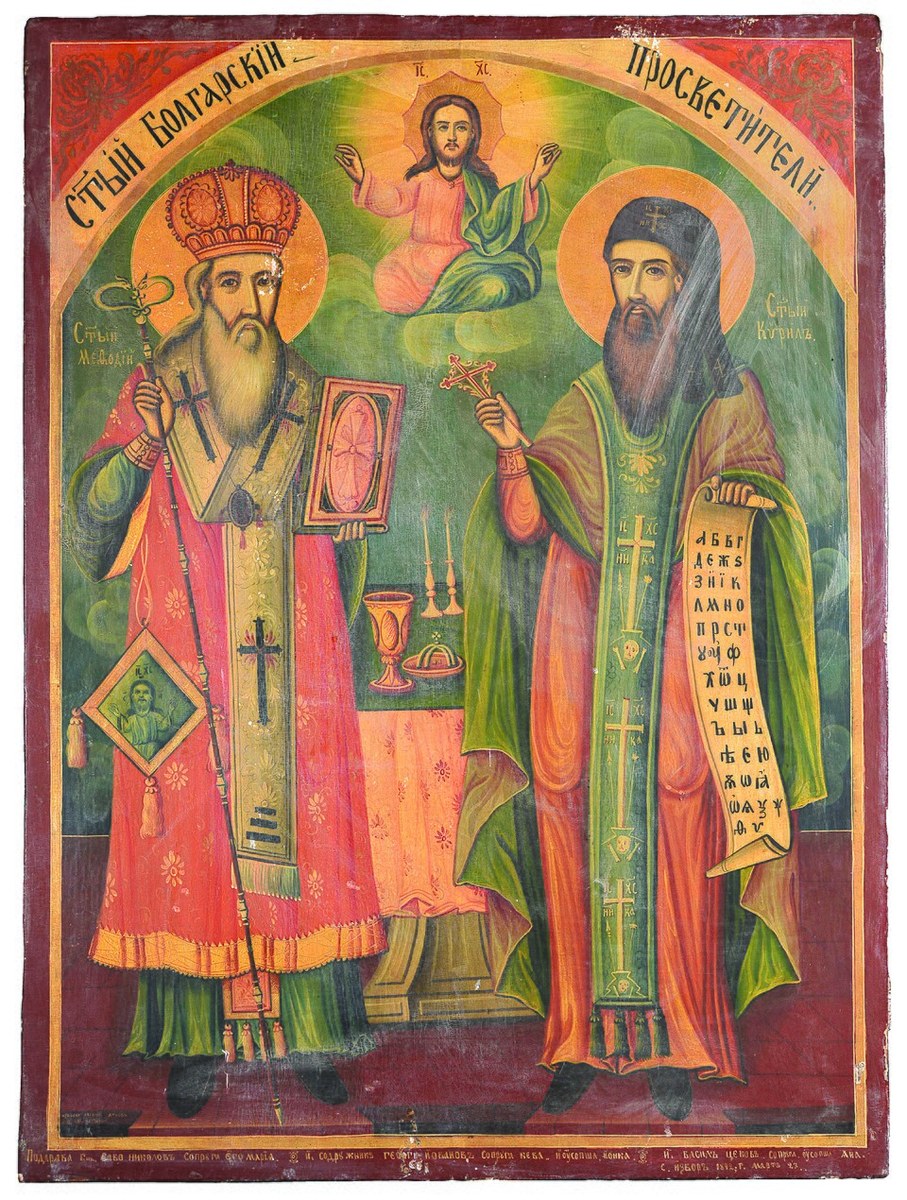
Cyril and Methodius are among the most richly depicted of Slavic saints, and are almost always shown together, as the tradition venerates them. Cyril, the younger, is depicted as a monk — in the dark monastic mantle and schema, his head sometimes bare, often holding an open scroll bearing the Slavonic alphabet or the first letters of the Gospel of John, sometimes a book; Methodius, the elder, is shown as a bishop, vested in the omophorion and holding the Gospel, since he alone attained the episcopate. Frequently the two brothers hold between them an open book or a scroll of letters, or an icon or church, emblems of the Scriptures and worship they gave the Slavs; behind or beside them the tradition sometimes ranges their disciples, the "Seven" (Cyril and Methodius with Clement, Naum, Gorazd, Sava, and Angelar). The type is beloved in Bulgarian, Macedonian, Russian, and Serbian iconography from the revival of the nineteenth century onward, when the brothers became the very emblem of Slavic Christianity and letters.
The stored image is a Bulgarian icon of 1892 by Avram Dichov, showing the two brothers as the Enlighteners of the Slavs — Cyril the monk and Methodius the bishop side by side, with the emblems of the Book and the alphabet between them (source, public domain, pd-old-work).
Disputed questions
- Glagolitic, not Cyrillic, was Cyril's own alphabet. The script that bears his name, Cyrillic, is now agreed by scholars to be the later creation of his disciples in Bulgaria — most likely at Ohrid or Preslav — while the alphabet Cyril himself invented was the older and more original Glagolitic. The name "Cyrillic" honours the founder of Slavonic letters without recording his actual invention; the entry above keeps the distinction.
- The date of birth (c. 826/827) rests on the Life's statement that he was forty-two at his death in 869; it is given with "c."
- Not to be confused with the several other saints named Cyril. This Cyril is the ninth-century apostle of the Slavs, a monk and equal-to-the-apostles — wholly distinct from Cyril of Alexandria (†444, the great dogmatic hierarch, kept January 18 and June 9), from Cyril of Jerusalem (†386, the catechist), from Cyril of Novoezersk (†1532, the Russian wonderworker of New Lake, kept February 4), and from Cyril of White Lake (Beloozero). His proper troparion pointedly calls him "another Cyril," wise "in mind and in name" — a conscious likening to Cyril of Alexandria that is itself the surest way to keep the two apart.