
Galaktotrophousa Icon of the Mother of God
Kept 3 July — Commemoration of the icon of the Karyes kellion of Hilandar, 12 January — Second commemoration of the icon
The Galaktotrophousa (Greek Γαλακτοτροφοῦσα, "she who nourishes with milk"; Slavonic Mlekopitatelnitsa) is the icon in which the Mother of God is shown nursing the Christ Child at the breast — the boldest assertion in all Orthodox iconography of the reality of the Incarnation. The icon commemorated on this day is the one kept at the kellion of Saint Sabbas at Karyes on Mount Athos, a dependency of the Monastery of Hilandar, which the Athonite tradition says came from the Lavra of Saint Sabbas the Sanctified near Jerusalem: Sabbas foretold on his deathbed that a royal pilgrim of his own name would one day come to the Lavra, and directed that the icon be given him. Six and a half centuries later Sabbas of Serbia came, the founder's staff fell at his feet, and the monks gave him the staff, this icon, and the icon "Of the Three Hands." At Karyes the icon is also called the Typikarnica, because the Typikon of St Sabbas of Serbia was kept there; and it stands, uniquely, on the right of the iconostasis, in the place ordinarily reserved for the Saviour.
.jpg)
The type
The nursing Mother of God is among the oldest of all Marian images — it is found in the Roman catacombs and in Coptic Egypt long before the Byzantine types were codified — and among the rarest in the developed Byzantine repertoire, because it sits awkwardly beside the hieratic reserve of the Hodegetria and the Eleousa. Where it does appear it is doing theological work. The suckling of God is the most concrete refutation available of every docetic and every monophysite reading of the Incarnation: what is not truly assumed is not truly saved, and a Christ who could be nursed is a Christ who could die and rise. In the Greek verses for the day the point is turned inward — "thou dost pour forth a spiritual milk, O thou who barest God: thy divine icon is the Milk-Giver" — and the image becomes an image of the Church's own nourishment.
The type is more common in the Slavic and Serbian than in the Greek sphere; in Russia the Mlekopitatelnitsa was widely copied from the eighteenth century, the copies deriving ultimately from Athos.
From the Lavra of Saint Sabbas to the Holy Mountain
The tradition, which survives at Hilandar as an oral one rather than in an early written source, runs as follows.
The icon was originally in the Lavra of Saint Sabbas the Sanctified in the Judaean desert. Before his death (December 5, 532) Sabbas the Sanctified told the brethren gathered round his bed that a royal pilgrim bearing his own name would one day come to the Lavra, and instructed them to give him the wonderworking icon as a blessing.
In the thirteenth century the prophecy was fulfilled. Sabbas of Serbia — son of the Grand Prince Stephen Nemanja, first archbishop of the Serbs, and with his father the founder of Hilandar — came to the Lavra on pilgrimage. As he approached the reliquary of Sabbas the Sanctified, the founder's staff fell at his feet. The brethren asked the visitor his name; he told them he was Archbishop Sabbas of Serbia. Obeying the instruction left them seven centuries before, they gave him the staff, the Galaktotrophousa, and the icon Of the Three Hands.
At Karyes
Sabbas brought the icon to the Holy Mountain and placed it in the church of St Sabbas at his kellion in Karyes — the hesychastirion he had built for himself above the Athonite capital, which belongs to Hilandar. There it was set on the right-hand side of the iconostasis, where by every rule of Byzantine church order the icon of the Saviour should stand; the icon of Christ was moved to the left. The reversal is deliberate, unique on the Mountain, and unexplained in the sources; it is the one thing every account of the icon mentions.
The kellion came to be called the Typikarnica, "the place of the Typikon," because the Typikon which Sabbas wrote for the hermitage was preserved there; and the icon took the same name, so that it is known indifferently as the Galaktotrophousa or the Typikonissa.
Feast and commemoration
July 3 (church date; New Calendar civil July 3, Old Calendar civil July 16). Greek, Athonite and Serbian usage; carried by the OCA as "Icon of the Mother of God the 'Milk-Giver' of the Hilandar Monastery on Mount Athos," with a second commemoration on January 12. The feast is kept with particular solemnity at the Typikarnica kellion at Karyes and at Hilandar. The Slavonic books, where they keep it, name the icon Mlekopitatelnitsa. It falls on the same day as the commemoration of the Serbian and Athonite tradition's other great gift from the Lavra of St Sabbas, though the Three-Handed icon is itself kept on June 28 and July 12.
Hymns
Apolytikion — Tone 1
Venerating thy divine icon as the tabernacle of thy glory, O Virgin Milk-Giver, we glorify thee; for from it thou dost mystically pour forth the milk of immaterial gifts, and dost nourish the hearts and the souls of those who cry to thee in faith: Glory to thy magnificence, O pure one; glory to thy wonders; glory to thine unutterable goodness toward us.
Kontakion — Tone 2
Let us hymn her who as a mother gives suck, as to an infant, to Him who was ineffably born of her — the only Theotokos, who nourishes with milk Christ our God; for she delivers us from many dangers.
Original translation from the Greek
Megalynarion
Come, brethren, let us venerate the sacred and honoured icon of the Milk-Giver; for it wells up the grace of ineffable compassion, and warms our hearts and our souls.
Original translation from the Greek
Synaxarion
A spiritual milk thou pourest forth, O thou who barest God: thy divine icon is the Milk-Giver.
Appointed readings
Epistle — Philippians 2:5–11
5Let this mind be in you, which was also in Christ Jesus: 6Who, being in the form of God, thought it not robbery to be equal with God: 7But made himself of no reputation, and took upon him the form of a servant, and was made in the likeness of men: 8And being found in fashion as a man, he humbled himself, and became obedient unto death, even the death of the cross. 9Wherefore God also hath highly exalted him, and given him a name which is above every name: 10That at the name of Jesus every knee should bow, of things in heaven, and things in earth, and things under the earth; 11And that every tongue should confess that Jesus Christ is Lord, to the glory of God the Father.
Gospel — Luke 10:38–42; 11:27–28
38Now it came to pass, as they went, that he entered into a certain village: and a certain woman named Martha received him into her house. 39And she had a sister called Mary, which also sat at Jesus’ feet, and heard his word. 40But Martha was cumbered about much serving, and came to him, and said, Lord, dost thou not care that my sister hath left me to serve alone? bid her therefore that she help me. 41And Jesus answered and said unto her, Martha, Martha, thou art careful and troubled about many things: 42But one thing is needful: and Mary hath chosen that good part, which shall not be taken away from her. 27And it came to pass, as he spake these things, a certain woman of the company lifted up her voice, and said unto him, Blessed is the womb that bare thee, and the paps which thou hast sucked. 28But he said, Yea rather, blessed are they that hear the word of God, and keep it.
Iconography
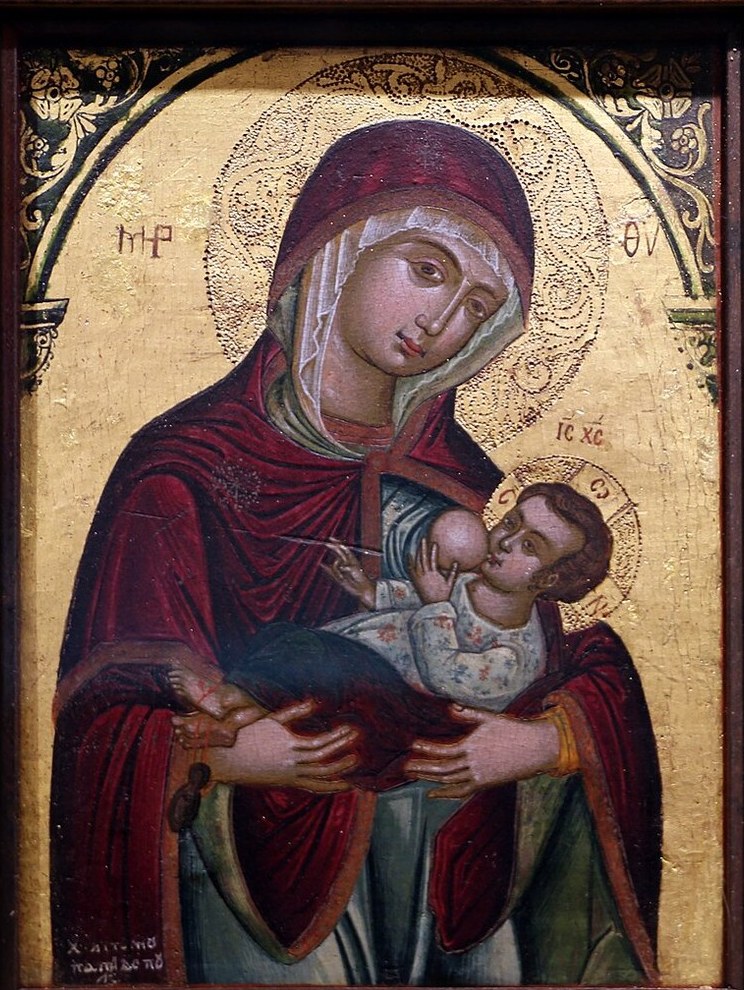
The Mother of God is shown half-length, inclining her head over the Child, who lies across her left arm and takes the breast; her right hand supports him and her own maphorion is drawn aside at the breast — the single gesture on which the whole type turns. The Child is ordinarily turned outward, his face lifted toward his mother's, one hand raised to the breast; in Greek examples he is often clothed in a white or flowered chiton rather than the gold-striped himation of the Hodegetria types, which reinforces the reading of the image as one of ordinary infancy. The inscriptions are the usual ΜΡ ΘΥ and ΙC ΧC. Later Russian Mlekopitatelnitsa copies of the Athonite icon generally reverse the composition, setting the Child on the Mother's right arm.
The stored image is not the Karyes icon, which has not been located under a storable licence. It is a Greek panel of the Galaktotrophousa type of about 1450–1500, signed at the lower left by the painter Antonios Papadopoulos and now in the Biblioteca Apostolica Vaticana: the Mother of God in the deep red maphorion over a green-blue chiton, against a tooled gold ground under a painted arch, the Child in a flowered white chiton across her arms with his face raised to the breast. It is given here to show the type; a the list of icons still being sought entry stands for the Hilandar icon itself.
Disputed questions
- Provenance. The account of the icon's journey from the Lavra of St Sabbas rests, as the Athonite sources themselves say, on oral tradition preserved at Hilandar, not on any document contemporary with Sabbas of Serbia. The same tradition, in the same words, carries the provenance of the Three-Handed icon; the two are transmitted as a single narrative, and stand or fall together.
- The date of the panel. No published art-historical dating of the Karyes icon has been located for this entry. Icons of the type at Hilandar and in Serbian churches are variously assigned from the fourteenth century onward.
- The two feasts. The Greek and Athonite books keep the icon on July 3; the OCA calendar notes a second commemoration on January 12. The reason for the second date is not given in the sources consulted.
- Western parallels. The Galaktotrophousa is the Eastern counterpart of the Western Madonna del Latte / Virgo lactans, and the two traditions influenced each other in Venetian Crete and in the Adriatic. Wikimedia Commons searches for the Greek term return overwhelmingly Western nursing Madonnas, which are not icons of this feast; care is needed.