
Friday 3 July 2026
Martyr Hyacinth; Trans. Rel. Philip, Metr. Moscow
Friday of the 5th week after Pentecost
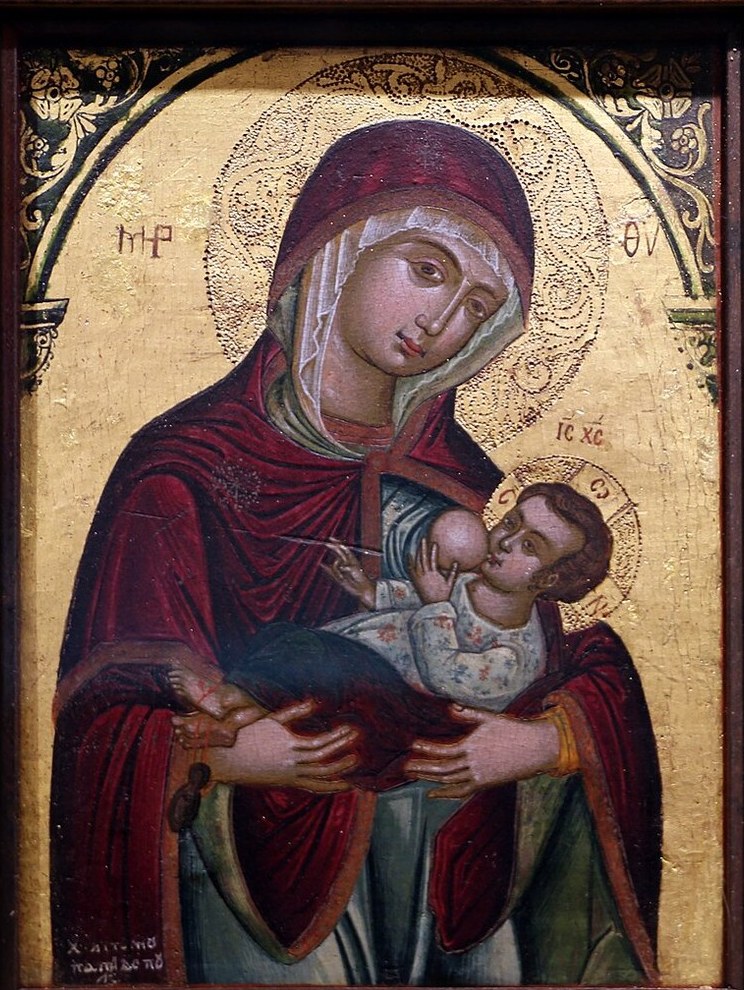
About Galaktotrophousa Icon of the Mother of God →
.jpg)
Saints commemorated
-
Saint of the day
Martyr Hyacinth
Hyacinth (Greek Ὑάκινθος, "the jacinth-stone") was a young Christian of Caesarea in Cappadocia who served in the household of the emperor Trajan as cubicularius — chamberlain of the imperial bedchamber, one of the most intimate offices of the palace. Denounced as a secret Christian while the court was sacrificing to the idols, he refused to deny Christ, was scourged, and was shut in a cell where the only food set before him was meat that had been offered to the idols. He would not touch it, and after some six weeks he died of hunger, about the year 108. He is one of the few martyrs of the calendar whose death was neither by sword nor by fire but by deliberate, patient starvation; the synaxarion couplet says simply that "on the third, Hyacinth died of the destroying famine."
-
Saint of the day
Trans. Rel. Philip, Metr. Moscow
Philip (1507–1569), born Theodore Kolychev of a great Moscow boyar family, was the hierarch-martyr who rebuked Ivan the Terrible to his face and paid for it with his life. Forsaking the court in his thirtieth year, he became a monk and then the renowned builder-abbot of the Solovetsky Monastery on the White Sea before Ivan drew him, against his will, to be Metropolitan of Moscow and All Russia (1566). From the cathedral pulpit he denounced the murders of the Oprichnina and refused to bless the Tsar in his blood-guilt; for this he was deposed in the midst of the Liturgy, stripped of his vestments, and exiled to a monastery in Tver, where in December 1569 the oprichnik Malyuta Skuratov strangled him in his cell. His relics were carried to Solovki in 1591 and, in 1652, translated in triumph to the Dormition Cathedral of the Kremlin, the Tsar sending a letter of repentance for his forebear's crime. He is venerated as a hieromartyr and wonderworker, the very type of the pastor who lays down his life against tyranny, and is kept on January 9.
-
Our Holy Father Isaiah the Solitary (491)
-
Our Holy Father Alexander, founder of the Monastery of the Unsleeping Ones (430)
Alexander the Sleepless (c. 350 – c. 430) was the founder of the Acoemetae (Greek Ἀκοίμητοι, "the Unsleeping" or "Sleepless Ones"), the monks who kept the praise of God unceasing day and night, dividing themselves into relays of choirs so that the Divine Office was never once silent in their churches — a literal enactment of the Apostle's command to "pray without ceasing." Born in Asia and educated at Constantinople, he abandoned a promising secular career for the Syrian desert, gave away all he had, and after years as a solitary conceived the discipline of perpetual psalmody that would make his name. Restless, uncompromising, and often at odds with the settled authorities of Church and city, he led a wandering band of ascetics through Syria and Mesopotamia before founding his monastery near Constantinople; driven out and persecuted, he died at Gomon on the Bosporus about the year 430. His community became one of the most famous of the Byzantine world and supplied the first monks of the great Monastery of Stoudios. He is commemorated on February 23.
-
Our Father among the Saints Anatolios, Archbishop of Constantinople (458)
Anatolius (died July 458) was Archbishop of Constantinople from 449 to 458 and the patriarch under whom the Fourth Ecumenical Council met at Chalcedon in 451. An Alexandrian by birth, ordained deacon by Cyril of Alexandria and present at Ephesus in 431, he was raised to the throne of the capital by Dioscorus of Alexandria in the wake of the Robber Council, in the expectation that he would be a compliant instrument of the Eutychian party. He was not. Within a year he had condemned Eutyches and Dioscorus at a council in his own city, received the Tome of Leo, and restored the name of the murdered Flavian to the diptychs; two years later he presided with the imperial commissioners over Chalcedon, where the definition of the two natures "without confusion, without change, without division, without separation" was promulgated and the celebrated 28th canon on the rank of the see of Constantinople was passed. He is remembered also as a hymnographer, and the Anatolian stichera of the Octoechos are traditionally ascribed to him.
-
Anatolius of the Kiev Near Caves
Anatolius (twelfth century) was a monk of the Kiev Caves Lavra whose relics rest in the Near (Antoniev) Caves and of whom the Paterikon records nothing whatever. He is one of the considerable number of Caves fathers known only by name, by the place of burial, and by the century assigned to him in the seventeenth-century catalogues of the Lavra. He is commemorated on July 3 and with the fathers of the Near Caves on September 28. He is not to be confused with his namesake of the Far Caves, whose memory falls on the same July day.
-
Anatolius the Recluse of the Kiev Far Caves
Anatolius the Recluse (thirteenth century) was a monk of the Kiev Caves Lavra who shut himself into a cell in the Far (Theodosian) Caves and whose relics rest there. Beyond the fact of his enclosure — which is what the epithet затворник records — nothing is transmitted about him: no origin, no teacher, no year, and no miracle. He is commemorated on July 3 and with the fathers of the Far Caves on August 28, and is distinguished in the calendars from his older namesake of the Near Caves, whose memory falls on the same day.
-
Basil and Constantine of Yaroslavl
Two brothers, Basil (died 1249) and Constantine (died 1257), successively princes of Yaroslavl on the Volga, orphaned as boys when their father Vsevolod fell fighting the Mongols and left to rule a burnt and depopulated principality in the first generation of the Tatar yoke. Basil bore the whole weight of it — the journeys of submission to the Horde, the rebuilding of a ruined town, the death of his only son — without complaint, and died young. Constantine succeeded him and fell in battle against a Tatar raid on the hill above Yaroslavl afterwards called Tugova Gora, "the hill of grief." Their relics were found incorrupt in 1501 after a fire in the Dormition cathedral, and they have been honoured since as the wonderworkers and heavenly patrons of Yaroslavl.
-
Basil of Ryazan
Basil was bishop of Murom and then of Ryazan in the second half of the thirteenth century, in the generation after the Mongol conquest, and is the chief hierarch-saint of the Ryazan land. His life is remembered for one thing above all: slandered by his own people at Murom and driven out, he spread his episcopal mantiya upon the water of the Oka, stood upon it holding the Murom icon of the Mother of God, and was carried against the current to Ryazan, where he was received as bishop. He reposed on 3 July 1295. On 10 June 1609, in the Time of Troubles, his relics were uncovered by Archbishop Theodoret of Ryazan and translated into the Dormition cathedral of the Ryazan kremlin, and that day became his second feast. He is invoked in Ryazan against the perils of travel and of drowning.
-
George the Recluse of the Black Mountain
George the God-bearer (died 1068) was a Georgian ascetic of the Black Mountain above Antioch, the great cosmopolitan monastic massif of the eleventh century, who withdrew from the quarrels of its many nations into a cleft of an inaccessible cliff — whence his other name, George the Recluse. He is remembered chiefly for what he made of another man: it was he who received the young George the Hagiorite, clothed him in the great schema, and sent him to Iviron on Athos with the charge to take up the unfinished translating work of Euthymius the Iberian — and who, when his disciple spent seven years on other obediences instead, sent a monk across the Mediterranean to rebuke him and remind him what he had been sent for. He was himself a copyist and a man of letters, and the Georgian books of Athos owe their existence to his insistence.
-
Gerasimus of Karpenisi
Gerasimus the New (c. 1787 – 3 July 1812) was a new venerable-martyr of the last Ottoman generation, born George at Megalo Chorio in the mountains of Karpenisi (Eurytania) in central Greece. Sent to Constantinople at eleven to work for a relative who kept a grocer's shop, he was taken in by a Muslim household after an accident in the street and, in gratitude and childish ignorance, allowed himself to be circumcised with the sons of the house. Years later, having returned to his village and repented, he went to Mount Athos, was tonsured Gerasimus, and after nine years of ascetic preparation under an elder who twice made him wait, went back to Constantinople, confronted the man who had adopted him, publicly repudiated Islam and confessed Christ. He was tortured and beheaded at Baba Humai, aged twenty-five. His relics are divided between the Monastery of Prousos in Eurytania and the church built in his name at Megalo Chorio.
-
John and Longinus of Yarenga
Two men of the White Sea coast — John and Longinus — of whom nothing whatever is transmitted except how they died and what happened afterwards. Both were drowned at sea, at different times, near the village of Yarenga on the Summer Coast of the White Sea, in the middle of the sixteenth century; both bodies were washed ashore and buried by the local people where they were found; and both, from their graves, began to appear to the living, to name themselves, and to heal — above all the possessed, and sailors caught in the storms of that sea. Their relics were gathered at the church of St Nicholas at Yarenga and, on 3 July 1638, translated in procession to a new church of Zosimas and Sabbatius built for them, in a ceremony described in detail by an eyewitness. They are among the very few saints of the Russian calendar whose entire hagiography is posthumous.
-
John of Moscow
Blessed John (died 1589), called Bolshoi Kolpak, "Big-Cap," was a fool-for-Christ of the reign of Theodore Ioannovich and the regency of Boris Godunov. Born near Vologda and a water-carrier in a saltworks in his youth, he took up the folly for Christ's sake first at Rostov and then at Moscow, going barefoot and half-naked through the hardest frosts, hung about with heavy iron chains and crosses and wearing on his head the great iron cap that gave him his name. He spoke without fear to anyone, the tsar and the regent included, and he foretold the Time of Troubles and the coming of the Poles. He asked to be buried at the Protection church on the moat — the cathedral of St Basil the Blessed — and was; his relics were found there in 1672.
-
Mark and Mokianus
Two martyrs of the fourth century, arrested as Christians and pressed by the eparch Maximus to sacrifice to the idols. They refused, confessed Christ, and were beheaded together. What the synaxarion remembers about them is not their trial but their families: as Mokianus walked to the place of execution his wife and children followed him weeping, and he turned and told them not to weep but to rejoice at the martyrdom God had counted him worthy of; and when Mark's head fell, his wife took it up in her hands with joy, as a precious treasure. The metrical couplet makes Mark the first to suffer — "Mark offered his neck to the blade, cutting the road of the passion for Mokianus."
-
Nikodemos of Kozheozero
Nikodemos (in the world Nikitas, c. 1550s – 3 July 1640) was a peasant's son from near Rostov who was called by name out of a field as a boy, learned the trade of blacksmith, was recognised in a Moscow street by a fool-for-Christ as "the ascetic of the Khuzyuga" before he had ever heard of the place, and became a monk of the Chudov monastery. Refusing preferment when his abbot was made a metropolitan, he went north to the Kozheozero monastery in the forests of the Onega, and thence to a cell on the little river Khuzyuga, five versts off, where he lived thirty-five years without coming out. He was granted tears, unceasing prayer, clairvoyance and healing; wild deer walked past his hut unafraid; and forty days before his death two saints in shining garments told him the day he would depart, which was July 3, 1640.
-
Theodotus, Theodote and Companions
A company of six martyrs — Theodotus, the woman Theodote, Golindouch, Diomedes, Eulampius and Asclepiades — arrested in the persecution of Trajan and shut up in the same prison as Hyacinth the Cubicularius, whose steadfastness under his slow death by starvation confirmed them in the faith. After Hyacinth died they were brought out to the temple and ordered to eat of the sacrifices; they refused, denounced the worship of idols aloud, were hung upon wooden frames and had their flesh torn away, and were then beheaded. The Christians buried them with honour on the spot where they suffered. They are commemorated with Hyacinth on July 3.
British Isles and Ireland
- St. Germanus, bishop of the Isle of Man and Enlightener of Peel, nephew of St. Patrick of Ireland (5th C)
- St. Byblig of Caernarvon (5th C)
- St. Gunthiern the Hermit (c.500)
- St. Bladus, bishop of the Isle of Man
- St. Cillene, abbot of Iona (c.752)
- St. Guthagon of Ireland, hermit in Belgium (8th C)
Troparia & kontakia
Apolytikion — Tone 1
Venerating thy divine icon as the tabernacle of thy glory, O Virgin Milk-Giver, we glorify thee; for from it thou dost mystically pour forth the milk of immaterial gifts, and dost nourish the hearts and the souls of those who cry to thee in faith: Glory to thy magnificence, O pure one; glory to thy wonders; glory to thine unutterable goodness toward us.
Apolytikion — Tone 3
Sealing thy name by thy work, O holy father, thou didst show forth to the world, in word and in deed, the radiance of the Dawn that is beyond understanding; for thou, O Anatolius, didst proclaim Christ twofold in wills and in natures, unconfusedly, yet bearing one hypostasis — for the salvation of our souls.
Apolytikion — Tone 4
Thy martyr, O Lord, in his contest received the crown of incorruption from Thee our God; for possessing Thy strength, he cast down the tyrants and broke the feeble insolence of demons. By his supplications, O Christ our God, save our souls.
Apolytikion — Tone 4
As a stone of jacinth of the Church of Christ, thou dost flash lightning to the ends of the earth with the rays of grace, O all-blessed Hyacinth; for being set aflame by the confession of true worship, thou didst shine in thy contest by imitation of the Word, and thence dost thou make glad those who honour thee. Thy martyr, O Lord, in his contest received the crown of incorruption from Thee our God; for possessing Thy strength, he cast down the tyrants and broke the feeble insolence of demons. By his supplications, O Christ our God, save our souls.
Apolytikion — Tone 4
Thy martyrs, O Lord, in their contest received the crowns of incorruption from Thee our God; for possessing Thy strength, they cast down the tyrants and broke the feeble insolence of demons. By their supplications, O Christ our God, save our souls.
Apolytikion — Tone 4
Thy martyrs, O Lord, in their contest received the crowns of incorruption from Thee our God; for possessing Thy strength, they cast down the tyrants and broke the feeble insolence of demons. By their supplications, O Christ our God, save our souls.
Kontakion — Tone 2
Let us hymn her who as a mother gives suck, as to an infant, to Him who was ineffably born of her — the only Theotokos, who nourishes with milk Christ our God; for she delivers us from many dangers.
Kontakion — Tone 8 (composed on the tradition)
Borne upon thy mantle against the stream, and bearing in thy hands the image of the Mother of God, thou didst come to Ryazan a bishop justified by heaven, O father Basil; wherefore be thou a guide to all who travel, and a helper to those who are in peril of the waters.
Kontakion — Tone 4
For Hyacinth today let all we faithful weave a crown out of unfading hyacinths, crying aloud with a great voice: Rejoice, O Hyacinth, glory of the martyrs!
Kontakion — Tone 3
Let us praise the teacher of Orthodoxy and herald of the truth, the emulator of Chrysostom, the lamp of Russia, Philip the all-wise, who wisely nourished his children with the food of his words; for with his tongue he sang praise and with his lips he uttered hymns, as an initiate of the grace of God.
Megalynarion
Come, brethren, let us venerate the sacred and honoured icon of the Milk-Giver; for it wells up the grace of ineffable compassion, and warms our hearts and our souls.
Oikos
Above many martyrs let us hymn the protector of our city, who guarding our city as the training-ground of his own contest, armed with boldness and holding the axe of truth — with which he cut down the tree of error — rouses us also to the working of good things. Let us therefore cry out with him: Rejoice, O Hyacinth, glory of the martyrs!
Synaxarion
A spiritual milk thou pourest forth, O thou who barest God: thy divine icon is the Milk-Giver.
Synaxarion
Setting, O Anatolius, at the end of thy life, thou drawest near to the Sun that never sets.
Synaxarion
Mark offered his neck to the blade, cutting the road of the passion for Mokianus.
Troparion — Tone 8 (from the common of a venerable father)
In thee, O Father, was the divine image kept secure; for taking up thy cross thou didst follow Christ, and by thy deeds thou didst teach us to despise the flesh, for it passes away, but to care for the soul, a thing immortal. Therefore doth thy spirit rejoice with the Angels, O venerable Alexander.
Troparion — Tone 8
O dweller of the caves and citizen of heaven, who didst hide thy labours from men as thou didst hide thy body in the earth, venerable father Anatolius: entreat Christ our God that our souls may be saved.
Troparion — Tone 8
Having shut thyself in the darkness of the caves that thou mightest see the unwaning Light, and having become dead to the world while yet alive, O venerable father Anatolius: entreat Christ our God that our souls may be saved.
Troparion — Tone 8
O ye who by your piety adorned the land committed to you, and in a time of bitter bondage kept the faith of Christ unshaken: Basil the meek and Constantine the valiant, ye wonderworkers of Yaroslavl, entreat Christ our God that our souls may be saved.
Troparion — Tone 4 (common of a hierarch)
O God of our fathers, who dealest ever with us according to Thy gentleness: take not Thy mercy from us, but by the prayers of Thy hierarch Basil, guide our life in peace.
Troparion — Tone 8
Fleeing the strife of tongues thou didst hide thyself in the rock of the Black Mountain, and there, made innocent as a dove, thou didst rear up a teacher for thy people and send him out to the Holy Mountain; O father George the God-bearer, entreat Christ our God that our souls may be saved.
Troparion — Tone 8
Given up by the sea and made known by God, O righteous John and Longinus, ye were laid in the sand of a strange shore and there glorified: for from your graves ye healed the sick and drove out unclean spirits, and ye stand by those in peril upon the waters. Wherefore we keep the day of the translation of your relics and cry: entreat Christ our God that our souls may be saved.
Troparion — Tone 8
Having made thyself a fool for Christ's sake, thou didst set at nought the wisdom of this world; barefoot in the frost and bound with iron thou didst walk the streets of the great city, rebuking the mighty without fear and foretelling the sorrows to come. O blessed John, entreat Christ our God that our souls may be saved.
Troparion — Tone 8
Called by name while yet a child, and named a hermit of the wilderness before ever thou hadst seen it, thou didst forsake the city and its honours, O father Nikodemos, and for five and thirty years didst pray in the forest for the whole world; wherefore, having known beforehand the day of thy departure, thou wast taken up in peace. Entreat Christ our God that our souls may be saved.
Troparion — Tone 8
O successor of the first-enthroned hierarchs, pillar of Orthodoxy and champion of the truth, new confessor, O holy hierarch Philip, who didst lay down thy life for thy flock: therefore, having boldness before Christ, intercede for our fatherland, and for the city and the people that worthily honour thy holy memory.
Readings
Epistle
Romans 16.1-16
1I commend unto you Phebe our sister, which is a servant of the church which is at Cenchrea: 2That ye receive her in the Lord, as becometh saints, and that ye assist her in whatsoever business she hath need of you: for she hath been a succourer of many, and of myself also. 3Greet Priscilla and Aquila my helpers in Christ Jesus: 4Who have for my life laid down their own necks: unto whom not only I give thanks, but also all the churches of the Gentiles. 5Likewise greet the church that is in their house. Salute my wellbeloved Epaenetus, who is the firstfruits of Achaia unto Christ. 6Greet Mary, who bestowed much labour on us. 7Salute Andronicus and Junia, my kinsmen, and my fellowprisoners, who are of note among the apostles, who also were in Christ before me. 8Greet Amplias my beloved in the Lord. 9Salute Urbane, our helper in Christ, and Stachys my beloved. 10Salute Apelles approved in Christ. Salute them which are of Aristobulus’ household. 11Salute Herodion my kinsman. Greet them that be of the household of Narcissus, which are in the Lord. 12Salute Tryphena and Tryphosa, who labour in the Lord. Salute the beloved Persis, which laboured much in the Lord. 13Salute Rufus chosen in the Lord, and his mother and mine. 14Salute Asyncritus, Phlegon, Hermas, Patrobas, Hermes, and the brethren which are with them. 15Salute Philologus, and Julia, Nereus, and his sister, and Olympas, and all the saints which are with them. 16Salute one another with an holy kiss. The churches of Christ salute you.
Gospel
Matthew 13.3-9
3And he spake many things unto them in parables, saying, Behold, a sower went forth to sow; 4And when he sowed, some seeds fell by the way side, and the fowls came and devoured them up: 5Some fell upon stony places, where they had not much earth: and forthwith they sprung up, because they had no deepness of earth: 6And when the sun was up, they were scorched; and because they had no root, they withered away. 7And some fell among thorns; and the thorns sprung up, and choked them: 8But other fell into good ground, and brought forth fruit, some an hundredfold, some sixtyfold, some thirtyfold. 9Who hath ears to hear, let him hear.