
Three-Handed Icon of the Mother of God
Kept 28 June — Commemoration of the icon and of the healing of the hand of John of Damascus (Greek and Athonite usage), 12 July — Commemoration of the icon in Slavonic usage
The Trikheirousa — in Slavonic the Troeruchitsa, "she of the three hands" — is the wonderworking icon of the Serbian monastery of Hilandar on Mount Athos, and one of the most immediately recognisable images in Orthodoxy: a Hodegetria of the Mother of God with the Child, beneath which a third hand is painted or affixed. The tradition explains it by the most famous miracle of the iconoclast age. John of Damascus, chief defender of the holy images from outside the empire, was denounced to the caliph by a letter forged at the instance of the emperor Leo III the Isaurian; his right hand was struck off and hung up in the market-place; and, praying before this icon of the Mother of God for the hand that had written in defence of Orthodoxy, he was healed in the night. In thanksgiving he fixed to the icon a hand of silver, from which it takes its name. Carried by John to the Lavra of St Sabbas, given long afterwards to Sabbas of Serbia, and brought at last — riderless, upon a donkey — to Hilandar, the icon stands there in the abbot's stall, for the monastery has taken no abbot since: the Mother of God is its abbess, and the brotherhood receives its blessing from her image. The commemoration is kept on June 28 in Greek and Athonite usage and on July 12 in the Slavonic books.
.jpg)
The Damascene and the forged letter
The setting is the first iconoclasm, under the emperor Leo III the Isaurian (717–741), whose edict against the holy images was answered from beyond the imperial frontier by John of Damascus — a Christian of a great Damascene family who served the caliph as a high official, and who was therefore beyond the emperor's reach. His three Orations against those who attack the divine images were the decisive theological answer to iconoclasm, and Leo, unable to punish him, resolved to destroy him by his own master's hand.
The tradition relates that a letter was forged in John's name, in which he appeared to offer to betray Damascus to the empire, and was conveyed to the caliph as if it had been intercepted. The caliph, believing himself betrayed by his minister, ordered that John's right hand be cut off and hung up in the market-place of the city, as the hand that had written the treason.
The healing before the icon
Toward evening, when the anger had cooled, John begged that the severed hand be given back to him; and receiving it he went into his chamber, laid the hand against the wrist, and fell down before an icon of the Mother of God, beseeching her to heal the hand — the hand, in the words the tradition gives him, that had written in defence of the holy images, and vowing that if it were restored it should write nothing thereafter but in praise of her Son.
He fell asleep before the icon, and in his sleep the Mother of God appeared to him and told him that he was healed, charging him to labour with that hand as he had promised. He woke to find the hand whole, with only a thread-like mark about the wrist to witness what had happened. The caliph, shown the miracle, knew the accusation for a forgery and would have restored John to his office; but John asked and obtained his freedom, distributed his goods, and departed for the Lavra of St Sabbas near Jerusalem, where he received the monastic habit and lived out his life as a hymnographer.
In thanksgiving he had a hand wrought of silver made and fastened to the icon before which he had prayed — a votive offering of the ordinary kind, a model of the healed member left with the image that healed it — and from that silver hand the icon received the name it has carried ever since: the Three-Handed.
The tradition further ascribes to this moment the composition of the hymn "Ἐπὶ σοὶ χαίρει, Κεχαριτωμένη, πᾶσα ἡ κτίσις" — "In thee rejoiceth, O Full of Grace, all creation" — which is sung as the megalynarion of the Liturgy of St Basil the Great in place of the Axion estin, so that the whole Church uses at its most solemn Liturgy a hymn born, the story says, of a severed and restored hand.
From Palestine to Serbia to Athos
John took the icon with him to the Lavra of St Sabbas, where it remained for some five centuries. The monastery's own tradition held that its founder, Sabbas the Sanctified (†532), had foretold that a royal pilgrim of his own name would one day come from a distant land, and that to him the icon should be given. When Sabbas of Serbia (†1236), the first archbishop of the Serbs, made his pilgrimage to the Holy Land, the fathers of the Lavra recognised the prophecy and gave him the Trikheirousa, which he carried home to Serbia.
There it remained until the Ottoman conquest. As the Turks advanced, the Serbs — unwilling to see the icon fall into their hands and unable to defend it — placed it upon the back of a donkey and let the animal go where it would. Unled and undriven, the donkey went south, and came at last to Mount Athos, to the Serbian monastery of Hilandar, where it halted at the gate; and there the icon was received.
The abbess of Hilandar
The last movement of the story took place in the monastery itself. After the death of an abbot, the brotherhood fell into contention over the election of his successor. The icon removed itself from its place in the church to the abbot's stall (ἡγουμενικὸν στασίδιον) in the choir; it was returned, and it removed itself again; and after a warning given to a recluse of the monastery the fathers understood the sign. From that time Hilandar has had no abbot: the Mother of God is reckoned the igoumene of the house, the icon stands in the abbot's stall, and the monastery is governed by a proigoumenos or vicar who, together with each of the brethren, takes his blessing from the icon — kissing it and receiving the abbot's blessing from her hand — as he would from a living superior. It is the only such arrangement in Athonite practice, and it is the living form of this feast.
The Troeruchitsa in Russia
A copy of the icon was sent from Hilandar to Moscow in 1661 to the patriarch Nikon, who set it in the New Jerusalem (Resurrection) monastery at Istra; from that copy the veneration spread widely through the Russian Church, and the Troeruchitsa became one of the most reproduced of all Marian types in Russia, in monastery churches and in the household icon-corner alike. In Russian popular devotion she is invoked particularly for diseases and injuries of the hands and arms, and by those who work with their hands — a specialisation drawn directly from the miracle that gave the icon its name.
Feast and commemoration
June 28 (church date; Old Calendar civil July 11) in Greek and Athonite usage, and July 12 (Old Calendar civil July 25) in the Slavonic books. The day is the eve of the feast of the chief apostles Peter and Paul and the last day of the Apostles' Fast. At Hilandar the icon is honoured continuously rather than on one day only, since the whole ordering of the monastery is built upon it; in the Russian Church the July commemoration is the more prominent, and is kept with an akathist in the many churches dedicated to the Troeruchitsa.
The feast belongs to the same June 28 as the translation of the relics of the unmercenaries Cyrus and John, so that the day carries two great commemorations of bodily healing — the physicians who healed without payment, and the hand restored at the Mother of God's word.
Hymns
Troparion — Tone 4 (common of an icon of the Theotokos)
O Mother of God, we thy servants offer thee this hymn of thanksgiving before thine honourable icon, from which thou pourest forth healings upon the faithful; and beholding the hand restored by thy prayer, we cry to thee: preserve from every affliction those who take refuge in thee, and save our souls.
Original translation from the Greek
Megalynarion
In thee rejoiceth, O Full of Grace, all creation: the angelic host and the race of men; O hallowed temple and noetic paradise, boast of virgins, of whom God took flesh and became a little child, He that is our God before all ages. For He made thy womb a throne, and thy body He made wider than the heavens. In thee rejoiceth, O Full of Grace, all creation: glory to thee.
Original translation from the Greek
Appointed readings
Epistle — Philippians 2:5–11
5Let this mind be in you, which was also in Christ Jesus: 6Who, being in the form of God, thought it not robbery to be equal with God: 7But made himself of no reputation, and took upon him the form of a servant, and was made in the likeness of men: 8And being found in fashion as a man, he humbled himself, and became obedient unto death, even the death of the cross. 9Wherefore God also hath highly exalted him, and given him a name which is above every name: 10That at the name of Jesus every knee should bow, of things in heaven, and things in earth, and things under the earth; 11And that every tongue should confess that Jesus Christ is Lord, to the glory of God the Father.
Gospel — Luke 10:38–42; 11:27–28
38Now it came to pass, as they went, that he entered into a certain village: and a certain woman named Martha received him into her house. 39And she had a sister called Mary, which also sat at Jesus’ feet, and heard his word. 40But Martha was cumbered about much serving, and came to him, and said, Lord, dost thou not care that my sister hath left me to serve alone? bid her therefore that she help me. 41And Jesus answered and said unto her, Martha, Martha, thou art careful and troubled about many things: 42But one thing is needful: and Mary hath chosen that good part, which shall not be taken away from her. 27And it came to pass, as he spake these things, a certain woman of the company lifted up her voice, and said unto him, Blessed is the womb that bare thee, and the paps which thou hast sucked. 28But he said, Yea rather, blessed are they that hear the word of God, and keep it.
Iconography
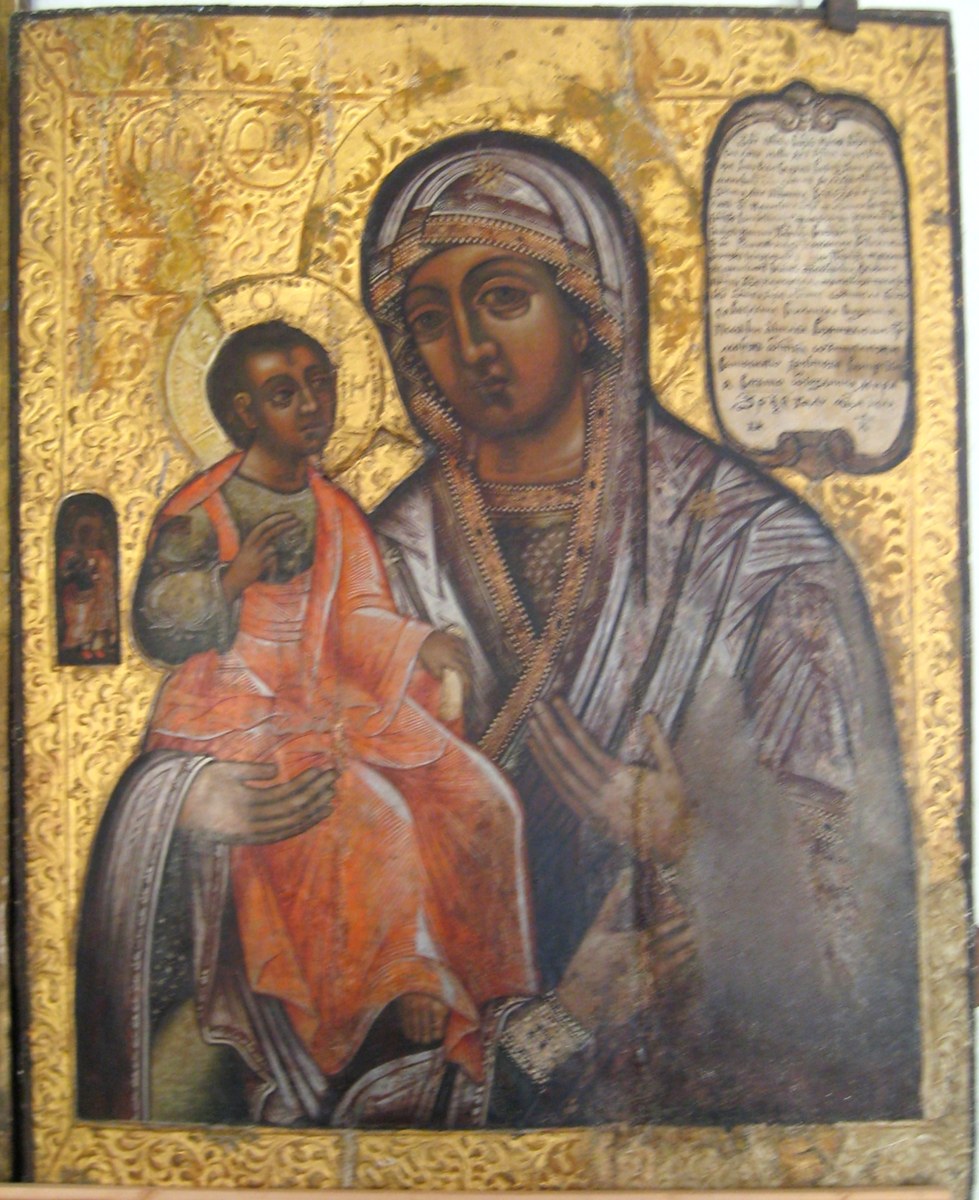
The Trikheirousa is a variant of the Hodegetria — the Mother of God holding the Child on one arm and indicating Him with the other hand — distinguished by a third hand set below, in the lower field of the panel, palm outward, in the posture of prayer or of offering. In the Hilandar original and in the Athonite copies the Child sits on the left arm and the third hand appears at the lower left, so that the composition reads as an ordinary Hodegetria with one member added; Russian copies frequently reverse the arrangement. The third hand is painted in flesh tones, in the same manner as the others, and is not marked off as an object; only its position, below and detached from the shoulders, shows that it is not anatomically the Mother of God's. Many copies carry a repoussé metal riza in which a silver hand is separately worked, preserving the memory of the original votive offering.
The type is unmistakable and has never been confused with another. It is also, of all Marian types, the one that most often provokes the question the Church has been happy to answer: why three? — so that the icon itself teaches the history of the defence of icons.
The stored image is a Russian icon of 1850 of the Troeruchitsa type, preserved in the Ferapontov Monastery: a half-length Mother of God with the Child on her left arm against a chased gold ground, her right hand raised across the breast, the third hand appearing below at the left beside the Child's feet; a small niche at the left edge holds a monastic figure, and an inscribed cartouche at the upper right records the icon's dedication (source, public domain — the underlying panel is of 1850 and the photograph is a faithful reproduction of a two-dimensional work, pd-old-work).
Disputed questions
- The third hand: votive object or painted member? The account given above — and it is the account the Church tells — makes the third hand a silver votive offering affixed by John of Damascus to an existing icon. In the icon as it now stands at Hilandar, and in nearly all copies, the third hand is painted, in the same flesh tones as the other two, as though it belonged to the Mother of God's own body. Art historians have generally read the painted third hand as a later copyist's misunderstanding of a metal ex-voto attached to the panel or to its revetment: what was a separate object hung upon the image was reproduced by a later hand as part of the image. The tradition and the art-historical reading are not necessarily in conflict — the second describes how the type took its present form, the first why there was a third hand to reproduce — and both are recorded here.
- The dating of the Hilandar panel. The icon venerated at Hilandar is generally dated by scholars to the fourteenth century, which is consistent with its arrival in Serbia in the thirteenth and its coming to Athos in the fourteenth or fifteenth, but not with an eighth-century original. Whether the present panel is the icon of the Damascene or a replacement of it cannot be settled.
- Which of two feasts is proper. The Greek Synaxaristes gives the Σύναξις τῆς Ὑπεραγίας Θεοτόκου τῆς Τριχερούσης on June 28; the Russian books keep the Troeruchitsa on July 12, and Hilandar itself observes both. Neither is a translation-feast; they are parallel usages, and both are recorded in the frontmatter.
- A related but distinct explanation is sometimes met, in which the third hand belongs not to the Theotokos but to the Damascene himself — his healed hand left in her keeping. It is a preacher's reading rather than a variant tradition.