
The Life-Giving Fountain
The Feast of our Most Holy Lady the Theotokos of the Life-Giving Fountain, and the memory of the supernatural wonders wrought therein by the Mother of God
Kept Bright (Renewal) Friday — the Life-Giving Fountain of the Mother of God
The one feast of the Mother of God that the Church keeps inside Bright Week, on the Friday of the Renewal — the only proper commemoration the Pentecostarion admits into a week that is otherwise nothing but the Resurrection. It honours the spring (Greek πηγή, "font, source") that rose in a wood outside the land walls of Constantinople, beyond the Golden Gate, and the healings worked there through the Mother of God; and, by extension, it honours the Theotokos herself under the name Zōodochos Pēgē, "the Fountain that receives Life," the vessel from which the Living Water came into the world. The tradition of the site, gathered and written up in the fourteenth century by the historian Nikephoros Kallistos Xanthopoulos, who also composed the office, begins with the soldier Leo Marcellus — the future emperor Leo I — who was directed by an unseen voice to water in the depth of the wood, gave it to a blind man to drink and laid the clay of it on his eyes, and saw him see. The church built over the spring became one of the great suburban shrines of the capital and was rebuilt many times; the shrine survives at Balıklı outside Istanbul, its holy water still flowing, and its feast is kept wherever the Byzantine rite is served, with the Lesser Blessing of Waters after the Liturgy and, in Greece and the Levant, a procession to the parish's own spring. It is not to be confused with the fixed commemoration of July 9, which keeps the anniversary of the dedication of Justinian's church on the same site: the two share a place and a spring and nothing else.

The spring outside the Golden Gate
Outside the Theodosian land walls of Constantinople, in the district beyond the Golden Gate, a spring rose in a grove of trees. A shrine of the Mother of God appears to have stood there before any of the emperors built, and the water was held to heal; by the time the tradition is written down the grove has become overgrown and the spring choked and foul, which is the state in which the story finds it. The gate nearest the shrine came to be called by the Byzantines the Gate of the Spring (Πύλη τῆς Πηγῆς), and the whole quarter was known simply as the Pege.
Leo and the blind man
The traditional account is that of Nikephoros Kallistos Xanthopoulos (c. 1256 – c. 1335), the last of the Greek ecclesiastical historians, who flourished about 1320, gathered the miracles of the shrine, and wrote the service that the Pentecostarion prints. A soldier named Leo Marcellus, on his way to the City, met near the Golden Gate a blind man who was thirsty and lost. Leo went to look for water and could find none. Then he heard a woman's voice, and could see no one who might be speaking: Leo, go into the deepest part of the wood, and thou shalt find water there. Take of the muddy water in thy hands and give the blind man to drink; then take of the clay and put it upon his eyes. Then shalt thou know who I am. The voice added that she had chosen that place for herself, and that he would one day wear the crown. He did as he was told; the blind man drank, and the clay was laid on his eyes, and he saw. Leo came to the throne as Leo I (457–474), and built a church over the spring at his own charges, and the water went on healing. From that the place had its name.
The narrative is deliberately built on two Gospel scenes and the day's own readings say so: the pool of Siloam, where the clay and the washing gave sight to the man born blind (John 9), and the Sheep Pool of Bethesda with the porch of Solomon where the paralytic lay thirty-eight years (John 5). The synaxarion verses of the day put the two together in a couplet — Manna, Siloam and the Porch of Solomon: in thy Spring, O Maiden, every man sees them plainly — which is as exact a statement of the feast's meaning as the office contains.
Justinian's church, and the confusion of the two feasts
A second account, going back to Procopius and repeated by the eleventh-century historian George Cedrenus, has the emperor Justinian out hunting, coming on a small chapel in the wood with a crowd about a priest and a spring, being told that this was "the source of the miracles," and ordering a great church built there out of the material left over from the building of Hagia Sophia. That church was raised in the last years of his reign, about 559–560; Procopius, who saw it, calls it remarkable κάλλει τε καὶ μεγέθει, "in beauty and in size."
The two accounts are not rivals so much as two strata: a first foundation under Leo and a great rebuilding under Justinian is the ordinary reconciliation, though some notices make Justinian the founder outright. What matters for the calendar is that the consecration of Justinian's church was itself entered in the Synaxarion of Constantinople and kept annually on July 9, and that this fixed dedication is a different commemoration from the movable feast of the Fountain kept on Bright Friday. Conflating them is the standing error in calendars of both days, and this repository keeps them apart: see Dedication of the Church of the Theotokos at the Pege.
Ruin, rebuilding, and Balıklı
The shrine stood outside the walls, in the path of every army that came against the City, and its history is a chain of destruction and restoration: rebuilt by the empress Irene the Athenian, by Basil I the Macedonian, by Romanos I Lekapenos; damaged in the earthquakes and in the Latin occupation; destroyed at the beginning of the fifteenth century. After the fall of the City in 1453 the church was pulled down and its stone carried off for a mosque. What remained was a small chapel reached by twenty-five steps below ground, lit by a window in its roof, with the holy spring railed off within it. Even that was destroyed after the Greek rising of 1821 and the font buried in the rubble.
Permission to rebuild was obtained under the Tanzimat. Clearing the ground in July 1833 the workmen uncovered the foundations of the older church, and the Sultan allowed not a chapel but a church to be raised on them: begun 14 September 1833, finished 30 December 1834, and consecrated to the Most Holy Theotokos by the Patriarch Constantine II on 2 February 1835. That church was sacked and burnt in the Istanbul pogrom of 6 September 1955. A smaller church stands on the site today; the hagiasma still runs, and the graves of the Ecumenical Patriarchs are in its courtyard.
The Turkish name of the place, Balıklı, means "the place with fish," from the fish that live in the sacred pool. The legend attached to them — that a monk frying fish beside the spring was told that the City had fallen, answered that he would believe it when the fish in his pan leapt back into the water, and was answered — is a piece of post-Conquest folklore of the shrine, not part of the feast, and the Church has never made anything of it liturgically.
The feast in Bright Week
Bright Week admits nothing but the Resurrection. The Pentecostarion's own synaxarion for Bright Monday, Tuesday, Wednesday, Thursday and Saturday is one sentence repeated verbatim each day — "on the holy and great [day] of Pascha we celebrate the very life-bearing Resurrection of our Lord and God and Saviour Jesus Christ" — and the propers of each day are simply the paschal propers again in the next mode of the Octoechos. Bright Friday alone breaks the pattern. Its synaxarion reads: On the Friday of the Renewal we celebrate the dedication of the church of our most holy Lady and Mother of God, the Life-bearing Fountain, and further we make memory of the supernatural wonders wrought therein by the Mother of God.
The books are candid about how the feast got there. The Pentecostarion heads the day with a rubric of unusual frankness: We chant the present service, which was made by the lord Nikephoros Kallistos Xanthopoulos, to the Most Holy Lady Theotokos the Life-receiving Fountain; for we did not find such a service in the Typikon, but it was set here out of love for the Most Holy Theotokos. It is, in other words, an admitted intrusion into the Renewal, kept because the faithful would not do without it — and it has been kept for six hundred years.
Note also the two names. The title of the office and the popular name of the feast is Ζωοδόχος Πηγή, the Fountain that receives or contains Life; the synaxarion of the same day writes Ζωηφόρος Πηγή, the Fountain that bears Life. Both are used, and the difference is not a difference of doctrine — the one looks at the Mother of God as the vessel, the other at the water as the gift.
Feast and commemoration
Bright (Renewal) Friday, 5 days after Pascha — the fifth day after Pascha and therefore movable, with no fixed date whatever. It has no eve and no afterfeast; its propers are sung together with the paschal propers, which they never displace, and Christ is risen opens and closes the day as on every other day of the week. In Greek, Antiochian, Slavic and American usage alike the day carries a Lesser Blessing of the Waters after the Divine Liturgy, and in Greece, Cyprus, the Levant and the islands the blessed water is carried in procession to the parish's own spring, well or cistern. In Russia and Ukraine, following the Greek custom, springs near churches were sanctified and dedicated under this title and icons painted for them, and a large number of churches in both traditions bear the name Живоносный Источник.
Two related commemorations should be kept distinct from this one:
- the fixed July 9 dedication of Justinian's church at the Pege, a Constantinopolitan anniversary of a building;
- the Life-Giving Fountain icon as such, which the OCA's notice reports as commemorated on April 4 in some Russian usage. The icon's principal day is nevertheless Bright Friday, and the fixed entry is a duplication of the type rather than a separate feast; it is recorded here and not asserted.
On the same Bright Friday the Slavic calendars keep the Appearance of the Icon of the Mother of God "The Footprint" (Stopa) at Pochaev — see Pochaev Icon of the Mother of God — a commemoration whose association with this day is not accidental: the Pochaev relic is likewise a spring rising in the print of the Mother of God's foot on the rock.
Hymns
Kontakion — Tone 8 (to the automelon *Τῇ ὑπερμάχῳ*)
Out of thine inexhaustible Fountain, O thou who art graced of God, thou bestowest upon me the waters of thy grace, which stream forth unfailingly and beyond all speech; for as thou didst bear the Word past all understanding, I entreat thee to bedew me with thy grace, that I may cry to thee: Rejoice, O water of salvation.
Original translation from the Greek
Oikos — Tone 8
O immaculate Theotokos, who ineffably didst bear the pre-eternal Word of the Father, enlarge my mouth, O pure one, and take me with thee unto thy praise, that I may sing thy Fountain and cry aloud: Rejoice, fount of unceasing gladness; rejoice, stream of beauty past telling. Rejoice, undoing of every sickness; rejoice, flood that drowns the manifold passions. Rejoice, clearest current, that makest the faithful whole; rejoice, most gracious water, to them that are many times diseased.
Exapostilarion
Thou art in very truth the fount of living water, O Lady; therefore thou dost wash away the grievous sicknesses of souls and of bodies by thy touch alone, who pourest forth Christ, the water of salvation.
Megalynarion
Let us honour with faith the life-flowing water of the Fountain, which poureth out the immortal dew, the manna, the divine nectar, the strange ambrosia, the honey out of the rock.
Appointed readings
Epistle — Acts 3:1–8
1Now Peter and John went up together into the temple at the hour of prayer, being the ninth hour. 2And a certain man lame from his mother’s womb was carried, whom they laid daily at the gate of the temple which is called Beautiful, to ask alms of them that entered into the temple; 3Who seeing Peter and John about to go into the temple asked an alms. 4And Peter, fastening his eyes upon him with John, said, Look on us. 5And he gave heed unto them, expecting to receive something of them. 6Then Peter said, Silver and gold have I none; but such as I have give I thee: In the name of Jesus Christ of Nazareth rise up and walk. 7And he took him by the right hand, and lifted him up: and immediately his feet and ancle bones received strength. 8And he leaping up stood, and walked, and entered with them into the temple, walking, and leaping, and praising God.
Gospel — John 2:12–22
12After this he went down to Capernaum, he, and his mother, and his brethren, and his disciples: and they continued there not many days. 13And the Jews’ passover was at hand, and Jesus went up to Jerusalem, 14And found in the temple those that sold oxen and sheep and doves, and the changers of money sitting: 15And when he had made a scourge of small cords, he drove them all out of the temple, and the sheep, and the oxen; and poured out the changers’ money, and overthrew the tables; 16And said unto them that sold doves, Take these things hence; make not my Father’s house an house of merchandise. 17And his disciples remembered that it was written, The zeal of thine house hath eaten me up. 18Then answered the Jews and said unto him, What sign shewest thou unto us, seeing that thou doest these things? 19Jesus answered and said unto them, Destroy this temple, and in three days I will raise it up. 20Then said the Jews, Forty and six years was this temple in building, and wilt thou rear it up in three days? 21But he spake of the temple of his body. 22When therefore he was risen from the dead, his disciples remembered that he had said this unto them; and they believed the scripture, and the word which Jesus had said.
Iconography
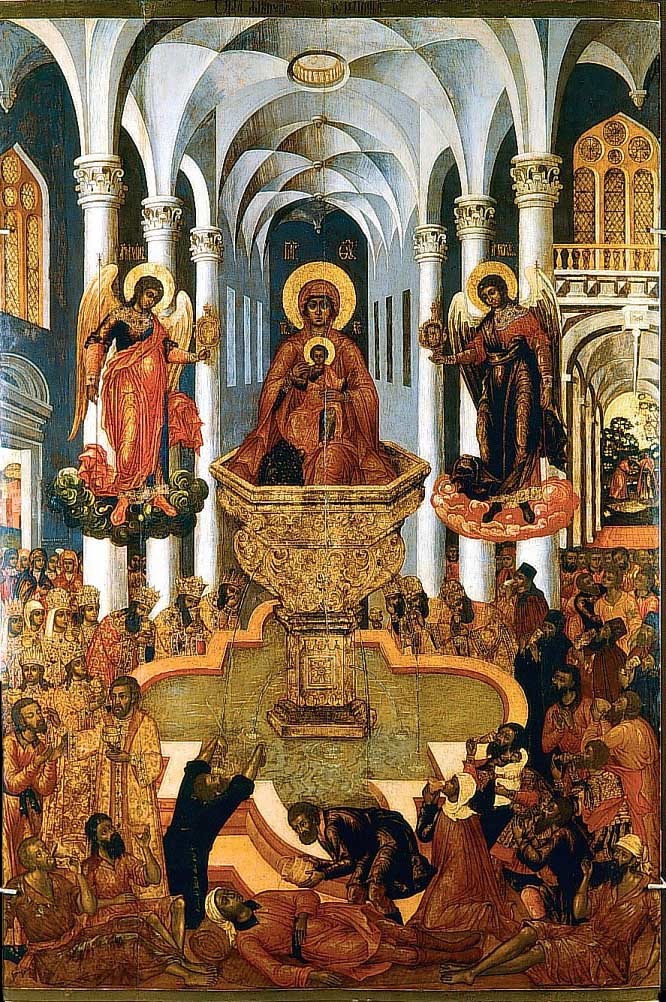
The composition is one of the most easily recognised in the Orthodox repertory and is entirely a picture of the office rather than of the historical shrine. In the centre, rising out of a great font — a chalice-shaped marble or gold basin on a stem — is the Mother of God with the Child, half-length, in the posture of the Blachernitissa or, in later Greek versions, embracing him; two angels flank her, censing or bearing the instruments of her praise. From the font the water pours down into a larger basin below, which in the older type is cross-shaped, the form of the ancient baptismal font, so that the whole image reads as the Living Water flowing from the Theotokos into the Church through baptism. Around the rim of the lower pool are the sick: the blind, the paralysed, the possessed, the lame, carried and led and stooping to drink, and often a man pouring the water over another's head. To the sides stand the emperor with his guard and the patriarch with his bishops, the two orders of the Byzantine world attending the miracle. In the fullest recensions the background carries the narrative: Leo and the blind man in the wood, and the walls of the City.
The panel stored here is by Kirill Ulanov (d. 1731), one of the leading icon painters of the Moscow Armoury, and is dated 1703. It is a good witness to the developed type: the Theotokos and Child rise from a golden chalice-font under the vaults of a great church, the two angels hover on either side upon clouds, the water falls into the wide pool below, and the whole lower third of the panel is a crowd of the sick and their attendants — a man kneeling with his hands raised, a paralytic stretched on the ground, a child being given the water to drink — with the ranks of court and clergy pressed in at either edge. The Russian recension keeps the essentials of the Greek and adds the architectural interior, which the Greek panels usually leave open. The underlying work is of 1703 and long out of copyright.
A distinct Greek variant, the Panagia Argokoiliotissa of Naxos, sets the same font among a larger cast and is the type most often reproduced in Greece.