
Nativity of Christ
The Nativity according to the Flesh of our Lord and God and Saviour Jesus Christ
Kept 25 December — Great Feast of the Lord; the birth of Christ at Bethlehem — "the mother of all feasts"
The Nativity according to the Flesh of our Lord and God and Saviour Jesus Christ (December 25) is the Great Feast of the Lord that celebrates the birth of the Son of God at Bethlehem of Judaea — the entry of the eternal Word into the world as a human infant, born of the Virgin Mary, laid in a manger, and worshipped by shepherds and Magi. The Church keeps it as the second feast of the year after Pascha, "the mother of all feasts," in which the whole mystery of the Incarnation is proclaimed: that God became man so that man might become god. Kept in the East on December 25 since the fourth century — a date that gradually separated the Nativity from the older unified feast of the Theophany on January 6 — it crowns the forty-day Nativity Fast, is preceded by a forefeast (December 20–24) and followed by an afterfeast to its leavetaking on December 31, and opens the twelve days of Christmas that run to the eve of Theophany.
.jpg)
The Gospel narrative
The birth of Christ is told by two of the four Evangelists, from two directions, and the Church reads both. Matthew tells it from Joseph's side. Mary, betrothed to Joseph, is found with child of the Holy Spirit before they come together; Joseph, a just man unwilling to make her a public example, is minded to put her away privately, when an angel of the Lord appears to him in a dream: "Joseph, thou son of David, fear not to take unto thee Mary thy wife: for that which is conceived in her is of the Holy Ghost. And she shall bring forth a son, and thou shalt call his name Jesus: for he shall save his people from their sins" (Matthew 1:20–21). Matthew reads the conception against Isaiah's prophecy — "Behold, a virgin shall be with child, and shall bring forth a son, and they shall call his name Emmanuel" — and Joseph, waking, takes Mary to wife and knows her not until she has brought forth her firstborn son.
Luke tells it from Mary's side and sets it in the machinery of empire. In those days a decree went out from Caesar Augustus that all the world should be enrolled — the census being made, Luke says, when Quirinius (Cyrenius) governed Syria — and every man went to his own city to be taxed. So Joseph went up from Nazareth of Galilee to Bethlehem, the city of David, because he was of the house and lineage of David, to be enrolled with Mary his espoused wife, being great with child. "And so it was, that, while they were there, the days were accomplished that she should be delivered. And she brought forth her firstborn son, and wrapped him in swaddling clothes, and laid him in a manger; because there was no room for them in the inn" (Luke 2:6–7). The two spare details the Church has never let go of — the swaddling bands and the manger — are Luke's own.
In the same country shepherds were keeping watch over their flock by night, and the angel of the Lord came upon them, and the glory of the Lord shone round about them, and they were sore afraid. "Fear not," the angel said, "for, behold, I bring you good tidings of great joy, which shall be to all people. For unto you is born this day in the city of David a Saviour, which is Christ the Lord. And this shall be a sign unto you; Ye shall find the babe wrapped in swaddling clothes, lying in a manger." Then suddenly there was with the angel a multitude of the heavenly host praising God and saying, "Glory to God in the highest, and on earth peace, good will toward men" (Luke 2:9–14) — the doxology the Church has taken up into the Great Doxology of every festal Matins. The shepherds went with haste and found Mary and Joseph and the babe lying in the manger, and made known the saying, and returned glorifying and praising God.
Matthew adds the coming of the Magi. When Jesus was born in Bethlehem in the days of Herod the king, wise men (μάγοι) from the east came to Jerusalem asking, "Where is he that is born King of the Jews? for we have seen his star in the east, and are come to worship him." Herod, troubled, gathered the chief priests and scribes, who named Bethlehem from the prophet Micah; and he sent the Magi thither, charging them to bring him word. The star they had seen went before them till it stood over where the young child was. "And when they were come into the house, they saw the young child with Mary his mother, and fell down, and worshipped him: and when they had opened their treasures, they presented unto him gifts; gold, and frankincense, and myrrh" (Matthew 2:11) — read by the Fathers as a confession of his kingship, his divinity, and his death. Warned in a dream, the Magi departed to their own country another way, and Herod, mocked, slew the children of Bethlehem — the Holy Innocents, commemorated on December 29 — while the Holy Family fled into Egypt.
The cave, the manger, and the ox and the ass
Neither Evangelist says where the manger stood, and the tradition supplies a cave. Already in the second century Justin Martyr, himself a Palestinian, writes that Joseph, finding nowhere to lodge in the village, took shelter in a cave near Bethlehem, and there Mary brought forth the Christ and laid him in a manger; the Protoevangelium of James, of about the same date, has the birth in a cave on the road, filled with a great light. Over such a cave the empress Helena raised the Church of the Nativity about the year 327, and the grotto beneath its altar has been shown as the birthplace ever since — the oldest church in continuous use in Christendom. The Byzantine iconography fixed the cave for good: the child is born not in a stable of the painter's own country but in a dark cleft of the rock, an image the hymns read as the earth itself opening to receive its Maker, and as a figure of the tomb from which he will rise.
The ox and the ass that stand over the manger in every icon of the feast are not in the Gospels either. They enter from the opening of Isaiah, read at the feast: "The ox knoweth his owner, and the ass his master's crib: but Israel doth not know, my people doth not consider" (Isaiah 1:3) — the Fathers taking the ox for the people of Israel under the yoke of the Law and the ass for the gentiles laden with idolatry, both now knowing their Lord in the crib their own master could not see. The two beasts appear on Christian sarcophagi by the fourth century, earlier than any other figure of the scene, and the tradition also read into them the "two living creatures" of Habakkuk 3:2 in the old Greek — "in the midst of two living creatures shalt thou be known." So the manger of an ordinary birth becomes, in the Church's reading, a throne attended by the whole creation.
The fulfilment of prophecy
The feast is built on the conviction that the birth at Bethlehem is the keystone toward which the whole Old Testament leant, and its services are a mosaic of fulfilled prophecy. Three texts stand at the centre. Isaiah's word to Ahaz — "Behold, the virgin shall conceive, and bear a son, and shall call his name Emmanuel, God with us" (Isaiah 7:14) — is quoted by Matthew himself and read as the charter of the virgin birth. Micah's word — "But thou, Bethlehem Ephratah, though thou be little among the thousands of Judah, yet out of thee shall he come forth unto me that is to be ruler in Israel; whose goings forth have been from of old, from everlasting" (Micah 5:2) — is the very text Herod's scribes cite, naming the town and, in its last clause, the eternity of the one born in time. And Isaiah's great oracle of the child — "For unto us a child is born, unto us a son is given: and the government shall be upon his shoulder: and his name shall be called Wonderful, Counsellor, the mighty God, the everlasting Father, the Prince of Peace" (Isaiah 9:6) — supplies the paradox the whole feast turns upon, a newborn infant named "the mighty God." Around these the services gather Balaam's star that shall rise out of Jacob (Numbers 24:17), read over the star of the Magi; Jacob's blessing of Judah (Genesis 49:10); the stone cut without hands from Daniel's vision (Daniel 2:34–45); and the enrolment of the nations, so that the census of Augustus is itself read as prophecy — "the peoples were enrolled by the decree of Caesar; we the faithful were enrolled in the name of the Godhead."
The theology of the Incarnation
The feast celebrates not merely a birth but the Incarnation — the eternal Son and Word of God, without ceasing to be God, becoming truly and completely man. Its classic formula is Athanasius of Alexandria's, from On the Incarnation: "He became man that we might become god" (αὐτὸς ἐνηνθρώπησεν, ἵνα ἡμεῖς θεοποιηθῶμεν) — the exchange the Fathers call the "wondrous exchange," God taking our humanity that he might give us his divinity, the second Adam gathering up and healing the first. The birth is the supreme instance of what Paul calls the kenosis, the self-emptying: he who was in the form of God emptied himself, taking the form of a servant, and was made in the likeness of men (Philippians 2:6–7). The hymns of the feast never tire of the paradoxes this opens — the Uncontainable is contained in a cave, the Ancient of Days becomes a young child, he who clothes the heaven with clouds is wrapped in swaddling bands, the bosom of the Father and the manger hold the same Son. Yet the emptying is no diminution of the Godhead: the one born of the Virgin is, in the words of the Epistle read at the Liturgy, the Son whom God "sent forth, made of a woman, made under the law, to redeem them that were under the law, that we might receive the adoption of sons" (Galatians 4:4–5). Thus the whole economy of salvation is opened at the manger: the Nativity is the beginning whose end is the Cross and the empty tomb, and the Church keeps it as the first act of the one drama of redemption — which is why, alone among the fixed feasts, it is furnished with a vigil, Royal Hours, and an eve of strict preparation on the pattern of Pascha and Theophany.
The history of the feast and the date
For the first three Christian centuries there is no trace of a feast of the Nativity: the earliest Church kept Pascha and, from the later second century, the Theophany. In the Christian East a single great feast of the Manifestation of God was kept on January 6 — the Theophany or Epiphany — gathering together the Nativity, the adoration of the Magi, and the Baptism in the Jordan as one celebration of God made manifest in the flesh. The separate feast of the Nativity on December 25 arose in the West, at Rome: the Chronograph of 354 records December 25 as the day of Christ's birth in a Roman list that reaches back to the year 336, the earliest firm attestation of the date. From Rome the December feast spread eastward through the second half of the fourth century. Its adoption at Antioch can be dated closely: about the year 386 John Chrysostom, then a priest there, preached a famous homily urging the new feast upon his congregation, calling it a custom "not yet ten years old" among them, brought from the West, and defending December 25 as the true day. Constantinople received it under Gregory the Theologian about 380; Alexandria and Jerusalem followed, Jerusalem last of the great sees, keeping the older unified January 6 feast well into the fifth century and beyond. Where the Nativity was given December 25, the Theophany of January 6 was left to celebrate the Baptism alone, and the twelve days between the two feasts — the Twelve Days of Christmas — were bound into a single festal season.
Two explanations of the date itself have long contended. The older and once standard "history of religions" view held that December 25 was chosen to overlay the Roman feast of the Sol Invictus, the "Unconquered Sun" of the winter solstice, the Church claiming for the true "Sun of righteousness" (the title the troparion gives Christ) the day the empire gave the sun-god. The alternative "computation" theory, older in its roots, holds that the date was reckoned rather than borrowed: an ancient tradition placed the conception of Christ (and the death) at the spring equinox, March 25 — the feast of the Annunciation — and nine months from March 25 falls on December 25. The two theories need not exclude one another, and the Church's own texts are content with the theological reading: whatever fixed the day, the feast proclaims the rising of the true Sun in the world's deep midwinter.
The calendar question: December 25 and "January 7"
The date of the feast is a single date — December 25 — kept by the whole Orthodox Church on the same church day. What differs among the Churches is only the civil calendar against which that church day is read. The Churches that have adopted the Revised Julian (New) calendar for the fixed feasts — among them the Patriarchate of Antioch, Constantinople, Alexandria, Greece, Romania, Bulgaria, and the Orthodox Church in America — keep December 25 on the civil December 25, together with the Western Churches. The Churches that retain the old Julian calendar for the fixed feasts — Jerusalem, Russia, Serbia, Georgia, the Athonite monasteries, and others — also keep the feast on their church December 25, but because the Julian calendar now runs thirteen days behind the Gregorian civil reckoning, that day falls on the civil January 7. The so-called "Old Calendar Christmas" of January 7 is therefore not a different feast or a different date but the same December 25, seen through the older civil calendar; the thirteen-day gap is the accumulated difference between Julian and Gregorian time, and will widen to fourteen days in the year 2100. The difference is one of civil reckoning and has never touched the unity of the faith or the content of the feast, and this entry records it as the Churches themselves do — without polemic, and without treating either usage as the measure of the other.
The Nativity Fast and the festal cycle
The feast is the goal of a long preparation. It is preceded by the forty-day Nativity Fast (also called the Philip's Fast, from the feast of the Apostle Philip on November 14 that stands at its threshold), kept from November 15 to December 24 — a fast milder than the Great Fast of Lent, in which fish is allowed on many days, growing stricter in its last week. The immediate approach is ordered like that of Pascha. Two Sundays gather the ancestry of Christ: the Sunday of the Forefathers (the second before the feast), commemorating the righteous of the Old Covenant from Adam onward, and the Sunday before the Nativity, the Sunday of the Holy Fathers, on which the genealogy of Matthew 1 is read. From November 21 the katavasiae of Matins become the irmoi of the Nativity canon, "Christ is born, give glory." A forefeast of five days (December 20–24) mounts toward the feast with its own proper hymns, culminating in the paramony or eve of December 24 with its Royal Hours and the Vesperal Liturgy of Basil the Great. December 25 itself, and the whole afterfeast, is fast-free: the Wednesday and Friday fasts are suspended through the twelve days to the eve of Theophany. The afterfeast runs six days to the leavetaking (apodosis) on December 31. Within it fall the great commemorations of the Nativity's own persons and events — the Synaxis of the Theotokos on the morrow of the feast, and the Sunday after the Nativity of Joseph the Betrothed, David the King, and James the Brother of the Lord.
Feast and commemoration
December 25 (church date; New Calendar civil December 25, Old Calendar civil January 7), a feast of the Lord and one of the Twelve Great Feasts — and, after Pascha, the greatest feast of the year, called in the tradition "the mother of all feasts." It is kept universally in the Byzantine rite with an All-night Vigil, and is furnished, uniquely with Theophany, with the full apparatus of a first-rank Dominical feast: a paramony (eve) with Royal Hours modelled on those of Great Friday, a Vesperal Liturgy of Basil on the eve, and a solemn Compline with the singing of "God is with us" (Isaiah 8) and the Lity.
The festal cycle is among the fullest of the year: a forefeast of five days (December 20–24), and an afterfeast of six days to the leavetaking on December 31. The morrow of the feast, December 26, is the Synaxis of the Most Holy Theotokos — the day on which the Church honours her through whom the Incarnation was accomplished, the proper commemoration always joined to a Great Feast falling on the person who served it. December 29 keeps the fourteen thousand Holy Innocents slain by Herod, and the movable Sunday after the Nativity commemorates Joseph the Betrothed, David the King, and James the Brother of the Lord, the kin and guardian of the newborn Christ. Where a liturgical colour is appointed, the feast is served in white and gold, the colours of light and of the Lord's feasts; Greek practice knows no fixed colour system and uses festal bright vestments by custom.
December 25 is fast-free. The forty-day Nativity Fast ends the evening before, and the feast and its afterfeast are wholly free of fasting, the fast of Wednesday and Friday being suspended through the twelve days of the feast to the eve of Theophany (January 5). The feast thus stands within the loosed and festal weeks of the year, the "Twelve Days of Christmas," a continuous celebration from the Nativity to the Theophany that keeps the two halves of the ancient single feast of the Manifestation within one unbroken joy.
Hymns
Troparion — Tone 4
Thy Nativity, O Christ our God, hath dawned upon the world as the light of knowledge; for by it they that worshipped the stars were taught by a star to worship thee, the Sun of righteousness, and to know thee, the Dayspring from on high. O Lord, glory to thee.
Original translation from the Greek
Kontakion — Tone 3
Today the Virgin gives birth to him who is above all being, and the earth offers a cave to the Unapproachable. Angels with shepherds give glory, and Magi journey with a star; for for our sake is born a young Child, the pre-eternal God.
Original translation from the Greek
Appointed readings
Epistle — Galatians 4:4–7
4But when the fulness of the time was come, God sent forth his Son, made of a woman, made under the law, 5To redeem them that were under the law, that we might receive the adoption of sons. 6And because ye are sons, God hath sent forth the Spirit of his Son into your hearts, crying, Abba, Father. 7Wherefore thou art no more a servant, but a son; and if a son, then an heir of God through Christ.
Gospel — Matthew 2:1–12
1Now when Jesus was born in Bethlehem of Judaea in the days of Herod the king, behold, there came wise men from the east to Jerusalem, 2Saying, Where is he that is born King of the Jews? for we have seen his star in the east, and are come to worship him. 3When Herod the king had heard these things, he was troubled, and all Jerusalem with him. 4And when he had gathered all the chief priests and scribes of the people together, he demanded of them where Christ should be born. 5And they said unto him, In Bethlehem of Judaea: for thus it is written by the prophet, 6And thou Bethlehem, in the land of Juda, art not the least among the princes of Juda: for out of thee shall come a Governor, that shall rule my people Israel. 7Then Herod, when he had privily called the wise men, enquired of them diligently what time the star appeared. 8And he sent them to Bethlehem, and said, Go and search diligently for the young child; and when ye have found him, bring me word again, that I may come and worship him also. 9When they had heard the king, they departed; and, lo, the star, which they saw in the east, went before them, till it came and stood over where the young child was. 10When they saw the star, they rejoiced with exceeding great joy. 11And when they were come into the house, they saw the young child with Mary his mother, and fell down, and worshipped him: and when they had opened their treasures, they presented unto him gifts; gold, and frankincense, and myrrh. 12And being warned of God in a dream that they should not return to Herod, they departed into their own country another way.
Iconography
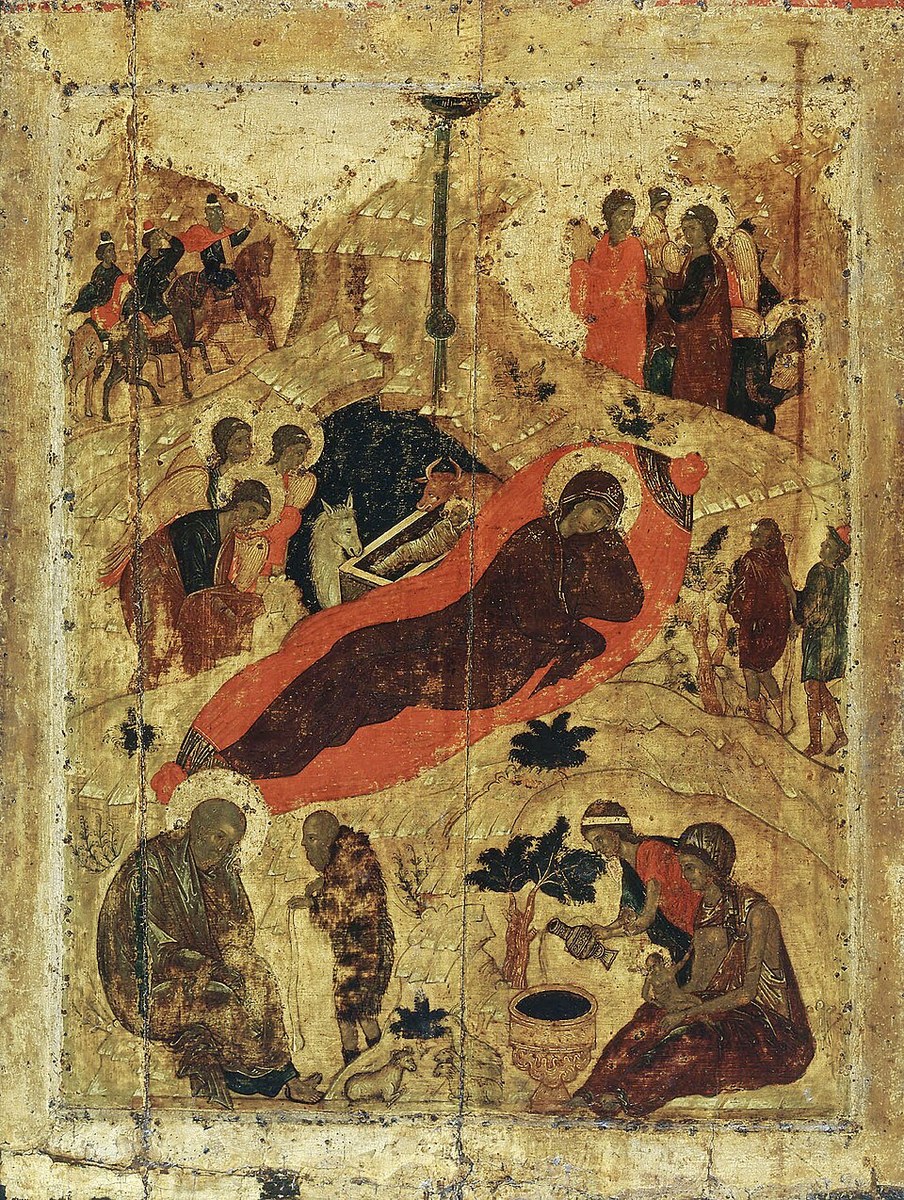
The icon of the Nativity is among the richest of all festal types, a whole narrative gathered onto one panel around a fixed centre and read, in Byzantine fashion, without regard to a single moment of time. At the heart, filling the middle of the icon, the Theotokos reclines on a red mattress or couch — not seated in the serene detachment of Western art but lying in the weariness of one who has truly given birth, the Church's silent answer to every denial of the reality of the flesh Christ took. Behind and above her opens the black mouth of the cave, and within it the Christ-child lies wrapped tight in swaddling bands in a stone manger shaped like a coffer — or a tomb — over which the ox and the ass lean their heads (Isaiah 1:3). A ray descends from a star at the very top of the panel to rest upon the cave, the single light that gathers the whole scene. Around this centre the narrative unfolds: at one upper corner the choir of angels bends in worship and proclamation; at the other an angel addresses the shepherds, who stand with their flocks and their pipes; along one side the Magi come riding, following the star. At the lower corners two scenes of the human birth balance one another — on one side the aged Joseph sits apart, his head on his hand, brooding, while a bent and shaggy old man stands before him: the tempter, who whispers the doubt of every age against the virgin birth, Joseph's own troubled thought given a face; on the other side two midwives bathe the newborn in a basin, the most homely and human note of the whole image, testifying that he who is bathed is a true child of our race.
The stored icon is one of the great examples of the type: a Russian panel of about 1405, from the festal tier of the iconostasis of the Annunciation Cathedral of the Moscow Kremlin, attributed to Andrei Rublev and his circle. Against a gold ground the Theotokos lies on a deep-red mattress at the centre; above her the dark cave holds the swaddled Child in the manger with the ox and the white ass bent over him; the ray of the star falls from the top of the panel. At the upper left the Magi ride down the mountain on their horses; at the upper right the shepherds and the worshipping angels are gathered; at the right an angel turns to a shepherd. Below, at the left, Joseph sits pondering before the stooped figure of the tempter in his rough garment, and at the right the two midwives bathe the Child at the basin. The mountains break into the faceted ledges of the Moscow school, and every episode of the feast is held in the one golden field.