
Cosmas of Maiuma
Our Venerable Father Cosmas the Hymnographer, Bishop of Maiuma, the Poet of the Canons
Venerable · Bishop · b. c. 675 — d. c. 760
Commemorated 12 October — Repose; Slavic and OCA placement — Greek use keeps October 14
Cosmas of Maiuma (†c. 760), called the Hymnographer, the Melodist, and simply "the Poet," is with John of Damascus one of the two great masters of the canon, the hymn-form that has framed Orthodox Matins for thirteen centuries. An orphan adopted by John's father and educated beside John by a learned Sicilian monk, he shared John's life at the monastery of St. Sabas and his defence of the holy icons, and was made bishop of Maiuma, the port of Gaza, around 743. His canons for the Exaltation of the Cross, the Nativity, Theophany, and the days of Great and Holy Week are among the summits of Byzantine hymnography, and their heirmoi are sung as katavasiai through the whole liturgical year.

Origins and early life
Cosmas was born about 675, and the tradition calls him a native of Jerusalem — whence his other title, "the Hagiopolite," the man of the Holy City. Left an orphan, he was taken into the household of Sergius, a high Christian official of the caliph's administration at Damascus — the father of John of Damascus — who adopted the boy and raised him as John's brother. The adoption gave the Church its most fruitful pairing of poets: the two boys were educated together by an elderly monk, himself named Cosmas, a Sicilian carried off by Arab raiders from Italy and ransomed from captivity in the slave market by Sergius precisely for his learning. From this elder Cosmas — remembered as "Cosmas of Sicily" or "the ascetic" — the two received the full Byzantine curriculum: grammar, dialectic, philosophy, astronomy, and music; the Life delights in recording that the ransomed captive wept not for his chains but because he had found no one to whom to hand on his learning, and found at last these two.
Mar Saba and the defence of the icons
When their education was complete the adoptive brothers withdrew together — the tradition places it about 732 — to the great lavra of St. Sabas in the Judaean desert, where both were tonsured and both began to compose. When the emperor Leo III opened his war on the holy icons (726), the Palestinian monasteries, lying beyond the empire's reach under the caliphate, became the stronghold of the Orthodox defence; Cosmas shared in that labour beside John, in whose three treatises against the iconoclasts the cause found its theologian. The hymnographic work of the two was likewise a single enterprise pursued side by side: the tradition pictures them examining and correcting one another's compositions at the lavra.
Bishop of Maiuma
About 743 — against his will, as the Lives insist — Cosmas was consecrated bishop of Maiuma, the port town of Gaza on the Palestinian coast, by the Patriarch of Jerusalem. He shepherded that small see into deep old age, "a father to his city and a light to the Church of Palestine," and reposed in peace — the Greek tradition placing his death about 752–760, the Slavic calendars extending his life to about 787. He thus died a bishop, but the calendars lead with his monastic glory and style him ὅσιος, "our venerable father": the poet-monk of St. Sabas who happened also to bear a mitre.
Hymnographic and literary legacy
Cosmas and John of Damascus stand together at the perfection of the canon (kanon), the great structure of eight or nine odes built on the biblical canticles which, in the eighth century, displaced the kontakion as the crowning hymn-form of Matins. Andrew of Crete had created the form; Cosmas and John raised it to its classical shape — Cosmas supplying, by the common judgment of the tradition, the more compressed and theologically dense manner, John the more soaring. The Menaia transmit Cosmas's work under the signature "of Cosmas the Monk" or "of Cosmas," as they transmit John's under "John the Monk" — the label already met throughout this collection's canon ascriptions (see, among others, Thecla of Iconium, Ananias of Damascus, and Symeon the Stylite); John of Damascus himself has his own entry (John of Damascus, commemorated December 4).
The certain and celebrated core of Cosmas's corpus includes:
- The canon of the Exaltation of the Cross (Tone 8), "Moses prefigured the Cross, stretching out his rod and parting the Red Sea" (Σταυρὸν χαράξας Μωσῆς) — sung on September 14 and already described at this collection's entry for the Elevation of the Cross; its heirmoi serve as katavasiai through great stretches of the year.
- The canon of the Nativity of Christ (Tone 1), "Christ is born, glorify ye him" (Χριστὸς γεννᾶται· δοξάσατε), whose opening ode takes its first words directly from a festal oration of Gregory the Theologian — the hymnographer setting the Father's prose to song.
- The canons of Theophany, the Meeting of the Lord, Palm Sunday, Pentecost, and the Transfiguration, each still the appointed canon of its feast.
- One of the two canons of the Dormition (Tone 1), the other being John's — the brothers sharing the feast between them.
- The hymns of Great and Holy Week: the abbreviated canons — diodia, triodia and tetraodia — appointed from Great Monday through Great Saturday, together with the full canon of Great Thursday. The tetraodion he composed for Great Saturday was in later centuries expanded into the present full canon of that day, odes being added in the tenth century (the tradition names Mark of Otranto, building on heirmoi of Cassia); Cosmas's odes remain its core. This Holy Week corpus — "a Triodion for the days of the Passion," as the older Lives summarise it — gave the Lenten service book, the Triodion, its very name.
To Cosmas the tradition also ascribes the best-known short hymn in Orthodox worship after the Trisagion: "More honourable than the Cherubim and beyond compare more glorious than the Seraphim" (Τὴν τιμιωτέραν τῶν Χερουβίμ), the megalynarion of the Theotokos sung at every Matins; the pious tradition adds that the Mother of God herself appeared to the poet and thanked him for it. Beyond the liturgical corpus, manuscripts transmit under his name a learned commentary on the poems of Gregory the Theologian, whose verse he loved and quarried; the attribution is accepted by part of modern scholarship.
Feast and commemoration
October 12 on the Slavic calendars and that of the OCA (church date; Old Calendar civil October 25) — the date this collection follows for his principal feast — but October 14 in Greek use, where the Menaion joins his service to that of the martyrs Nazarius, Gervasius, Protasius and Celsius. The OCA's own notice records the two-day divergence explicitly. On either date he is commemorated as "the Poet" (ὁ Ποιητής), and church musicians and hymnographers keep him, with Romanus the Melodist and John of Damascus, as a patron of their craft.
Hymns
Troparion — Tone 8
Guide of Orthodoxy, teacher of piety and purity, luminary of the whole world, God-inspired adornment of hierarchs: O Cosmas most wise, by thy teachings thou hast enlightened all. O harp of the Spirit, intercede with Christ God that our souls may be saved.
Original translation from the Slavonic
Kontakion — Tone 8
Adorned with the virtues, O God-inspired Cosmas, thou wast made an adornment of the Church of Christ, for with songs thou didst adorn her, O blessed one. Pray to the Lord that we be delivered from every device of the enemy, for we cry to thee: Rejoice, O thrice-blessed father.
Original translation from the Slavonic
Iconography
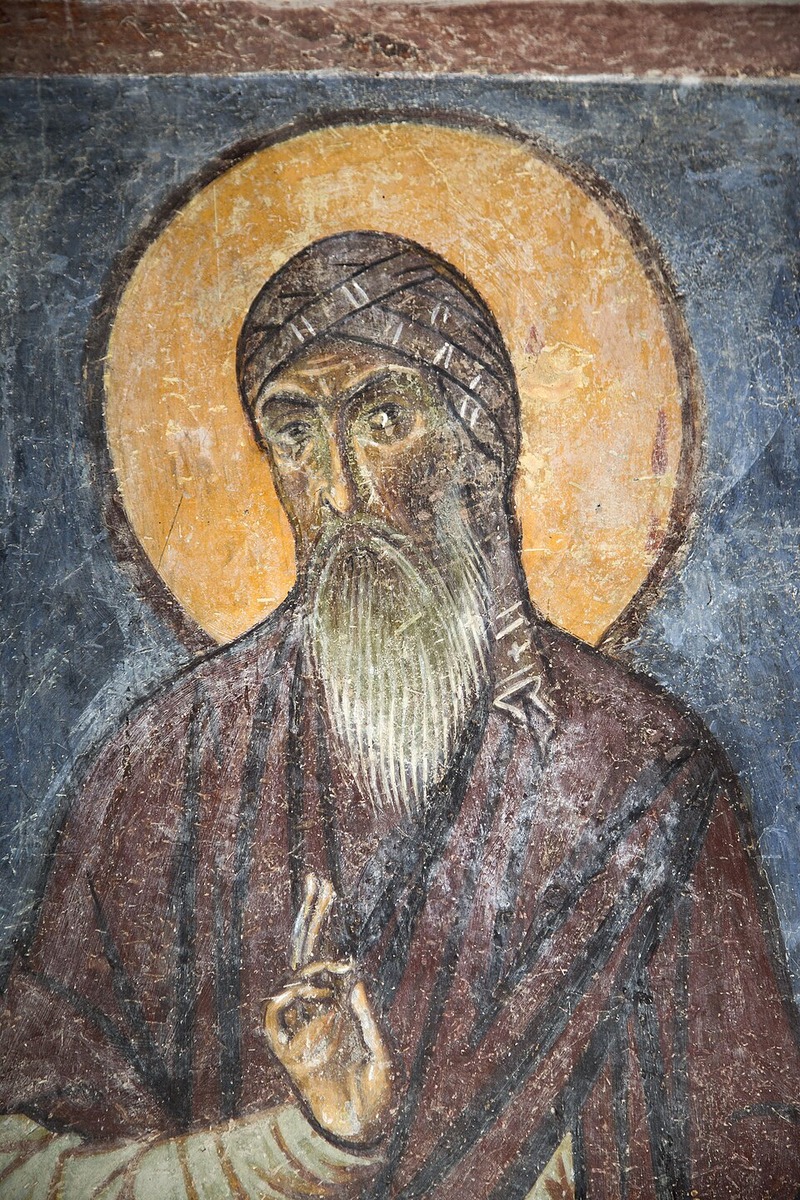
Cosmas is portrayed as an aged monk with a long tapering beard, and — his constant and identifying attribute — a wrapped monastic head-cloth tied about his head, the mark under which the hymnographer-saints are grouped in Byzantine programmes; he holds a scroll, often inscribed with the opening of one of his canons, or a book. From the twelfth century onward he appears paired with John of Damascus among the melodists, most famously in the fresco cycles flanking scenes of the Theotokos. The stored image is exactly such a witness: the fresco of 1164 from the church of St. Panteleimon at Nerezi near Skopje, showing Cosmas half-length in the wrapped head-covering, blessing, his face furrowed with the ascetic's age.
Disputed questions
- Date of repose. The Greek tradition and most modern scholarship place his death about 752–760 ("about 760" is conventional); the Slavic calendars and the OCA give "about 787," and a strand of the tradition stretches his life to 794. The divergence is old and unresolved; this entry follows the Greek dating while recording the Slavic.
- Birthplace. The synaxaria call him a Jerusalemite; his upbringing was at Damascus in the household of Sergius. Both traditions are transmitted, and they are compatible — a Jerusalem-born orphan raised at Damascus — but the sources do not allow certainty.
- The two Cosmases. The teacher and the pupil bear the same name, and the hagiographic tradition occasionally confuses Cosmas of Sicily (the ransomed elder, sometimes commemorated separately) with Cosmas of Maiuma; the Lives of John of Damascus keep them distinct.
- Not to be confused with the unmercenary Cosmas (of Cosmas and Damian), nor with the later Cosmas Equal-to-the-Apostles of Aetolia (†1779).