
Protection of the Theotokos
Kept 1 October — The vision of the Theotokos spreading her veil over the people at Blachernae, 28 October — The Holy Protection (Hagia Skepi) as kept by the Church of Greece since 1952, joined to the national anniversary of 1940
The Protection (Pokrov) of the Most Holy Theotokos (October 1) commemorates a vision granted at the church of Blachernae in Constantinople: during an all-night vigil, Andrew the Fool-for-Christ and his disciple Epiphanius saw the Mother of God enter the church, pray with tears for the world, and spread her shining veil over all the people as a sign of her protection. Received from the Life of Andrew the Fool, the commemoration found little place in Byzantium itself but was established as a feast in twelfth-century Rus' by prince Andrei Bogolyubsky, and became one of the most beloved festivals of Slavic Orthodoxy; the Church of Greece has kept its own observance of the Holy Protection on October 28 since 1952.
.jpeg)
The vision at Blachernae
The church of the Theotokos at Blachernae, in the north-west corner of Constantinople by the Golden Horn, was the greatest Marian shrine of the imperial city. Founded in the fifth century — the tradition connects its beginnings with the empress Pulcheria — it housed from the reign of Leo I the precious robe (maphorion) of the Mother of God brought from Palestine, kept in the chapel of the "holy reliquary" (Hagia Soros), and it was to Blachernae that the city turned in every peril, crediting the Theotokos with its deliverance from siege after siege. It is against this background that the Church reads the vision of the Protection.
The account comes from the Life of Andrew the Fool-for-Christ, the Constantinopolitan ascetic who feigned madness for the sake of Christ (his own feast follows the next day, October 2). During an all-night vigil at Blachernae, the church crowded with worshippers, Andrew — with his disciple Epiphanius, a young man of noble house — lifted his eyes about the fourth hour of the night and saw a woman of majestic height advancing from the royal doors toward the ambo, escorted by a shining company in which he knew John the Forerunner and John the Theologian. Kneeling, she prayed a long while with tears for the world; then, entering the sanctuary, she prayed again for the people standing about. And when she had prayed, she took the veil that lay upon her head — flashing like lightning, the accounts say — and with great solemnity spread it out over all the people in the church. "Seest thou, brother, the Queen and Lady of all, praying for the whole world?" Andrew asked; and Epiphanius answered, "I see, holy father, and am in dread." As long as the Mother of God was visible the veil was seen spread over the people, radiating glory; when she had withdrawn, it too passed from sight — but, the Life concludes, she left her grace with those who were there.
The source and the question of date
The episode is a short chapter of the Life of Andrew the Fool, a lengthy Greek text transmitted under the name of Nikephoros, a priest of Hagia Sophia who presents himself as Andrew's contemporary and confidant. The Life's own chronology is famously tangled: it sets Andrew's career in the reign of Leo I (457–474), while the received synaxarion tradition places him — and therefore the vision — under Leo VI the Wise (886–912), the date usually repeated being about the year 910; modern scholarship (above all Lennart Rydén's critical edition) regards the Life as a composition of the tenth century whose fifth-century setting is literary. The Church's calendar does not resolve the question and neither does this entry: the feast keeps the vision itself, on October 1, the eve of Andrew's own commemoration. Later Russian retellings joined the vision to a deliverance of the city from besieging enemies, as at Blachernae of old; the Life itself records no siege, and the connection is devotional rather than documentary.
The feast's ascendancy among the Slavs
Byzantium, which gave the vision its setting, never made of it a general feast: no Constantinopolitan festival of the Protection on October 1 is attested in the Greek service books of the Byzantine period. It was in Rus' that the commemoration became a great feast. The establishment is credited to the holy prince Andrei Bogolyubsky of Vladimir-Suzdal (†1174), in the 1160s: the Russian "Discourse on the Protection" composed in his circle marvels that so great a wonder had remained without a festival and ordains its celebration, and the prince's devotion gave the feast its first and most perfect architectural monument — the church of the Protection on the Nerl (Pokrov na Nerli, 1165), the white-stone church standing alone in the water-meadows near Bogolyubovo, built, the tradition says, in memory of his son Izyaslav. From Vladimir the feast spread through all the Russian lands and sank deep into the people's piety: Pokrov churches and monasteries multiplied beyond counting — the cathedral of the Protection on the Moat in Moscow, better known as St. Basil's, was raised in 1555–1561 in thanksgiving for the capture of Kazan on the feast itself (October 1, 1552) — and the day, falling at the turn of autumn, gathered a whole folk calendar about it: the first snows that "cover" the earth, the season of weddings, the maiden's prayer for a protecting veil of her own. Among the Cossacks of Ukraine the Pokrova was kept as a patronal feast of the host. In Russian usage the Protection ranks as a "great feast," though not of the Twelve, and is kept with vigil; the Slavic service — troparion, kontakion, canon and all — is a Rus' composition, one of the earliest original feasts of the Russian Church.
The Greek observance and October 28
Greek observance of the feast remained, by contrast, modest: the commemoration entered Greek usage late, chiefly through Athonite and Russian contact, and the older printed Greek Menaia for October 1 carry only the Apostle Ananias and Romanus the Melodist, with no service of the Skepi. In the twentieth century the feast took on a new and national character in Greece. After the Italian ultimatum was refused on October 28, 1940 ("Ohi Day"), the deliverance of the nation in the war that followed was piously ascribed to the Protection of the Theotokos, and in 1952 the Church of Greece transferred the celebration of the Holy Protection (Ἁγία Σκέπη) from October 1 to October 28, to coincide with the national anniversary; a new service was composed (the work of the hymnographer Gerasimos Mikragiannanites), whose stichera explicitly hymn the Theotokos for delivering "the new people of thy nation" from foreign invasion as she once delivered Byzantium. The Greek Menaion service for October 28 (consulted live at glt.goarch.org) opens precisely so. Thus the one feast is now kept on two dates: October 1 in the Slavic churches and those that follow the older placement, October 28 in the Church of Greece — a difference of calendar politics and national memory, not of substance.
Meaning
The feast has no scriptural event behind it and needs none: it celebrates a standing reality of the Church's life, the intercession of the Mother of God, made visible for one night to a fool-for-Christ. The veil spread over the people is the feast's whole theology — protection, not as magic, but as the prayer of the Theotokos "to her Son and our God" — and the hymns draw the circle wide: angels, apostles, prophets and hierarchs are gathered under the same omophorion, and the Church on earth stands where the congregation of Blachernae stood, asking to be covered. It is characteristic of the feast that its seer was the least of the city: the vision of the Queen of heaven was given not to patriarch or emperor but to a slave who played the madman for Christ's sake.
Feast and commemoration
October 1 (church date; Old Calendar civil October 14), ranked in Russian usage among the great feasts (though not of the Twelve) and kept with an All-night Vigil; there is no forefeast or afterfeast. The feast governs the Slavic service books for the day, the offices of the Apostle Ananias and of Romanus the Melodist being joined to it. The Antiochian and Greek calendars keep October 1 for Ananias and Romanus; the Church of Greece celebrates the Holy Protection on October 28 (since 1952, as above), while the OCA and the Slavic churches keep October 1. In Russian practice the clergy vest in blue, the colour there appointed for feasts of the Theotokos; Greek practice knows no fixed system of liturgical colours, and festal vestments follow local custom — the difference is one of usage, not of rank. October 1 falls outside every fasting season.
Hymns
Troparion — Tone 4
Today we, the right-believing people, keep radiant festival, overshadowed by thy coming, O Mother of God; and gazing upon thine all-pure image, with compunction we say: shelter us with thy precious Protection, and deliver us from every evil, entreating thy Son, Christ our God, to save our souls.
Original translation from the Slavonic
Kontakion — Tone 3
Today the Virgin stands in the church, and with the choirs of the saints invisibly prays to God for us: angels with hierarchs bow down in worship, apostles with prophets rejoice exceedingly; for on our behalf the Theotokos entreats the pre-eternal God.
Original translation from the Slavonic
Magnification
We magnify thee, O most holy Virgin, and we honour thy holy Protection: for holy Andrew beheld thee in the air, praying to Christ for us.
Original translation from the Slavonic
Appointed readings
Epistle — Hebrews 9:1–7
1Then verily the first covenant had also ordinances of divine service, and a worldly sanctuary. 2For there was a tabernacle made; the first, wherein was the candlestick, and the table, and the shewbread; which is called the sanctuary. 3And after the second veil, the tabernacle which is called the Holiest of all; 4Which had the golden censer, and the ark of the covenant overlaid round about with gold, wherein was the golden pot that had manna, and Aaron’s rod that budded, and the tables of the covenant; 5And over it the cherubims of glory shadowing the mercyseat; of which we cannot now speak particularly. 6Now when these things were thus ordained, the priests went always into the first tabernacle, accomplishing the service of God. 7But into the second went the high priest alone once every year, not without blood, which he offered for himself, and for the errors of the people:
Gospel — Luke 10:38–42; 11:27–28
38Now it came to pass, as they went, that he entered into a certain village: and a certain woman named Martha received him into her house. 39And she had a sister called Mary, which also sat at Jesus’ feet, and heard his word. 40But Martha was cumbered about much serving, and came to him, and said, Lord, dost thou not care that my sister hath left me to serve alone? bid her therefore that she help me. 41And Jesus answered and said unto her, Martha, Martha, thou art careful and troubled about many things: 42But one thing is needful: and Mary hath chosen that good part, which shall not be taken away from her. 27And it came to pass, as he spake these things, a certain woman of the company lifted up her voice, and said unto him, Blessed is the womb that bare thee, and the paps which thou hast sucked. 28But he said, Yea rather, blessed are they that hear the word of God, and keep it.
Iconography
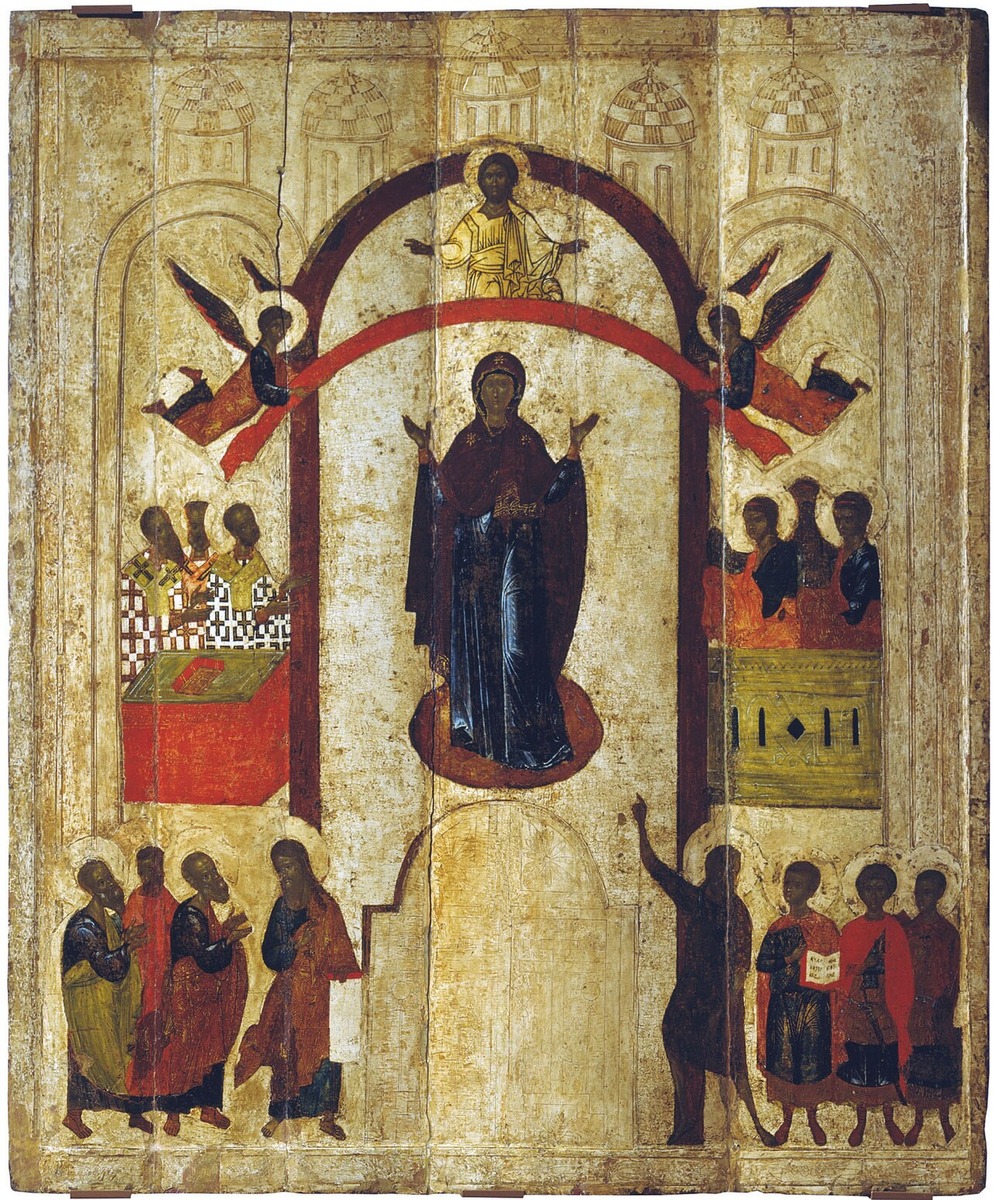
Pokrov icons are one of the great achievements of Russian iconography, and from the fourteenth century they divide into two classical recensions. In the Novgorod type the Theotokos stands orans before the closed sanctuary doors of Blachernae, and the veil is held spread above her by flying angels; Christ blesses from the highest register. In the Suzdal or Central-Russian type (whose oldest witnesses come from the lands of Vladimir-Suzdal, where the feast was born) the Mother of God herself holds the veil outstretched in her hands, and below her, on the ambo, stands Romanus the Melodist with his scroll — the sweet-singer of the Theotokos, drawn into the feast's image because his memory shares its day. Around them both types gather the witnesses: Andrew the Fool-for-Christ in his rags, pointing out the vision to Epiphanius, the emperor and patriarch, and the choirs of saints. Later icons merge the two recensions freely.
The stored icon is the Novgorod Pokrov of 1399: the orans Theotokos on a cloud at the centre, the red veil arched above her in the hands of two angels, Christ overhead among the domes of Blachernae, hierarchs at the altar to the left, apostles below, and at the lower right Andrew in silhouette pointing out the vision to the company beside him.
A second stored image is of the Suzdal recension: the icon of the 1360s from the Intercession (Pokrov) convent at Suzdal, now in the Tretyakov Gallery, in which the Theotokos holds the veil herself beneath the domes of Blachernae and the young Romanus stands on the ambo below with his scroll (source: Commons, public domain, pd-old-work).