
Andrew the Fool-for-Christ
Blessed Andrew, Fool-for-Christ, of Constantinople
Fool for Christ · d. 936 (traditional)
Commemorated 2 October — Repose; kept the day after the Protection of the Theotokos, whose vision he beheld
Andrew the Fool-for-Christ (†936, by the traditional reckoning) is the most famous of the Byzantine "fools" — a Scythian (Slav) slave in Constantinople who, obeying a vision of Christ, feigned madness and lived for decades on the capital's streets in rags, mocked and beaten, secretly ascetic and clairvoyant. His Life, written by Nikephoros, a priest of Hagia Sophia, recounts his rapture into paradise and, above all, the vision at the Blachernae church in which he and his disciple Epiphanios saw the Theotokos spreading her shining veil in protection over the praying people — the vision from which the feast of the Protection of the Theotokos (October 1) arose. The Life's date and authorship are among hagiography's celebrated problems, recorded honestly below.

Origins and early life
According to the Life, Andrew was a Scythian — the term the Byzantines used for the Slavs of the north — sold as a boy among many slaves to Theognostos, a protospatharios (a high court dignitary) of Constantinople. His master loved him, had him taught letters, and made him his personal attendant; the boy grew devout, given to the church services and the lives of the saints and martyrs.
The turning point came in a dream-vision: Andrew saw two hosts drawn up for contest — the saints in white raiment on one side, a black horde of demons on the other — and a champion demon of gigantic size challenging any to single combat. A radiant youth — the Lord Himself, as the Life understands it — held three crowns of unearthly workmanship, treasures not of this world, promised to those who would defeat the dark host; and Andrew, wrestling and throwing the demonic champion, heard the call: "Be a fool for My sake, and you shall receive much in the day of My kingdom." He understood that the Lord was summoning him to the strangest of ascetic vocations.
Ascetic struggle: the feigned madness
Andrew began to act as one out of his mind. His alarmed master had him chained at the church of the martyr Anastasia — the shrine where the mad were taken for healing — but as the "madness" proved incurable he was at length released and turned loose. From then on Andrew lived on the streets of the capital: half-naked in all weathers, sleeping among the dogs and the destitute, begging alms and secretly giving them away to the poor, enduring mockery, blows, hunger, thirst, the summer heat and the killing frost of the Constantinopolitan winter. By day he played the fool; by night he prayed. The Life shows him conversing with demons and unmasking them, seeing the sins and secrets of passers-by, correcting sinners by absurd prophetic gestures that only their consciences could read, and receiving for his hidden endurance the gifts of clairvoyance and wisdom.
He acquired one confidant: Epiphanios, a pious young aristocrat, to whom alone Andrew showed himself as he was, and who became his disciple and the witness of his visions; the Life foretells that Epiphanios would in time become patriarch of Constantinople.
The visions
Two visions dominate the Life. In the first, during a two-week rapture in the depth of a lethal winter, Andrew was caught up — like Paul — to the third heaven: he walked in paradise among flowering trees, saw the courts of heaven and the Lord enthroned in glory; but when he sought the Theotokos there, he was told that she was not in heaven but had gone down into the troubled world, to help those in distress.
The second is the vision of the Protection. During an all-night vigil at the church of Blachernae, where the robe of the Theotokos was kept, Andrew — with Epiphanios beside him — saw the Mother of God enter through the royal doors, tall and terrible in beauty, escorted by John the Forerunner and John the Theologian and a host of saints. She knelt and prayed long with tears for the world; then, entering the sanctuary, she took off her shining veil — her maphorion — and spread it with her own hands over all the people praying in the church, a covering of light. "Seest thou, brother, the Queen and Lady of all praying for the whole world?" Andrew asked; and Epiphanios answered, "I see, holy father, and am in dread." From this vision the feast of the Protection (Pokrov) of the Theotokos, kept on October 1, took its origin; Andrew himself is commemorated the following day.
The Life also contains a long apocalyptic discourse — Andrew's answers to Epiphanios on the last things and the future and final destruction of Constantinople — which circulated widely and gave the Life much of its enormous medieval readership, in Byzantium and among the Slavs.
Repose
Andrew died, by the traditional reckoning, in 936, having spent some sixty-six years of life and decades in his feigned madness. The Life relates that he gave his soul to God in a portico of the city, hidden as he had lived; a fragrance of myrrh led the poor to the place, but the body itself was not found — translated, the author believed, by God.
Veneration and later cultus
Andrew's cultus, modest in Byzantium, became great in Rus'. His Life was translated into Slavonic by the twelfth century, and its Blachernae vision gave the Russian Church one of its best-loved feasts: the Protection of the Theotokos, established in the Vladimir-Suzdal lands in the mid-twelfth century under Andrew Bogolyubsky — the singular case of a feast arising in Rus' from a vision seen in Constantinople. That the visionary was himself "a Scythian," a Slav, endeared him the more; Russian Pokrov iconography always includes him, and the whole lineage of the Russian iurodivye — Basil the Blessed, Xenia of Petersburg, and the rest — looks to Andrew (with Symeon of Emesa before him) as its pattern. In the Greek books his memory is kept on May 28; in the Slavic books, and in this collection's calendar, on October 2.
Feast and commemoration
October 2 (church date; Old Calendar civil October 15), the day after the Protection of the Theotokos — a deliberate pairing: the feast of the vision is followed by the memory of the visionary. This is the date of the Slavic tradition, followed by the OCA and in Antiochian usage. The Greek synaxaria commemorate Andrew on May 28; the difference is recorded here and not resolved. In Russian usage Andrew is styled blazhenny ("blessed"), the customary title of the fools-for-Christ.
Hymns
Troparion — Tone 1
Having heard the voice of Thine Apostle Paul, saying, "We are fools for Christ's sake," Thy servant Andrew became a fool upon the earth for Thy sake, O Christ God; wherefore, honouring his memory now, we entreat Thee: O Lord, save our souls.
Original translation from the Slavonic
Kontakion — Tone 4
Becoming a fool of thine own will, thou didst utterly hate the beauties of this world; thou didst wither the mindings of the flesh by fasting and thirst, by scorching heat and the cold of frost, and never didst thou shrink from rain or snow or any burden of the air: and thou didst cleanse thyself as gold in the furnace, O blessed Andrew.
Original translation from the Slavonic
Iconography
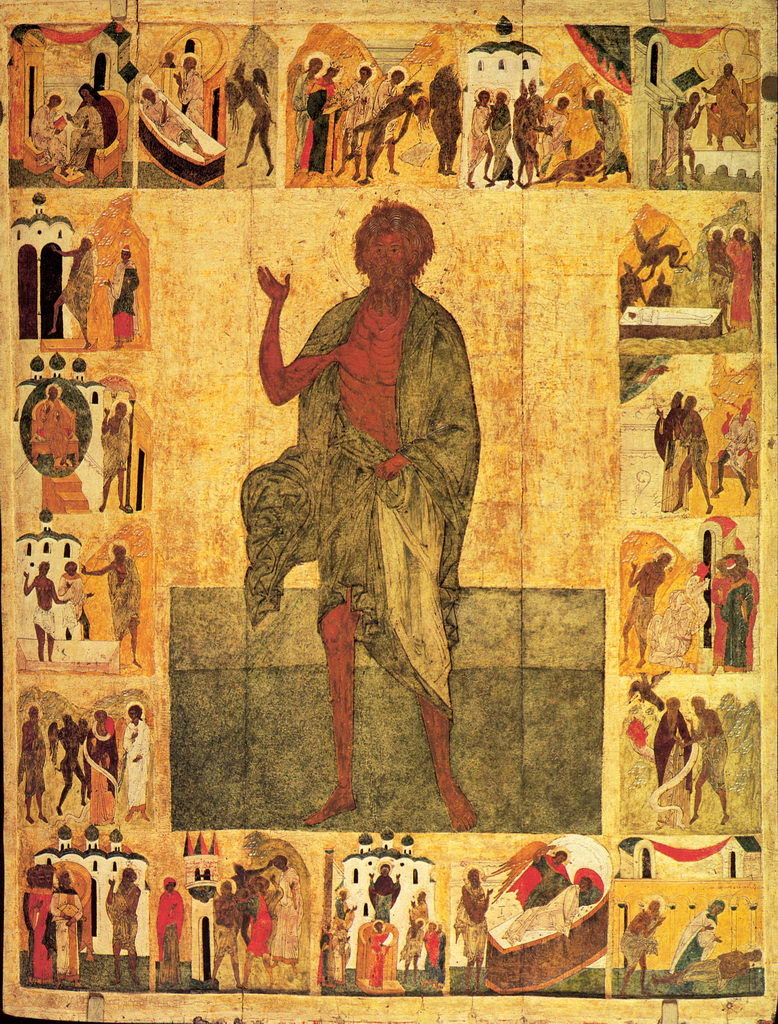
Andrew is painted as the archetypal fool: emaciated, nearly naked, his long hair and beard unkempt, his body weathered dark, clothed only in a ragged himation that leaves shoulder and legs bare; he raises a hand in prayer or gestures heavenward. In icons of the Protection he stands at the lower right among the congregation of Blachernae, pointing out the Theotokos above to the young Epiphanios beside him — his fixed and instantly recognisable role in that composition. The stored image is a sixteenth-century Russian vita icon (State Russian Museum): the saint full-length in rags at centre, surrounded by border scenes of his life and visions.
Disputed questions
- The Life's setting vs. the calendar's date. The Life of Andrew (BHG 115z–117), written by "Nikephoros, priest of the Great Church of Hagia Sophia," presents itself as the work of a contemporary and sets Andrew's career in the reign of Leo I (457–474). Yet the text is shot through with anachronisms impossible for the fifth century, and no independent witness to Andrew exists outside it. The Byzantine calendar tradition itself abandoned the Life's own chronology, placing Andrew under Leo VI the Wise (886–912) and his death in 936 — the dating this entry records as traditional.
- Date of composition. Lennart Rydén, the Life's modern editor, concluded that it was composed in the mid-tenth century (c. 950s), the fifth-century setting and the author's claimed intimacy with his hero being deliberate literary fiction; Cyril Mango argued instead for composition in the late seventh century (c. 674–695). On either view the Life is not the eyewitness document it claims to be, and whether a historical Andrew stands behind it cannot now be established. The cultus and the feast are facts of the Church's life; the biography is received from a single, problematic literary source — the reader should hold both truths together.
- Epiphanios. The Life implies its Epiphanios became patriarch of Constantinople; no patriarch of that name fits the traditional tenth-century dating, a difficulty usually taken as another sign of the Life's fictional framing.
- Not to be confused with the apostle Andrew the First-called; with the hieromartyr Andrew the presbyter of Ephesus (September 21, with Hypatius); with the martyr Andrew of Syracuse (September 23, with John, Peter and Antoninus); or with the later Russian fool Andrew of Totma (October 10), whose vocation was modelled on his.