
Alexander of Alexandria
Our Father among the Saints Alexander, Pope and Patriarch of Alexandria
Patriarch · Bishop · Confessor · b. c. 250 — d. 326 (Greek synaxaria) or 17 April 328
Commemorated 29 May — Repose of the patriarch who first condemned Arius
Alexander, archbishop and pope of Alexandria from 313 until his death, is the hierarch who first identified and condemned the heresy of Arius — a priest of his own city and of his own clergy — and who thereby began the struggle that produced the First Ecumenical Council at Nicaea in 325 and the Creed of the Church. He deposed Arius in synod, circulated encyclical letters that put the whole episcopate on notice, went up to Nicaea as the chief accuser, and left as his successor his deacon and secretary Athanasius the Great, whom he had formed. He reposed within a few years of the Council, and the Church keeps his memory on May 29, close by the commemoration of the Fathers whose work he began.
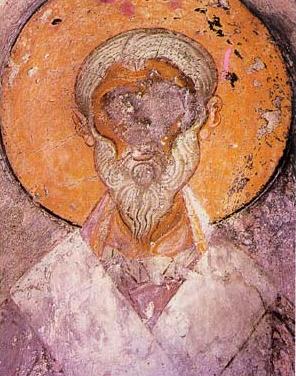

Presbyter of Alexandria under persecution
Alexander was an Alexandrian, born about the middle of the third century, and rose in the clergy of that city in the worst years it ever knew. He was one of the presbyters of the great Peter of Alexandria, the martyr-bishop beheaded in 311 under Diocletian's successors, and the tradition remembers him — with the presbyter Achillas — at his bishop's side in the persecution and in the prison. It also preserves the account of the dying Peter's warning against Arius, then a deacon or presbyter under censure for adherence to the Melitian schism, whom Peter refused to receive back and whom, on this telling, he charged his successors never to trust. Achillas succeeded Peter and reigned only a few months; on his death, about 313, Alexander was elected to the see of St Mark.
He inherited a church exhausted by persecution and split by the Melitian schism — the rigorist party of Melitius of Lycopolis, which had set up a rival hierarchy over the question of the lapsed. Managing that division consumed the early years of his episcopate, and it is worth noting that Arianism arose in a church already fractured, and drew on the discontented.
Arius and the first condemnation
Arius was a presbyter of the Alexandrian parish of Baucalis, an ascetic of great personal austerity, a formidable dialectician and a gifted popular teacher. The quarrel broke out, the sources say, when Alexander preached on the unity of the Trinity and Arius accused him publicly of Sabellianism — of collapsing the distinction of the Persons. Arius' own answer to the question was to deny that the Son is co-eternal with the Father: the Word is a creature, made before the ages but made; there was when He was not; He is not of the Father's substance but of His will, and is called God by grace and adoption. Alexander saw immediately that this was not a variation within the faith but its destruction, since a created Word cannot be the worshipped Christ of the Church's own prayer.
He proceeded first by persuasion, and the sources — including Alexander's own letters — suggest he was reproached afterwards by hard men for having been too patient. When persuasion failed he acted synodically. About 320 he assembled the clergy of Alexandria and the Egyptian bishops: the record names some thirty-six presbyters and forty-four deacons, and among the deacons Athanasius. They condemned Arius' teaching and subscribed the condemnation. A larger council, of a hundred or more bishops of Egypt and Libya, followed — Arius argued his case, and was placed under anathema, deposed from the presbyterate, and excommunicated with the clergy who stood with him, among them the deacons who had signed his memorandum.
Arius left Egypt and appealed abroad, and here the local quarrel became the crisis of the whole Church: he was received and championed by Eusebius of Nicomedia, a bishop with the ear of the court, and by other bishops of Asia who had studied with him under Lucian of Antioch. Alexander answered by writing to the episcopate at large. His encyclical — the letter Henos sōmatos, and the longer letter to Alexander of Thessalonica preserved by Theodoret — laid out the history of the affair, quoted the Arian propositions verbatim, and argued the case from Scripture; he circulated a confession of faith and gathered, the report runs, some 250 episcopal subscriptions to it. This was the first time an Alexandrian bishop had summoned the whole Church to a doctrinal judgement, and the dossier Alexander assembled is the reason Nicaea knew exactly what it was condemning.
Nicaea
When Constantine, having failed to compose the dispute by the mission of Hosius of Córdoba, summoned the bishops to Nicaea in 325, Alexander came at the head of the Egyptian delegation, bringing with him the confessor Potamon of Heraclea — who had lost an eye in the persecution — and his deacon Athanasius, who acted as his spokesman in the debates. Alexander did not preside: the presidency was left to Hosius, and Alexander took instead the position of chief accuser, the party to the case. The Council condemned Arius, formulated the homoousion, and in its canons and its letter confirmed to the see of Alexandria its ancient jurisdiction over Egypt, Libya and the Pentapolis and its office of announcing the date of Pascha to the churches — a recognition of Alexander's standing as much as of his see's.
He returned to Alexandria in possession of the field and reigned there a short time more, refusing to the end the pressure — imperial and episcopal — to readmit Arius to communion. The tradition says that as he lay dying he called for Athanasius, who was absent, and named him his successor.
Repose
Alexander died at Alexandria. The Greek synaxaria give the year 326; the chronology of the Alexandrian church, and most modern scholarship, gives 17 April 328, with Athanasius consecrated on 8 June of that year. He had governed the see for some fifteen years. He is counted among the confessors for his sufferings under the persecution as a presbyter and for his unbroken confession of the Son's divinity afterwards, and his memory is kept with particular honour in the Coptic and Alexandrian tradition as well as in the Byzantine.
Of his writings only fragments and a handful of letters survive — the two great encyclicals on Arius, quoted by Socrates and Theodoret, and pieces in Syriac and Armenian. They are the earliest documents of the Arian controversy from the orthodox side, and the vocabulary they use is already substantially that of Nicaea.
Feast and commemoration
May 29 (church date; New Calendar civil May 29, Old Calendar civil June 11) in the Byzantine calendars, together with the other commemorations of the day. The Roman calendar keeps him on 26 February and 17 April, and the Coptic Church commemorates him in its own reckoning. The proximity of his feast to the movable Sunday of the Fathers of the First Ecumenical Council (the Seventh Sunday of Pascha) is fitting rather than accidental: he is counted first among those Fathers in the Alexandrian memory, and some Greek lists attach a fixed commemoration of the 318 Fathers to this same May 29.
Because Orthodox Pascha falls between April 4 and May 8, this day always stands within the Pentecostarion, and whatever belongs to the movable cycle in a given year takes precedence over the fixed commemoration.
Hymns
Apolytikion — Tone 4 (common of a hierarch)
The truth of things hath shown thee to thy flock as a rule of faith, an image of meekness and a teacher of temperance; therefore thou hast attained the heights by humility and riches by poverty. O father and hierarch Alexander, intercede with Christ God that our souls may be saved.
Kontakion — Tone 2
Thou didst discern the wolf in the sheepfold and didst not spare him, O wise hierarch, but didst cast down the blasphemy that made the Word a creature; and having summoned the shepherds of the whole earth to the judgement of the truth, thou didst leave Athanasius as thine heir. O father Alexander, pray for us who honour thee.
Original translation from the Greek
Iconography
Alexander is painted as an aged hierarch: white-haired and with a full white beard, in the phelonion and the crossed omophorion, blessing with the right hand and holding the Gospel book in the left, in the type common to the great patriarchs. Because his memory is inseparable from Nicaea, he appears above all in the composite icon of the First Ecumenical Council, where he is shown in the front rank of the seated fathers — often with the young deacon Athanasius beside him and the figure of Arius cast down beneath — and in the frescoed rows of hierarchs in the sanctuaries of Byzantine and Serbian churches, where his name is written beside the omophorion. Alexandrian and Coptic painting shows him enthroned with the pallium of his see.
No pre-1900 icon of him alone has been secured for this collection. A Wikimedia Commons file titled for a fresco of him in the church of the Theotokos Eleousa at Veljusa (dated XI–XIV c.) was examined and rejected: the underlying fresco is safely pre-modern, but the photograph is low-resolution and the accompanying inscription is illegible, so that nothing in the image itself distinguishes this hierarch from any other aged bishop, and identity could not be verified as the project's constitution requires. The identification rests only on the uploader's file title.
Disputed questions
- The year of his death is genuinely uncertain: 326 in the Byzantine synaxaria (and in the notices that place his repose two years after the Council), 17 April 328 on the Alexandrian and modern reckoning. The Athanasius entry in this collection follows 328; the discrepancy is a matter of the sources, not of identity, and is left standing on both sides. The Roman calendar's dates of 26 February and 17 April for him reflect the same disagreement about the day.
- Not to be confused with the other Alexandrian patriarchs of the name — Alexander II (702–729) and Alexander II of the eleventh century — nor with the several martyrs called Alexander of Alexandria in the synaxaria, nor with Alexander of Jerusalem (†251) or Alexander of Rome, pope.
- Not to be confused, above all, with his exact contemporary Alexander of Constantinople (†337/340, kept August 30 with John and Paul the New), the other great anti-Arian hierarch of the Nicene generation. The two are constantly interchanged, because both are patriarchs named Alexander whose fame rests on the condemnation of Arius: this Alexander deposed Arius in synod at Alexandria and carried the case to Nicaea; the Constantinopolitan Alexander represented the aged Metrophanes at the Council and, as patriarch, prayed through the night that Arius might not be forced upon the Church's communion — the prayer answered by the heresiarch's death in the street the next morning.
- How much of the anti-Arian dossier is his own has been discussed since antiquity, since Athanasius was his archdeacon and secretary and the letters are the work of the chancery he directed. The judgement of the Life of Athanasius — that Alexander made Athanasius — need not be reversed to admit that the pupil's hand may be in the master's letters.
- The relation of his condemnation to Nicaea. Older accounts treated Nicaea as the beginning of the controversy; the correct order is that the Egyptian synods of c. 320–321 had already condemned Arius, and the Council confirmed a judgement already made in Alexandria. This is the substance of Alexander's importance.