
Alexandra the Empress
The Holy Martyr Alexandra the Empress
Martyr · d. 303 (traditional) — or 314/315 in the historicised account
Commemorated 23 April — Kept with George the Great Martyr, whose witness converted her
Alexandra, honoured as the wife of the emperor Diocletian, is the most exalted of the converts won by the sufferings of George the Great Martyr. The passion of George relates that she followed the whole contest between the young officer and her husband, and that when George shattered the idols in the temple of Apollo she forced her way through the crowd crying "O God of George, help me, for thou alone art almighty!" and fell at the martyr's feet confessing Christ. Condemned with him on the spot, she is said to have died on the way to execution, sitting down to rest against a wall and giving up her soul without the sword. She is commemorated with George on 23 April. The historical woman behind the commemoration — Diocletian's wife, called Prisca in the Latin sources, put to death with her daughter Valeria under Licinius about 314–315 — is the subject of a genuine and unresolved question.
.jpg)
The empress at the court of Nicomedia
The Church remembers Alexandra as the consort of Diocletian, who reigned from 284 to 305 and who ruled the East from Nicomedia in Bithynia. Her name appears in the record for a single reason: the martyrdom of the comes George in the spring of 303, at the opening of the Great Persecution. The hagiographical tradition presents her as a woman already inclined to the faith of Christ — some accounts make her a secret believer from the first, others have her convinced only by what she saw — and it attributes to her the Christian upbringing of her daughter, whom the Orthodox tradition calls Valeria.
Her position in the passion is dramatic rather than biographical. Standing behind her husband through the long cycle of the martyr's torments — the wheel, the pit of lime, the iron shoes, the poison of the magician Athanasius — she is the witness whose attention the narrative repeatedly returns to, the emperor's own household turned against the emperor's own decree.
The confession in the temple of Apollo
The turn came on the last day. Diocletian, having failed by every torture and by every promise of advancement, had George brought to the great temple of Apollo for a final attempt at sacrifice. The martyr went up to the idol, signed it with the cross, and asked whether it wished to be worshipped as God — at which, the tradition says, the demon within confessed itself, and the images fell and were broken through the whole temple.
At that Alexandra thrust her way through the crowd, cried aloud "O God of George, help me, for thou alone art almighty!", and threw herself down at the martyr's feet, confessing Christ before the court, the priests and the people. Diocletian, the account says, asked her whether she had lost her senses, and, receiving from her only the confession of the faith, condemned his own wife to the sword together with the soldier she had defended.
Her repose
The received passion relates that as the two were being led out of the city to the place of execution the empress grew faint, asked leave to rest, sat down and leaned against a wall, and there gave up her soul to God — so that she was crowned without the executioner's stroke, the sentence already passed over her. George was beheaded the same hour, on 23 April 303. Because her death in this account is not by the sword, some synaxaria are careful to say that she "received the crown" or "reposed in the confession of Christ," while still numbering her among the martyrs: the will to suffer, freely declared before the tribunal, is what the Church honours in her.
Veneration
Alexandra has no independent cultus and no proper office: she is commemorated within the feast of the Great-martyr, and her name enters the calendar through his. Her veneration is nevertheless very old and very wide, and it became especially strong in Russia, where Александра was a great dynastic name; the empress-martyr was the patron and name-day saint of the Russian empresses Alexandra Feodorovna, wife of Nicholas I and, later, of Nicholas II, and countless nineteenth-century Russian icons, church side-altars and charitable foundations were dedicated to her on their account. (The later Empress Alexandra Feodorovna, martyred at Ekaterinburg in 1918 and glorified among the Royal Passion-bearers, is an entirely different saint — see Disputed questions.)
Feast and commemoration
23 April (church date; Old Calendar civil 6 May), kept in the service of George the Great Martyr, whose propers carry the day; the Menaion appoints her no separate canon or stichera, and where a hymn to her is sung it is taken from the common of a woman martyr. Slavic calendars list her as мученица царица Александра and, following the older reckoning, at the year 303; the OCA synaxarion lists her with the year 314 (see Disputed questions). The servants of the palace converted in the same hour as she — Isaac, Apollos and Quadratus — are kept two days before, on 21 April, so that the calendar spreads the converts of George's passion across the days about his feast; some Greek synaxaria are reported to attach Alexandra's own memory to 21 April as well, a placement not verified live for this entry and flagged for a later pass. Commemorated on the same day are the other converts of George's passion — the soldiers Anatolius and Protoleon, the magician Athanasius, Glycerius the farmer — and George's mother Polychronia, all deferred to a later pass.
Hymns
Apolytikion — Tone 4
Thy lamb Alexandra crieth out to thee with a great voice, O Jesus: I love thee, my Bridegroom, and seeking thee I contend; I am crucified and buried together with thee in thy baptism, and I suffer for thy sake that I may reign with thee; I die for thee that I may live in thee. Receive me as a spotless sacrifice, offered to thee in love. At her entreaties, O merciful one, save our souls.
Kontakion — Tone 2
Thou didst forsake a throne and a crown of earth for the confession of Christ, O glorious Alexandra, and crying out in the midst of the tyrants, "Thou alone art God," thou wast numbered with the martyrs; wherefore, entreat him without ceasing for us who honour thee.
Original translation from the Greek
Iconography
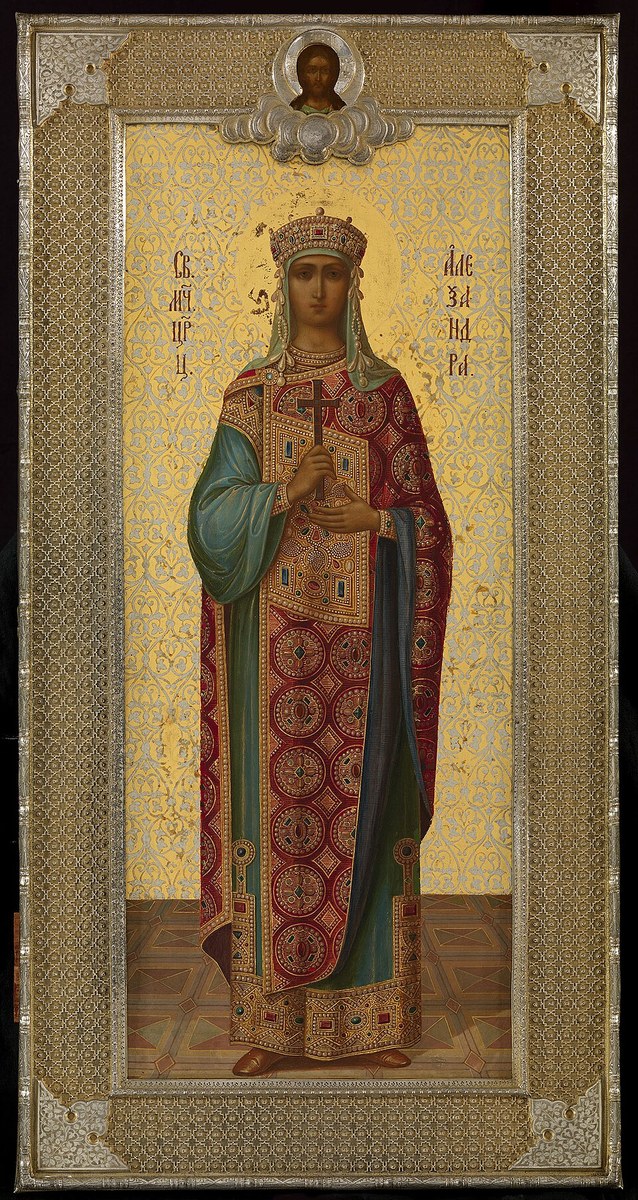
Alexandra is painted as a crowned empress: standing frontally in the jewelled loros or the brocaded imperial mantle of a Byzantine — or, in Russian icons, of a Muscovite — sovereign, wearing the closed crown with pendilia, and holding in her right hand the small cross of the martyrs, sometimes with the palm. Her inscription is regularly given with her rank (Ἡ ἁγία Ἀλεξάνδρα ἡ βασίλισσα; СВ. МЧ. ЦРЦ. АЛЕѰАНДРА), which is how she is distinguished from other saints of the name. She appears also in the narrative cycles of the Great-martyr George, in the scene of the temple of Apollo, kneeling or prostrate at the martyr's feet as the idols fall; and in some vita-icons of George at his side among the converts.
The stored image is a Russian icon of 1883, of the careful academic-influenced workmanship of the late imperial period, in a chased silver frame with the Saviour in a medallion above: the saint stands full-length on a chased gold ground, crowned and veiled, in a crimson mantle worked all over with jewelled medallions over a green under-robe, holding the martyr's cross before her breast; the inscription at either side of the halo reads СВ. МЧ. ЦРЦ. АЛЕѰАНДРА — "Holy Martyr Empress Alexandra." Icons of this kind were produced in quantity in nineteenth-century Russia as name-day images for the imperial family and their namesakes.
Disputed questions
- The identification with Prisca, and the date of her death. The historical wife of Diocletian is named Prisca by the Latin sources, and her fate is recorded with unusual precision by Lactantius (De mortibus persecutorum): Prisca and her daughter Valeria — the widow of Galerius — were compelled at the outbreak of the persecution to eat of the sacrifices; after Galerius's death in 311 Valeria refused the hand of Maximinus Daza and was exiled with her mother; and after Maximinus's fall the two women, having sought the protection of Licinius, were seized, beheaded, and their bodies thrown into the sea, about the year 315. If — as the OCA synaxarion and most modern Orthodox writers hold — Alexandra is Prisca, then she cannot have died at Nicomedia in 303 alongside George, and the scene of her repose against the wall belongs to the hagiographer's art. The OCA account states this frankly: the death "described in the Martyrdom of Saint George, written immediately after his death," is not what happened, and the empress "received the crown of martyrdom several years later, in 314," with her daughter. Even then the details diverge: the Orthodox account places the execution at Nicomedia, Lactantius at Thessalonica. The name is a further difficulty — Alexandra may be a baptismal name, or a substitution of the Greek tradition, or the hagiographical figure may be a separate woman of the palace altogether, drawn into George's passion because an imperial convert made the best possible witness. This repository keeps the received commemoration on 23 April with George, states the received account as the Church transmits it, and records the historical evidence against it without pretending to resolve the two.
- Whether Diocletian's wife was a Christian at all. Lactantius's report that Prisca and Valeria had to be compelled to sacrifice is generally read as evidence that they were at least catechumens or sympathisers, which is the historical foothold of the whole tradition; but Lactantius never calls them Christians, and Eusebius is silent about them.
- Classification. The calendars style her βασίλισσα / царица — "queen," "empress" — and she is a reigning consort, but this corpus has no emperor/empress term, and the interim convention for Byzantine imperial saints (king/queen) is itself an open question: see the project's record of open questionsb. She is typed here as martyr alone, which is how the day's synaxarion leads, with her rank carried in official_name and in the prose; a later normalising sweep may add a royal-office term.
- Not to be confused with Alexandra Feodorovna, the last Russian empress (†1918, glorified with the Royal Martyrs of Russia, commemorated 4 July); with Alexandra the martyr of Amisus, kept with the virgin-martyrs of Amisus on 20 March; or with the several other Alexandras of the Greek and Slavic synaxaria.