
Anastasius the Persian
The Holy Venerable-martyr Anastasius the Persian
Venerable Martyr · b. c. 590, in Persia (region of Ray/Razikh) — d. January 22, 628, in Persia
Commemorated 22 January — Martyrdom in Persia, 24 January — Translation of his relics (kept in some calendars)
Anastasius the Persian (†628), born Magundat, was a Persian soldier and the son of a magus, who was converted to Christ by the miracles surrounding the True Cross that his own emperor Chosroes II had carried off from Jerusalem. Leaving the Persian army, he was baptized at Jerusalem by the Patriarch Modestus — taking the name Anastasius, "Resurrection" — and became a monk in the monastery of Abba Anastasius near the Holy City, where he passed seven years in ascetic labour. Burning to confess Christ before his own people, he went into Persian-occupied Caesarea of Palestine, openly denounced the fire-worship of the magi, and was seized, imprisoned, and cruelly tortured. Sent into Persia and pressed to renounce his faith, he was at last strangled with seventy other captive Christians and beheaded on January 22, 628. His relics, untouched by the dogs to which his body was thrown, were carried to his monastery in Palestine, thence to Constantinople and to Rome. He is honoured as a venerable-martyr — a monk crowned as a martyr — and his memory is bound to the Cross whose power first drew him to Christ.
.jpg)
Magundat, son of a magus
The saint was born about the year 590 in Persia, in the region of Ray (the district his Greek life calls Razikh), the son of a magus — a priest and sorcerer of the Zoroastrian religion — named Bau (or Babu). His given name was Magundat. Trained by his father in the arts of the magi, he learned also the practice of arms and entered the cavalry of the Persian army under the great king Chosroes II (Khosrow II, r. 590–628), in the years when Persia and the Roman Empire were locked in their last and most terrible war.
The True Cross and the seed of faith
In the year 614 the armies of Chosroes, having overrun Syria, took and sacked Jerusalem; among the spoils carried in triumph back to Persia was the Precious and Life-giving Cross of Christ, the great relic of the Holy City. The captured Cross, and the marvels reported of it, worked upon the young soldier's mind. Magundat began to ask what this wood might be that the Christians so revered and for which they grieved, and to inquire into the faith of the crucified God. The seed took root: turning from the fire and the sun of his fathers' worship, he conceived the desire to become a Christian, and he left the army to seek baptism.
Conversion, baptism, and the monastic life
Making his way westward as the tide of the war turned — the emperor Heraclius had begun the campaigns that would break the Persian power — Magundat came first to Hierapolis, where he lodged with a Christian silversmith and learned the craft, and thence, drawn by the holy places, to Jerusalem. There he was received and, after instruction, baptized by the Patriarch Modestus (the locum tenens of the see after the Persian sack, later its bishop), who gave him the name Anastasius — from Anastasis, the Resurrection. Not long after, he took the monastic habit in the monastery of Abba Anastasius, some miles from Jerusalem, and there, under obedience, learning the Psalter and the Greek tongue, he spent about seven years in fasting, prayer, and the labour of the cell, kindling all the while a longing to suffer for the Name he had found.
Confession and torture at Caesarea
At length, moved (his life says) by visions and by an unquenchable desire for martyrdom, and with his abbot's blessing, Anastasius went to Caesarea of Palestine, then held by the Persian occupation. There he confronted a company of magi openly, reproaching their fire-worship and confessing Christ before them. He was arrested and brought before the Persian governor, the marzban (whom the Greek life calls Marzabanes). Refusing every inducement to return to the religion of his birth — which in a former soldier and a magus's son the Persians reckoned apostasy and treason at once — he was subjected to a long succession of torments: bound by the neck and the ankle to another prisoner and set to carry stones, beaten with staves, his hands crushed, and hung up by one arm with a weight dragging at the other. Through all he was steadfast, and his constancy drew other captive Christians to take heart.
Martyrdom in Persia
Unable to break him, the governor referred his case to Chosroes himself, and Anastasius was carried in chains into Persia, to a place on a river near the Euphrates (the life names Bethsaloe). There the king's officers, having failed by threats and by torture, at last put him to death together with a company of seventy other Christian captives: they were strangled with cords, and Anastasius, the last, after them; his head was then struck off and sent to Chosroes as proof. It was January 22, in the year 628 — within months of the final Roman victory that would compel Persia to restore the Cross. His body was cast out to be devoured by dogs, but the tradition holds that the dogs would not touch it, and the faithful gathered it reverently.
Relics and the veneration of the Cross
The relics of Anastasius were carried from Persia to his own monastery near Jerusalem, and afterwards, as the fortunes of the East shifted, translated to Constantinople and at last to Rome, where they were enshrined at the abbey by the Aquae Salviae — the Abbey of Saints Vincent and Anastasius at the Tre Fontane — which guards his memory in the West. His head, or a portion of it, was long venerated there. His icon became famous early: the Fathers of the Seventh Ecumenical Council (Nicaea, 787) cited a wonderworking image of Anastasius the Persian among the proofs of the honour due to holy icons, so that the monk-martyr stands, by a fitting providence, twice bound to the defence of the Cross and its images — converted by the Cross taken captive, and invoked in the age when the icon of Christ crucified was itself contended for.
The whole shape of his life ties him to the Exaltation of the Cross: the relic whose captivity under Chosroes drew Magundat to the faith was, in that very generation, recovered by Heraclius and restored in triumph to Jerusalem (the event the Church keeps on September 14), so that the story of Anastasius and the story of the Cross's exile and return are one story told from two sides.
Feast and commemoration
Anastasius is kept universally on January 22 (church date; New Calendar civil January 22; Old Calendar civil February 4), the day of his martyrdom, together with the Apostle Timothy; the two are joined in the single kontakion of the day. Some calendars keep a translation of his relics on January 24. The Antiochian, Greek, and Slavic calendars agree on the principal day, and the West too honours him (the Roman calendar long kept him on January 22). The feast falls in no fasting season.
Hymns
Troparion — Tone 4
Wisely forsaking the error of the Persians, thou didst run in piety to the faith of Christ, O wise Anastasius; wherefore, having shone forth divinely in the ascetic struggle also, thou didst contend beyond nature and cast down the serpent. Therefore with a twofold crown hast thou been crowned from God.
Original translation from the Greek
Kontakion — Tone 1
Let us the faithful all hymn Timothy, the divine disciple and fellow-traveller of Paul, and with him let us honour the wise Anastasius, who shone forth from Persia like a star and drives away the passions of our souls and the sicknesses of our bodies.
Original translation from the Greek
Iconography
Anastasius is depicted as a monk-martyr: in the dark monastic schema and mantle, bearded, holding the cross of a martyr in his hand — often with the rope or the emblem of his strangling — and sometimes shown at the moment of his death, bound among his fellow-captives. His early and famous icon, cited at the Seventh Council, fixed his type in the East. In Western art, at the Tre Fontane, he appears with Vincent of Saragossa, the abbey's co-patron.
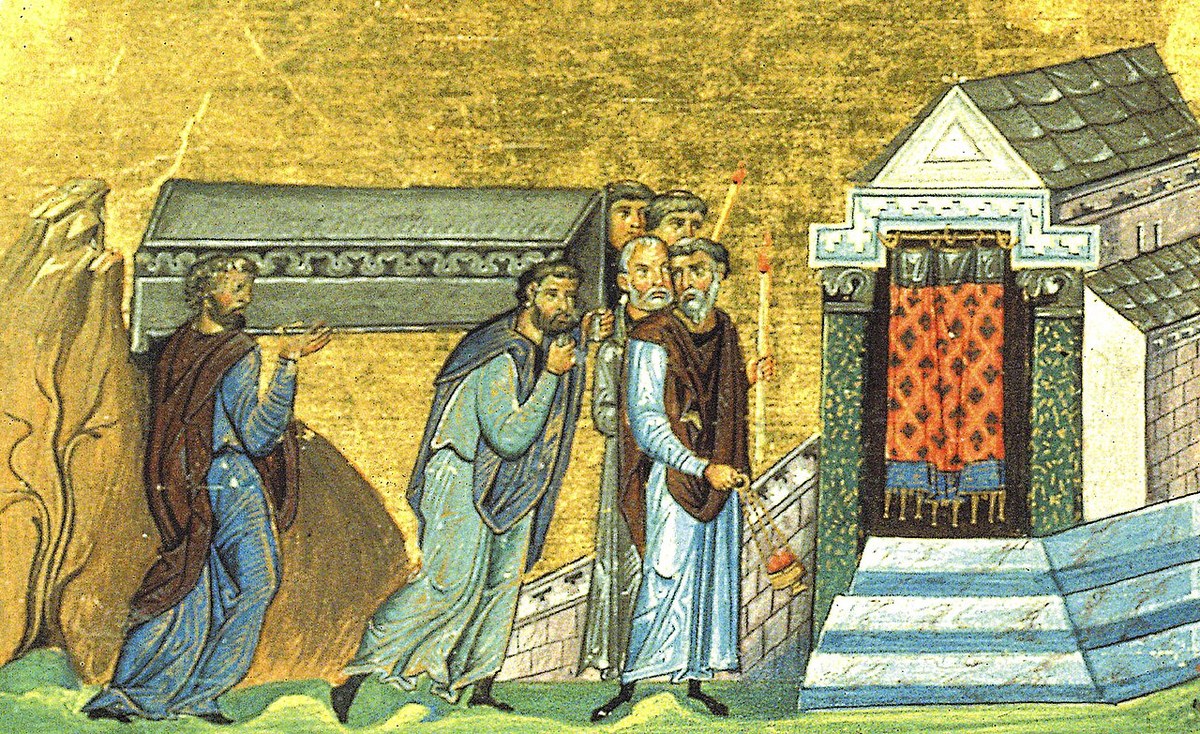
The stored image is the miniature for January 22 from the Menologion of Basil II (Constantinople, c. 985; Vatican, Vat. gr. 1613), depicting Anastasius the Persian as the venerable-martyr (source, public domain, pd-old-work).
Disputed questions
- His birth-name and origin. The Greek life names him Magundat, son of the magus Bau, of the region of Ray (Razikh); the details of place (Rasnuni, Nunia) vary in the manuscripts, as does the notice of his early service, described as in the corps the life transliterates Therones (perhaps a cavalry unit). The substance — Persian, a magus's son, a soldier — is constant.
- The date. His martyrdom is firmly dated to 628 (some reckonings 627), in the last months of Chosroes II's reign and the war; January 22 is the fixed day. A translation of his relics is kept in some calendars on January 24.
- Not to be confused with Anastasia the Deliverer-from-Bonds (Pharmakolytria) — a woman and a great-martyr of the early fourth century, kept December 22, whose name (and whose association with loosing from bonds and from Persia in popular devotion) is easily confused with his; nor with Anastasius of Sinai (the abbot and theologian, †c. 700, kept April 20), nor with Anastasius I, Patriarch of Antioch (†599). This Anastasius is the Persian monk-martyr of the seventh century alone.