
Timothy the Apostle
The Holy Apostle Timothy of the Seventy, Bishop of Ephesus
Apostle · Apostle of the Seventy · Hieromartyr · Bishop · b. c. 17, at Lystra in Lycaonia — d. c. 97, at Ephesus
Commemorated 22 January — Martyrdom at Ephesus
Timothy (c. 17 – c. 97) was the beloved disciple and inseparable companion of the Apostle Paul (who has no separate entry in this collection as yet), who called him "my own son in the faith" and "my dearly beloved son." A native of Lystra in Lycaonia, born of a Greek father and a believing Jewish mother, Eunice, he was reckoned by the tradition among the Seventy Apostles and became the first bishop of Ephesus, where Paul left him to order the Church and to which he addressed the two epistles — 1 and 2 Timothy — that bear his name and stand among the pastoral charters of the Christian ministry. After Paul's martyrdom he governed Ephesus for many years, associated there in old age with the Apostle and Evangelist John the Theologian, and about the year 97, opposing a licentious pagan festival called the Katagogia, he was set upon by the idolatrous mob, beaten with clubs and stones, and died of his wounds two days later. His relics were translated to Constantinople in 356 and laid in the Church of the Holy Apostles beside those of the Apostles Andrew and Luke. He is kept on January 22.
.jpg)
Origins and family at Lystra
Timothy was born about the year 17 at Lystra, a small Roman colony in the highlands of Lycaonia in central Asia Minor. His family was of the mixed world the Gospel would soon gather in: his father was a Greek — a pagan, so far as the record shows — while his mother Eunice and his grandmother Lois were devout Jewesses who had come to faith in Christ. Paul remembered them with tenderness: "the unfeigned faith that is in thee, which dwelt first in thy grandmother Lois, and thy mother Eunice; and I am persuaded that in thee also" (2 Timothy 1:5). From a child Timothy had "known the holy scriptures" (2 Timothy 3:15), taught them at his mother's knee; but because his father was a Greek he had not been circumcised, and grew up on the seam between the synagogue and the Gentile city.
Conversion and the call to follow Paul
The tradition, following the OCA and Greek synaxaria, places Timothy's coming to Christ about the year 52, when Paul first passed through Lystra on his missionary journeys and the young man — with his mother and grandmother — was won to the faith. When Paul returned to Lystra on his second journey, he found Timothy "well reported of by the brethren that were at Lystra and Iconium" (Acts 16:2), and resolved to take him as a fellow-worker. "Him would Paul have to go forth with him; and took and circumcised him because of the Jews which were in those quarters: for they knew all that his father was a Greek" (Acts 16:3) — a step Paul took not from any need of the Law, which he had just been defending against at the Council of Jerusalem, but from pastoral prudence, that the mixed parentage of his companion should be no stumbling-block to the Jews they would meet. From that hour Timothy was Paul's own, ordained to the ministry by the laying-on of the Apostle's hands and of the presbytery (1 Timothy 4:14; 2 Timothy 1:6), and sent out on the work with a prophetic word spoken over him (1 Timothy 1:18).
Companion and fellow-worker of Paul
For some fifteen years Timothy shared Paul's labours, his journeys, and his imprisonments, and no companion is named so often or so warmly in the Apostle's letters. He was with Paul in Macedonia and at Philippi, at Thessalonica and Beroea — where he and Silas were left behind to establish the young church (Acts 17:14) — and at Corinth and Ephesus. Paul sent him on the most delicate errands, as his own presence in another form: to Thessalonica, "to establish you, and to comfort you concerning your faith" (1 Thessalonians 3:2); to Corinth, "who shall bring you into remembrance of my ways which be in Christ" (1 Corinthians 4:17; 16:10); to Philippi, "for I have no man likeminded, who will naturally care for your state… ye know the proof of him, that, as a son with the father, he hath served with me in the gospel" (Philippians 2:19–22). So fully was Timothy joined to the Apostle's mind that Paul names him co-sender of no fewer than six of the epistles — 2 Corinthians, Philippians, Colossians, 1 and 2 Thessalonians, and Philemon — "Paul… and Timothy our brother." He shared, too, the Apostle's chains: the Letter to the Hebrews closes with the news that "our brother Timothy is set at liberty" (Hebrews 13:23), a glimpse of an imprisonment and release of his own.
Bishop of Ephesus and the two epistles
When Paul, journeying on, could no longer remain at Ephesus, he left Timothy there to govern the great church of Asia: "As I besought thee to abide still at Ephesus, when I went into Macedonia, that thou mightest charge some that they teach no other doctrine" (1 Timothy 1:3). The tradition of the Church, East and West alike, knows Timothy as the first bishop of Ephesus — the see he held for the rest of his life, some three or four decades.
To him, in this charge, Paul addressed the two epistles that are Timothy's enduring monument and, with the Letter to Titus, the "Pastoral Epistles." No other of the Seventy is the named recipient of Scripture, and the two letters have shaped the Church's ministry ever since. In them the aged Apostle sets out the qualifications of a bishop and of deacons (1 Timothy 3), the ordering of prayer, of widows, and of elders, the guarding of "that which is committed to thy trust" (1 Timothy 6:20), and the whole temper of a pastor: "Let no man despise thy youth; but be thou an example of the believers, in word, in conversation, in charity, in spirit, in faith, in purity" (1 Timothy 4:12). There too is the homely counsel that has fixed itself in memory — "Drink no longer water, but use a little wine for thy stomach's sake and thine often infirmities" (1 Timothy 5:23) — a word that tells us Timothy was of frail health and ascetic habit, drinking only water until his father in the faith bade him spare himself. The Second Epistle, written from a Roman prison as Paul faced death, is the most moving of the two: the Apostle, "ready to be offered," longs to see his son once more — "Do thy diligence to come shortly unto me" — charges him to "preach the word; be instant in season, out of season" and to "do the work of an evangelist, make full proof of thy ministry" (2 Timothy 4:2, 5, 9), and leaves him, as a testament, the words that have steadied countless Christians since: "I have fought a good fight, I have finished my course, I have kept the faith" (2 Timothy 4:7). The hymnography of Timothy's feast turns on just this: that the disciple, taught by the "Chosen Vessel," himself "kept the faith and finished a like course."
With John the Theologian
After the martyrdom of Paul at Rome, Timothy continued at Ephesus, and the tradition joins him in his later years to the Apostle and Evangelist John the Theologian, who spent the close of his life in that same city. The synaxaria relate that Timothy received John on his return from exile on Patmos and drew from him, as once from Paul, an abundance of grace — so that the last of the Twelve and the beloved son of the Apostle to the Gentiles kept the church of Ephesus together in the sunset of the apostolic age.
Martyrdom at the Katagogia
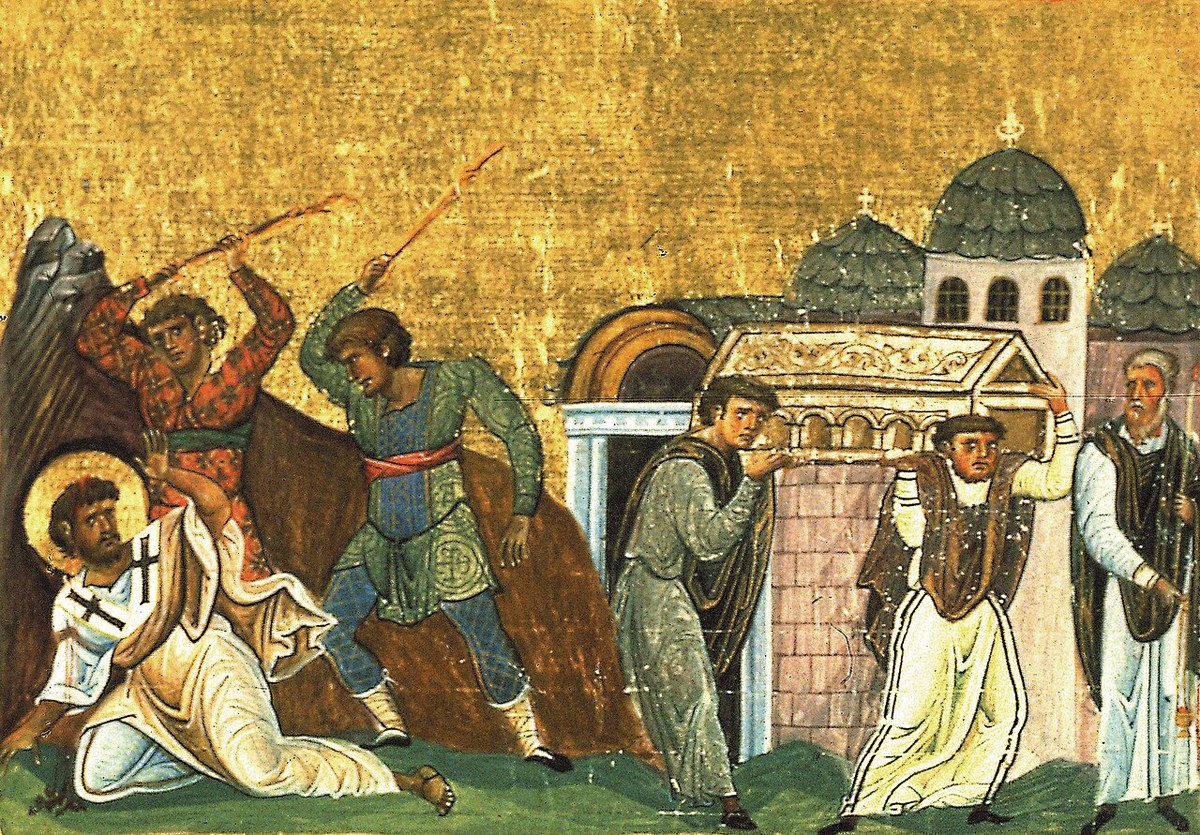
Timothy's death, about the year 97 (the reign of the emperor Nerva or the early years of Trajan), sprang from his zeal against idolatry. Ephesus was the city of the great temple of Artemis, and its pagans kept a wild yearly festival which the synaxarion names the Katagogia (Καταγώγια): the crowds, their faces hidden behind masks so that none should be known, went in procession through the streets bearing idols and clubs, singing and raving, and falling upon whomever they met to rob and to beat and to murder under cover of the feast. The aged bishop, unable to bear the frenzy and the shame done to God, went out among them and preached Christ, calling them from their idols to the living God. The maddened mob rounded on him: they beat him with their clubs (the bakloi of the account) and stoned him, and left him for dead. His disciples carried him out, and two days later he died of his wounds — a bishop of Christ slain by the very idolatry he had spent his life opposing. He was buried on a hill outside the city (the tradition names Mount Pion).
Relics and translations
The relics of Timothy rested at Ephesus for more than two centuries and a half. In the year 356, in the reign of the emperor Constantius II, they were translated to Constantinople and enshrined with great honour in the Church of the Holy Apostles, laid — as the historians Jerome and the Byzantine chroniclers record — beside the relics of the Apostles Andrew the First-Called and Luke the Evangelist, the three apostolic bodies gathered into the imperial city's shrine of the Apostles. (This translation is one of the earliest recorded gatherings of apostolic relics to the new capital, and the church father Jerome mentions it, as does the pilgrim record of the age.) The presence of the three apostles at the Holy Apostles was famed through the Byzantine centuries; portions of Timothy's relics were later dispersed to the West, and a skull venerated as his is kept in Italy, but the great translation the tradition remembers is that of 356 to Constantinople.
Feast and commemoration
Timothy is kept universally on January 22 (church date; New Calendar civil January 22; Old Calendar civil February 4), the day of his martyrdom at Ephesus. The day joins him with the monk-martyr Anastasius the Persian, and the two are hymned together in the kontakion of the feast. The Antiochian, Greek, and Slavic calendars agree on the day. As one of the Seventy, Timothy is also honoured within the common Synaxis of the Seventy Apostles on January 4, which "indicates the equal honour of each" of that company. The feast falls in no fasting season.
Hymns
Troparion — Tone 4
Instructed in goodness, and sober in all things, clothed in a good conscience as befits a saint, thou didst draw from the Chosen Vessel the things unutterable; and having kept the faith, thou didst finish a like course, O Apostle Timothy. Intercede with Christ our God that our souls may be saved.
Original translation from the Greek
Kontakion — Tone 1
Let us the faithful all hymn Timothy, the divine disciple and fellow-traveller of Paul, and with him let us honour the wise Anastasius, who shone forth from Persia like a star and drives away the passions of our souls and the sicknesses of our bodies.
Original translation from the Greek
Appointed readings
Epistle — 2 Timothy 1:3–8
3I thank God, whom I serve from my forefathers with pure conscience, that without ceasing I have remembrance of thee in my prayers night and day; 4Greatly desiring to see thee, being mindful of thy tears, that I may be filled with joy; 5When I call to remembrance the unfeigned faith that is in thee, which dwelt first in thy grandmother Lois, and thy mother Eunice; and I am persuaded that in thee also. 6Wherefore I put thee in remembrance that thou stir up the gift of God, which is in thee by the putting on of my hands. 7For God hath not given us the spirit of fear; but of power, and of love, and of a sound mind. 8Be not thou therefore ashamed of the testimony of our Lord, nor of me his prisoner: but be thou partaker of the afflictions of the gospel according to the power of God;
Gospel — Matthew 10:32–33, 37–38; 19:27–30
32Whosoever therefore shall confess me before men, him will I confess also before my Father which is in heaven. 33But whosoever shall deny me before men, him will I also deny before my Father which is in heaven. 37He that loveth father or mother more than me is not worthy of me: and he that loveth son or daughter more than me is not worthy of me. 38And he that taketh not his cross, and followeth after me, is not worthy of me. 27Then answered Peter and said unto him, Behold, we have forsaken all, and followed thee; what shall we have therefore? 28And Jesus said unto them, Verily I say unto you, That ye which have followed me, in the regeneration when the Son of man shall sit in the throne of his glory, ye also shall sit upon twelve thrones, judging the twelve tribes of Israel. 29And every one that hath forsaken houses, or brethren, or sisters, or father, or mother, or wife, or children, or lands, for my name’s sake, shall receive an hundredfold, and shall inherit everlasting life. 30But many that are first shall be last; and the last shall be first.
Iconography
Timothy is depicted as a bishop, but characteristically a young one — the tradition's memory of Paul's "let no man despise thy youth" — with dark hair and a short, rounded beard, vested in the phelonion and omophorion and holding the Gospel-book or a scroll. Where he appears as one of the Seventy he may hold a scroll; where his martyrdom is shown, he is beaten by the club-bearing crowd of the Katagogia. He is often set beside Paul, as the son beside the father, and in the great menologia he keeps his own miniature for January 22.
The stored image is the miniature for January 22 from the Menologion of Basil II (Constantinople, c. 985; Vatican, Vat. gr. 1613): Timothy vested as the apostolic bishop of Ephesus, the young hierarch of the Seventy (source, public domain, pd-old-work).
Disputed questions
- One of the Seventy? The received tradition — the synaxaria, Dimitry of Rostov, and the Synaxis of the Seventy of January 4 — numbers Timothy among the Seventy Apostles. Strictly, this is a difficulty of chronology, for the Seventy were sent by the Lord during his earthly ministry (Luke 10:1), whereas Timothy was converted by Paul years after the Ascension and cannot literally have been of their original company. The Church has never treated the roll of the Seventy as a closed apostolic-age register (the catalogues themselves vary and include other later fellow-workers of Paul, such as Titus and Onesimus); "of the Seventy" functions in the tradition as the honour paid to the wider apostolate of the Lord's first disciples and their nearest co-workers. This entry keeps Timothy among the Seventy as the calendars do, while noting the point openly.
- The year of his martyrdom. The sources give the date variously in the 90s — most commonly about 97, others reckoning the reign of Domitian (81–96) or the early years of Trajan; the day, January 22, is the fixed liturgical anchor.
- Not to be confused with the several later monastic Timothies of the calendar — Timothy of Symbola (the "Well-Girded," February 21) or Timothy of the Kiev Caves — nor with the Timothy who was patriarch of Alexandria. The Apostle Timothy of Ephesus, the son of Paul in the faith, is a saint of the first century and of the New Testament alone.