
Anna of Kashin
Our Venerable and Right-believing Mother Anna, Grand Princess of Tver, Nun of Kashin
Venerable · Princess · b. c. 1280, at Rostov — d. 2 October 1368, at Kashin
Commemorated 12 June — Uncovering and translation of the relics (1650) and second glorification (1909), 21 July — Second commemoration in Russian usage, 2 October — Repose at Kashin
Anna of Kashin (c. 1280–1368) was Grand Princess of Tver in the worst years that principality ever knew, and the only saint in the history of the Russian Church to have been formally de-canonised. Daughter of the prince of Rostov and wife of the martyred Grand Prince Michael of Tver, she outlived husband, sons and grandson, all destroyed in the long ruin of Tver by the Horde and by Moscow; and at the end she was tonsured a nun — as Sophia at Tver, and in the great schema as Anna at Kashin, in the monastery her youngest son had built — and reposed there on October 2, 1368. Her relics were uncovered in 1649 and translated with great solemnity on June 12, 1650; in 1677 a council under Patriarch Joachim annulled the whole veneration, because the Old Believers were appealing to the two-fingered blessing of her incorrupt hand; and her people went on venerating her regardless until, on June 12, 1909, she was glorified a second time. She is invoked as the patron of widows.

Origins and marriage
Anna was born about 1280, the daughter of Dimitri Borisovich, prince of Rostov, in a family that had already given the Church the passion-bearing prince Basil (Vasilko) of Rostov, killed by the Mongols in 1238, from whom she was descended. In 1294 she was married to Michael Yaroslavich, prince of Tver and afterwards Grand Prince of Vladimir — the ruler whose reign was one long duel with Moscow for the primacy of the Russian lands, and who is honoured as a passion-bearer for his death in the Horde. Her father died in that same year of her marriage; two years later the princely residence at Tver burned to the ground. A daughter, Theodora, died in infancy. Four sons grew up: Dimitri, called the Terrible Eyes; Alexander; Constantine; and Basil.
The years of ruin
In 1318 Michael was summoned to the Horde, held, tried on the accusation of Yury of Moscow, and after long torments put to death; his body was brought back to Tver for burial. In 1325 her eldest son Dimitri killed Yury of Moscow in the Horde to avenge his father, and was executed for it by the khan. In 1327 Tver rose against the Tatar tax-gatherers, and the punitive expedition that followed devastated the whole principality; in 1339 her son Alexander and her grandson Theodore were killed together in the Horde. Anna thus buried a husband, two sons and a grandson, all of them by execution, and lived through the sack of her country. It is this — not any recorded ascetic feat — that the Russian tradition reads as her podvig: the Life praises above all her endurance, her chastity in a long widowhood, and her steadiness in prayer through a catastrophe that lasted twenty years.
Nun Sophia, nun Anna
In her widowhood she took the veil, first — the tradition says — at Tver, with the monastic name Sophia; afterwards she went to Kashin, a town of the Tver land where her youngest son Basil had his seat and had founded the Dormition (later Assumption) convent, and there she was clothed in the great schema with the name Anna, by which the Church knows her. She reposed at Kashin on October 2, 1368, and was buried in the wooden church of the Dormition. Local veneration began soon afterwards; but her memory faded so far that by the sixteenth century the town scarcely knew whose tomb stood in its church.
The rediscovery of 1611 and the glorification of 1650
The story resumes in 1611, when Kashin was under threat in the Time of Troubles. During repairs in the Dormition church the neglected tomb was found; and — the account transmitted at Kashin says — the saint appeared to a sick deacon named Gerasim, named herself, and told him that she had been appointed a protectress of the town. Healings began at the tomb, and the townspeople's petitions eventually reached Moscow. In 1649 a commission opened the tomb and found the relics incorrupt; in 1650, in the reign of Tsar Alexei Mikhailovich and under Patriarch Joseph, they were translated with the Tsar and his family present to the town's cathedral church, a service was composed, and her name was entered in the calendars. The date of that translation — June 12 — is the second of her feasts.
The de-canonisation of 1677
Then came the one event that makes Anna's case unique. The Old Believer schism was at its height, and the schismatics had seized on her: the icons painted after 1650 and, they claimed, the hand of the incorrupt body itself showed the two-fingered sign of the cross, the very usage Patriarch Nikon's reforms had abolished; her cultus became a piece of polemical evidence. In 1677 a council at Moscow under Patriarch Joachim examined the 1650 proceedings, found the composed Life and the miracle-record wanting in several particulars, and annulled the glorification: the service was withdrawn, the church that had been dedicated to her was rededicated, her name was to be struck from the books, and veneration was restricted — in practice reduced to whatever the people of Kashin did without permission. No other saint of the Russian Church has ever been treated so, and the decision has remained a standing precedent and a standing embarrassment.
The second glorification, 1909
Kashin did not obey. Pilgrims kept coming, the healings were recorded locally, and petitions were renewed for two centuries. In 1908 the Emperor Nicholas II approved the restoration of her veneration, and on June 12, 1909 — the anniversary of the 1650 translation — she was glorified a second time, with a great celebration at Kashin, a new service, and churches dedicated in her name (among them the church of Anna Kashinskaya on the Great Sampsonievsky Prospect in St Petersburg). Her relics were profaned and removed in the Soviet period and afterwards returned; she is kept in the Kashin cathedral, and is named among the Synaxis of the Saints of Tver. She is invoked especially by widows and by the bereaved, and is a patron of Kashin and of Tver.
Feast and commemoration
October 2 (church date; Old Calendar civil October 15) — her repose — and June 12 (Old Calendar civil June 25), the translation of the relics of 1650 and the second glorification of 1909. Both are Russian commemorations rather than universal ones; they are kept in the Moscow Patriarchate and in the Orthodox Church in America, and she is also numbered in the local Synaxis of the Saints of Tver. June 12 falls after Pentecost and so lies inside or outside the Apostles' Fast according to the year.
Hymns
Troparion — Tone 4
In thee, O right-believing Anna, the image of God was preserved amid affliction; for receiving the cross of widowhood thou didst follow after Christ, and hast taught us to despise the passing glory of this world and to seek that which abideth. Wherefore, having laid aside the rank of a princess and taken upon thee the angelic habit, thou dost now rejoice with the angels; pray thou to Christ God, that our souls may be saved.
Original translation from the Slavonic
Iconography
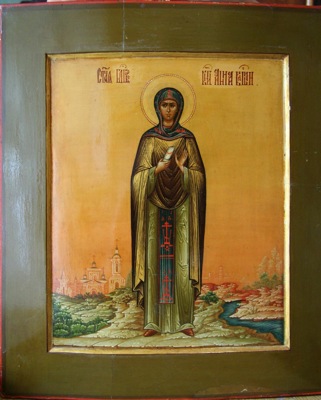
Anna is painted as a nun of the great schema: in the black mantle and koukoulion or dark veil, with the analavos — the schema-cross embroidered on the breast — showing over her habit; the face is that of an aged woman, thin and grave. Her hands are raised in prayer or hold a scroll. Because her cultus was created in 1650 and re-created in 1909, almost every icon of her is late; the standard type sets her full-length in a landscape with the town and convent of Kashin behind her at one side, sometimes with the river Kashinka. In the icons painted after 1650 the right hand often gives the two-fingered blessing — the detail that cost her her canonisation in 1677 — and in icons of the 1909 revival the hand is generally shown differently, so that the gesture is a rough dating criterion. Where she is shown with her husband and sons, the group is that of the martyred princes of Tver.
The stored image is a Russian icon of the late nineteenth century from the sacristy of the Protection church of the Moscow Theological Academy, inscribed to the right-believing Princess Anna of Kashin: the saint stands full-length in the monastic mantle and veil with the schema worn over her habit, a church and the town at the left and the river at the right.
Disputed questions
- Which feast is primary. October 2 is the day of her repose and is her principal feast; June 12 commemorates the translation of 1650 and, since 1909, the second glorification, and in Russian practice it is often the more festively kept of the two, because it is the summer date and the date of the pilgrimage. Some listings accordingly present June 12 as her chief day. This entry ranks October 2 primary, as the day of repose, and June 12 as translation-of-relics, and records the divergence here.
- The monastic names. The tradition that she was tonsured Sophia at Tver and only later received the name Anna in the great schema at Kashin is not uniformly reported; some accounts give only the one tonsure at Kashin. The double tonsure is the received Kashin version and is followed here with this caveat.
- The 1677 grounds. Contemporary polemic and later Russian church historians disagree about how much of the 1677 annulment rested on genuine defects in the 1650 dossier and how much on the anti-Old-Believer politics of the moment. The 1909 restoration did not reverse the historical judgment on the documents; it restored the cultus.
- Not to be confused with Anna of Novgorod (the Swedish-born princess Ingegerd, †1050) or with Anna the Prophetess of the Gospel.